Friday, January 29, 2016

India 700-MHz Spectrum Auction Faces Potential Buyer Strike

Minimum prices set for an auction of 700-MHz spectrum in India are so high (two to four times higher than prior auctions)  that many of the leading mobile companies will not bid. And, according to Fitch Ratings, the eventual spectrum winners might well regret having won. That “winner’s curse” has happened before, often with 3G spectrum auctions.

India's telecom regulator recommended a reserve price of INR115bn (US$1.7 billion) per MHz for nationwide 700MHz spectrum.

Fitch Ratings “believes that efficiency gains from deploying 4G services on 700MHz will be insufficient to offset the relatively high price.”

The reserve price is about twice the price set for 800-MHz spectrum, 3.4 times the reserve price for 900-MHz spectrum and four times the minimum prices set for 1.8 GHz spectrum.

Winning therefore “could exert further pressure on participating telcos' balance sheets and cash flow, and limit their ability to invest in capex over the medium term,” say Fitch Ratings analysts.

In fact, the top four telcos, including Bharti Airtel, Vodafone, Idea Cellular and Reliance Communications may hesitate to bid, as balance sheets already are “stretched,” while available cash is expected to become an issue once Reliance Jio enters the mobile market in the spring of 2016.

Instead, the leaders might choose to rely on spectrum they already have acquired. Bharti Airtel will use 900 MHz, 1.8 GHz and 2.3 GHz.

Reliance Jio, after having invested about US$15 billion on spectrum and networks, will use 800MHz and 850MHz spectrum.

In March 2015, the leading mobile operators had to spend of US$17.7 billion to retain use of spectrum they already were using.

“We believe that there are far fewer reasons for telcos to invest as much in the 700 MHz auction,” Fitch says. As always, there are other alternatives.

Companies can, to some degree, trade and share spectrum, for example.

They also can buy other firms, acquiring spectrum in the process.

During 2015, Reliance Communications merged with Sistema JSFC's MTS India. Reliance Communications also has further plans to merge its wireless unit with that of Maxis Berhard's Indian unit, Aircel Limited.

Fitch believes that smaller and weaker telcos will further seek to be acquired  or exit the industry.

Videocon India, one of the smaller firms which is struggling, has agreed to sell its 4G spectrum assets to the third-largest telco, Idea Cellular.

Fitch expects competition to intensify upon Jio's entry in the market

Blended monthly average revenue per user could fall by five percent to six percent to around INR160 (2015: INR170.

Earnings will suffer as prices drop and marketing spend increases.

Thursday, January 28, 2016

"Long, Slow Decline" for Fixed Network Telcos, Says Moody's

Not every problem has a solution, at least not a solution satisfying to the entities with the problem.

In the U.S. market, for example, an entire category of service providers--”long distance” suppliers--ceased to exist. Sure, the assets remained in service, but the firms, and the category, essentially disappeared.

Recall that AT&T and MCI were stand-alone firms engaged solely in the long distance voice (and to some small extent in the capacity market). AT&T was bought by SBC, which took the name and assets.

MCI was purchased first by Worldcom and then Worldcom by Verizon. Sprint still owns its long distance assets, but it is a smallish and declining business with little impact on overall company financial results.

The same fundamental problem is faced by the larger fixed network U.S. telcos. “Slow yet steady decline” is the fate that awaits CenturyLink, Frontier Communications and Windstream Services, according to ratings agency Moody’s.

“Constraints such as capital allocation practices that favor shareholder returns, lagging infrastructure relative to cable companies and high cost of capital will prevent wireline telecommunications companies (telcos) from taking the necessary steps to fuel growth, resulting in their slow yet steady decline,” says Moody's Investors Service.

Essentially, the telcos are caught in a death spiral (my words, not Moody’s). As they are owned by dividend-seeking investors, the firms cannot shrink or cancel their dividends without causing massive investor flight, with few “growth” investors available to replace those fleeing equity owners, since virtually nobody believes those firms can become “growth” properties.

“Telcos such as CenturyLink Inc. (Ba1 negative), Frontier Communications Corp. (Ba3 stable) and Windstream Services LLC (B1 stable) all have high dividend yields that promote a cycle that steadily erodes each company's value and scale,” says Moody’s. In other, the need to pay dividends starves the firms of the capital they might otherwise put into network infrastructure.

"These telcos have strong operating cash flows and the ability to invest more, but they are hindered by market expectations for dividends," said Mark Stodden, a Moody's Vice President and Senior Credit Officer. "Their weak market position can only be changed by increased investment, but this would threaten dividends and is unpalatable to both equity investors and management teams."

Moody's also notes that the high cost of capital has kept these companies from investing in the necessary infrastructure to provide faster-speed service to residential and small-business customers.

A widening competitive gap between these telcos and cable TV operators is the result.

Some problems just have no positive solutions. As was the case for the long distance providers, market exit will be the eventual result.

Iliad Ponders U.K. Mobile Market Entry

Iliad’s Free Mobile, eyeing asset disposals a Three UK and O2 merger would entail, is considering entering the U.K. mobile market.

European Union regulators will give the proposed merger close scrutiny, as the merger would reduce the number of facilities-based national mobile providers from four to three.

That is a key reduction, as many observers and regulators think four is the minimum number of contestants to promote robust competition. An entry by Iliad might, some could argue, immediately bring the number of leading providers back up to four.

Others might argue the U.K. market already has Virgin Mobile and other mobile virtual network operators, with future entry by Liberty Global a virtual certainty. Sky might be interested in any divested transmission and customer assets as well.

Ironically, no matter what regulators or incumbents seem to desire, new competitors seem able to enter mobile and Internet access markets rather frequently, despite the high barriers to entry that many would say exist.

In India, Reliance Jio has triggered a massive restructuring wave.

In the U.S. Internet service provider market, Google Fiber and scores of independent ISPs are building gigabit Internet access networks in markets dominated nearly completely by cable TV and telco ISP operations.

In the U.S. mobile market, where regulators nixed a merger of number three and number four mobile providers (Sprint and T-Mobile), Comcast is preparing its own entry into the market, while Dish Network has amassed serious spectrum assets (either to entry as a retailer or to sell its assets), while additional contestants such as LIghtSquared and Globalstar also want to get into the mobile business in some way.

One might well argue that no matter what service providers and regulators might prefer, reducing the number of leading providers in mobile or Internet access markets is proving to be ephemeral.

Telco Success in New Markets Can Take a While

As mobile and fixed network telcos gear up for coming Internet of Things opportunities, it will be helpful to remember that success will take time. That same admonition applies for mobile video services or any other over the top efforts telcos ultimately will undertake.

Rarely do telcos achieve success right out of the gate. In fact, it can take a decade or two before it is clear they have obtained a sustainable position in a new market.

A few will remember the skepticism many had a few decades ago about prospects for telco to succeed in entertainment video, especially in roles other than as distributors of subscriptions.

The argument had been that telco ownership of content assets would not work well, as content was not a core competence. Skepticism about telco roles in the over the top app (OTT) arena are similar, and early efforts in OTT sometimes have suggested skepticism is warranted.

But it also is fair to recall that it has taken decades for telcos to position themselves for a leading role in linear video entertainment. There was no “overnight success.” In part, the reason was the need to upgrade a substantial percentage of physical plant to support quality video.

Many do not recall that US West, Pacific Bell, Bell Atlantic and AT&T once considered owning, or actually owned, major cable TV assets.

That those assets later were divested only shows how long it can take before a sustainable business model develops in the telecom business. BellSouth filed to operate a cable TV service in 1996.

Prior to that, PacBell, Bell Atlantic and Nynex had formed TeleTV, a business unit to create programming.  

And as many would attest, replacing copper access with fiber to home is a huge financial undertaking.

That alone, given the difficulties, would have been an obstacle.

But AT&T now is the single biggest distributor of linear video in the U.S. market. Yes, it relies heavily on former DirecTV assets, but its leading position is striking, for an industry not believed to be a serious contender in video, decades ago.

There has been even more skepticism about telco ability to compete in the video programming part of the business. But that might have been said about former cable TV operators as well, and that has proven a misplaced fear.

So long as programming entities are allowed to manage themselves, there has proven to be no serious impediment to cable TV operator success as owners of programming assets. Verizon hopes to prove that also is the case for telcos.

It has been two decades since those early forays, and telcos now are established providers of linear TV in the U.S. market. They now are positioning for mobile video and related businesses.

It might take some time. But there is no reason to believe telcos are incapable of success in video services or any of the related businesses. They just have to approach it the right way.

If history is any guide, it might take some time.

Wednesday, January 27, 2016

In Many Cases, Key Result of Gigabit Internet Access Will be Uptake of "Less Than Gigabit" Services

Gigabit internet access connections might seem a clear case of abundance way beyond a user’s ability to consume such bandwidth.

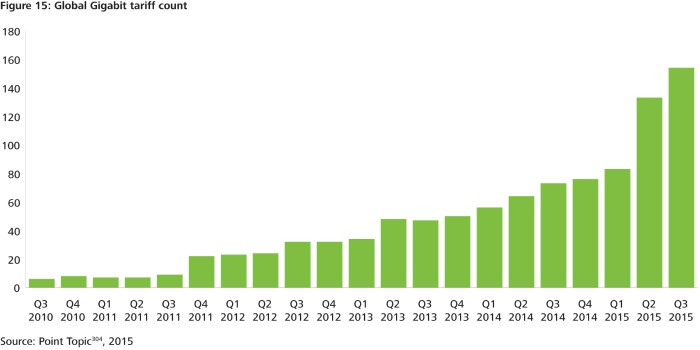
Nevertheless, Deloitte Global predicts that the number of gigabit per second Internet connections will climb to 10 million by the end of 2016, up an order of magnitude from the 2015 level.

About 70 percent of those connections will be bought by consumers, about 30 percent by businesses.

Greater availability and reasonable prices will drive adoption. Perhaps of equal importance is the prediction that, in 2016, some 250 million consumer locations will be able to buy gigabit connections, and will not.

By 2020, some 600 million subscribers may be on networks that offer a Gigabit tariff as of 2020, representing the majority of connected homes in the world, Deloitte says. Of those 600 million potential connections, between 50 and 100 million consumers might actually buy gigabit services (between five and 10 percent of the potential buyer base).

At the end of 2012, the average entry level price for gigabit service was over $400. By the third quarter of 2015, the average had fallen to under $200, and the cheapest package was priced at under $50, Deloitte says.

The likely result of all those gigabit offers will in many cases be that consumers opt to buy faster connections, but not at the full gigabit rates. Internet service providers that sell gigabit connections and no other speeds will see the highest adoption.

Telcos and cable TV companies that typically offer a range of speeds will probably find most consumers satisfied with speeds lower than a gigabit.

Shift Away from "Calling" Continues

Though, globally, mobile calling volumes continue to climb, developed market users often are using voice less, messaging more. Mobile voice volumes as measured in minutes have increased by 20 percent between 2012 and 2015, for example.

Deloitte Global, for example, predicts that, in 2016, 26 percent of smartphone users in developed markets will not make any traditional phone calls in a given week.

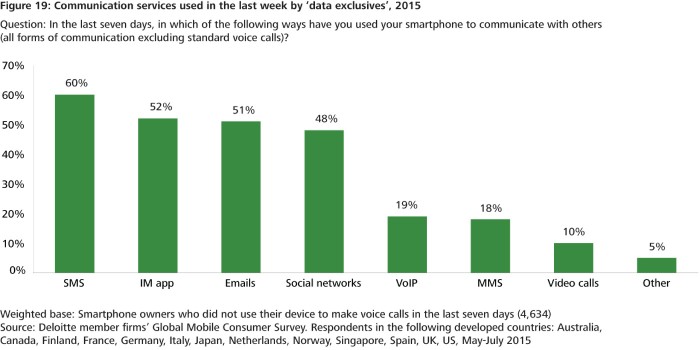
“They have not stopped communicating, but are rather substituting traditional voice calls for a combination of messaging (including SMS), voice and video services delivered over the top,” Deloitte Global says.

In 2015, some 22 percent of all smartphone users behaved that way, up from 11 percent in 2012.

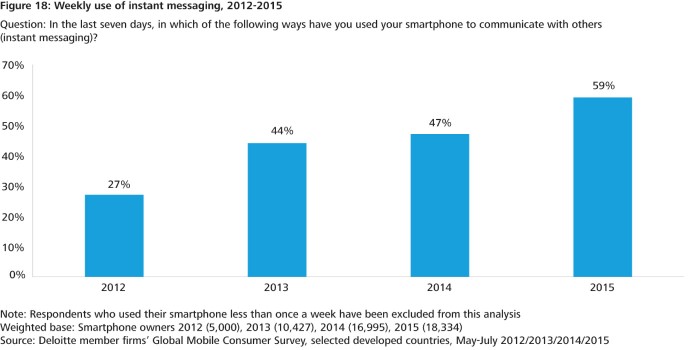
The percentage of adults using instant messaging, for example,  more than doubled from 27 percent in 2012 to 59 percent in 2015.

Instant messaging

Communication services

New Networks Often Do Not Drive New Revenues

Incumbent telcos often face business model challenges when evaluating next generation network platforms. The biggest problem is that investments sometimes have to be justified on a number of drivers, since the incremental revenue is questionable.

Fixed network telcos, for example, have struggled to justify fiber to the home investments strictly on the basis of incremental revenue (linear video entertainment has been the one new revenue stream).

There is little advantage in the voice segment, and while FTTH or other fiber access networks underpin higher Internet access speeds, telcos generally have been unable to match the faster increases provided by cable TV operators.

Voice over LTE provides another example in the mobile business.
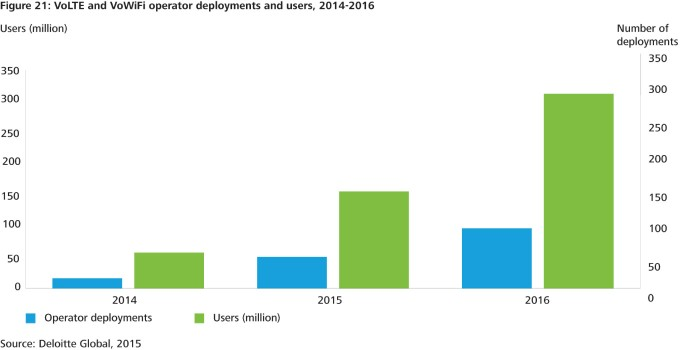
Deloitte Global predicts about 100 carriers worldwide will be offering at least one packet-based voice service at the end of 2016, double the amount year-on-year, and six times higher than at the beginning of 2015.

That will mean some 300 million customers will be using Voice over WiFi (VoWiFi) and Voice over LTE (VoLTE); double the number at the start of the year and five times higher than at the beginning of 2015.

So what is the upside?

“For most carriers launching VoLTE or VoWiFi in 2016, the primary motivation is likely to be to increase network capacity and extend the reach of their voice services,” says Deloitte.

Note what is not said: VoLTE and VoWiFi will drive higher revenues at a significant level. While eventually new revenues could emerge, that is for a later time.

What VoLTE offers, near term, is the ability to move voice calls off 2G and 3G networks and onto the LTE (4G) network.

The often lower frequency spectrum that is freed up can be reused for data services. So the benefit is indirect.

LTE is perhaps twice as bandwidth efficient as legacy voice, but that is a minor advantage in most cases, since voice occupies little bandwidth, and many users globally are shifting communications to text and social media.

Where it is possible to turn off a whole network, that also provides value. But, again, the benefits are indirect. VoLTE does not generally, at the moment, drive higher revenues.

source: Deloitte

Public Wi-Fi Will Help Some Rearrange Mobile Service Provider Markets

Disagreements about what network neutrality legitimately entails aside, trends in the Wi-Fi hotspot market are trending in the direction of quality assurance and “carrier grade” rather than “best effort,” a concept at the heart of the network neutrality debate.

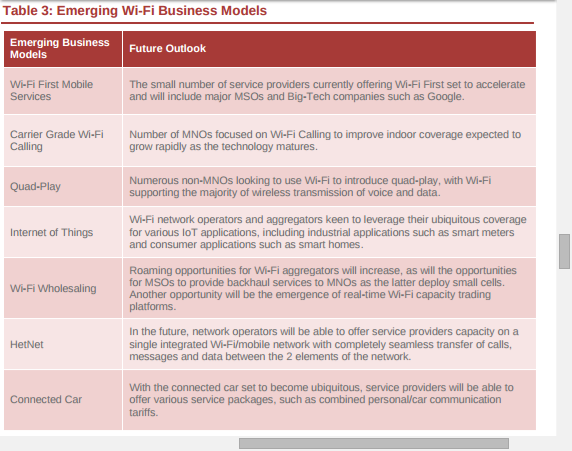
“The Wi-Fi market is undergoing a major transformation driven by the introduction of carrier grade Wi-Fi networks which offer improved security, QoS (Quality of Service) and an enhanced user experience compared to best-efforts Wi-Fi,” say researchers at Juniper Research.

That change will affect business models in both the fixed and mobile domains, allowing some fixed network owners to create new revenue streams, while enabling lower-cost mobile business models.

Cable TV providers will be primary beneficiaries of both trends, while mobile operators largely will benefit from the latter trend.

Critical enablers of the carrier grade Wi-Fi capability and developing revenue streams and business models include IEEE 802.11 protocols such as 802.11ac;  the Wireless Broadband Association Next Generation Hotspot initiative;  and the Wi-Fi Alliance’s Passpoint (HotSpot 2.0 specifications) platform.

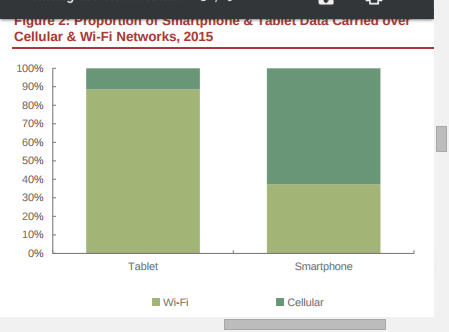
To the extent that carrier grade Wi-Fi becomes a viable substitute for mobile network access, it is likely that cable operators and fixed line telcos will be responsible for an increasing percentage of deployments, Juniper Research predicts. In at least one sense, that implies the function of the fixed network is backhaul for untethered and mobile services.


Among the leading trends of the next five years, where it comes to Wi-Fi, aside from the trend towards quality-assured Wi-Fi, is the functional integration of Wi-Fi with other networks, which means that the Wi-Fi network can be controlled from the operator’s core network, Juniper Research notes.

Globally,  at least 33 percent of consumer at-home routers will be used as public Wi-Fi hotspots by 2017 and that the total installed base of such dual-use routers will reach 366 million by the end of 2020, Juniper Research argues.

Major broadband operators such as BT, UPC and Virgin Media in Europe and several of the biggest cable TV operators in the United States, such as Comcast and Cablevision, are leading adopters.

Free Mobile in France also has used such hotspots to contain its operating costs in the mobile business. By 2014 Free Mobile had put into place some four million hotspots. BT in the UK also has apidly extended its Wi-Fi coverage by using Homespots.


The bottom line is that the technology changes will create new business model and revenue opportunities for at least some new contestants in the mobile business. Cable TV providers will be the biggest winners, many would argue.

But mobile service providers also will be able to leverage the platform to contain their operating costs and capital investment demands.

In some markets, Wi-Fi hostspots will allow new entrants to rearrange mobile markets.

Tuesday, January 26, 2016

Sprint: Subs Up, Costs Down, Operating Profit Within Sight

Subscribers up, costs down, operational profit within sight. That’s the good story for Sprint.

As a result of accelerated cost reductions, Sprint has raised its guidance for fiscal year 2015 adjusted earnings from its previous expectation of $6.8 billion to $7.1 billion to a range of $7.7 billion to $8 billion.

Sprint also is raising its guidance for fiscal year 2015 operating income from its previous expectation of an operating loss of $50 million to $250 million to operating income of $100 million to $300 million.

Sprint’s preliminary estimate for fiscal year 2016 adjusted earnings is $9.5 billion to $10 billion.

For its third fiscal quarter of 2015, Sprint reported growth in postpaid phone customers for the second consecutive quarter with the highest net additions in three years at 366,000, the lowest-ever postpaid churn for a third quarter at 1.62 percent, and the highest postpaid net ports on record.

The company also reported net operating revenue of $8.1 billion, an operating loss of $197 million, and adjusted EBITDA of $1.9 billion

Net operating revenues of $8.1 billion decreased 10 percent year-over-year, but stabilized over the last three quarters, and grew two percent sequentially, said Sprint.

Consolidated adjusted EBITDA of $1.9 billion improved from the prior year period, as expense reductions more than offset the decline in operating revenues.

Total expenses improved primarily because of lower cost of product expenses related to device leasing options for which the associated cost is recorded as depreciation expense, and $500 million of lower selling, general, and administrative expenses.

Monday, January 25, 2016

Big Shift in Technology Thinking at AT&T

The AT&T system used to develop and deploy its own technology (Bell Laboratories and Western Union). That began to change with the AT&T breakup in 1984, and today the tier one providers source their core technology from third-party suppliers.

That might change in the future, as virtualized networks are developed, running on common and commodity hardware, using more open approaches, and with a core commitment to develop strategic systems in a way that allows AT&T to survive even the bankruptcy of any key suppliers.

There are any number of implications for suppliers. An equally-important change is a shift back towards service provider knowledge of, creation of, and maintenance of, core technology services and systems.

We haven’t seen that since before 1984.

There are some logical shifts. Since all computing now is shifting to open, Internet Protocol based and cloud based delivery, so will AT&T evolve.

“AT&T services will increasingly become cloud-centric workloads,” the AT&T Domain 2.0 vision indicates. That means both infrastructure and services that are “used, provisioned, and orchestrated as is typical of cloud services in data centers.”

That implies virtualized networks, using white box equipment (merchant silicon) and services will increasingly become cloud-centric workloads.

That also requires “architecturally decoupling the network function, based in software,from the support infrastructure, based in hardware.” In other words, AT&T will use the same loose coupling also typical of the entire software ecosystem and application architecture.

Domain 2.0 seeks to follow agile development processes, and will avoid locking-in to a specific system architecture.

“To mitigate business risk, the company has developed business rules for second suppliers and evaluates the risk of doing business with suppliers should they go out of business,” AT&T says.

“AT&T expects to increase the depth of understanding of our core technologies held by our staff to the point that they can integrate, and even design the systems from scratch,” AT&T’s white paper says. “AT&T expects to develop key software resources in a way that they can be openly used, and cannot be lost through the acquisition or insolvency of a vendor partner.”

Those are big changes, indeed.

Good Intentions Not Enough for Satellite, Mobile, SMB Internet Access

Where it comes to subsidized Internet access by satellite, good intentions apparently are not enough. The U.K. government has spent The £60 million scheme to provide satellite Internet access to 300,000 locations.

So far, just 24 people have signed up for the service, provided by Avanti and BT, where the government pays for a arge part of the installation cost. Users pay the recurring service costs.

Apparently, just £8,000 of the subsidy funds have been spent,

The contract was between satellite company Avanti and BT.

The apparent lack of consumer interest in the program apparently is not unusual.

The government encountered similar problems with its SME broadband voucher scheme, intended to provide grants for faster web access of up to £3,000 in 2013, and with a mobile infrastructure program.

The government allocated £150 million to add new cell towers, but managed to erect just eight towers, out of a projected 600.

Sunday, January 24, 2016

Is Openreach a "Natural Monopoly?"

A study group anchored by U.K. members of Parliament wants full separation of BT Openreach, arguing that the current “functional” separation has not worked.

Since the functional separation from BT, Openreach “claimed in 2009 that 2.5 million homes would be connected to ultra-fast Fiber to the Premises (FTTP) services by 2012, which is 25% of the country,” the report says. “Yet by September 2015 they had only managed to reach around 0.7 percent of homes,” despite receiving £1.7billion in taxpayer subsidies.

That is perhaps not an uncommon problem. The report uses the term “natural monopoly” to describe Openreach, which is an accurate way to describe the supply of wholesale “telco access” capacity to retail partners for about half the U.K.’s homes.

What the report does not address at all is the face that cable TV operators are successfully taking market share and upgrading access speeds, using their own facilities, and able to reach about half the U.K. homes.

So Openreach is not, perhaps, actually a “natural monopoly” everywhere, where it comes to the supply of Internet access and other services. In fact, Openreach has a monopoly across perhaps half of all U.K. homes.

As early as 2006, the U.K. Internet access market was dominated by six companies, with the top two taking 51 percent. Virgin Media with a 28% share, while BT had 23 percent.

At the end of 2010 48 percent of U.K. homes were passed by Virgin Media’s cable broadband network, largely in the urban areas.

Virgin Media’s cable services are available to 30 percent of UK television homes, the company now says.

Virgin Media passes 12.7 million homes out of a total of 25 million homes. So Virgin Media can reach a bit more than half of all U.K. homes.

So Openreach functionally is a monopoly for access to about half of U.K. homes.

Making good policy always is difficult under such circumstances, where facilities-based competition already is a reality for half of U.K. homes, but the other half have no facilities-based choices.

Rapid SMB Cloud SaaS Adoption Since 2011

How has small and medium-sized business adoption of cloud services changed over the last several years? By some estimates, the answer is rapid adoption, with annual adoption rates as high as 40 percent.

In 2011, a Spiceworks survey of cloud adoption among SMBs found that smaller SMBs were more aggressive when it comes to cloud adoption than their larger SMB counterparts.

At least in terms of expectations, 38 percent of SMBs with fewer than 20 employees used or planned to use cloud solutions within six months.

Some 17 percent of organizations with between 20 and 99 and 22 percent of organizations with more than 100 employees planned to use cloud services over the same time period.

SMBs in emerging markets were especially active. Some 41 percent of small and medium businesses in Latin America/South America (LASA) and 35 percent of SMBs in the Asia/Pacific region are adopting cloud services.

That  was well ahead of the 24 percent of SMBs in North America and 19 percent in Europe that are adopting cloud services.

In 2015, North American cloud services adoption had grown to perhaps 37 percent, growing at about 40 percent annually. At such rates, by 2020 about 78 percent of U.S. small businesses will be using cloud computing.

Some other surveys suggest 64 percent of U.S. SMBs are already using cloud-based software, using an average of three apps. As you likely would guess, software as a service is what small businesses tend to buy.
rac cloud.adoption infographic rnd03
source: Rackspace

Eliminating Digital Divide: 1/2 of the Gap Will be Closed in India and China

Some problems--ensuring that every human being has access to communications, clean water and sanitation, freedom from violence or hunger or disease often seem intractable.

The difficulties sometimes can obscure genuine progress. Fewer people than ever can remember when “people unable to make a phone call” was a major problem. That remains a problem in some population segments, but largely has been solved.

The new problem is how to give everyone access to the Internet. The barriers are formidable, but there is every reason to believe that problem also will be solved, and in relatively short order. Major advances in access technology, costs of access, value of Internet apps and device costs all are helping set the stage for a prodigious advance.

For example, rates of mobile broadband, which virtually everyone assumes will be the way most humans get access to the Internet, globally, have the fastest rates of growth precisely in the areas that need access most.

Also, adoption rates are increasing non-linearly. In part, that is because smartphone prices are dropping fast, allowing more people access to mobile devices they can afford. In part, the prices of mobile Internet access are plummeting fastest in the areas where the need is greatest.

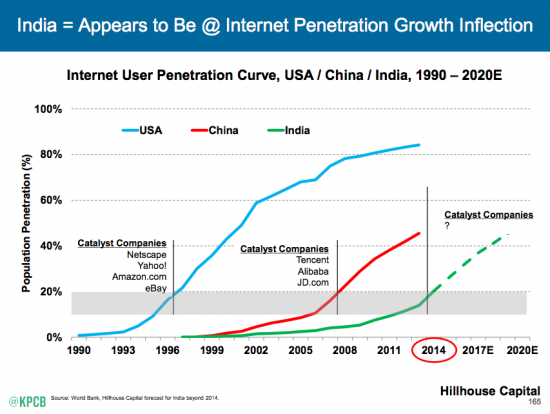
Significantly, Internet adoption increasingly is at an inflection point, promising rapid adoption in the near future. Granted, at the moment perhaps 60 percent of humans remain unconnected. But change is coming fast.

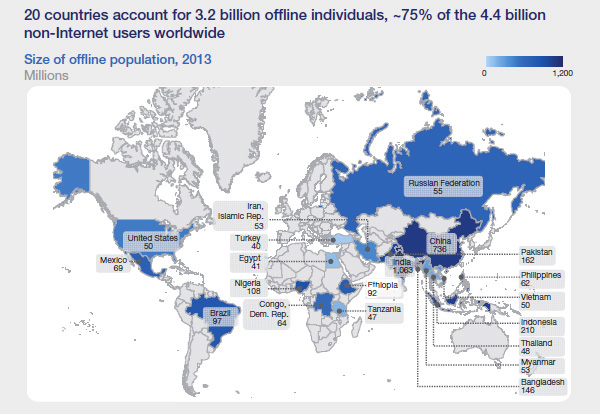
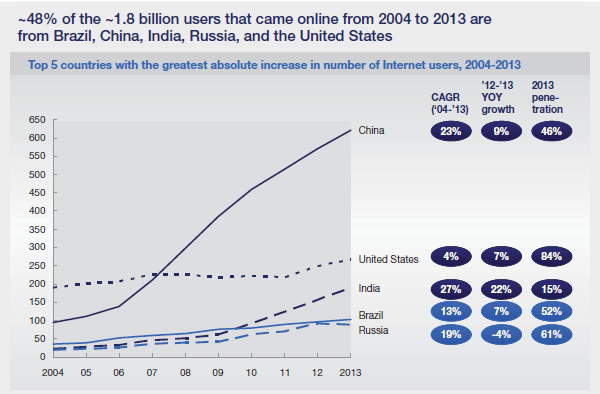
India and China are important, since they represent such a large percentage of the unconnected. Those two countries represent 54 percent of all the people remaining to be connected.

Given the expected growth rates in China and India, half the world's Internet access gap will be closed quickly, as the adoption curves in those countries now have the same rate of change as earlier was the case in the United States and many other developed countries.


On the Use and Misuse of Principles, Theorems and Concepts

When financial commentators compile lists of "potential black swans," they misunderstand the concept. As explained by Taleb Nasim ...