Wednesday, August 12, 2015

Fairness or Optimized Performance? Choose One

In many ways, the difference between traffic management and network neutrality is rather subtle.
In fact, one objection some have had to mandating “best effort only” consumer Internet access is that although some applications do just fine, others might require network-specific performance assurance.

It does seem inevitable that tensions between “fairness,” the objective of most network neutrality rules, and “effectiveness,” the ability of a network to support specific applications, as they require, will be an on-going issue.

Suggestions that future fifth generation networks will support “network slicing” provide yet one example. If specific apps have different functional requirements, Ericsson’s vision for 5G includes the ability to tune the network to support those specific apps, giving each app what it requires, without the overhead of generic resources unrelated to app performance.

Each use case will require a different configuration of requirements and parameters in the network.
In other words, networks will be built in a flexible way so that speed, capacity and coverage can be allocated in logical slices to meet the specific demands of each use case.

But that is not “treating all bits equally.” That’s the enduring problem. “Fairness” conflicts with “optimizing performance.”

AT&T Expecs Higher Earnings, Cash Flow Next 3 Years

The addition of DirecTV, Iusacell and Nextel Mexico will be directly accretive to AT&T in terms of revenue and earnings, something that does not always happen with transactions so large ($48.5 billion for DirecTV) or small (Nextel Mexico represented a deal less than $2 billion in size).

AT&T said it will earn $2.62 to $2.68 a share in 2015, above the $2.60 analysts had anticipated. Revenue will grow in the double-digit range, the company said.

Moreover, AT&T expects earnings and cash flow to grow over the next three years as well.

Those results are driven by a revenue mix, products, geographies and customer bases that are significantly different.

AT&T expects that, by the end of 2015, its largest revenue streams will be, in descending order: mobility and business solutions (mobile and wireline); entertainment & Internet; consumer mobility; and international mobility and video.

In other words, services sold to business customers has become AT&T’s biggest single revenue stream. Video entertainment and Internet access is the second largest bucket of revenue, followed by consumer mobility.

Mobile services remain a key driver of revenue in all but one of the segments.

The company plans to begin providing detailed reporting on these segments beginning with the third quarter.

AT&T also is operationally a changed company. AT&T now is the largest linear TV provider in the United States and the world, serving more than 26 million subscribers in the United States and more than 19 million customers in Latin America.

AT&T has 132 million wireless subscribers in the United States and Mexico; offers 4G LTE mobile coverage to nearly 310 million people in the U.S. and expects LTE coverage to 350 million people in its North American service area by the end of the year; covers 57 million U.S. customer locations with high-speed Internet; and has nearly 16 million broadband subscribers, the company said.

The three-year view of certain financial metrics now features 2015 double-digit consolidated revenue growth due to the DirecTV acquisition.

From 2016 through 2018, the company expects in each of the next three years consolidated revenue growth in line with GDP growth or better and adjusted earnings per share growth in the mid-single digit range.

The broader trend across the tier-one service provider landscape might soon begin to reflect the importance of business customers, compared to consumer customers.

In the U.S. market, a similar trend has developed for three former rural telcos, each of whom now drives a clear majority of revenue from business customers, not consumers.

Of $4.4 billion in CenturyLink second quarter 2015 revenue, business revenues represented $2.7 billion while consumer revenues were about $1.5 billion. In other words, the business segment represented 61 percent of company revenue.

That is a huge transformation for a firm that once mostly got its revenue from subsidies and consumers.

Since about 2010, both Windstream and Frontier have earned most of their money in the business segment as well, despite the continuing preponderance of consumer accounts.

In its second quarter of 2015, Windstream had revenues of $1.4 billion. Consumer revenues  represented just $314 million--about 22 percent--of total revenues.

Frontier Communications total revenue of about $1.4 billion as well, with consumer revenue of about Total residential revenue was stable at $615 million for the second quarter of 2015, while total business revenue was $621 million. So a bit more than half of revenue was generated by business customers.

Over time, many former incumbent providers are likely to discover that they are best suited to serving customers in the business segment, while other providers take market share in the consumer segment.


Tuesday, August 11, 2015

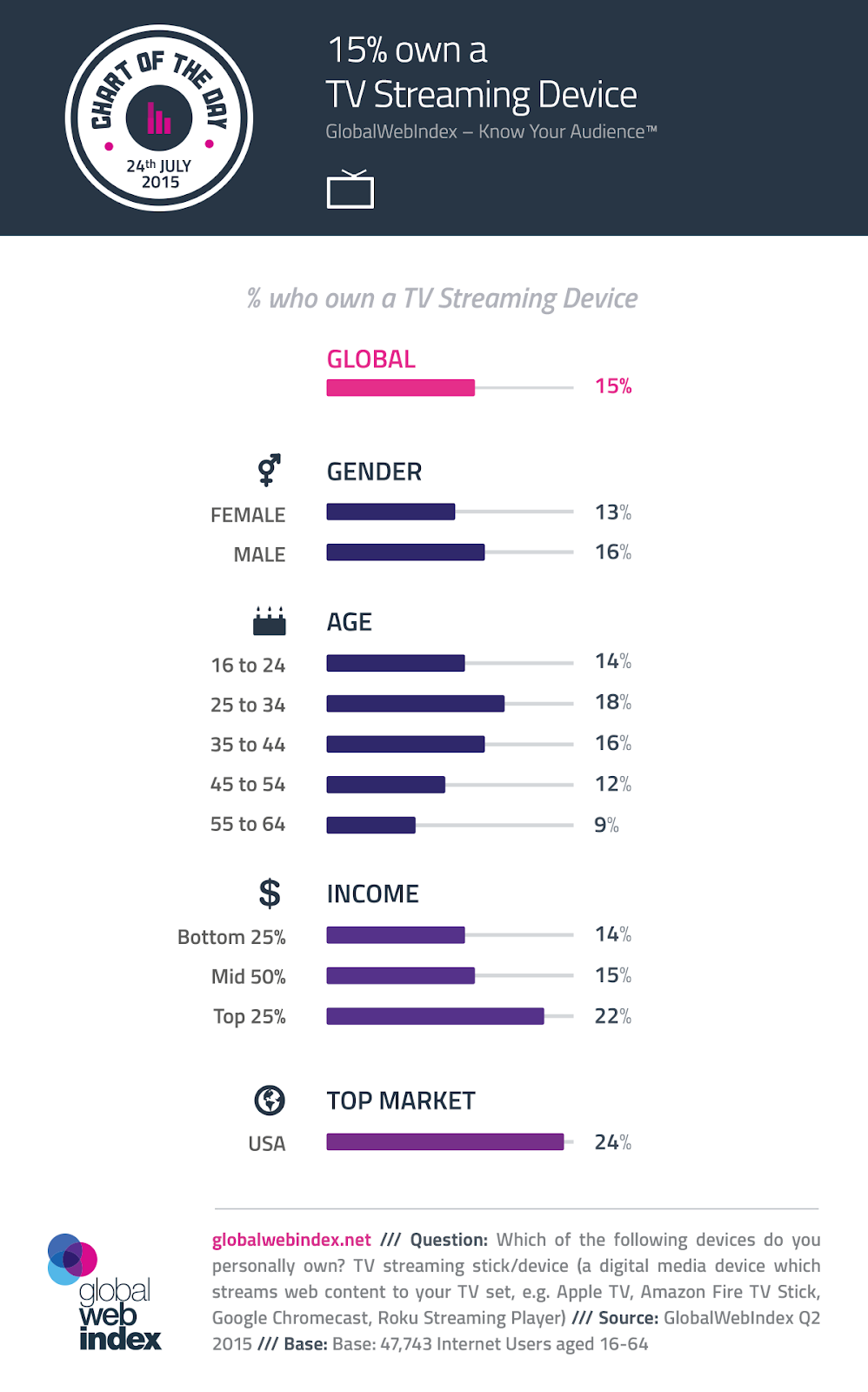
15% Globally Own a Streaming Media Appliance or Device

Globally, about 15 percent of respondents to a survey report they own a streaming video device such as a Chromecast stick or a dedicated streaming media device such as a Roku that enables streamed content to be viewed directly on a TV.

About 25 percent of U.S. respondents reported owning such a device.

Those sorts of developments are important. For any new trend to develop, the underlying ecosystem (Internet access, content rights, access devices, affordable service plans, the right value proposition) must be in place. Internet-connected TVs, dedicated devices and sticks are part of the required infrastructure.


24th-July-2015-15-own-a-streaming-device

Monday, August 10, 2015

Google Creates New "Alphabet" Holding Company

As part of a major reorganization, Google will become part of Alphabet, a new entity a bit like a holding company that provides greater transparency for investors.


Alphabet will be a collection of companies, the largest of which is Google, and ABC.xyz will be parent's new web address.


The more speculative entities--moonshots--will be housed separately in Alphabet.
Life Sciences (that works on the glucose-sensing contact lens), and Calico (focused on longevity) are examples.


Android One Aims for $30 to $50 Smartphone Prices

Among other issues, smartphone costs are a barrier to widespread adoption of Internet access services in India and other South Asia and Southeast Asia countries. That is why Google is making Android One--its low cost Android operating system--a priority for India.

Phones made by manufacturers under the standard were priced at about $100 in 2014 and early 2015.

But the desired price targets are much lower. The “sweet spot” is a price between Rs2,000 and Rs3,000 ($31-$47).

Facebook and Twitter already count India as their second and third largest market by users respectively.

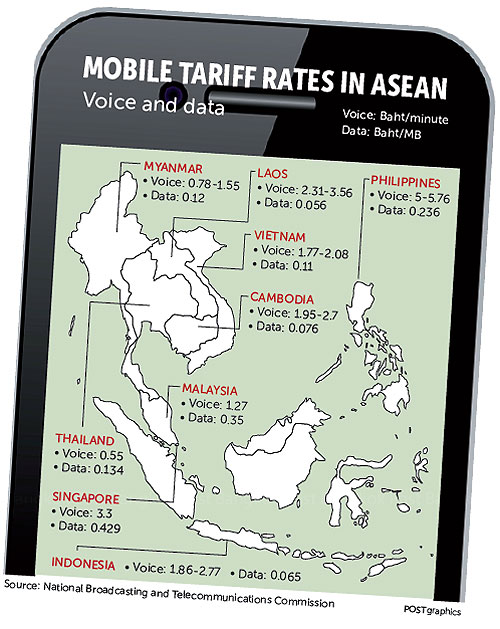
Lower Mobile Tariffs Across ASEAN Region by 2016?

Will mobile rates be harmonized across the ASEAN region. Quite likely. By early 2016, telecom regulators across the ASEAN region are expected to use a rate harmonization as a way of reducing mobile rates across the region.

Video Drip, Drip, Drip. For How Long?

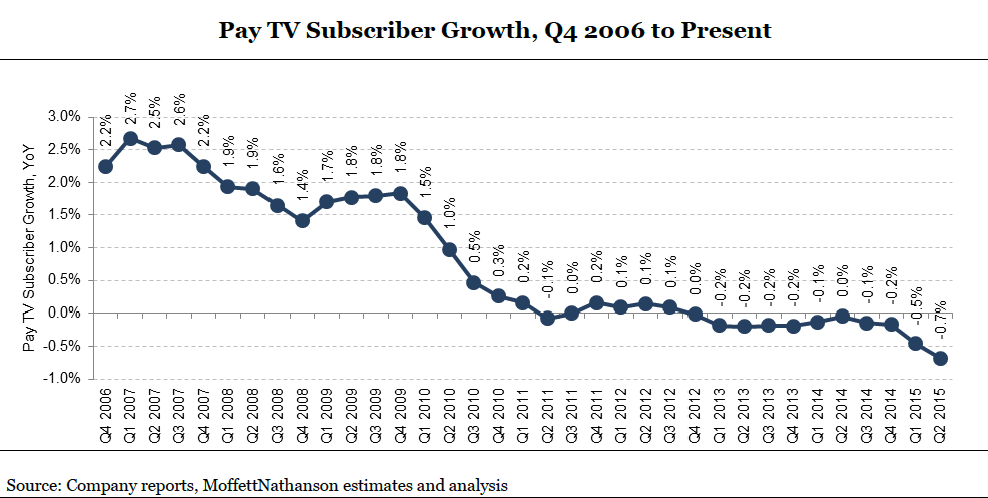
With the exception of Internet access, it would be fair to say that the other legacy applications sold by cable TV and telcos, such as linear video subscriptions, are in a decelerating mode. In fact, voice, texting and video revenues are declining.

Including market share shifts, cable TV still sees growth in high speed access and business services, while mobile operators seen growth in subscriptions, lead by internet access revenues, and some fixed line telcos see revenue growth in business segments, even if revenue or subscription numbers from the consumer segment are waning.


Many observers in the linear TV business continue to say the transition to over the top video will be gradual, shifting only a portion of the audience from linear to OTT over five to 10 years.

That's possible. It also is possible that OTT hits an inflection point and just zooms. New technologiesl do that. 

Quick Fixes and Fixations

“One pill makes you larger, and one pill makes you small,” sang Jefferson Airplane lead singer Grace Slick . Some might say that was just a...