Wednesday, February 8, 2017

Incentives Always Matter; Free Always Encourages Usage

Nothing encourages use of any desirable product so much as a price point of "zero." That seems clearly to be the case in India, where Reliance Jio in the fourth quarter of 2016 allowed new customers 4 GB of mobile data usage, each day, and even now offers new customers 1 GB of free mobile data usage, as a promotion.

Such generous offers should have consequences. Indeed, they have, allowing Reliance Jio to sign up 50 million new accounts in a few months. But such generous mobile data promotions also seem to decrease use of Wi-Fi.

We normally expect consumers to rely on Wi-Fi for much of their internet access from mobile phones, and often expect the majority of total data consumption (not sessions) to occur over Wi-Fi networks, since such behavior helps customers protect their mobile data usage allowances.

In India, where Reliance Jio has been offering first 4 GB of free data usage per day, and 1 GB of free data usage per day through early 2017, such offers have proven to increase use of mobile data far beyond what one might typically expect.

Since September 2016 Reliance Jio has signed up 50 million customers and has triggered a price war among India’s established mobile operators.

But Jio customers also differ from other mobile customers in India in one way: they have a very low usage of Wi-Fi connections, according to OpenSignal.

OpenSignal data from Sept. 1 to Nov. 30, 2016  (the three months in which Jio has been available), Jio users connected to Wifi networks about 8.2 percent of the time. That is well below the average of 29.8 percent of internet access time on Wi-Fi.

  • Jio                  8.2 percent
  • Idea               24.1 percent
  • Telenor          24.3 percent
  • Aircel            24.9 percent
  • Airtel             27.1 percent
  • Reliance        28.1 percent
  • Tata DoCoMo 30.4 percent
  • BSNL             31.1 percent
  • Vodafone      31.3 percent

The obvious reason for the low Reliance Jio customer use of Wi-Fi is that they simply have so much free access on the mobile network that Wi-Fi access to “save on data usage” is simply an unnecessary move. Of course, all that could--and should--change once Jio starts charging for mobile data usage.  

Verizon has a Brand Promise Problem

Verizon arguably has a problem: its positioning in the mobile market as the carrier with the best network is challenged by T-Mobile US, though on several dimensions Verizon still has a small lead.

One example: The two service providers were tied for first place in OpenSignal 4G and overall speed metrics.

To be sure, Verizon maintains a slim lead. OpenSignal testers were able to find a Verizon LTE signal 88.2 percent of the time, but T-Mobile US 4G availability was less than two percentage points below Verizon's, OpenSignal says.

In fact, says OpenSignal, “either Verizon or T-Mobile won or shared every single national award in our report.”

The LTE speed race between T-Mobile and Verizon has long been a close one, but in our last U.S. report T-Mobile US  held the edge, OpenSignal says. “That narrow lead, however, disappeared in our latest round of testings.”

“We measured average LTE download speed on T-Mobile at 16.7 Mbps and on Verizon at 16.9 Mbps, results close enough to produce a statistical tie,” said OpenSignal.

The point is that such rankings pose a key marketing problem for Verizon. It always has claimed to have the best network. Arguably, it still does, but by such a slim margin that the difference is negligible. So if Verizon does not have a demonstrably-better network, what is the point of paying a “quality premium” for buying Verizon?

AWS has 40% Public Cloud Services Share

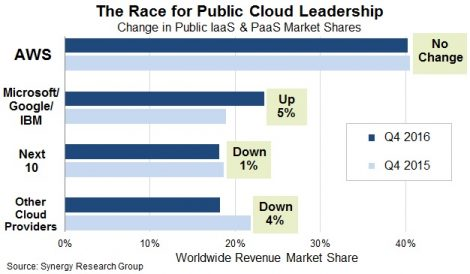
Amazon Web Services (AWS) is maintaining its dominant share of the burgeoning public cloud services market at over 40 percent, while the three main chasing cloud providers--Microsoft, Google and IBM--are gaining ground but at the expense of smaller players in the market, Synergy Research Group says.

Microsoft, Google and IBM increased their worldwide market share by nearly five percentage points over the last year and together now account for 23 percent of the total public infrastructure as a service (IaaS) and platform as a service (PaaS) market.

Synergy estimates that quarterly public cloud infrastructure service revenues (including both public IaaS and public PaaS) have now reached well over $7 billion and continue to grow at almost 50 percent per year.

If managed private cloud services are included, quarterly cloud revenues are now well over $9 billion.

The cloud providers and rankings are very different in the managed private cloud, where IBM continues to lead while Rackspace and traditional IT service providers feature more prominently than they do in public cloud.

source: Synergy Research

Half of Website Visits are Driven by Bots

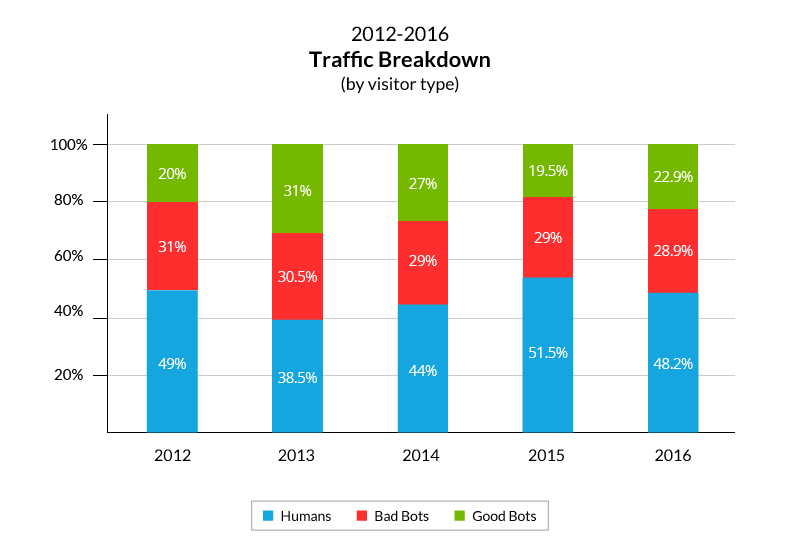
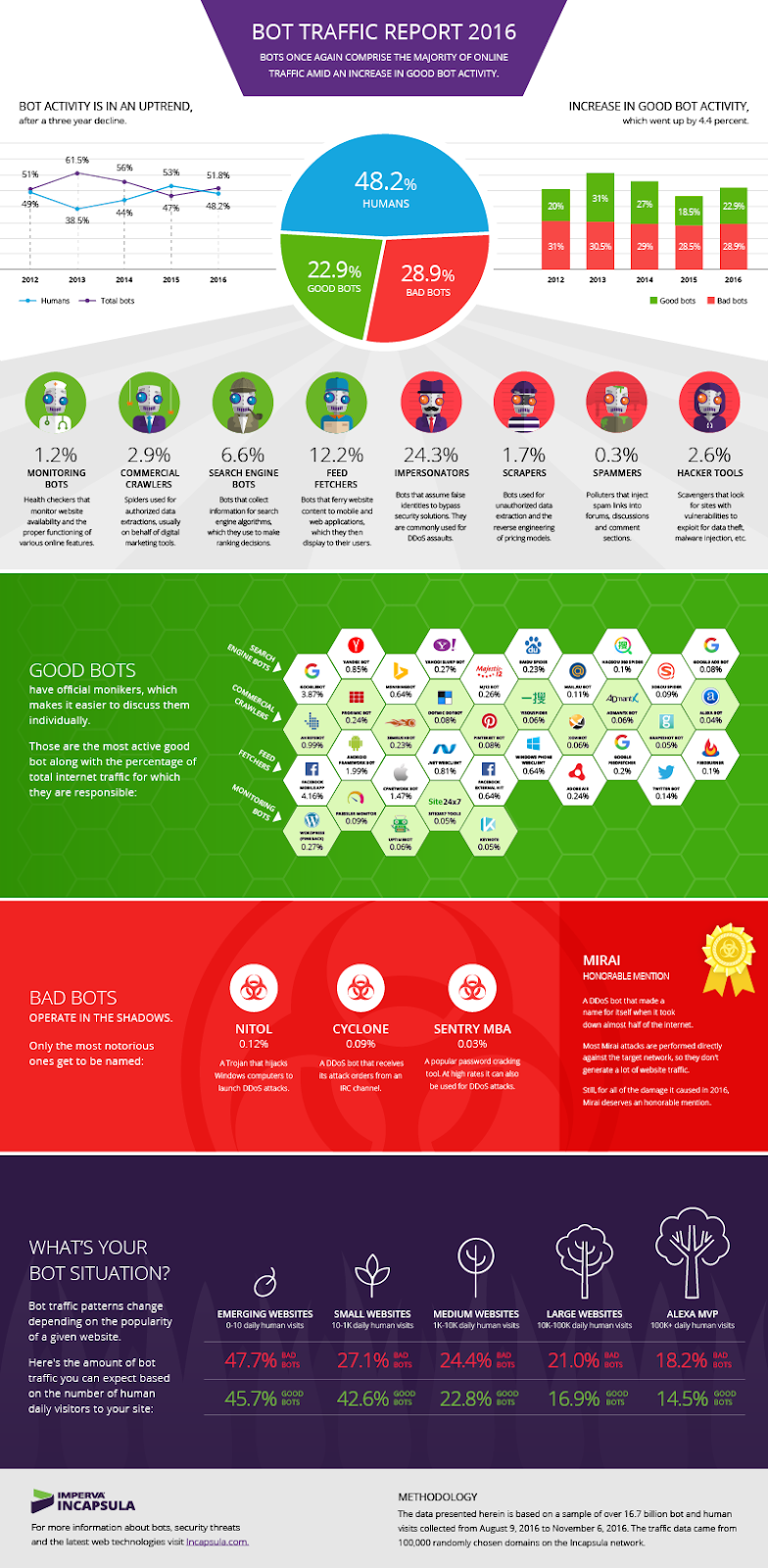
Nearly half of website visits monitored by Imperva Incapsula were by bots, not humans, Imperva Incapsula says. More prominent mobile bot activity is the result of a larger trend toward mobile browsing. Since November 2016 mobile traffic has been greater than desktop traffic, reaching 50.31 percent of total.

“In 2016 we tracked 504 unique good bots, 278 of which were active enough to generate at least 1,000 daily visits to our network,” the company says.

The relative amount of bad bot visits (and bot visits in general) is higher to less trafficked websites. For instance, on the least trafficked domains—those frequented by ten human visitors a day or less—bad bots accounted for 47.7 percent of visits while total bot traffic amounted to 93.3 percent.

Good bots fall into several buckets.
  • Feed fetcher – Bots that ferry website content to mobile and web applications, which they then display to users.
  • Search engine bots – Bots that collect information for search engine algorithms, which is then used to make ranking decisions.
  • Commercial crawlers – Spiders used for authorized data extractions, usually on behalf of digital marketing tools.
  • Monitoring bots – Bots that monitor website availability and the proper functioning of various online features.

The most active feed fetcher—and the most active bot in general—was that associated with Facebook’s mobile app. It fetches website information so it can be viewed in the in-app browser. Overall it accounted for 4.4 percent of all website traffic on Incapsula network.


Bots vs Humans 2016


Average Fixed Network Internet Access Costs $98 a Month, Globally

In the fourth quarter of 2016, the average monthly charge for fixed network residential broadband services was $98, down slightly from $100 in the third quarter of 2016, apparently unadjusted for purchasing power parity, which adjusts all local prices to allow cross-country comparisons.
The average bandwidth provided to residential subscribers was 118 Mbps, compared to 112 Mbps in the third quarter of 2016. As has been the case in the U.S. market and United Kingdom, “the increase in the average bandwidth was due to a jump in the average speeds provided over cable connections.”
That trend is expected to continue.
The average global cost per Mbps was 83 cents at the end of the fourth quarter of 2016, compared to 89 cents per Mbps at the end of the third quarter of 2016.
average cost per mbps
The Asia-Pacific region had the highest speed levels, at 419 Mbps compared to 328 Mbps in the previous quarter. The region also had the best “value for money” in terms of bandwidth compared to price.
Western Europe had average bandwidth of 168 Mbps in the third quarter of 2016 but had the lowest price per Mbps.
North America had average bandwidth of 143 Mbps in the fourth quarter of 2016, up from 122 Mbps in the third quarter.

Tuesday, February 7, 2017

Cloud Data Centers Now Originate, Terminate Traffic


Among the many changes happening in the global communications industry are changing patterns of traffic origination and termination. It has been some time since central offices originated and terminated most traffic. For some decades, internet exchange points were the places where traffic moved to, and from. 

Now it is starting to be the cloud data centers that originate and terminate most traffic. 

How Artificial Intelligence is Relevant for a Mobile Apps Company


Charles Fan, Cheetah Mobile CTO, has a marvelous ability to take somewhat abstract ideas and make them concrete. You might wonder, for example, why a mobile apps firm actually thinks about how artificial intelligence and machine learning affects its business. 

The immediate application for Cheetah is a news curation app. But Fan thinks artificial intelligence algorithms, which might today seem to represent value, eventually will be commoditized. When that happens, value will no longer be conferred by access to the algorithms, but to owners of content stores. 

In other words, he wins who has the best data stores. That will be a change from today, when perhaps value is generated by firms able to hire "hundreds of PhDs." In the future, that will not confer value, Fan argues. 


Quick Fixes and Fixations

“One pill makes you larger, and one pill makes you small,” sang Jefferson Airplane lead singer Grace Slick . Some might say that was just a...