Wednesday, November 23, 2011

Rocks, Hard Places for U.S. Mobile Service Providers

The next year will continue to be a story of being caught between rocks and very-hard places for a few of the leading U.S. mobile service providers. AT&T seems to be facing higher obstacles as it continues to try and convince regulators that its proposed purchase of T-Mobile USA would not harm competition.

The possible rejection of the deal might cost AT&T $3 billion in cash and an equivalent amount of spectrum. For T-Mobile USA, a failed deal means not only that it has failed to exit the U.S. market, failed to free up valuable capital that it needs to deploy elsewhere, but also has lost well more than a year of marketing blocking and tackling. The cash and spectrum might prove small consolation.

Sprint seems to have gambled its future on what the Apple iPhone can do for it, and continues to have a complicated relationship with Clearwire, which it owns, with 53 percent of the equity, but cannot control. Clearwire is running out of money, hasn't finished building its national WiMAX network and now says it has to build a Long Term Evolution network as well.

Clearwire also says it might not make a coming debt service payment, which would raise questions about whether bankruptcy is coming. Clearwire seems to want help from Sprint, which has pressing capital needs of its own, as it is pushing hard on a key network upgrade that will allow Sprint to build its own LTE network.

Sprint might be happy to see Clearwire restructure, under bankruptcy protection or not. What Sprint can’t afford is for Clearwire’s network to shut down. As many as eight million Sprint customers would lose service should that happen. But a chapter 11 bankruptcy would allow those services to continue.

Some argue Sprint would do better to have Clearwire go into chapter 11 bankruptcy, then buy the company. If Clearwire files for bankruptcy protection, the company’s spectrum licenses go to the bondholders, though, not to Sprint. That doesn't mean Sprint could not then try and buy the spectrum from bond holders. But there is risk. Sprint, Clearwire

LightSquared still hasn't managed to satisfy the U.S. GPS industry that its own launch of LTE services will avoid signal interference with the GPS system. So much hangs in the balance for LightSquared and its wholesale customers as well.


Tuesday, November 22, 2011

"Telcos will Compete with Banks"?

Smartphones using encryption and biometrics will enable telecom companies to compete with banks and credit card companies for retail payment transactions, argues Futurist Patrick Dixon. That might not seem to be the way providers of mobile wallet services such as Google, Isis and PayPal are heading. In most cases, all of those providers require the existing payment providers to provide a complete solution. 


But there might be a difference between the ways new contestants side step into a market, and the efforts such firms might make in the future. As many strategists could argue, a common way new firms get into a market is by starting at the "low end," and then, over time, adding more and more capabilities until, at some point, full head to head competition is feasible. 


Rogers, in Canada, provides an example. Rogers is becoming a "bank," though it likely will confine its early efforts only to some highly-focused applications related to its current customer base. But it would require little imagination to suggest that, once successful, additional functions would become attractive. 


With the caveat that predicting the future is an often-perilous undertaking, and that predictions about the future are more often wrong than right, Dixon thinks big things can happen in mobile commerce, mobile payments and shopping. 


Mobile payments could generate commissions of up to EU2 billion a year in countries like France, Germany, Italy and the UK, he says.  Mobile Payments Future

What is a Facebook Fan Worth?


The old quip about advertising spend--namely that half is wasted, but nobody can tell you which half--remains true, it seems.

According to social media agency SocialCode, a Facebook fan is worth about $10. Looking at more than five million Facebook ads placed by over 50 clients (spanning verticals, but mostly in consumer packaged goods, auto and finance) from between May 2011 and September 2011, the study looked at the cost of acquiring new fans, and what it took to get them to perform a desired action. Value of a "fan"

The study  found that fans perform desirable actions such as installing an app, voting in a contest and making a purchase at a much higher rate, and it's significantly cheaper to prompt them to do so, using advertising, than it is to prompt non-fans.


Facebook fans also are more likely to engage in actions that suggest more involvement. .

The study looked at seven actions a user might perform on a Facebook fan page: app install, contest submission, contest voting, fan acquisition (which encompasses "liking" a sub-brand for existing fans), program sign-up, purchase and sweepstakes.

The cost per acquisition, calculated by dividing the total cost of clicks by the total number of actions, for fans and non-fans is $9.56.


The total conversion rate for fans, obtained by dividing the total users who performed an action by the total who clicked on an ad, is 19 percent, compared to seven percent  for non-fans.

But other studies come up with different figures. Values range from two cents to $136, depending on how one wishes to tally the presumptive value. It all hinges on the assumptions.
  • 2 cents: (offer for 500 new fans for $10.51; eBay).
  • 57 cents: (offer for 1000 new fans for $57 by this fan-creating agency).
  • $1.07: (the cost of advertising on Facebook that encourages a user to become a “fan”; Webtrends).
  • $3.60: (as a media buy to reach 1 million fans; Vitrue).
  • $9.56: (extra cost per acquisition for "conversion" of fan/non-fan into a purchase or other action; calculated by SocialCode).
  • $71.84: (extra amount fans spend vs. non-fans; Syncapse)
  • $136.38: (average annualized value of total fan purchases; Syncapse).
  • 20 extra visits to your web site: (vs. one visit from a non-fan; Hitwise).

None of the studies address the obvious fact that a person willing to become a Facebook fan of an advertiser is probably already buying that company's brand. In other words, the extra value Facebook fandom adds for advertisers is $0 if the fan was already locked in. Value of a fan varies

The Facebook Phone is Coming

After years of considering how to best get into the phone business, Facebook has tapped Taiwanese cellphone maker HTC to build a smartphone that has the social network integrated at the core of its being.

Code-named “Buffy,” after the television vampire slayer, the phone is planned to run on a modified version of Android that Facebook has tweaked heavily to deeply integrate its services, as well as to support HTML5 as a platform for applications, according to sources familiar with the project. The Facebook Phone

Precisely how all this will play out is hard to envision. People now can use Facebook on virtually all smart phone operating systems and devices. So what Facebook seeks is a much-deeper integration of the Facebook experience with the devices. It might be way too simplistic to say Facebook probably is looking to control a fuller range of the end user experience on a Facebook-optimized mobile, but that is as close to an explanation as seems possible, right now.


The whole point of Android, the Google ecosystem; and Apple and the iOS ecosystem, is to leverage user experience on mobiles into mobile commerce, mobile advertising and other developing revenue streams. Facebook probably assumes its own experience likewise needs to become a business platform, as Google and Apple seem to be attempting. 

Monday, November 21, 2011

One in Three Online Consumers to Use a Tablet by 2014 - eMarketer

US Tablet Users and Penetration, 2010-2014One in three people who are online will use a tablet device in 2014, eMarketer predicts. That would represent 90 million people.


That could have many consequences. Beyond the obvious benefits for firms that make and sell tablets, some percentage of those devices will be connected to mobile broadband networks. That means incremental revenue for access providers. 


Application providers will have to create user interfaces that do not require use of a mouse or keyboard. Content providers will have 90 million new screens that are primarily content consumption devices. App stores will have a chance to sell more content of all types to those new devices. 


Mobile marketers will be "freed" from the "tyranny" of small screens and will have a new potential audience of 90 million people whose attention partly will be shifted from other devices and might also represent some incremental new attention as well. 


Tablets also will blur the lines between "mobile" and "fixed" usage. Tablets are likely to be used while people are on couches, and not so much when people actually are in transit or out and about. 


More than the screen size, that usage pattern will create distinct marketing opportunities different than the location-driven smart phone screen or the "work-oriented" PC screen. Where devices tend to be used, screen size, storage and output and input methods will tend to shape smart phone, tablet and PC environments as distinct venues.


Right now, eMarketer estimates that 33.7 million Americans use a tablet device at least monthly. 


Growth will slow to double digits beginning in 2012, but the number of users will rise to nearly 90 million, or 35.6 percent of all Internet users, by 2014. One in Three Online Consumers to Use a Tablet by 2014


Chorus, New Zealand Wholesaler, Goes Public

On Nov. 23, 2011, Chorus, the wholesale business including assets that once were part of Telecom New Zealand, will start trading on the New York Stock Exchange.

The listing means Telecom New Zealand now is now longer a facilities-based service provider, but will lease capacity from Chorus, as will other New Zealand service providers competing in the fixed-network business.

There was an earlier BT precedent for thinking about structural separation, SingTel also operates under similar principles, and though most people don't realize it, Rochester Telephone in New York also agree to structural separation, in exchange for freedom to pursue unregulated business opportunities.

Despite the changes, Telecom New Zealand will retain its ownership of mobile services, making Telecom a more-focused mobile play, in a sense.


Timothy Geithner: US Must Make Choices

"We're facing a very consequential debate about some fundamental choices as a country," says Treasury Secretary Timothy Geither. "Those choices are fundamentally about what role can government play and what role can government not play and should not play in trying to create conditions for stronger growth and better opportunity, and how are we going back to a point where we're living within our means as a country." decisions the country must make

Though it is reasonable to criticize the White House and the Congress for failing to act resolutely ("why can't they reach a compromise?"), it also is reasonable to note that there is a huge, virtually unbridgeable gap between competing visions for the future, including the size and role of government. Some believe the size of government itself is a key problem. Others want government to do more. You can agree or disagree with either position. But if you really believe in one of the positions, compromise is not an option, is it?

Under such conditions, compromise is likely to be viewed as surrender. Hence, no compromise. But some big issues are not amenable, fundamentally, to compromise, even when agreement on smaller issues often is possible.

Friday, November 18, 2011

Is Clearwire Headed for Bankruptcy?

Clearwire Corp. is weighing whether to make a big debt payment that comes due in two weeks, a decision that could ultimately lead to a bankruptcy, a danger Clearwire has been warning in its quarterly reports for some time, as the company's full business plan remains substantially unfunded. 


The $237 million payment is due Dec. 1, 2011, and Clearwire, with $698 million in cash and short-term investments on Sept. 30, 2011 can afford to make it.

But the company needs to raise lots of money if it is to stay in business after the next 12 months. Clearwire May Skip Big Debt Payment

Sprint, which owns 53 percent of Clearwire, recently has suggested it could help Clearwire with an additional cash infusion. Will Sprint throw Clearwire a Lifeline? But it also has been argued that Sprint, or any other potential investor, would be better off waiting until Clearwire actually goes bankrupt, and then buy the asset then.


Clearwire has never completed its national WiMAX network, and now says it will build an LTE network as well. Some believe even AT&T or Verizon might invest, under some circumstances, or that Clearwire could attract another major anchor customer other than Sprint. Would AT&T invest? 


Consumer Brand Videos Do Best on Tablets

Online videos produced by consumer brands to promote their brand, products, or services appear to be least engaging when viewed on smart phones, most engaging when watched on tablets, according to Ooyala. 


But that might not indicate much other than that mobile users are more likely to have more distractions than users of tablets or PCs.Viewers watching on a game console are at home, not at work, and not commuting. Tablet users are much more likely to be relaxing, and sitting on a couch. 

Data from the “VideoMind Video Index Report” indicates that although the consumer brands vertical reflects some of the highest viewer engagement numbers of the industry segments studied, relative to other devices, viewer engagement is lowest on mobile devices.

Roughly 75 percent of tablet viewers watched one-quarter of a consumer brand video, with tablets also leading mobiles, desktops, and connected TV devices and game consoles among viewers who watched half or three-quarters of a video. ooyala-consumer-brand-engagement.jpg

However, less than half of tablet viewers completed a consumer brand video, slightly less than the proportion of connected TV devices and game console viewers. Mobile trailed all devices in every completion rate studied. Brand Videos on Mobile


One might also argue that viewership is highest on the largest screens, ranging from TVs to PC and tablet screens. 

Canadian Regulators Try to Help, Might Harm

One of the enduring challenges of "regulating" in the public interest is that it is not always possible to foresee all outcomes. The Canadian
CRTC capacity-based billing plan could double consumer Internet rates: Tek...Radio-television and Telecommunications Commission has been grappling with rules on wholesale pricing of broadband capacity sold to third parties who use that wholesale capacity to provide retail broadband service.


Metered pricing has been among the issues. Wholesalers, especially Bell Canada, wanted a metered system of rates, where wholesale customers pay based on the volume of data their customers actually use. ISPs oppose that scheme. 


If the goal was to stimulate competition by helping third parties create new retail plans for end users, that goal might be unattainable under the new rules, at least according to independent ISPs. 


“A key component of our costs [under the rate plan for business access] just went up 70 per cent,” said Michael Garbe, president of Accelerated Connections, a Toronto-based ISP that serves business customers. CRTC's broadband pricing rules will lead to price hikes


Whether that will be the case for consumers isn't entirely clear. 

AT&T: churn unaffected after rivals got the iPhone - MarketWatch

AT&T customers, apparently including many of those who use iPhones and might have complained at some point about inconsistent service, seem not to have defected to either Verizon or Sprint, AT&T says.


There is no question that iPhone exclusivity seemed to help AT&T reduce its churn rate. But many expected churn to increase once Verizon got rights to sell the iPhone. 


"Churn has not moved at all," said Glen Lurie, president of emerging devices for AT&T. Of course, aggregate or "net" churn might not entirely tell the story.


It is theoretically possible that more customers left, but even more customers signed up, producing no adverse effect on overall churn. AT&T churn unaffected after rivals got the iPhone

Technically, it appears AT&T churn has been inching upwards, but by an amount small enough that the overall trend is "flat."


Patent Lawsuits Might Decline Under New Rules

The explosion of umber of mobile handset patent lawsuits in U.S. courts went from 24 cases in 2006 to 84 in 2010, said David McDonald, an attorney at K&L Gates. It might be argued that the number of lawsuits has climbed because companies and people profit from such lawsuits. But the volume of such suits already is pinching the legal system in a purely logistical sense, and that is leading to changes that will undercut the profit motive for filing many cases.


That is not to say it is easy to design a mobile device without possibly using intellectual property of an astounding quantity. "Today, it's a lot more complex to resolve the IP gap between what you own and what you need," said Mario Obeidat, head of licensing for telecommunications at Intellectual Ventures, a company that primarily acquires patents and earns revenue by licensing them.

A mobile phone today requires 70,000 to 100,000 patents, he said. Spike in Mobile Lawsuits Spurs Changes

Among some of the changes, the U.S. International Trade Commission now can require litigants to   submit information regarding the impact of a case on the public interest. The new rule will also allow more public comment on the potential public impact of cases before the ITC. Such submissions could allow the ITC to decide against considering some cases if it finds that they are unlikely to have much impact on the public.


With potentially less incentive, fewer lawsuits are likely to be filed. 

Thursday, November 17, 2011

"Untethered" Versus "Mobile" Apps, Devices, Access

Mobile or remote collaboration once was a matter of users communicating using enterprise-approved smart phones and PCs, with a couple of key applications. 

These days, non-standard devices including tablets, over-the-top and non-authorized applications now are quite common. A mobile worker's toolkit includes a combination of smartphones, tablets, laptops, netbooks, corporate devices and a bunch of applications.

True mobility is the ability to work from anywhere over any device and then be able to switch them when the user wants. This breaks the link between "wireless" and "mobility," Cisco tends to argue. In other words, there is a difference between "untethered" communications and collaboration, and "mobile" collaboration. 

Workers at a desk might start a video on a tablet and then move to the PC or move other content around between devices. Some of that activity might use or require a "mobile" device, connected to a mobile service provider's network. In other cases, Wi-Fi connections are sufficient. Most people, most of the time, prefer untethered or cordless devices, even when an access connection uses the fixed network. Collaboration in a Post-PC World


Much the same situation prevails in the consumer market as well. Most of the devices consumers now use, or will use increasingly in the future, can use Wi-Fi, which means the dominant connectivity requirement for a consumer is the fixed broadband connection, with wireless "tails" inside the house. 


In fact, given the growing use of mobile devices to consume content, most consumers will benefit from switching even their mobile phones to Wi-Fi connections when at home. 

That provides one obvious clue about the future value of the fixed network. Though mobile broadband and voice might be sufficient for many people, much of the time, the value-price relationship will, in all likelihood, "always" favor untethered use of the fixed network.
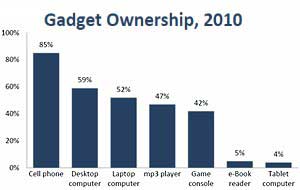
Generations and their gadgets - Pew Internet
Untethered device ownership

Sony Considers Internet Rival to Cable TV

Sony Corp. is considering launching an Internet-based alternative to cable-TV service, the Wall Street Journal reports.


The Japanese electronics and entertainment company apparently has approached several big media companies that own TV channels to negotiate the rights to offer TV channels over the Web to U.S. consumers, the people say.


But what Sony wants to purchase is rights to a selected number of core channels that would allow Sony to sell the package at less cost than s typical cable TV, satellite or telco video subscription.


It isn't clear how much chance Sony will have to get the programming it wants. Content owners, particularly the networks, have been unwilling to license channels on terms less favorable than what now is the case for cable, telco and satellite providers. 


It seems unlikely that networks will want to jeopardize their substantial legacy revenue streams even to pick up one additional distributor such as Sony. 


Sony also wants to distribute only to Sony-made devices including PlayStation gaming consoles, television sets and Blu-ray players.


Sony has sold approximately 18.1 million PlayStation 3 consoles in the U.S., according to the latest data from tracker NPD Group Inc., and many homes have other Internet-connected Sony devices as well.

Wednesday, November 16, 2011

Steve Jobs Originally Wanted iPhone on its own Network

When Steve Jobs first dreamed up the iPhone with his team at Apple, he didn't want it to run on AT&T's network. He wanted to create his own network, says venture capitalist John Stanton, who spent a good deal of time with the late Apple CEO during the phone's development period.

Jobs wanted to replace carriers completely, Stanton says, instead using the unlicensed Wi-Fi spectrum. Jobs would not have been the first executive to think about how Wi-Fi could literally replace use of mobile networks for mobile voice and data. There was a fair amount of such speculation in the late 1990s and earlier 2000s. Wi-fi for mobile service?

By about 2005, most began to see Wi-Fi as a complementary access alternative to mobile service. Wi-Fi becomes complementary Republic Wireless, the new mobile service provider, is the latest example of that line of thinking. 


For ubiquity, no service provider yet has shown an ability to completely displace mobile networks. 
On the other hand, for consumers, most important personal devices are equipped, or increasingly will be equipped, with Wi-Fi capability. 


So even though it remains a challenge to design a mobile phone's connectivity around Wi-Fi-only connections, the in-home environment is becoming a "Wi-Fi mostly" sort of environment. 

Steve Jobs wanted iPhone on its own network

Yes, Follow the Data. Even if it Does Not Fit Your Agenda

When people argue we need to “follow the science” that should be true in all cases, not only in cases where the data fits one’s political pr...