An extensive agency network seems to be emerging as a fundamental requirement for a successful peer to peer money transfer service in Africa. For instance, Kenya’s M-PESA has more than 40,000 agents countrywide where customers can make and receive payments, payments can be made via Western Union from 70 countries and it has in excess of 900 paybill partners.
Interestingly M-PESA has never really gained traction in South Africa, where it was launched by Vodacom in 2010. Some would blame high fees and a tougher banking environment for that sluggish performance.
Still, it stands to reason that convenience, in form of lots of places where people can deposit and redeem cash, would be crucial for success.
Sunday, October 28, 2012
An Extensive Agent Network Needed for P2P Payments

 Gary Kim was cited as a global "Power Mobile Influencer" by Forbes, ranked second in the world for coverage of the mobile business, and as a "top 10" telecom analyst. He is a member of Mensa, the international organization for people with IQs in the top two percent.
Xcel's "Smart Grid" Fails in Boulder, Colo.
The idea of a "smart grid" is sexy. A growing number of communications service providers think "smart grid" projects offer lots of revenue potential for machine to machine communications services. And a recent failure by Xcel Energy in Boulder, Colo. shows why communications service providers should be optimistic.
Xcel Energy planned to launch "the world's biggest project" in Boulder, Colo., and got started in 2007.
Xcel's "SmartGridCity" was supposed to manage power flows, allow more wind and solar on the grid, and enable consumers to control electricity consumption.
Among other things, Xcel spent $21 million to build its own broadband fiberoptic network linking homes, substations and central control in Boulder. Xcel it won't do that again.
Five years later, costs have nearly tripled to $44.5 million, and Xcel wants its Colorado customers to pay for the cost overruns.
That experience might suggest the advantage access providers have: they can provide the communications network function at a fraction of the cost of a power company building its own network.
Xcel Energy planned to launch "the world's biggest project" in Boulder, Colo., and got started in 2007.
Xcel's "SmartGridCity" was supposed to manage power flows, allow more wind and solar on the grid, and enable consumers to control electricity consumption.
Among other things, Xcel spent $21 million to build its own broadband fiberoptic network linking homes, substations and central control in Boulder. Xcel it won't do that again.
Five years later, costs have nearly tripled to $44.5 million, and Xcel wants its Colorado customers to pay for the cost overruns.
That experience might suggest the advantage access providers have: they can provide the communications network function at a fraction of the cost of a power company building its own network.
Gary Kim was cited as a global "Power Mobile Influencer" by Forbes, ranked second in the world for coverage of the mobile business, and as a "top 10" telecom analyst. He is a member of Mensa, the international organization for people with IQs in the top two percent.
Economic Development Officials Think Broadband Helps
It is not a surprise that economic development executives think broadband helps their local economies. That is not too surprising. Most people probably think so, as well. It is probably quite accurate to say that broadband doesn't hurt. What really is hard to say is how much it helps.
Consultant Craig Settles conducted a survey in partnership with the International Economic Development Council (IEDC) about what 365 economic development professionals think about broadband. The survey was sent to 7,000, so an order of magnitude more officials declined to say whaqt they thought.
The respondents clearly see upside to broadband, both wireless and fixed. The problem always is that correlation is not causation, and it is impossible to analytically separate all the other factors that contribute to economic growth, from the particular impact of broadband.
You might say broadband is "hygenic," a precondition for business decisions, but not a sufficient economic driver, on its own. As clean water, waste disposal, air service, rail connections and electricity are likewise necessary, so is broadband. But electricity does not "cause" economic development.
The lack of electricity clearly inhibits potential development, but the converse is not true: electricity does not, by itself, cause development to occur.


Consultant Craig Settles conducted a survey in partnership with the International Economic Development Council (IEDC) about what 365 economic development professionals think about broadband. The survey was sent to 7,000, so an order of magnitude more officials declined to say whaqt they thought.
The respondents clearly see upside to broadband, both wireless and fixed. The problem always is that correlation is not causation, and it is impossible to analytically separate all the other factors that contribute to economic growth, from the particular impact of broadband.
You might say broadband is "hygenic," a precondition for business decisions, but not a sufficient economic driver, on its own. As clean water, waste disposal, air service, rail connections and electricity are likewise necessary, so is broadband. But electricity does not "cause" economic development.
The lack of electricity clearly inhibits potential development, but the converse is not true: electricity does not, by itself, cause development to occur.
Gary Kim was cited as a global "Power Mobile Influencer" by Forbes, ranked second in the world for coverage of the mobile business, and as a "top 10" telecom analyst. He is a member of Mensa, the international organization for people with IQs in the top two percent.
Are We All Becoming Geeks? Is Technology Adoption Curve Shifting?
 The ways products are adopted usually are depicted as a bell-shaped curve. The notion is that, at first, "geeks and nerds" adopt new technology because they like technology.
Only later do people who value the benefits start to adopt. Technology features matter most to the early adopters. Value, ease of use and price matters most to the great majority of adopters. Price matters quite a lot to late adopters.
But there are signs the curve might be shifting, with more consumers than before paying attention to technology aspects of the products, some might argue.
Instead of the traditional bell curve, there is a sort of "smooshing" in the direction of earlier adoption.

 Gary Kim was cited as a global "Power Mobile Influencer" by Forbes, ranked second in the world for coverage of the mobile business, and as a "top 10" telecom analyst. He is a member of Mensa, the international organization for people with IQs in the top two percent.
Saturday, October 27, 2012
Does New Technology Create Net Jobs, or Destroy Them?
Most of us believe that technology creates net jobs. But history might suggest the net impact is more mixed. Agricultural automation allowed farmers to do vastly more work with vastly less people, for example.
And it is possible that, on a net basis, software and hardware businesses, while creating new jobs, might displace more jobs, overall, than they create.
Some might argue the same also is true of broadband access, which virtually all of us might suggest is essential for learning and working in the 21st century. But some studies suggest the answer is quite nuanced.
One study suggests there are clearest benefits to "high technology" firms, fewer benefits for other firms, and limited benefits for consumers. Other studies also suggest there is a nuanced or subtle mix of benefits.
Consider the example of "rural" broadband, a seemingly clear case of how high speed Internet access can boost economic activity. The argument is that businesses will not locate in areas where high speed access is not available.
That arguably makes sense. But think about it: places where high speed access is best tend to be places where there are lots of people, lots of economic activity, the best transportation facilities, the closest distance to big markets, the biggest pools of skilled workers and the largest populations of consumers.
For that reason, one might argue that the best high speed Internet access follows people, rather than people following high speed access. It is an observation that cannot be scientifically tested, but correlation is not necessarily causation, in other words.
Some also might argue that the ability to work from home also has a negative impact on potential job creation in a particular rural area, since the connectivity might allow a job to be created remotely, even if the employee lives in a remote area and telecommutes.
Any many would argue that the impact is hard to discern, either way. That is not to say promoting broadband is wrong. We all agree it is important infrastructure. What is not so clear is whether spending too much on areas where broadband delivery is not so good will actually change very much in those areas.
Social equity is a praisworthy goal. But there is a difference between arguing that residents in rural areas should have substantially the same service are residents of urban areas, and arguing that providing such access equity will actually do much to boost economic activity in rural areas.
Talk to anybody in the business of rural communications and you quickly will find there are few customers of any type, business or consumer, to serve. And without a critical mass of people, many businesses simply cannot afford to locate in a rural area, no matter what the potential benefits might be.
There still is an income effect, but less than if a company were physically located in a rural area. One example is offshore call centers, or offshore software development. Because of high speed communications, jobs that might otherwise be sited in one country are actually sited in another country.
The bigger issue is now whether high speed access supports existing companies and jobs, or creates some number of new jobs that did not exist before. The larger question is whether those new jobs actually destroy other jobs in the broader economy, as agricultural mechanization has done.
And it is possible that, on a net basis, software and hardware businesses, while creating new jobs, might displace more jobs, overall, than they create.
Some might argue the same also is true of broadband access, which virtually all of us might suggest is essential for learning and working in the 21st century. But some studies suggest the answer is quite nuanced.
One study suggests there are clearest benefits to "high technology" firms, fewer benefits for other firms, and limited benefits for consumers. Other studies also suggest there is a nuanced or subtle mix of benefits.
Consider the example of "rural" broadband, a seemingly clear case of how high speed Internet access can boost economic activity. The argument is that businesses will not locate in areas where high speed access is not available.
That arguably makes sense. But think about it: places where high speed access is best tend to be places where there are lots of people, lots of economic activity, the best transportation facilities, the closest distance to big markets, the biggest pools of skilled workers and the largest populations of consumers.
For that reason, one might argue that the best high speed Internet access follows people, rather than people following high speed access. It is an observation that cannot be scientifically tested, but correlation is not necessarily causation, in other words.
Some also might argue that the ability to work from home also has a negative impact on potential job creation in a particular rural area, since the connectivity might allow a job to be created remotely, even if the employee lives in a remote area and telecommutes.
Any many would argue that the impact is hard to discern, either way. That is not to say promoting broadband is wrong. We all agree it is important infrastructure. What is not so clear is whether spending too much on areas where broadband delivery is not so good will actually change very much in those areas.
Social equity is a praisworthy goal. But there is a difference between arguing that residents in rural areas should have substantially the same service are residents of urban areas, and arguing that providing such access equity will actually do much to boost economic activity in rural areas.
Talk to anybody in the business of rural communications and you quickly will find there are few customers of any type, business or consumer, to serve. And without a critical mass of people, many businesses simply cannot afford to locate in a rural area, no matter what the potential benefits might be.
There still is an income effect, but less than if a company were physically located in a rural area. One example is offshore call centers, or offshore software development. Because of high speed communications, jobs that might otherwise be sited in one country are actually sited in another country.
The bigger issue is now whether high speed access supports existing companies and jobs, or creates some number of new jobs that did not exist before. The larger question is whether those new jobs actually destroy other jobs in the broader economy, as agricultural mechanization has done.
Gary Kim was cited as a global "Power Mobile Influencer" by Forbes, ranked second in the world for coverage of the mobile business, and as a "top 10" telecom analyst. He is a member of Mensa, the international organization for people with IQs in the top two percent.
Mobile Wallet Runs into the "Adoption Curve"
Mobile wallets or mobile payments are not the first new technology-based innovations presented to U.S. consumers as the "next big thing." So far, actual adoption has been fairly limited, outside of Starbucks stores, where Starbucks operates what most would consider to be the most-successful closed-loop mobile payments or mobile wallet service.
"Mobile payments and purchasing at the physical point of sale have experienced little adoption in the U.S. marketplace despite abounding innovation in mobile and payments technologies," according to Javelin Strategy & Research.
But that will change, for other reasons. A major shift of credit card security technology is coming, and that will be favorable for mobile payments.
Globally, an estimated 76 percent of point of sale terminals and 45 percent of cards are EMV‐enabled. “EMV” stands for “Europay, MasterCard and Visa,” a global standard for integrated circuit cards (IC cards or "chip cards") and IC card capable point of sale (POS) terminals and automated teller machines (ATMs). EMV often is referred to as a “chip and PIN” approach to security, as contrasted with the more-familiar U.S. “magnetic stripe” found on the backs of credit, debit and prepaid cards.
Right now, about 10 perent of U.S. terminals deployed in the United States support EMV. About one percent of cards use EMV.
The potential of mobile payments based on near field communications, which Javelin believes will ultimately emerge as the most successful mobile payments technology for the long-term, provides a powerful justification for merchants to invest in dual‐interface EMV terminals that support contactless NFC transactions and NFC-based mobile wallets.
“Javelin believes that NFC will ultimately be the leading technology underlying mobile wallet solutions, and implementing the EMV standards will facilitate that,” said Beth Robertson, Javelin director.
In other words, if most retail merchants upgrade to EMV, and they will, then the companion NFC support will create a ubiquitous point of sale infrastructure to support NFC-based payments. And retailers will adopt EMV because the payment networks have clearly said any merchant not using EMV will in the future bear the losses from fraud, not the payment networks, as now is the case.
That’s a big enough carrot to drive 100 percent of merchants to adopt EMV.
But new technologies historically take some time to reach 10 percent, then 50 percent, then virtually ubiquitous adoption. To be sure, there has been a tendency for new technologies based on digital and electronic technology to be adopted faster. But a decade period to reach perhaps 10 to 20 percent adoption is hardly unusual.
That is not much of an issue for point solutions like computers that can be used without lots of additional change in infrastructure. That is not true for highly-complex ecosystems such as payments, though.
ATM card adoption provides one example, where "decades" is a reasonable way of describing adoption of some new technologies, even those that arguably are quite useful.
Debit cards provide another example. It can take two decades for adoption to reach half of U.S. households, for example.


"Mobile payments and purchasing at the physical point of sale have experienced little adoption in the U.S. marketplace despite abounding innovation in mobile and payments technologies," according to Javelin Strategy & Research.
But that will change, for other reasons. A major shift of credit card security technology is coming, and that will be favorable for mobile payments.
Globally, an estimated 76 percent of point of sale terminals and 45 percent of cards are EMV‐enabled. “EMV” stands for “Europay, MasterCard and Visa,” a global standard for integrated circuit cards (IC cards or "chip cards") and IC card capable point of sale (POS) terminals and automated teller machines (ATMs). EMV often is referred to as a “chip and PIN” approach to security, as contrasted with the more-familiar U.S. “magnetic stripe” found on the backs of credit, debit and prepaid cards.
Right now, about 10 perent of U.S. terminals deployed in the United States support EMV. About one percent of cards use EMV.
The potential of mobile payments based on near field communications, which Javelin believes will ultimately emerge as the most successful mobile payments technology for the long-term, provides a powerful justification for merchants to invest in dual‐interface EMV terminals that support contactless NFC transactions and NFC-based mobile wallets.
“Javelin believes that NFC will ultimately be the leading technology underlying mobile wallet solutions, and implementing the EMV standards will facilitate that,” said Beth Robertson, Javelin director.
In other words, if most retail merchants upgrade to EMV, and they will, then the companion NFC support will create a ubiquitous point of sale infrastructure to support NFC-based payments. And retailers will adopt EMV because the payment networks have clearly said any merchant not using EMV will in the future bear the losses from fraud, not the payment networks, as now is the case.
That’s a big enough carrot to drive 100 percent of merchants to adopt EMV.
But new technologies historically take some time to reach 10 percent, then 50 percent, then virtually ubiquitous adoption. To be sure, there has been a tendency for new technologies based on digital and electronic technology to be adopted faster. But a decade period to reach perhaps 10 to 20 percent adoption is hardly unusual.
That is not much of an issue for point solutions like computers that can be used without lots of additional change in infrastructure. That is not true for highly-complex ecosystems such as payments, though.
ATM card adoption provides one example, where "decades" is a reasonable way of describing adoption of some new technologies, even those that arguably are quite useful.
Debit cards provide another example. It can take two decades for adoption to reach half of U.S. households, for example.
Gary Kim was cited as a global "Power Mobile Influencer" by Forbes, ranked second in the world for coverage of the mobile business, and as a "top 10" telecom analyst. He is a member of Mensa, the international organization for people with IQs in the top two percent.
Gartner Forecasts Android Tie With Windows By 2016
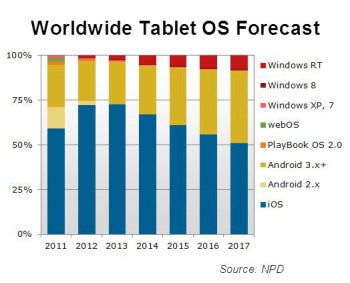 Apple, whose iPad, and now iPad mini, are expected to achieve sales of 219 million units globally by 2016, Gartner says. That would make Apple the leading provider of tablet computers.
Android suppliers will collectively hold second place, with 109 million in unit sales. Microsoft will grow from 2.3 million units in 2012 and 9.3 million in 2013 to 34.4 million by 2016 for third place. The total tablet market may reach 364 million units by 2016, Gartner predicts.
Gary Kim was cited as a global "Power Mobile Influencer" by Forbes, ranked second in the world for coverage of the mobile business, and as a "top 10" telecom analyst. He is a member of Mensa, the international organization for people with IQs in the top two percent.
Freemium Works: Leads App Store Revenue Sources
If you look at revenue being earned by mobile apps, the "freemium" approach seems to be working. In fact, actual revenue earned by app providers leans heavily in "in direct" revenue earned from users paying for content or products supplied by "free" apps, compared to direct revenue earned by selling those apps to use.
Over the last two years, global revenues for freemium apps on iOS have more than quadrupled. In 2012, worldwide freemium revenues on Google Play have grown 3.5 times, according to App Annie.
Those revenue growth figures do not tell the full story, unless you compare the growth and absolute revenue figures with the revenue created by apps whose revenue model is "you buy the app."


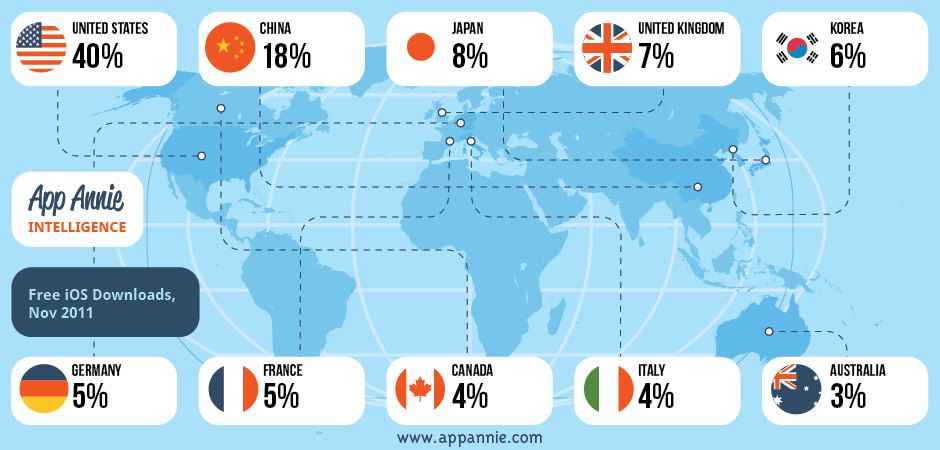
Over the last two years, global revenues for freemium apps on iOS have more than quadrupled. In 2012, worldwide freemium revenues on Google Play have grown 3.5 times, according to App Annie.
Those revenue growth figures do not tell the full story, unless you compare the growth and absolute revenue figures with the revenue created by apps whose revenue model is "you buy the app."
Gary Kim was cited as a global "Power Mobile Influencer" by Forbes, ranked second in the world for coverage of the mobile business, and as a "top 10" telecom analyst. He is a member of Mensa, the international organization for people with IQs in the top two percent.
Apple Understands Product Life Cycle and Executes
Despite some complaints from iPad users upset about Apple introducing a new and "better" iPad at intervals of less than a year, Apple does cannibalize its own products at a prodigious rate, and has done so for some time.
While cynical observers might say cannibalization is a great way to force customers to upgrade, others might also argue that Apple cannibalizes products and models as a way of protecting its overall share in the device market.
Others might say Apple under Steve Jobs, at least, understood the notion of a product life cycle and executed on its with perfection. Apple further seems to have understood and implemented product strategies that match the ways customer adoption changes over time from early adopters to majority.
Starting with the iPod, Apple has lead with its most powerful, most expensive model first, aiming at early adopters, then introducing less costly versions as the market grows, capturing larger segments of the consumer base that do not value technology prowess so much as value.
The iPhone launched as Apple was achieving peak iPod sales of about 22 million units. It was exactly the right time for Apple to cannibalize its own business, in that view.

While cynical observers might say cannibalization is a great way to force customers to upgrade, others might also argue that Apple cannibalizes products and models as a way of protecting its overall share in the device market.
Others might say Apple under Steve Jobs, at least, understood the notion of a product life cycle and executed on its with perfection. Apple further seems to have understood and implemented product strategies that match the ways customer adoption changes over time from early adopters to majority.
Starting with the iPod, Apple has lead with its most powerful, most expensive model first, aiming at early adopters, then introducing less costly versions as the market grows, capturing larger segments of the consumer base that do not value technology prowess so much as value.
The iPhone launched as Apple was achieving peak iPod sales of about 22 million units. It was exactly the right time for Apple to cannibalize its own business, in that view.
Gary Kim was cited as a global "Power Mobile Influencer" by Forbes, ranked second in the world for coverage of the mobile business, and as a "top 10" telecom analyst. He is a member of Mensa, the international organization for people with IQs in the top two percent.
Friday, October 26, 2012
A Look at "Post PC" Device Sales
By 2016, tablet sales are projected to exceed sales of PCs, according to NPD.
Overall mobile PC shipments will grow from 347 million units in 2012 to 809 million units by 2017.


Gartner projects worldwide media tablet sales to end users are forecast to total 118.9 million units in 2012, a 98 percent increase from 2011 sales of 60 million units, for example.

Overall mobile PC shipments will grow from 347 million units in 2012 to 809 million units by 2017.
Notebook PC shipments are expected to increase from 208 million units in 2012 to 393 million units by 2017, while tablet PC shipments are expected to grow from 121 million units to 416 million units in this period, for a compound annual growth rate of 28 percent.
A key driver for tablet PC growth is adoption in mature markets (including North America, Japan and Western Europe), which will account for 66 percent of shipments in 2012 and remain in the 60 percent range throughout the forecast period.
Tablet PC shipments into mature markets will grow from 80 million units in 2012 to 254 million units by 2017.
Worldwide Mobile PC Shipment Forecast (000s)
Source: NPD
“Consumer preference for mobile computing devices is shifting from notebook to tablet PCs, particularly in mature markets,” said Richard Shim, NPD senior analyst . “While the lines between tablet and notebook PCs are blurring, we expect mature markets to be the primary regions for tablet PC adoption.
Emerging and Mature Market Tablet Shipments (000s)
Source: NPD
Gartner projects worldwide media tablet sales to end users are forecast to total 118.9 million units in 2012, a 98 percent increase from 2011 sales of 60 million units, for example.
Gary Kim was cited as a global "Power Mobile Influencer" by Forbes, ranked second in the world for coverage of the mobile business, and as a "top 10" telecom analyst. He is a member of Mensa, the international organization for people with IQs in the top two percent.
Service Providers Clearly are Cutting Spending
What seems like an endless wave of job cuts in the telecom equipment supplier industry has been going on for more than a year, separate from the background shrinkage that has been going on for more than a decade.
Among the latest is Ericsson, the largest global supplier of mobile network infrastructure, according to Bloomberg.
Ericsson AB reported a 43 percent decline in third-quarter profit as wireless operators curbed spending in a sputtering economy.
Net income fell to 2.18 billion kronor ($324 million) from 3.82 billion kronor, Stockholm-based Ericsson said today. Gross margin, or the percentage of sales remaining after production costs, slid to 30.4 percent from 35 percent, missing the 32.2 percent average of analysts’ estimates.
The clear evidence of investment in Long Term Evolution notwithstanding, it is clear enough that other projects are being postponed. Telecom capex fell in the wake of the Great Recession of 2008, as would be expected. Spending picked up by 2010, but it now appears more stringency has returned.
The problems arguably are centered in the European markets.
Severe competition between smart phone and tablet makers will intensify in the period leading up to the Christmas and holiday season, likely signaling a tougher earnings climate.
Apple, Samsung and HTC gave cautious guidance on their fourth quarter prospects. Major new device launches and the impact of a slowing global economy are seen as issues.
Total worldwide handset shipments reached 410 million units in the third quarter of 2012, Strategy Analytics says.Overall global shipments of mobile handsets were virtually flat in the second quarter, rising only one percent to 362 million units, according to Strategy Analytics.
But some might note that smart phone sales in some markets, such as the United States, have been slowing for years
Among the latest is Ericsson, the largest global supplier of mobile network infrastructure, according to Bloomberg.
Ericsson AB reported a 43 percent decline in third-quarter profit as wireless operators curbed spending in a sputtering economy.
Net income fell to 2.18 billion kronor ($324 million) from 3.82 billion kronor, Stockholm-based Ericsson said today. Gross margin, or the percentage of sales remaining after production costs, slid to 30.4 percent from 35 percent, missing the 32.2 percent average of analysts’ estimates.
The clear evidence of investment in Long Term Evolution notwithstanding, it is clear enough that other projects are being postponed. Telecom capex fell in the wake of the Great Recession of 2008, as would be expected. Spending picked up by 2010, but it now appears more stringency has returned.
The problems arguably are centered in the European markets.
Severe competition between smart phone and tablet makers will intensify in the period leading up to the Christmas and holiday season, likely signaling a tougher earnings climate.
Apple, Samsung and HTC gave cautious guidance on their fourth quarter prospects. Major new device launches and the impact of a slowing global economy are seen as issues.
Total worldwide handset shipments reached 410 million units in the third quarter of 2012, Strategy Analytics says.Overall global shipments of mobile handsets were virtually flat in the second quarter, rising only one percent to 362 million units, according to Strategy Analytics.
But some might note that smart phone sales in some markets, such as the United States, have been slowing for years
Gary Kim was cited as a global "Power Mobile Influencer" by Forbes, ranked second in the world for coverage of the mobile business, and as a "top 10" telecom analyst. He is a member of Mensa, the international organization for people with IQs in the top two percent.
CEO Says Sprint Did Not Gain Control of Clearwire
Though Sprint now owns what might under other circumstances be a controlling interest in Clearwire, both Sprint and Clearwire say that is not the case.
Clearwire CEO Erik Prusch addressed that issue on Clearwire's latest earnings report. "I want to be crystal clear, Sprint has not gained any additional governance rights or board seats through their agreement to purchase Eagle River shares," said Prusch.
"The strategic investor group board seats and governance rights do not transfer when shares are sold," said Prusch. That means Sprint does not gain additional board seats whenever it buys investment stakes held by other Clearwire investors, says Prusch.
It appears that some of the confusion grows from earlier decisions by Sprint and Clearwire whereby Sprint agreed not to have management control of Clearwire. Also, Sprint has in the past declined to take steps to control Clearwire or buy the company outright.
Still, many believe, despite the logic of the latest Clearwire statement and its factuality, in a de jure sense, that the de facto reality could be different.
Clearwire CEO Erik Prusch addressed that issue on Clearwire's latest earnings report. "I want to be crystal clear, Sprint has not gained any additional governance rights or board seats through their agreement to purchase Eagle River shares," said Prusch.
"The strategic investor group board seats and governance rights do not transfer when shares are sold," said Prusch. That means Sprint does not gain additional board seats whenever it buys investment stakes held by other Clearwire investors, says Prusch.
It appears that some of the confusion grows from earlier decisions by Sprint and Clearwire whereby Sprint agreed not to have management control of Clearwire. Also, Sprint has in the past declined to take steps to control Clearwire or buy the company outright.
Still, many believe, despite the logic of the latest Clearwire statement and its factuality, in a de jure sense, that the de facto reality could be different.
Gary Kim was cited as a global "Power Mobile Influencer" by Forbes, ranked second in the world for coverage of the mobile business, and as a "top 10" telecom analyst. He is a member of Mensa, the international organization for people with IQs in the top two percent.
Samsung, HTC, Apple Warn Abouit 4Q Earnings
Severe competition between smart phone and tablet makers will intensify in the period leading up to the Christmas and holiday season, likely signaling a tougher earnings climate.
Apple, Samsung and HTC gave cautious cautious guidance on their fourth quarter prospects. Major new device launches and the impact of a slowing global economy are seen as issues.
Total worldwide handset shipments reached 410 million units in the third quarter of 2012, Strategy Analytics says. Overall global shipments of mobile handsets were virtually flat in the second quarter, rising only one percent to 362 million units, according to Strategy Analytics.
But some might note that smart phone sales in some markets, such as the United States, have been slowing for years.

Apple, Samsung and HTC gave cautious cautious guidance on their fourth quarter prospects. Major new device launches and the impact of a slowing global economy are seen as issues.
Total worldwide handset shipments reached 410 million units in the third quarter of 2012, Strategy Analytics says. Overall global shipments of mobile handsets were virtually flat in the second quarter, rising only one percent to 362 million units, according to Strategy Analytics.
But some might note that smart phone sales in some markets, such as the United States, have been slowing for years.
Gary Kim was cited as a global "Power Mobile Influencer" by Forbes, ranked second in the world for coverage of the mobile business, and as a "top 10" telecom analyst. He is a member of Mensa, the international organization for people with IQs in the top two percent.
Thursday, October 25, 2012
Clearwire Scales Back LTE Deployment, as Planned
Clearwire plans to have 2,000 Long Term Evolution sites on air by the end of June 2013 and expects to start receiving Sprint prepayment installments in June 2013. That plan is a reduction in sites from the earlier plan to light about 5,000 LTE sites.
Clearwire has decided not to attempt to create a full national LTE network, but instead will focus on a smaller number of markets where Clearwire could hope to provide wholesale service to other carriers.
Clearwire has decided not to attempt to create a full national LTE network, but instead will focus on a smaller number of markets where Clearwire could hope to provide wholesale service to other carriers.
Gary Kim was cited as a global "Power Mobile Influencer" by Forbes, ranked second in the world for coverage of the mobile business, and as a "top 10" telecom analyst. He is a member of Mensa, the international organization for people with IQs in the top two percent.
Order of Magnitude Better Wireless Bandwidth by Tweaking TCP?
 Researchers at MIT, the University of Porto in Portugal, Harvard University, Caltech, and Technical University of Munich have developed, and have started to license, a new coding approach to TCP that they claim can improve mobile and wireless bandwidth efficiency by an order of magnitude.
Testing the system on Wi-Fi networks at MIT, where two percent of packets are typically lost, Medard's group found that a normal bandwidth of one megabit per second was boosted to 16 megabits per second.
In a circumstance where losses were five percent—common on a fast-moving train—the method boosted bandwidth from 0.5 megabits per second to 13.5 megabits per second.
The technology is said to work by transforming the way packets of data are sent. Instead of sending packets, the system sends algebraic equations that describe series of packets.
So if a packet goes missing, instead of asking the network to resend it, the receiving device can solve for the missing one itself. Since the equations involved are simple and linear, the processing load on a phone, router, or base station is negligible,
The licensing is being done through an MIT/Caltech startup called Code-On Technologies.
As with all new technologies, it isn't clear whether similar results will be seen in the "real world," in commercial, mass deployments. But significant improvements should be expected.
Gary Kim was cited as a global "Power Mobile Influencer" by Forbes, ranked second in the world for coverage of the mobile business, and as a "top 10" telecom analyst. He is a member of Mensa, the international organization for people with IQs in the top two percent.
Subscribe to:
Posts (Atom)
-
We have all repeatedly seen comparisons of equity value of hyperscale app providers compared to the value of connectivity providers, which s...
-
It really is surprising how often a Pareto distribution--the “80/20 rule--appears in business life, or in life, generally. Basically, the...
-
Financial analysts typically express concern when any firm’s customer base is too concentrated. Consider that, In 2024, CoreWeave’s top two ...

