Sunday, October 16, 2016

Study Suggests 3 Facilities-Based Competitors Unlikely to Succeed in U.K. Market

source: Analysys Mason
A new analysis of facilities-based competition in the United Kingdom tends to support the view that ubiquitous fixed network on a facilities basis will tend to be a duopoly; that a third network offering triple-play services would not be able to cover most of the country, even under the most-optimistic scenarios.

That conclusion likely comports with the notions most researchers have reached, namely that facilities-based and ubiquitous fixed access network markets are oligopolies, because that is all the market will tend to support.

The only issue here is whether the stable oligopoly structure (in terms of facilities) features two providers or can include three (and if so, under what conditions).

That is not to say an oligopoly at the retail level is inevitable: robust wholesale policies have proven effective at stimulating retail competition. What robust wholesale has tended not to promote is investment in new facilities.

Analysys Mason researchers estimate that, at about 25 percent market share, a third facilities-based provider would be able to sustain access to about seven percent (two million locations) of homes.

The study tends to reconfirm that housing density encourages investment. But the study also suggests that robust wholesale policies actually discourage investment.

source: Analysys Mason
The researchers note that the greatest degree of facilities-based competition elsewhere in Europe relies on duct and pole access by competitors in countries where there is no wholesale regime in place.

In other words, where competitors must build their own facilities, and have some clear incentives to do so, facilities-based investment is most robust.

Also, third parties seem to have been most successful where the percentage of high-density housing is high.

The study authors conclude that investment in a third facilities-based network is highly risky and unlikely to succeed in the U.K. market, on a wide basis, though the business case might work in some high-density areas representing about 1.1 million households.

The analysis concluded that "it is highly unlikely that a third operator will be able to reach 40 percent (FTTP) coverage on a commercially viable basis".

“Our economic modelling suggests that encouraging a third separate network to invest in covering more than five to 10 percent of the country will be extremely difficult to achieve,” the study states.

Some might point to the key role cable TV competition tends to play, as well. In several countries, the primary facilities-based competition comes from cable TV operators.


Saturday, October 15, 2016

For All Networks, "Fiber to Where You Can Make Money" is the Issue

"Fiber to where you can make money" is a good way to evaluate various fixed network access methods. For cable TV operators, the issue is fiber deep into the neighborhood. For some telcos, that is the same issue.

For some telcos, fiber to the premises is the choice, but the issue of revenue generated by such networks remains.

For fixed wireless networks, the issue is fiber to tower or building. For mobile operators, the issue is fiber to the macrocell or fiber to the small cell.

In other words, the issue is not the choice of physical media, or the topology, but the revenue that any given deployment can generate. And, at a time when voice revenues are declining, and where facilities-based competition exists, the financial returns from fiber to the home often are questionable.

The choices are even more difficult for any telco operating in a market where cable TV firms are active, serious competitors. Stranded assets then are the real issue, as up to 60 percent of deployed assets can routinely be stranded (assuming cable TV gets 40 percent to 45 percent share, the telco gets 40 percent share, while other suppliers get 15 percent to 20 percent market share.

In other words, the issue is to deploy “fiber to where you make money.” That is true for all fixed network suppliers, including cable TV firms using hybrid fiber coax technology.

Assuming fiber is deployed rather deep into the network, coaxial cable can carry huge amounts of bandwidth.

25 Gbps on Hybrid Fiber Coax

Huawei has demonstrated 25 Gbps downstream speeds on a hybrid fiber coax network running DOCSIS, the cable modem protocol. As always, if one has enough capacity, huge amounts of throughput are possible. The Huawei demonstration used 3 GHz of spectrum on the simulated cable network.

Separately, Nokia has demonstrated symmetrical 10 Gbps bandwidth on an HFC network. There are a couple of important caveats. Achieving such speeds requires fiber fairly close to the end user location (about 200 meters in the Nokia demonstration), or new methods for extending the range of frequencies that can be carried over an HFC network (Huawei dem).

DOCSIS 3.0 supports use of 1.6 Gbps downstream bandwidth.

The DOCSIS 3.1 solution, with a 1.2 GHz spectrum, used with multi-channel bonding and orthogonal frequency division multiplexing (OFDM) technologies, already can support a downstream rate of 10 Gbps.

Huawei’s demonstration extended the amount of usable coaxial cable spectrum to 3 GHz for the first time.

Huawei believes a symmetrical 25 Gbps capability can be commercialized.

All Internet of Things Forecasts Slope Up and to the Right

It is impossible to find any Internet of Things forecasts, for any segment of the market, that fail to show an”upward sloping to the right” growth curve. In other words, virtually every forecast predicts significant to strong growth.

That seems to be true whether one looks at single-country or global forecasts. Of course, as always, global forecasts can obscure as much as they illuminate. Most of the near-term deployment of IoT will happen in a relative handful of countries.

So far, by some forecasts, North America represents as much as 45 percent of the global total, Asia perhaps 30 percent, Europe perhaps 20 percent.


More U.S. Teens Watch YouTube Than Linear TV

Whether YouTube is a “substitute” product for linear TV is debatable. What apparently is harder to debate is that YouTube is a preferred venue for consumer video consumption among U.S. teenagers.

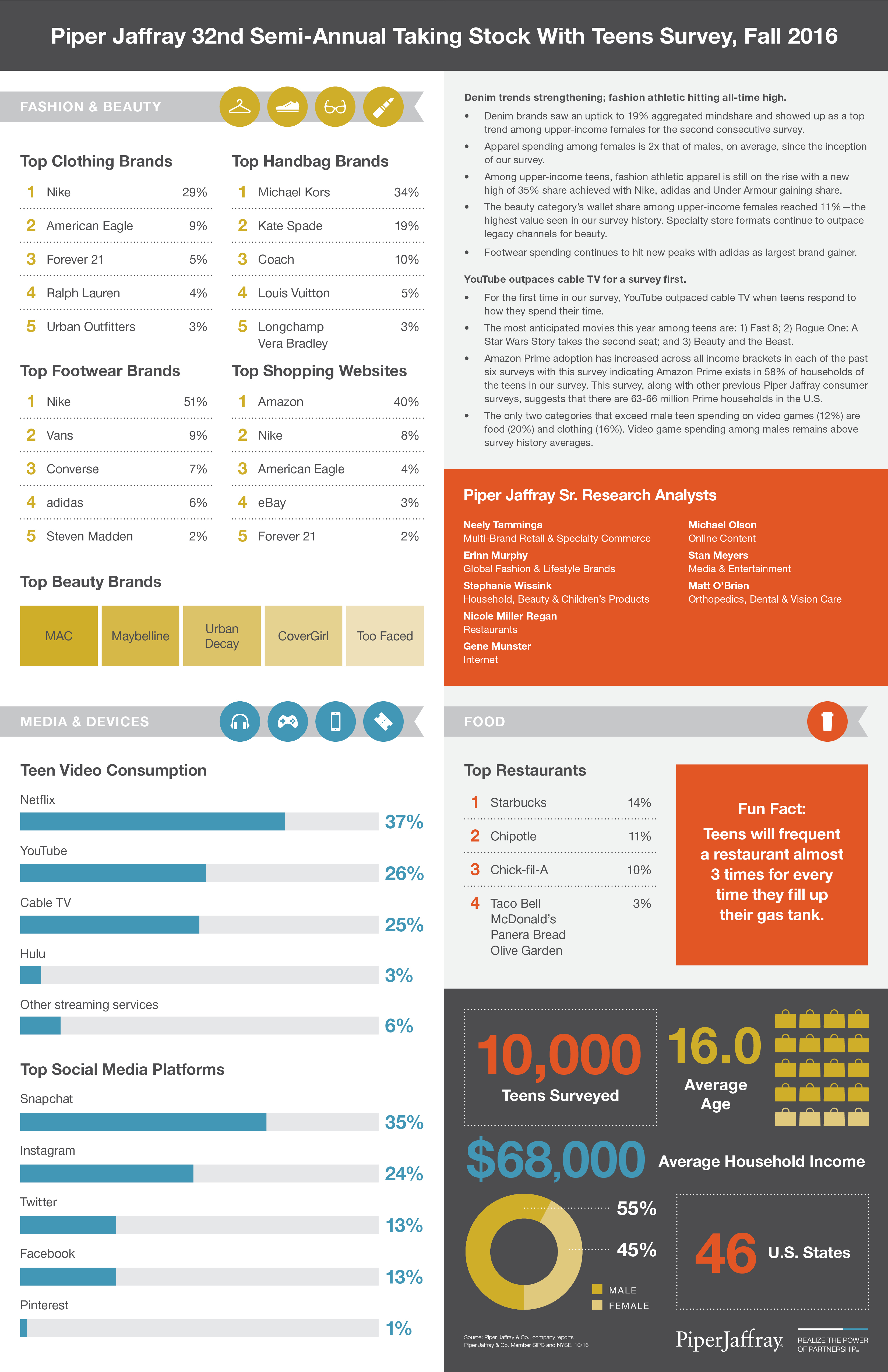
In a survey of U.S. teenagers, analysts at Piper Jaffray found teens spent more time watching YouiTube than watching linear TV. Though 37 percent of respondents reported watching Netflix, 26 percent said they watched YouTube, compared to 25 percent who reported watching linear TV.

And 40 percent say their top shopping website is Amazon, leading other sites by an order of magnitude.


Friday, October 14, 2016

The Reason Why Video Entertainment is The Only Service To Increase Prices

Over the past several decades, it would have been a reasonable question to ask why entertainment video service prices grew faster than inflation, while retail prices for communications services (voice, texting, Internet access) declined, either on a price-per-unit basis or in terms of absolute price per unit.

The answer is simple: entertainment video is about the purchase of content, not access to content.

Compared to voice, texting or Internet access, entertainment video is more akin to fashion than a utility service. And that means retail price is not a direct function of production cost.

That is clear in the latest Federal Communications Commission report on content prices in the U.S. linear video market.

However, given diminished consumer appetite for the traditional “big content bundles” and a shift to over-the-top or on-demand viewing, it will be necessary for most, if not all, providers to “just say no” to content providers and restrict the size of bundles.

That is going to shift the way content gets to market, with increasing amounts of programming moving through new services such as Netflix and Amazon Prime.

According to a new FCC report, the average monthly price of expanded basic service (the combined price of basic service and the most subscribed cable programming tier excluding taxes, fees, and customer premises equipment charges) for the communities surveyed grew by 2.7 percent over the 12 months ending January 1, 2015, to $69.03, compared to a decrease of 0.1 percent in the consumer price index.

That is to say, linear video prices rose by an order of magnitude more than the overall level of consumer prices.

This compares to a compound ten-year average rate of increase from 2005 to 2015 of 4.8 percent in the price of expanded basic and a 1.5 percent increase in the CPI.

To be sure, linear video providers have argued in the past that prices are up in large part because the number of channels offered in bundles has grown.

The price per channel (price divided by number of channels) for subscribers purchasing expanded basic service decreased by 1.8 percent over the 12 months ending January 1, 2015, to 46 cents per channel.

Over the 10 years from 2005-2015, the price per channel has declined by 1.4 percent on an average annual compound basis.

In the past, consumers might not have had as much choice. In the future, they will. Prices are going to come down. Still, the issue is whether entertainment video might still outperform voice, texting or Internet access, in some cases, in terms of absolute revenue contribution, price per unit or profit margin.


Google Will Go "Mobile First" for Search

The business strategy known as mobile-first is affecting Google’s continued development of its search business.

Google is going to create a separate mobile index within months, becoming the main or “primary” index that the search engine uses to respond to queries.

A separate desktop index will be maintained, but will not be as up-to-date as the mobile index, it is expected.

Thursday, October 13, 2016

Gigabit Era for Mobile: Telefónica and Telia Make Strides

The gigabit era for mobile Internet access is coming faster than many believe.

New improvements in 4G platforms will boost 4G network speeds to a gigabit per second on Telefónica networks in Spain, while Telia plans to launch 5G in 2018, supplying gigabit speeds--and possibly multi-gigabit speeds--as well.

Telia plans to launch commercial 5G services in Sweden and Estonia in 2018, and recently demonstrated 5G operating in a real world environment over a live network.

The system used 800 MHz of spectrum in the 15 GHz band and achieved peak rates of 15 gigabits per user, and a latency below three milliseconds.

Separately, Telefónica, Nokia, and Qualcomm Technologies, Inc. have demonstrated download speeds of up to 800 Mbps on Telefónica’s Long Term Evolution 4G mobile network. That is part of work the company is taking to boost peak speeds on its 4G network to a gigabit per second over the next few years.

The test used Nokia radio network equipment and a test terminal equipped with the Qualcomm Snapdragon X16 LTE modem.

To achieve the new throughput, two radio carriers were used, allowing mobile terminals to simultaneously download data from two frequency bands.  MIMO 4x4 technology (Multiple-input Multiple-output) also was used, multiplying the number of data flows that a mobile terminal can use with a given cell.

Also, the new 256QAM modulation (Quadrature Amplitude Modulation) also was employed. Taken together. All of these technologies will be introduced into the Telefónica Spain radio network.

Are Webscale App Providers Shaping Core Telecom Platform Trends?

Webscale Internet companies (Google, Apple, Facebook, Microsoft and Amazon) now are exerting a “markedly increased influence” on markets for communications service. Analysts at Heavy Reading now think the webscale players also increasingly are shaping the market for networking hardware, software and services.

That will be a contentious point of view, even if many telecom industry execs and others think that is true, to some extent.

Google and Facebook are developing new backhaul and access platforms. Google Fiber does buy industry-standard optical access networks as well.

But Facebook mostly is looking at open source platforms that can be manufactured by supplied by industry suppliers.

Clearly, there is impact in terms of buying behavior in the case of Google Fiber, and development potential in the open source efforts by Facebook.

At least some telecom industry professionals believe the webscale providers are "leading in networking innovation"; are "increasingly calling the shots"; increasingly "building out their own telecom infrastructure" and that "it's a matter of time before one of these guys buys one of the big CSPs (communications service providers).”

A Heavy Reading analyst team interviewed more than a dozen leading network infrastructure professionals at leading CSPs at the CTO, VP and director level, as well as more than 25 senior individuals in network equipment vendors at CTO, VP and director level; plus several leaders in key telecom industry associations, standards bodies and other specialist consultancies; and some of the WICs themselves.

The primary and secondary research was complemented by a Heavy Reading online survey, generating responses from 82 qualified respondents in network equipment vendors and 57 from qualified respondents in CSPs.

Keep in mind that about half the 82 vendor respondents came from individuals from one vendor company.

Around half came from vendors from whom two or more (but no more than four) respondents supplied responses. Those companies from which two or more respondents participated include ADVA, Broadsoft, Casa Systems, Cisco Systems, Ericsson, F5, Huawei, HP, IBM, Infinera, Juniper Networks, Nokia, NetScout, Vasona Networks and Radisys.

As you might expect, the online respondents identified Google as the webscale player posing the greatest threat to communications service providers.

Excerpt


Sprint, Sprint Foundation to Make Free Mobile Service Available to One Million High School Students

Sprint and the Sprint Foundation will help change the lives of one million high school students by giving them free mobile devices and free Internet access.

The One Million Project is supported in part by device donations from handset suppliers. Sprint and the Sprint Foundation will raise funds through special events, donation drives and other activities aimed at employees and customers, as well as company-owned, dealer, and national retail stores across the country.  

Sprint will work with non-profit agencies including EveryoneOn and My Brother’s Keeper Alliance which will help to recruit community organizations such as schools, libraries, public-housing authorities, and non-profits to deliver the devices and activate the mobile internet service, usable by students for up to four years in high school.

Each student may receive either a free smartphone, tablet, laptop or hotspot device and 3GB of high-speed LTE data per month.

Unlimited data is available at 2G speeds if usage exceeds 3GB in a month. Those who receive a smartphone can use it as a hotspot and for unlimited domestic calls and texts while on the Sprint network.

Wednesday, October 12, 2016

AT&T Selling Gigabit Services to More than 3 Million Locations, Will Exceed 12.5 Million Locations by 2019.

With the caveat that a “passing” (customer location that can buy a service) is not an “account,” AT&T says its gigabit services now are available in parts of 32 major metro areas, with plans to reach at least 45 metros by the end of 2016 and 67 markets overall.

AT&T says it is marketing service to over three million locations, of which over 500,000 include apartment and condo units. AT&T also says it is on track to exceed the 12.5 million locations planned by mid-2019.

DirecTV Might Help AT&T Connect MDUs Out of Region

Most multi-product businesses earn disparate amounts of revenue--and profit--from each discrete product line. In a perhaps-ideal scenario, a mix of young and fast-growing “next product cycle” products as well as mature, cash-producing lines of business contribute to overall earnings, profits and strategy.

Telecom companies are no different, featuring a mix of products, customer segments and growth profiles. And, frequently, profits and revenues from one part of the business are used to subsidize the operation or growth of other segments.

So it is that AT&T’s DirecTV operations might help AT&T grow its Internet access services outside its historic fixed network footprint.

The reason: AT&T plans to serve customers living in apartment complexes outside of its fixed network service area, operating as a competitive local exchange carrier, and offering 100 Mbps Internet access, perhaps using millimeter wave spectrum and fixed wireless.

Obviously, roof rights are required, and many apartment complexes might already have business deals with DirecTV that AT&T can leverage to supply high speed Internet access as well, using fixed wireless to reach some buildings.

The strategy apparently is to use a hub-and-spoke network where a central building is connected directly using optical fiber, while nearby buildings are connected using fixed wireless.

Google to Light 6th Undersea Cable in Which It has Ownership Interest

Google is working with Facebook, Pacific Light Data Communication and TE Subcom to build the first direct submarine cable system between Los Angeles and Hong Kong. The move highlights changes in the way global wide area network capacity is created and supplied.

The Pacific Light Cable Network (PLCN) will have 12,800 km of fiber and an estimated cable capacity of 120 Tbps, making it the highest-capacity trans-Pacific route, a record currently held by another Google-backed cable system, FASTER.

The project represents the sixth submarine cable in which Google has an ownership stake, joining the ranks of the Unity, SJC, FASTER, MONET and Tannat projects. The new network is expected to be operational in 2018.

Though data center traffic is a fraction of end-user traffic or traffic within single data centers, intra-data-center traffic has the fastest growth rate, at about a 32 percent compound annual growth rate.

In addition to cloud computing and cloud-based apps, video, mobile users and Internet access now drives wide area network capacity demand.

Those apps and functions now drive “in the data center” traffic, long haul and metro traffic growth. In fact, wide area network traffic, though growing robustly, is not growing as fast as “within the metro” demand.

Metro-area traffic likely surpassed long-haul traffic in 2015, and will grow nearly twice as fast as long-haul traffic from 2014 to 2019.

The higher growth in metro networks is due in part to the increasingly significant role of content delivery networks, which bypass long-haul links and deliver traffic to metro and regional backbones.

Content delivery networks will carry over half of Internet traffic by 2019. Globally, 62 percent of all Internet traffic will cross content delivery networks by 2019 globally, up from 39 percent in 2014.

Traffic from wireless and mobile devices will exceed traffic from wired devices by 2019. By 2019, wired devices will account for 33 percent of IP traffic, while Wi-Fi and mobile devices will account for 66 percent of IP traffic. In 2014, wired devices accounted for the majority of IP traffic at 54 percent.

Though there has been a mix of “carrier-purchased” and “enterprise private networking,” the current trend in the WAN market includes a higher mix of “owned” networking by big app providers such as Facebook and Google.

Equinix Will Use Space-Based Optical Communications

Equinix will be first to use a Laser Light Communications space-based laser communications system. As part of the initial agreement, Laser Light will establish its inaugural global Point of Presence (PoP) at Equinix’s DC11 International Business Exchange data center in the Washington, D.C. area.
Once operational, the All Optical Hybrid Global Network (HALO) will offer wide area communications to carriers, enterprises and government customers at Equinix facilities around the globe.

The initial deployment in Equinix’s DC11 IBX is expected to grow with additional Points of Presence planned globally, including Equinix facilities in the UK, Japan, Brazil, Australia, the Middle East, and Europe.

The system is based on use of medium earth orbit satellites, initially using eight to 12  satellites.

It Has Taken a Couple of Decades, but Fixed Wireless is Coming Back in a Big Way

Windstream plans to expand its fixed wireless access operations in 40 U.S. markets, using 39-GHz millimeter wave spectrum, presumably for backhaul and business customer access.

Ironically, Windstream in 2008 wrote down the value of its 39 GHz spectrum holdings to zero, as part of a sale of mobile and wireless assets to AT&T Mobility.

The collapse of a millimeter-wave access services business is not terribly unusual. Whole companies (Windstar and Teligent, for example) went bankrupt after trying to build an enterprise access business using millimeter wave technology, after the passage of the Telecommunications Act of 1996.   

But times change. Platforms become more capable. Costs go down. And with coming 5G mobile networks embracing millimeter wave technology, what was a broken business model two decades ago might well become an essential underpinning of next generation networks, both mobile and fixed.

Google Fiber, Facebook, AT&T and Verizon are a few of the leading firms now developing or planning to use fixed wireless in a significant way for Internet access.

Cambridge Broadband Networks (CBNL) is providing the radios and and Straight Path Communications is supplying the spectrum licenses for the Windstream rollout.

The new technology will allow Windstream customers data speeds of up to 275 Mbps full duplex, and it also supplements Windstream's other fixed wireless access technologies that range in speed from 1 Mbps to 1 Gbps.

Windstream will deploy in seven existing markets where it currently offers fixed wireless access technology - Chicago, New York City, Boston, Cleveland, Philadelphia, Milwaukee and Little Rock  using equipment from CBNL and spectrum from Straight Path.

Windstream will also deploy CNBL equipment in 33 new markets where it will begin offering its fixed wireless technology. Those markets include Atlanta, Baltimore, Charlotte, Cincinnati, Dallas, Detroit, Kansas City, Miami, Minneapolis,Nashville, Oklahoma City, Phoenix, Richmond, San Antonio, Seattle and St. Louis.

Under the agreement, Windstream has the option of eventually expanding fixed wireless to an additional 32 markets where Straight Path owns 39 GHz spectrum.

Yes, Follow the Data. Even if it Does Not Fit Your Agenda

When people argue we need to “follow the science” that should be true in all cases, not only in cases where the data fits one’s political pr...