Thursday, September 27, 2012

Can Rival Mobile Operating Systems Beat Android at Low End?

Google’s Android smart phone operating system will have about 62 percent share in 2013, and clearly leads as the operating system for lower cost devices. 

But there are challengers, including those backed by Huawei, ZTE, Samsung, Mozilla and Nokia. But it always is tough to unseat a supplier that has such dominant market share. 

Strategy Analytics 
notes that the Firefox OS, Mozilla’s mobile effort, will get one percent of all global smart phone shipments in 2013, compared to 67 percent for Android. 

undefined

Mobile Service Providers Should Use Pricing to Counter Over the Top Apps

At least for the moment, mobile service providers can and should use pricing as a tool to improve the appeal of operator messaging and discourage the use of competing over-the-top communication services, Strategy Analytics says. 

In some cases, one might say, service providers can price messaging or domestic voice so attractively that the value of using an over the top app to save money simply evaporates. That doesn't address the value of an OTT app when different functionality is the attraction, though.

So over the longer term, Strategy Analytics offers the advice that pricing alone will be insufficient, and additional changes to the user experience will be needed "to keep customers within the operator communication ecosystem." says Nitesh Patel, Strategy Analytics senior analyst. Patel says Rich Communications Suite is needed to add more functionality. 

That's conventional wisdom and generally good advice, one might argue. The issue is whether RCS can become established fast enough that users have not already become accustomed to using third party apps. 


Wednesday, September 26, 2012

Google Play to Hit 50 Billion Downloads Early in 2013?

Google Play, the app store formerly known as the Android Market, expects to hit the 50 billion downloads milestone early in 2013. In March the company said it had had 13 billion downloads

The Play Store now has 675,000 applications and games available, which is within distance of the 700,000 applications Apple claimed earlier this month. Apple does have the edge on media, however, stocking over 26 million songs, 190,000 TV episodes, and over 45,000 films.

Others Will Drive Mobile Payments, Not Telcos

Mobile (including communications, commerce, platforms, and software and applications) comes a close second to cloud computing in its potential to shake up consumer and enterprise markets, a survey of 668 global technology executives, conducted by KPMG, has found. 

As you might suspect, in a specific market, namely mobile payments, respondents believe Internet companies, technology companies, credit card companies, payment specialists and commercial banks are likely to lead the market, ahead of telecom companies. 

That is one illustration of the concern telecom and other access providers have about innovation within the ecosystem, namely that most of the value is being provided by third parties who use access to the Internet as an input, but are not especially dependent in any fundamental way on access providers to get to the potential customers. 


Three key findings highlight the "mobile anytime, everywhere" nature of the coming potential market disruptions.  Smart phones and tablets lead as top tech breakthroughs, followed by cloud and storage.

What is truly transformational is the combination of the mobile Internet connected to the cloud as an enabler of new business models, KPMG says. 


When it comes to their home country, respondents feel that mobile device manufacturers (such as Apple) outrank other types of businesses for tech innovation leadership.

Roughly a third of respondents say that Internet companies are the emerging champions in the fast-developing mobile commerce ecosystem.

These trends are led by the advanced mobile communications markets of Japan and Korea, big and growing mobile bases in China and India, and the fast uptake of next-generation mobile standards around the globe.


More than half of respondents point to the cloud (SaaS, IaaS and PaaS) as the next indispensable consumer technology and the greatest driver of business transformation. Smartphones and tablets lead as top technology breakthroughs that will result in the biggest business transformation for the time being.


Nearly half (44 percent) forecast mobile as the next indispensable consumer technology while more than one-third (36 percent) predict mobile will be the leading game-changer in the enterprise market. Of the four mobile sub-categories, mobile communications leads the pack.

Select geographic markets favor mobile over the cloud as the top change agent. In Israel, for instance, 64 percent believe mobile will lead the next generation of consumer technologies while 58 percent feel the same way about the enterprise market. 

Additionally, in the Europe, Middle East and Africa region (EMEA), 54 percent foresee mobile as the most likely technology to shake up consumer markets in the next three years.

In one more measure of mobile’s impact, smart phones and tablets lead as the next technology breakthrough that will provoke the greatest business transformation four years from now (according to 22 percent of respondents), followed by cloud and storage, at 18 percent.

U.K. Domino's Pizza Gets 18.5% of All E-Sales from Mobile Devices

In its U.K. market, Domino’s Pizza in its most recent quarter saw online sales accounting for 58.4 percent of U.K. delivered sales, compared to the 2011 level of 46.5 percent for tthe 13 week period leading up to Sept. 23, 2012.

Total online sales for the period rose by 39.3 percent to £62.8 million (2011: £44.8m) and have
reached £184.9m for the year to date (2011: £129.9m).

But it is mobile sales that are the most significant number, some would say. In fact, mobile sales were up by 46.9 percent, and now account for 18.5 percent of total online sales. That's a significantly higher percentage than would be expected in the U.S. market, for example.


Does Twitter Have a Role in E-Commerce?

Twitter is looking at ways it might play in the e-commerce business, which might suggest to some how heated the e-commerce space has gotten. Others might say there is a direct relationship between distribution of perishable inventory and real-time offers that Twitter might provide. 

Twitter CEO Dick Costolo says Twitter is looking at ways to “participate” in transactions that take place on the social network.

“It’s particularly interesting in areas where you’ve got things like perishable inventory, like tickets,” Costolo says.

In the past, for example, Google tweeted a promotion code that people could use for tickets to its IO conference, and about 100 tickets sold in a little over 10 minutes. 

“That’s $55,000 with one tweet in 13 minutes,” said Costolo . Separately, the San Diego Chargers tweeted about tickets that were left for a game, and in a little over half an hour they were gone. Those are concrete examples of how Twitter might build a new business based on liquidating high perishable excess inventory. 

People Don't Remember Mobile Ads: Duh!

Smart phone owners don’t really remember the promotions that appear on their devices, a study of U.K. phone owners has found. But that is completely in keeping with most studies of ad recall. Few human beings pay much attention to most ads, ever, in any medium. 

Azullo conducted a survey of 1,014 U.K. smart phone owners and found about 21 percent could recall an ad on their smart phone in the past six months. But look at matters another way, how many people could recall many details of any event with low emotional impact or involvement, at some point in the last half year?

When asked if they could recall brands, products or services promoted by these ads, 53 percent said no, Azullo says. 

Smart Phones Will Grow Share of Smart Devices Through 2016

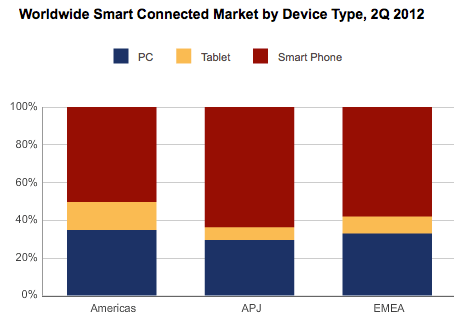
Smart phones now account for 59 percent of connected device shipments, and will grow 15.8 percent annually, to reach nearly 63 percent of smart device shipments by 2016, Forrester Research says.

Tablets will grow the fastest, though, rising from a 10 percent share in 2012 to 13 percent by 2016.

PC share will drop from 31 percent to 24 percent during the same time period. 

App Users Younger, Wealthier


Among U.S. mobile device users, those who use apps tend to be younger and more affluent than those who stick just to the web,  Forrester Research says
Nearly a third of those who use mobile apps fall between the ages of 23 and 31, and another third are in the 32 to 45 category. So roughly 66 percent of app users are younger than 46. 
Usage varies by OS, however, and Apple’s iPhone app audience are generally younger and better off financially, while those on Android tend to be older and less moneyed.

Tough Economy Affecting Cable, Mobile in Opposite Ways


Between 2007 and 2011, U.S. consumer spending generally shrank, as a response to the Great Recession and anemic recovery since 2008.

But though spending dropped overall, there was one area where spending actually rose: telecom services.

As you might guess, the growth was driven by mobile services, and most would attribute those gains to the attractions of smart phones such as the Apple iPhone. 

U.S. consumer spending on phone services rose more than four percent in 2011, the fastest rate since 2005, according to Department of Labor statistics. 

Families with more than one smart phone sometimes pay more for mobile service than they pay for cable TV and home Internet access. 


The tough economic conditions are not helping cable companies, though.

“The real important economic stats for us in terms of potential wind at our back really relate to improvements in occupied housing, improvements in the unemployment stats, increases in disposable income and increases in consumer confidence,” according to Time Warner President and Chief Operating Officer Robert Marcus. “To tell you the truth, we really haven’t seen a whole lot of meaningful improvement in those stats across our footprint.”


Of course, as happy as mobile service provider executives might be about the revenue growth, the cost of subsidizing those smart phones creates operating margin issues. Still, the numbers speak for themselves: consumers are making cuts elsewhere to fund mobile services.

Other purchasing categories, including cars, clothing, entertainment and food consumed away from home have suffered, in comparison.

The big issue is how long that growth trend in mobile spending can continue.


Tuesday, September 25, 2012

Kindle Fire HD Generates 11% of Kindle Fire Web Traffic After 1 Week

The new Amazon Kindle Fire HD was released Friday, September 14th, 2012 and seems quickly to have made a mark on bandwidth consumption. 

After only five days, the Kindle Fire HD represented 11 percent of all Kindle Fire Web usage, according to Chitika

Service Providers to Challenge Game Console Market

AT&T, Verizon Communications, Time Warner Cable Inc., Comcast and Cox Communications are gearing up for a push to deliver video games directly to televisions, Bloomberg :reports, a strategy shift that poses a threat to traditional consoles such as the PlayStation, Wii and Xbox, and shows how ecosystem partners increasingly find themselves competitors as well.

With cloud gaming, consumers will be able to avoid buying Sony’s PlayStation 3, Microsoft’s Xbox 360 or Nintendo’s Wii, and play using generic controllers connected to their set-top box or TV. Some carriers are looking at software that turns smartphones into controllers.

There still are a few technical upgrades required to set-top boxes, such as more powerful graphics processors. But none of that is a show stopper.

Media CEOS Bullish on Tablets, Mobile

CEOs from global entertainment and media companies are bullish on mobile and tablets for future growth, a study by Ernst & Young suggests.

Some 79 percent of CEOs said tablets would have the greatest impact, while 62 percent said smart phones would also be influential. 


Mobile devices also are expected to be the biggest drivers of
growth in content consumption over the next three years. 

How Long Can Separate Regulation of Broadcasting, Cable, Communications Continue?

It long has been a fixture of regulatory policy that different media have had distinct regulatory frameworks. In the U.S. market, the fundamental frameworks include unregulated “media,” partially regulated broadcasting and cable; and heavily-regulated common carrier services.

That “regulation by function” made sense at the time. As all networks become multi-purpose networks, the logic of regulating networks “by function or media type”  is subverted. That necessarily raises huge issues that affect the foundation of contestant business models.


In a simple way, the issue is whether stricter common carrier rules should be applied to "less regulated" media, or whether less regulation should be applied to common carrier services.

Also, some would argue, the growing instability of all legacy revenue models, across print, video, music, audio, television and communications industries means that regulation has to incorporate, as a primary objective, the fostering of innovation and investment in network facilities, as there is much less certainty than in the past. 

Greater risk, all other things being equal, means less investment.
A new International Telecommunications Union broadband report incorporates a healthy measure of those perspectives.

“Service providers have struggled with legacy inherited laws and regulations that award licenses per service, and many companies have taken the issue to court – for example, cable TV companies seeking to provide telephone service over their networks, and telephone companies wanting to upgrade their networks to offer video programming services and compete with the cable companies,” the ITU report says.

“More modern approaches to regulation may be needed – such as converged regulation, simplifications to the licensing regime or unified licensing, where one unified license can allow any telecommunication company to provide any service, as long as consumer rights are protected, and the competitiveness of markets is not threatened,” the International Telecommunications Union broadband report suggests.

The historic division between regulation of communications and separate regulation for broadcasting was acceptable in the past when spectrum and telecommunications were clearly divided, and regulation of content was a major focus of any broadcasting agency, the ITU says.  

With the shift of virtually all networks to Internet Protocol, virtually all networks can deliver any type of media. And that complicates any efforts to regulate media, broadcasting and communications separately.

The ITU study notes that policy-makers and regulators now must “stimulate”  demand for broadband and in promote investment in infrastructure. That also requires a “balance” of technologies and policy approaches appropriate to specific situations, including more wireless effort.

The growth rate in global mobile  data traffic is projected to grow 60 percent annually from 2011 to 2017, which will result in a 15-fold increase in traffic by 2017, mainly due to video traffic.

“Such an explosion in data traffic requires more spectrum,” the ITU says.  In this regard,
policy-makers and regulators can help to create a supportive environment and encourage
investment and ensure sufficient availability of quality spectrum, the ITU says.

Monday, September 24, 2012

Should all Internet Device User Interfaces be the Same?

Ask yourself whether it is especially helpful for all your digital devices to use a similar look and feel. How important is it that your PC, your tablet, your smart phone and possibly other devices have a similar user interface? Microsoft is about to find out, it appears, with the launch of Microsoft 8. 

Making radical changes to Windows poses a risk for Microsoft as enterprises and other large organizations prefer to reduce technology risk by deploying mature, stable, well-supported products, Gartner argues. 

Windows Vista, for example, never gained significant success in corporate environments, and its lack of success can be glimpsed in the market share statistics. Gartner estimates that just eight percent of PCs run by Gartner clients ran Vista at its peak. 

The bottom line is that IT leaders are questioning whether Windows 8 will suffer a similar fate, Gartner argues. 

"Microsoft's approach is very different from Apple's and Google's, where phones and tablets have much more commonality than PCs and tablets," Gartner says.  The new "Metro-style" user interface, which includes large buttons for touch and eliminates the ability to boot to the familiar Windows Desktop and have a traditional Windows start menu,  is probably the most controversial decision Microsoft has made in Windows 8, Gartner says. 

The result is an operating system that looks appropriate on new form factors of PC hardware including tablets, hybrids and convertibles, but has people questioning its appropriateness for traditional desktop and notebook machines, which comprise the majority of the existing PC market, Gartner notes. 


On the Use and Misuse of Principles, Theorems and Concepts

When financial commentators compile lists of "potential black swans," they misunderstand the concept. As explained by Taleb Nasim ...