Monday, January 9, 2012

Mobile Now Drives Enterprise Cloud Adoption

Up to this point, it might have been reasonable to consider the impact of "mobility" on enterprises mostly in relation to remote or distributed work, and separately from other trends, such as "consumerization" or "cloud computing," though all three are related.

Increasingly, though, it is looking as though mobility is now driving cloud adoption. That's new.

When cloud storage provider Box tracks its enterprise sales, it finds there has been a 30-fold increase in the number of enterprise deployments that are mobile-driven.
So while mobile user growth may be up nine times, enterprise activity is producing more revenue growth.

The Box enterprise customer base now includes 82 percent of the Fortune 500, the company says. Mobile drives cloud adoption

That mobile drives enterprise cloud computing adoption should not be surprising. Networked computing has been driving most application trends for some time. Most consumer apps now run in the cloud. And though enterprises can afford to run apps using their own data center infrastructure, it increasingly makes sense to create web interfaces for enterprise apps, whether the facilities are run "in the cloud" or on owned facilities.



Ultrabooks "Versus" Tablets? Sorta

I might be a complete contrarian, but I don't believe notebooks and tablets are "product substitutes." Most people do think about it that way, and there is a clear logic for doing so.

Will people spend incremental cash on a tablet or a PC? Yes. Will tablets displace many PCs in the workplace? Yes. Will tablets displace many PCs in consumer environments? Yes.

Given my agreement with all those propositions, why do I think tablets are, in fact, not replacements for PCs? For the same reason a high-end Lexus is not a product substitute for a SmartCar. It is true that both provide "transportation," but so do skateboards, bicycles, mopeds, motorcycles, buses, airplanes and trains.

My point is that we have had, for decades, a multi-purpose device, the PC, that has gotten more portable, and now mobile form factors over time. There are some instances where some users have considered even a BlackBerry smart phone a functional substitute for a notebook PC.

I know a few people who claim that, on business trips, they compose articles on BlackBerries. I wouldn't. Most people probably wouldn't, but some do. Smart phones as content consumption devices

Still, there will be many more people who routinely use a tablet as a substitute for a PC, some of the time, most of the time, or nearly all the time. But the notion of "substitute" implies, rather directly, than one product provides equivalent satisfactions for some problem or need.

It might be viewed as a technicality or just "semantics," but I'd argue that, for decades, the ways people use PC devices have changed, though our portals have not, quite so much.

If you at the "birth" of the PC, you will discover that a particular application, namely the spreadsheet, lead to rapid adoption of PCs as ways to enable scenario and modeling exercises by accountants and financial personnel. That generally remains the case: it is applications that create the demand for devices.

What some of us might say is that the tablet starkly illustrates the principle that devices get used because people want to use applications. And what tablets illustrate is the massive shift of application consumption from "work" or "content production" to "entertainment" and "content consumption." Content consumption

It's just that, up to this point, we have not made attractive content consumption devices available. To be sure, most tablet users do some amount of content creation on tablets, but it mostly takes the form of answering emails. Most of the other activities are one form or another of content consumption.

It's a matter of latent user behavior being "uncovered," more than the creation of a new product category, though clearly, that also has happened. As it turns out, most of us, most of the time, seem to use connected PCs to consumer content, and little time "creating" it. Ultrabooks vs tablets

The point is that PCs increasingly get used for content creation ("work"). Tablets get used for most of the other things people do on the Internet, which is consume content. 


Tim Tebow's "Immaculate Reception" in Overtime Against Steelers

Some still are skeptical about Tim Tebow's future as a star National Football League player. On the first play of overtime, with a new rule barring "sudden death" victories, Tebow took the first snap and did the only thing a team can do, on offense, to win a game "sudden death" style: score a touchdown.

He's got the problems many say he has. But he's clearly progressing fast. There's something else, though. The whole team plays better when he's on the field. It's a total team effort. It's an intangible, but it seems to be "real."

Sunday, January 8, 2012

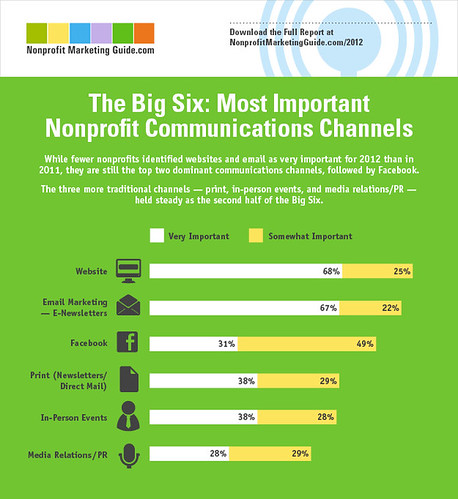
6 Most Important Non-Profit Communication Channels

Half of the top-six marketing and donor communications activities non-profits will use in 2012 require the use of broadband access. The other three partially use broadband access. Non-profit Marketing in 2012

Saturday, January 7, 2012

Cutting the Video Cord Sounds "Good" to Some, But Isn't a Perfect Substitute


Around 80 percent of what most Americans watch on TV can be had for free, some would argue. Some of us would say that is a pretty big and overly-broad generalization. But keep in mind there is an 80-20 rule.

The 20 percent of programming people really cannot get "for free" includes what many would consider the "most valuable" programming.

Also, few people really seem to be willing to live with their video subscriptions, at the moment.

About nine percent of U.S. respondents to a Deloitte  survey say they have stopped buying video entertainment subscriptions from cable, telco or satellite providers, while another 11 percent report they are considering doing so.  Nine percent have cut the video cord

Cable providers lost about 1.77 million subscribers over the past year, similar to 1.76 million lost in 2010, according to Leichtman Research Group. But cable industry losses are virtually directly balanced by subscribers gained by telco and satellite providers.


The implication is fairly clear: video cord cutting remains largely a potential danger, not a current reality.

Telcos added 1.53 million video subscribers in 2011, compared to 1.61 million in 2010. Satellite providers added about 480,000 subscribers in 2011 and 930,000 in 2010. 2011 video market was stable, overall.

One complicating factor, Leichtman notes, is that growth traditionally has come from new housing starts. Since housing construction is down, the opportunity to grow the universe of subscribers is stilted. On the other hand, customer churn generally increases when people are moving. To the extent that people are not moving domiciles as much as they have in the past, that should contribute to lower churn.

What those figures do not shed light on is whether average revenue per accounts is stable, rising or dropping. One might argue that new features such as digital video recorder or HDTV are pushing average revenue up, while a desire to save money could be leading some customers to drop premium channels such as HBO.

Evidence seems to have been mixed in the third quarter of 2011. Comcast's basic video ARPU remained flat $72.7 during the period while broadband ARPU increased 2.2 per cent to $42.6. Telephony ARPU declined 2.4 percent from the previous quarter's $31.9.

DirecTV ARPU increased almost two percent from the previous quarter, reaching $92.20. Third quarter 2011 ARPU

Time Warner Cable had declines across the board in ARPU, with the sole exception of broadband.

DISH saw its ARPU decline two percent from the previous quarter, marking the company's first consecutive quarter ARPU decline since the recession in 2009.

AT&T U-verse and FiOS TV ARPUs continued to grow, however. FiOS monthly ARPU increased two percent from the previous quarter and U-verse's monthly ARPU was up 2.5 percent.

The larger point is that though service provider market share is changing, and average revenue per account is mixed, with no clear pattern, there is, at least according to Leichtman Research, no evidence that video cord cutting is happening on anything more than an insignificant level.  
But it always has been clear that some content is "more valuable" to consumers than others. Cable TV executives used to say that "nobody watches more than seven channels; the problem is that each person watches a different seven."
That is why distributors continue to argue that, for all its problems, a "bundled" approach still makes the most financial sense for consumers and suppliers. Cord cutting still minor

Friday, January 6, 2012

Verizon Fixed-Line Divestiture?

It might never happen, and wouldn't happen soon, but Goldman Sachs Group analysts think Verizon Communications might actually split in two, divesting all of its fixed-line assets to become a pure-play mobile operator.  

That would clear the way for some eventual combination of the wireless company with another partner. In recent years, Verizon's growth has been lead by its Verizon Wireless unit.

In many ways, such a decision would be driven by the simple economics of the landline business. By about 2016, it is conceivable that only half of U.S. households will be buying fixed line voice services. If you assume there are two dominant suppliers in most markets, and that market share is split evenly (it will probably be more like 60-40 or 70-30), then no single contender will have more than about 25 percent of homes passed as customers.

If you know anything about the economic of capital-intensive networks, you will sense the problem. A supplier builds a network reaching every location, then is able to generate revenue from only a quarter of the locations. That means 75 percent of the investment is simply stranded, unable to produce revenue.

That also means the 25 percent of users have to pay for all of the capital investment. And where the per-customer investment is that high, retail prices would have to be three to four times higher than if nearly everybody bought the product.

There are other products, though, including video entertainment, broadband access and other smaller revenue contributors that could include advertising and other services. That is a primary reason revenue will not fall as much as penetration would indicate. 

It also would be reasonable to point out that few companies have Verizon's assets or problems. AT&T, for example, has vastly more scale in terms wired network customer base, and in a scale business, that makes a difference. 

Also, Verizon's smaller footprint means it has a larger "out of region" opportunity than does AT&T, for example, in terms of "wired network services." In wireless services, AT&T and Verizon compete virtually head to head in all  U.S. markets. 

But Verizon has been signaling for some time that it might have new plans based on its new fourth generation Long Term Evolution mobile network. With some limitations, Verizon Wireless would be able to provide broadband access, voice and messaging to most consumers across the United States using only the 4G mobile network. Verizon Fixed-Line Divestiture?

Verizon already has business agreements with DirecTV to provide video entertainment, meaning Verizon Wireless could provide a quadruple play using only its wireless assets and business deals with other suppliers. Resale deals with leading cable operators

The challenging news here is the growing disconnect of sorts between the costs of a fiber to home network and the revenues that can be generated from deploying such a network, under competitive conditions.

That suggests we might once again hear calls for rather-substantial changes in regulatory framework that would somehow better "rationalize" competitor access to fixed networks. At some point, structural separation, robust mandatory resale and cable operator inclusion in such a framework will be on the agenda.

As important as facilities-based competition has been, there is a growing disconnect between investment cost and revenue opportunity for landline fiber networks, at a time when revenue growth is moving to a "mobile first" pattern.

Any future Verizon "divestiture" would be the first indication that matters are reaching a potential tipping point. Certainly there are continuing reasons to ponder the economics of the fixed network business.

By 2016, U.S. household  voice penetration will be about 52 percent, according to Pyramid Research. And that will be the highest penetration rate in the world.

In the Asia Pacific region fixed-line voice will be used by 24 percent of households.

In Western Europe, 21 percent of households will have a voice line. Revenue, on the other hand, will grow, in aggregate, on the strength of broadband access services.

“According to our estimates, global narrowband line penetration of households decreased from 45 percent in 2007 to 37 percent in 2011, and it will decline to 27 percent by 2016,” says Sylwia Boguszewska, Pyramid Research senior analyst.

Fixed services in every region are losing ground fast to mobile services, with mobile data capturing an increasingly substantial share of total telecom revenue, she says.

In 2007, U.S. voice penetration was about 97 percent of households, and seems to have peaked about 2000.

So penetration will have fallen in about a decade and a half. Those sorts of changes seem to be more common these days, as the volatility of the business reaches new heights.

Nor would that be the first such change, at about that time frame. In 1997 long distance revenue represented about half of fixed line network revenue in the U.S. fixed-line market.

By 2007 long distance had fallen by half. At the same time, and over the same time period, mobile services had grown to represent half of industry revenue.

And it is revenue, more than service penetration or usage, that seems to be important. Pyramid Research also suggests that fixed line revenue will be stable, or even grow slightly, as penetration falls.

That will be due in part to new revenue sources such as video entertainment, one might argue, and higher spending for broadband access and related products.


At the same time, it has over the last decade also been clear that the enterprise customer segment has become more crucial, not only for Verizon Communications but for most other tier-one service providers. Verizon Fixed-Line Divestiture?

Some skeptics will note that such ideas, which spawn transactions, always get speculated about because there are firms that make a good living advising clients about such transactions.

While true, it also is true that the fundamental industry drivers change quite dramatically over time. In 1999, tehre still were "Personal Communications Service" and "Cellular" segments of the wireless business. These days, the term is never used, because there no longer is any distinction between what used to be thought of as "PCS," and "cellular" service. U.S. telecom in 1999

In 1999, there still was an independent "long distance" industry. There was a company named "WorldCom."

A company known as "America Online" had a $125 billion market capitalization. Other Internet service provider firms, including "@Home," had market valuations of $100 billion.

In 1999, reasonable people would have argued that newer contestants in the "local" telecom business, namely competitive local exchange carriers, had a bright and substantial future.

Cable TV companies did not provide voice services at a significant level. But AT&T owned TCI, the biggest U.S. cable company. As I recall, US West owned Media One, another leading U.S. cable company.

Against that backdrop, it might have appeared that the former "Baby Bells" would have a hard time competing. Just a bit over a decade later, many of the "upstarts" have disappeared. The differences between leading cable TV companies and leading telcos are mostly of a regulatory sort, rather than any fundamental differences in product line.

The point is that if, barely more than a decade ago, the largest U.S. long distance company could own the largest cable TV company, if the wireless business was still thought of as having distinct personal communications service and cellular segments, if whole segments of the business can virtually disappear (long distance), then all sorts of other changes are conceivable.

Verizon deciding it has to get bigger on a global basis, and get out of the landline business, is not unthinkable.


Top 1% of Mobile Users Use Half of World’s Wireless Bandwidth - NYTimes.com

Just one percent of mobile consumers use half of all bandwidth, reports Arieso, which also notes that the top 10 percent of users consume 90 percent of wireless bandwidth, according to a study of the habits of 1.1 million customers of a European mobile operator during a 24-hour period in November 2011. Extreme bandwidth users

The gap between extreme users and the rest of the population also is widening over time, according to Arieso. In 2009, the top three percent of heavy users generated 40 percent of network demand. Now, Arieso said, just three percent of users represent 70 percent of the traffic. Top 1% of Mobile Users Use Half of World’s Wireless Bandwidth

Video is a likely reason for the explosion of usage by the heaviest users.


How Might "Mobile First" Apply?

Google has talked for nearly two years about a development strategy it calls "mobile first." The notion has much to do with cloud-based applications and much to do with the growing importance of mobile devices as a key platform for application-based businesses.

“It's clear that we're experiencing a fundamental shift in how we access information,” said Google VP Vic Gundotra, in 2010. “Clearly, the mobile phone is the iconic device of the moment, and we're encouraging a new rule: Mobile First.” Mobile is the key

“When we announce new services for desktop computers, such as real-time search, we will debut an equally powerful mobile version,” said Gundotra.

That rule might not make as much sense for most other businesses whose products are physical rather than virtual. That isn’t to say that the mobile context is irrelevant.

Most firms conduct some marketing activities, and the mobile venue increasingly is important, even if indirectly much of the time (perhaps 40 percent of all Facebook interactions now occur on mobiles rather than PCs, for example).

For any firms using Facebook, that means being aware that a growing percentage of activity occurs when people are out and about, on devices with small screens, and in a context that is distinct from a desktop PC environment.

In a growing number of cases, that means being alert to the mobile commerce, comparison shopping and other activities that pertain directly to people engaged in the act of shopping.

The notion of “mobile first,” not too strictly interpreted, might make sense for any firm contemplating the ways it markets and communicates with prospects or customers. For retailers, the imperatives might be more stark. People already are using their mobiles to compare prices when inside stores.

The point is that, for many firms, it is a reasonable question to ask how  "mobile first" might apply in product development, sales, marketing, customer service or fulfillment.

Right Now, "Speed" is the Killer App for LTE

Many observers would argue there will be no "killer app" for Long Term Evolution fourth generation mobile networks, though virtually everybody expects new apps to develop, at some point. No killer app?

It might be more accurate to say that, at first, the 4G killer app will be "speed and lower latency," compared to 3G. In that case, "speed" is not a "unique new app," but is the value driver.

In fact, speed is a "default" killer app, by design, in some markets where new networks launch with an exclusive focus on PC modems. In that case, the current killer app is mobile broadband access for notebooks and PCs, but "faster."

The largest LTE device segment will be PC modems through 2014, as operators initially focus on mobile broadband access for PCs, argues Pyramid Research.

But after 2014, the PC segment will be replaced by smart phone connections. In that case, one might simply argue that Internet access is the killer app, as it has been for 3G networks. But it also might be argued that entertainment video or various cloud computing services could emerge as key apps that require broadband access.

In 2016, Pyramid Research forecasts there will be 592 million  LTE subscriptions in service, equivalent to 7.3 percent of all cellular subscriptions at that time.

Orange's LTE/EPC Program Director Rémi Thomas says "LTE is not driven by a killer application, but it will essentially be driven by capacity needs," said Thomas. No Killer App for LTE


In other words, the killer value is simply "faster access" to the Internet. Perhaps that is all consumers will require, or that developers will build upon. But some think new apps specific to 4G capabilities could emerge, rather than being "planned for." Killer app is a myth


Other candidates for eventual killer apps might be those which are cloud-based and therefore offer better or new functionality; video services; gaming, telemetry or other "new" apps we haven't discovered yet. Some of us would say the unique "killer app" for 4G is the personal Wi-Fi hotspot. It's an app that is used on 3G networks, but arguably works much better on 4G networks. 


It would be perfectly fine, in one sense, for "faster" to be the unique 4G network value, at least initially. But there are good reasons why service providers would love to discover some novel app that becomes really popular. As was the case with text messaging, large new revenue streams would then be possible. LTE Devices and Applications

Execs Differ on "Simplicity or Value" in Mobile Pricing

Usage-based billing is not the ideal solution to manage usage of mobile broadband capacity, nor is it the solution consumers prefer, one study of European mobile consumers suggests. A separate study suggests that, despite those findings, mobile service provider executives would rather bill by usage.

In other words, although many suppliers believe service providers would be better off using more-complex pricing schemes, service provider executives tend to prefer simple usage-based mechanisms. To be sure, that reflects the industry’s heritage.

But many mobile executives seem to prefer simplicity, rather than “value-based” mechanisms. In recent days, there has been more thinking about how to manage mobile networks destined to face high congestion problems because of growing volumes of video consumption, for example.

So some think monetary incentives can be used to induce bandwidth-conserving behavior. For example,
the survey by Tekelec suggests that about 40 percent of respondents would prefer to have a plan that has restrictions on video usage, so long as the plan was about $5 a month cheaper than a plan without such restrictions, says Randy Fuller, director of strategic marketing at Tekelec. About 60 percent would buy such a plan for a $10 a month discount.

About half of respondents would consider buying a package costing about $5 a month more than a standard package, if it offered live video streaming, but did not count against a usage cap. Perhaps 43 percent would buy a video on demand service, if it did not count against a cap and cost about $5 a month more than a standard plan.

"It is amazing how many people ignore what consumers prefer, in terms of how they buy video," said Fuller. "Our hypothesis was that while video is between 30 to 50 percent of bandwidth consumption, it is less important than that, to consumers."

That’s one form of pricing according to value. "A lot of tiered pricing models head in one of two directions, buy a bucket, or allow consumers to make trade offs," said Fuller. "If you want to use more services that cost more to deliver, you pay for that, and that, essentially, is what we tried to think through."

At least for the European subscribers polled, video was fourth behind Web browsing, email and navigation services in perceived value. Instant messaging, music and social networking ranked higher than voice, in terms of perceived value.

In fact, when asked to rank the value of various applications as standalone applications, Web browsing was valued at $6.94 a month. Voice was valued at $2.91 a month.

“Pricing based on value now seems to make more sense to end users,” said Fuller. “Byte-based pricing is not optimal.” But the larger conclusion one might draw is that “there is no one rate plan that is best for different consumers,” said Fuller.

Mobile Internet offers should be segmented to match end user demand, said Fuller. In fact, that sort of thing is common in Austria, Germany, France and Poland, for example. Orange  in several countries has a “happy hour” plan where you get an hour of unlimited usage, no matter what plan you are on, said Fuller.

The point is that “people should have choices,” he said. The big difference between fixed and mobile is that mobile bits are more expensive to deliver, Fuller added. But the fundamental issue is that mobile networks will continue to be more expensive than fixed networks.

Mobile Internet pricing perhaps has to move to tiered pricing, but some forms are better than others, Fuller said. Plans designed for messaging could be different than plans supporting lots of video consumption, for example.

The simplicity of an unlimited plan will appeal to some people, but not to all. Others might be quite fine with plans that feature buckets of usage, so long as they have an easy way to track their usage and control it.
Segmentation will work, Fuller argues, and also will allow mobile service providers to match usage and the cost of meeting that demand. Many consumers in the study preferred unlimited Web browsing and limited video consumption, for example.

Still, mobile executives seem to prefer simplicity.

Leap Plans "Bursty" Pricing

Leap Wireless has announced it plans to launch session-based data services over its existing tiered data pricing structure, a move that will allow "Cricket" customers to purchase faster data speeds for short periods of time. The company said it will launch the service in the first half of 2012.


The ability to temporarily pay for expedited or faster access is one example of on-demand pricing, congestion pricing or value-based pricing. But Leap is relatively unusual among mobile service providers, most of whom do not yet see the need or benefits of moving to value-based pricing mechanisms. 

There always is a tension between operational simplicity and sophistication in retail customer packaging and network management. Simple approaches often are cheaper, but at the cost of forfeiting creation of more-nuanced subscriber plans.


Likewise, policy management tools that can prioritize and shape bandwidth consumption can help service providers alleviate congestion and provide higher end user experience, where regulators allow such tools to be used. But there appear to be lots of trade offs.


Most executives would agree that flat-rate billing for unlimited use is a difficult and likely unsustainable retail packaging model for broadband access, especially in the mobile services realm. 


But what should be the replacement? That seems to be a tougher question. There always is a tension between simplicity and value where it comes to pricing, billing and retail packaging. 


As a corollary, executives must weigh “pricing by value,” or “pricing by application,” which means more complexity for consumers, or some simpler “pricing by consumption” approach.


Leap CEO and President Doug Hutcheson appears to believe that "pricing by value" will make sense for consumers, and also can be made simple enough that consumers will understand the value proposition. 


"The next big step for us that we believe is important is to add what's called session-based capability on top of that [tiered pricing]," Hutcheson said. "And that will give us a lot more rate plan flexibility."


Cricket might have more incentive than many other service providers to do so, though, as Cricket competes in the value segment of the mobile market. That suggests users frequently might prefer lower monthly charges, but occasionally have the need to consume more data, or occasionally ramp up speed. 


"Should you have a very low amount of data but want to buy more within a month, you'll have the ability to buy sessions or time periods where you can accelerate that speed, and it will be done very simply and very straightforward over the device or on a simple transaction with us," Hutcheson says. Leap to launch session-based pricing

A related idea is that applications have distinct and different value, and that pricing could reflect end user value. Few mobile service providers have been willing to attempt that sort of pricing, either. 

Mobile Coupon Redemption Rates to Outperform Paper Coupons 800%

Global redemption rates of mobile coupons will average at over eight percent by 2016, Juniper Research forecasts. "So what?" you might say, but consider that paper coupon redemption rates are about one percent.

North American and Western European markets are now beginning to follow the same growth path as the Far East and China and by 2016 there will be over 600 million regular mobile coupon users worldwide.

Though some would dismiss the whole mobile coupon business as a bit of a fad, with difficult economics for providers and few barriers to entry, others might say such "daily deals and offers" will be quite strategic for mobile payments platforms.

The reason is simple: mobile coupons address the question of "value" for retailers and end users to adopt mobile payments systems. Since few now believe new mobile payments systems will save retailers much money in transaction fees, and since in most cases check out using a "wave" approach does not necessarily save a customer much time, proponents have the challenge of showing where the value lies.

Juniper researchers argue that mobile coupons are particularly strategic for bricks and mortar retailers in their quest to regain ground lost to online retailers during the Internet revolution.

A mobile coupon bridges the divide between online and physical retailing and can be individually targeted to drive customers into stores. Mobile Coupon Redemption Rates

Apple’s Siri Feature Doubles IPhone Data Usage

Apple's voice recognition software, Siri, seems to encourage people to make more intensive use of data on their iPhones. In fact, some iPhone 4S users studies by Arieso seem to have doubled their data consumption as iPhone 4 users and three times as much data as iPhone 3G users, Arieso says.


And though one might dispute what it actually means, Arieso also finds that one percent of all mobile data users now consume 50 percent of all downstream capacity. In other words, extremely-heavy users now have become even heavier users of mobile data capacity.


Those changes in behavior illustrate the reasons there will never be “enough bandwidth.” As developers and users find they have more processing power, memory and bandwidth, new input and output methods and types of devices, developers create new apps and features that use those capabilities, and as Arieso has found, people respond.


Decades ago, serious cable TV engineers would scratch their heads when, about every five years, it was possible to double bandwidth. “What will anybody want to do with all that bandwidth?” they used to ask themselves. Telecom engineers probably can recall having similar thoughts. But it happens. Bloomberg notes that Apple’s Siri feature alone doubles data usage.


The point is that users seem to consume more mobile network bandwidth every year for a variety of reasons, ranging from heavier consumption of video to heavier use of their devices for other reasons, and sometimes because applications require more bandwidth.


Consider the shift from web browser operations to use of mobile apps. As it turns out, using a mobile app is itself more bandwidth intensive than the same operation using a Web browser. So virtually every trend in user behavior and application behavior is pushing towards consumption of more bandwidth.


Arieso's study of mobile bandwidth use also found that Google Nexus One users make twice as many data calls as iPhone 3G users. Arieso network study 


The Arieso analysis compares the data consumption of users of the latest smartphones against the iPhone3G as a “normalised benchmark”. The study found that different users and different devices exhibit very different demands on the network.


The most significant change in consumer behavior between 2010 and 2011 is the finding that iPhone 4S users download 2.76 times as much data as users of the iPhone 3G.


And while an Android-powered device maintains last year’s position at the top of the table for uplink data volumes, with HTC Desire S users typically uploading 3.23 times as much data as iPhone 3G users, the iPhone 4S falls just behind in this category with a typical 3.20 times as much data uploaded, Arieso says.


Using the iPhone 3G as the benchmark, though, many other devices place differential loads on mobile networks. In terms of data calls per subscriber, for example, three devices over-index compared to the iPhone 3G.


Since mobile networks are limited by spectrum allocations in ways that fixed networks are not, mobile networks are going to require more intensive management than fixed networks, irrespective of any “public policy” concerns about potential anti-competitive behavior on the part of mobile service providers. 


Some would say the most pernicious idea is that “all packets should be treated alike,” in terms of prioritization. But all bits are not equally valuable, nor are all applications equally tolerant of congestion and delay. Voice and video are good examples of delay-sensitive apps, but any user also will attest that when buying an airline ticket online, delay and latency are important issues.


Since mobile networks feature more latency than fixed networks network management is more crucial, to maintain end user experience. Bandwidth consumption is one genuine issue. But latency is the other important issue.


Thursday, January 5, 2012

Visa CEO Says Mobile Service Providers Will Not Become Banks

Mobile service providers will not become full-fledged banks, Visa Chief Executive Joseph Saunders predicts, even though some are doing so, and others are looking at it.

At first blush, the notion that mobile service providers would think about becoming banks is not logical. But the burgeoning interest in mobile-facilitated commerce, with serious mobile wallet and mobile payment businesses, is the reason the idea is not far fetched.

If one assumes that large mobile service providers have to find sizable new businesses to enter as their voice, text messaging and broadband revenue streams mature, there is one over-riding concern.

Firms that earn scores of billions of dollars every year have a scale problem when considering new businesses to enter. If a firm seriously faces the challenge of replacing half its current revenue over a 10-year period, then a firm now earning $20 billion a year has to find replacement revenues of $10 billion a year.

Small business opportunities will not do the job. And most who have looked at the matter generally conclude that only a few opportunities actually have $1 billion a year potential for each and every firm that decides to participate. Among them are mobile banking, machine-to-machine services, mobile advertising and specialized services for business customers.

M2M services, including all sorts of telemetry services, could be a big and totally new business, with key utility and medical customers, for example. Specialized services for business customers, taking the form of embedding communications capabilities into key business applications, likewise is a logical and sizable opportunity.

Advertising already is a huge business, as is retail banking. Some will argue that some form of participation in payment transaction fees is interesting. Others will argue that business simply is not big enough. And that is why some believe mobile service providers, no matter what they now say, will have to consider banking, not just mobile payments.

In Africa, that already is happening. Mobile operators as banks

Keep in mind that Visa is a payments clearing network, not a "bank." Mobile service providers, if banks, would be customers for Visa, not competitors. That is not true of other participants in the mobile payments business.

Saunders also says Apple is a customer that could someday become a competitor, while PayPal already is a competitor, albeit one that also uses the Visa network to clear about half its transactions.

Sprint Puts Investment in LightSquared on Hold

Sprint Nextel Corp. says it has put its investment in a partnership with LightSquared Inc. on hold, since LightSquared has not yet gotten approval from the Federal Communications Commission to redeploy its original satellite spectrum as the foundation for a terretrial Long Term Evolution mobile network.

“The companies have agreed to realigning our deployment timeline to coincide with potential FCC actions,” Scott Sloat, a spokesman for Overland Park, Kansas-based Sprint, said. Until approval is received, “both companies believe it is prudent to pull back on expenses,” he said. Sprint Puts Investment in LightSquared on Hold

LightSquared still has not managed to convince the GPS community or military users that its proposed use of former satellite frequencies can avoid interference with GPS receivers. Sprint deal hinges on spectrum approval

Tests continue to show interference issues, though. LightSquared is not the only entity proposing to re-purpose satellite spectrum to build new broadband Long Term Evolution fourth generation mobile networks. Dish Network also is asking the FCC for permission to build a network simialr to LightSquared.

The obvious potential here is the possibility that as many as three brand new LTE networks could be built in the U.S. market, in addition to the networks Sprint, Verizon Wireless and AT&T also are building. Some will argue that is too many 4G networks, but the business models and market segments might be different.

Dish Network will have a primary interest in providing mobile broadband services that augment its moves into new forms of TV distribution. Clearwire's LTE network, as will LightSquared's proposed network, are designed as wholesale platforms for other retail providers to use. 

Quick Fixes and Fixations

“One pill makes you larger, and one pill makes you small,” sang Jefferson Airplane lead singer Grace Slick . Some might say that was just a...