Friday, June 8, 2012

Facebook App Center Isn't a Store, It's a Discovery or Search Tool

Facebook's new "App Center" might sound like an app store, but it is not. Rather, the App Center is a way to encourage people to use Facebook-affiliated mobile apps, by helping them find useful and entertaining apps. 


It's partly a discovery or search tool, partly an incentive for developers to work with Facebook and hence part of Facebook's effort to maintain its platform relevance.

It also is one example of how device and application providers now are orienting their businesses around a “mobile first” strategy.

Facebook says there are more than 4,500 separate applications that integrate with Facebook.  

The company also took the opportunity to highlight the role it has played in driving mobile application sales. It has released statistics indicating that Facebook sent users to the Apple App Store 83 million times in May alone, and sent iOS users into installed applications 134 million times during the same month.

The App Center is rolling out immediately in the United States and will be made available to users in other countries over the next few weeks. It is intended to replace the Facebook website’s existing Apps and Games interface.

Will Google, Apple, PayPal Ever Want to be Banks?

Will Google, Apple, PayPal and others ever decide there is a reason to become "banks?" The question might seem far fetched, except that once application and device firms decide payments and loyalty are businesses with direct implications for their existing businesses, it isn't so clear what other functions associated with "banks" might then seem reasonable as well. 


Rogers Communications in Canada already has applied to become a formal bank. To be sure, that appears to be primarily for the purpose of providing credit, payment and charge card services. In one sense, the move is similar to any other large retail brand creating a branded charge card.


"We have no plans to become a full-service deposit-taking financial institution," Rogers Public Affairs Manager Carly Suppa said. "The license, if granted, would give us the flexibility to pursue a niche credit card opportunity to our customers should this make sense at a future date."

In other words, Rogers doesn't want to become a full-fledged retail bank. But becoming a credit card issuer does set Rogers up for a smooth transition to becoming a mobile payments provider in the future.

Credit cards present a distinct opportunity for Rogers to expand its reach, as the media, cable and wireless giant also owns the Toronto Blue Jays and has direct relationships with millions of customers, including many who pay bills using credit or direct-deposit accounts. So there is an incremental opportunity to capture some of the current transaction revenue, at the very least.

Beyond that, analysts say the company can build a broader card business by leveraging those relationships to market its brand of cards, especially by reaching out to customers who have good credit standing in its database. That would create a new revenue stream for the broader number of retail transactions for which its customers use credit cards.


"People have already slowed their use of cash and checks in favor of credit and debit cards. Within five years, half of today’s smart phone users will be using their phones and mobile wallets as their preferred method for payments," argues Peter Olynick, Carlisle & Gallagher's Card & Payments Practice leader.


Keep in mind, he isn't saying Google, Apple, PayPal and many others immediately threaten the core banking function, just the parts of their business associated with payment operations. 


A survey of 605 U.S. consumers found high receptivity, at least in principle, to use of mobile wallets for loyalty purposes. The same survey also found consumers conceptually also willing to use entities such as PayPal for core banking functions as well. 


Once can be skeptical, without being dismissive, about the degree to which such sentiments might eventually become actual behavior. One might remain skeptical that the core banking function actually is attractive for application and device suppliers, or mobile service providers. 


But in many African markets, mobile service providers have already in droves become authorized payment providers. You might not consider that banking so much as money transfer. But bill paying has become a more-important banking feature, at the very least, and money transfer is bleeding over broadly into bill paying, in Africa. 


What seems unlikely or improbable today might not always seem outlandish. But a reasonable person might still bet against the likes of Google and Apple becoming banks in the common sense of the term, even if payments will be contested terrain. 

Thursday, June 7, 2012

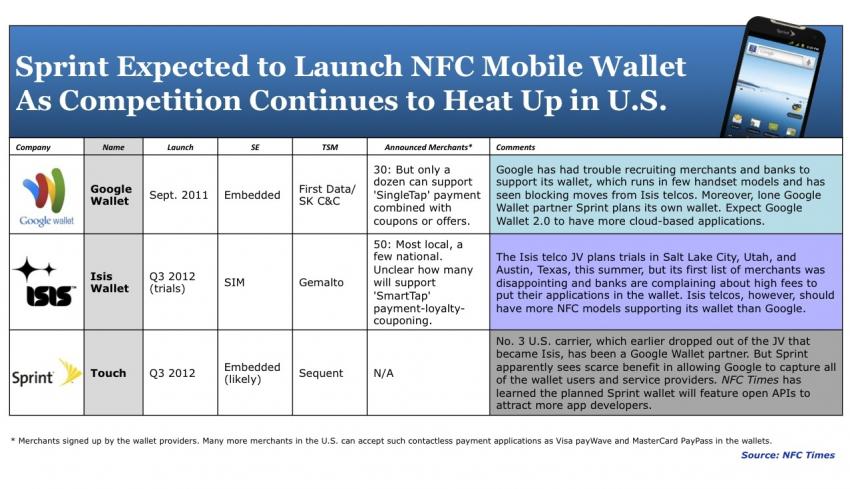
Sprint Plans to Launch own NFC Mobile Wallet?

Sprint plans to launch its own NFC mobile wallet, likely to be called "Touch," as early as this summer.Sprint is planning to launch its own NFC mobile wallet as early as this summer, NFC Times reports. Sprint earlier had been the only U.S mobile service provider to support Google Wallet. The obvious question is whether this means Sprint will drop support for Google Wallet.

Sprint apparently sees advantages in rolling out its own wallet, which according to the sources is named “Touch.” With a wallet, Sprint could build relationships with banks and other service providers.

“The limitation isn’t the wallet; the limitation is the secure element,” said a source at Sprint, who added the Sprint wallet offers a “legitimate alternative to Isis.” That rather suggests Sprint has to make a choice between its own offering and Google Wallet, as a wallet apparently needs control of the secure element used to authenticate users and credentials.

Some of you will want to shake your heads at the growing number of wallet platforms, not to mention payment systems. Market fragmentation always is quite high at the start of any new business expected to be sizable.

The emergence of more competitors "validates" the market, executives like to say. That might be true, but fragmentation also will slow adoption, to the extent that users have to lock into devices, service providers or exclusive apps.

What Happens to Google Revenue as Apple Dumps Google Maps?

Most observers would probably guess that if Apple represents about 40 percent of Google mobile search ad revenue, and Apple stops offering Google Maps in favor of its own map application, that Google revenue will suffer.

But Piper Jaffray's Gene Munster predicts that Apple's decision to abandon Google Maps shouldn't have any "material impact" on the revenue Google gets from iOS.


Munster estimates that Google will generate about $4.5 billion in gross mobile revenue in 2012, the lion's share ($4 billion) from search ads and the rest ($500 million) from display. 


He believes that iOS is likely to remain the biggest or close to the biggest source of that revenue, generating roughly $1.6 billion. Assuming Google keeps half (after subtracting acquisition costs), iOS would generate about two percent of Google's total revenue in 2012.

You might wonder how that could possibly be. Munster assumes Google Maps still will be available in the Apple app store, and that iOS device users will be able to figure out how to keep using it. Munster says Apple represents about two percent of Google's net revenue overall.

Google might hope Munster is right, but is acting as though the loss could be more significant. Google's recent addition of 3D features to Google Maps probably indicates Google's belief that Apple will try and use the 3D feature to differentiate from Google Maps.

Mobile ads associated with maps or locations are estimated to account for about 25 percent of the roughly $2.5 billion spent on mobile ads in 2012, according to Opus Research, up from 10 percent in 2010. That is reason enough for a battle over map applications.

The reason maps get so much advertising is that geo-location is a fairly serious indicator of purchase intent when a retailer is searched for, within a map app. That obviously has implications if you believe location-based advertising and offers are a big business opportunity.

Global Mobile Advertising Market: $5.3 Billion in 2011

Mobile advertising reached $5.3 billion (€3.8 billion) in 2011. You might call that a good start, but still quite a smallish business, by tier one mobile service provider standards. The reason is simply that an entity booking scores of billions worth of revenue each year would need a market opportunity far bigger than that to become "really interesting."

But mobile advertising is a new and growing business, so most observers think the market eventually will grow to a size that is truly significant for mobile service providers.

Of current revenue, Europe represents 25.9 percent; North America 31.4 percent; Latin America 3.5 percent; Asia-Pacific 35.9 percent; Middle East and Africa 3.2 percent, according to the Interactive Advertising Bureau.

Obviously, mobile service providers in Europe, North America and parts of Asia are likely to reach a "critical mass" of revenue sooner than other regions.


2011: Mobile ad spend in $million
 DisplaySearchMessagingTotal
Europe3679001141,380
North America5728112951,677
Latin America317483188
Asia-Pacific4911,384411,916
Middle East & Africa441244172
Global1,5043,2925365,333

What Will Apple Do After Every Sizable Mobile Service Provider Sells the iPhone?

Apple will face a common supplier issue, namely product saturation, at some point, after every significant (in terms of market share) mobile service provider, in each market, sells the iPhone. Except for T-Mobile, all of the largest four U.S. carriers already sell the iPhone, and regional or prepaid carriers also are starting to get the device.

So Apple will do what any supplier normally does, in such situations. Refresh products so that existing buyers want to buy again. Apple also will continue wooing customers who now buy other devices to buy its own.

As it did with the iPod family of products, Apple will flesh out devices in a range of price segments, to capture more of the addressable market. Apple also will try to get existing and potential buyers to spend for other products Apple makes, such as tablets.

Apple Thinks Mobile Service Providers Will Not Cut iPhone Subsidies

Mobile service providers globally are unhappy about the impact to earnings and cash flow phone subsidies are causing. Most undoubtedly would prefer not to subsidize devices at all. But it is a complicated issue. How many consumers would be so happy to buy an iPhone if it cost $500 to $600?
[SUBSIDY]
We might soon find out as prepaid service providers start to offer Apple iPhones in conjunction with prepaid service, with no device subsidies.

Apple's CFO Peter Oppenheimer, and head of Internet services, Eddy Cue, don't believe carriers actually will cut subsidies for iPhones. They argue that iPhones are important reasons why customer churn is lower, among iPhone users, than among users of other devices.

And in a saturated market where gaining a customer essentially means taking that customer away from another mobile service provider, anything that measurably reduces churn is a very-helpful tool indeed.

Apple believes that the iPhone, which has the industry's lowest churn rate of under two percent is in part a result of customer affinity for the device, and also drives higher adoption of family service plans, which further reduces churn.

Though service providers might not agree, the typical iPhone $400 subsidy also is the foundation for service provider data revenues of about $1920 over a two-year period when signing up a customer to a typical $80 monthly plan.

Naturally, Apple argues that any carrier than abandoned subsidies would lose lots of customers to other carriers who do offer subsidies.

But carriers are unlikely to keep experimenting with ways to avoid the subsidies. Vodafone allows users to pay in installments for phone purchases, with zero interest charges, over a period of a year or two.

In fact, service providers now are effectively trying to dissuade consumers from upgrading phones, by adding upgrade fees of perhaps $30 to $35 when existing customers want to buy a new phone. That might seem counter-intuitive, but an existing customer who can be persuaded to continue service with a device that already has been amortized does improve a service provider's lifetime profit margin and revenue from that account.

Citrix Systems Buys Bytemobile to Go "Mobile First"

In yet another example of how cloud computing and mobility are essential parts of the new computing architecture now emerging, Citrix, a leading provider of cloud-based collaboration and virtualization capabilities, is acquiring Bytemobile, a leading provider of data and video optimization solutions for mobile network operators.

This acquisition gives Citrix a key strategic foothold in the core infrastructure of more than 130 mobile operators in 60 countries around the world, Citrix says.

By joining forces, Citrix and Bytemobile will be able to offer mobile service providers, globally, with  combined solutions that deliver a high quality user experience to mobile subscribers, while helping operators manage the growth of mobile network traffic.

The acquisition builds on a strategic partnership announced earlier this year that combined the Bytemobile Smart Capacity technology with the Citrix NetScaler line of cloud networking solutions.

It isn't yet clear what name eventually will be adopted for the next generation of computing, but beyond the "PC" or "Internet" area lies an architecture based on cloud mechanisms and mobile devices. In fact, many would argue that mobile computing and cloud computing are virtually inseparable.

Biggest Consumer Trend is Lower Discretionary Spending, but Video and Communications Products Could Still Gain Value

Among top trends affecting the consumer market, perhaps the most important, for providers of communications and entertainment products, is the reduction in discretionary spending, Gartner analysts say.

In mature markets, many consumers have cut back on discretionary spending in the wake of successive financial crises. But there is potential for service providers, globally.

Even as they generally practice restraint, consumers seem to put a higher value on media and communications products. In fact, that is congruent with traditional thinking within the U.S. cable industry.

The rationale is that, when other alternative forms of entertainment outside the home become relatively less desirable, video entertainment provided by a cable subscription offers quite a lot of value for a reasonable amount of money.

The Gartner survey would seem to confirm that sort of thinking about value and price.

Tough times create "buyer's markets," meaning that service providers might have an opportunity to protect or even gain market share and revenue, but must adjust their operations to accommodate changing consumer expectations.

This involves switching to more recession-friendly marketing messages, a greater range of "affordable" or "value" product options, more-strenuous customer engagement efforts, and improved customer experience, Gartner argues.

That sort of business climate might also provide benefits for application providers and services able to supply entertaining content that consumers deem to have a reasonable value to price relationship.

Executives Expect Economic Downturn in 2012, But Still Invest for Growth

They might be wrong, but global executives think there will be an economic downturn in 2012, and the sentiment is pervasive. Some 85 percent of CEOs surveyed said they believe their enterprises will be affected by an economic downturn in 2012, according to Gartner analysts.

The Gartner CEO and senior business executive survey of more than 220 CEOs in user organizations from more than 25 countries was conducted in November and December of 2011, from organizations  with annual revenue of $500 million or more.

Concerns are less severe in the Asia/Pacific and North America regions than in Europe and Africa, it is the dominant point of view within each of the three geographies. But there is an important qualification.

“Costs are now the second biggest priority area, the highest ranking in our surveys since 2009,” said Mark Raskino, vice president and Gartner fellow. The number one priority remains growth.

That might be why CEOs said they will increase IT investment in 2012, rather than cut it.

What Might TV Business Look Like "After" the Collapse?

It is hard to ignore the potential danger to the traditional TV distribution business posed by Internet distribution. It is much harder to predict when Internet distribution will begin to disrupt existing business models, as the Internet has disrupted virtually every other form of media. As significant as the hurdles are, one probably would not bet that change can be forestalled forever.


Henry Blodget  apparently believes a change is imminent. "We still consume some TV content, but we consume it when and where we want it, and we consume it deliberately. In other words, we don't settle down in front of the TV and watch "what's on," Blodget says. 


Blodget isn't alone Consumer behavior has changed. Nor is Blodget alone in thinking something like a "wholesale collapse" of behavior already has occurred. What hasn't yet followed is a decisive change in content distribution business.


Earlier in 2012, for example, Accenture presented results from a new survey of consumer behavior indicating that that traditional television viewership is experiencing a "wholesale collapse."

The number of consumers who watch broadcast or cable television in a typical week dropped to 48 percent in 2011 from 71 percent in 2009, for example. Viewing on mobile devices are a major contributor.


In a typical week, 33 percent of consumers now watch shows, movies or videos on their
PCs, and 10 percent are watching such programs on their smart phones, Accenture found.


Blodget believes those changes will break the existing TV business. The prediction would not be unusual. That he believes a break is imminent is the news. At risk: affiliate fees paid by distributors to networks, network advertising, and revenue earned by just about everybody involved in creating content.

Also, "networks" will change. Netflix and iTunes will become virtual networks, displacing entirely many smaller specialty networks.

The cost of traditional subscription TV also will have to drop, he insists.


Users will have to get more for less, or they'll stop paying for much at all. The eventual price points aren't so clear. But a drop of half to 80 percent is not inconceivable.

Ultimately, the distinction between "TV" and other forms of video content will disappear, he argues. As other content industries already have found, that will wring all sorts of overhead out of the TV business. People in the business won't like it, but consumers likely will.


  • Is There a Social Media Bubble?

    Whether you believe there is a social media valuation bubble, or not, here's a look at metrics. Run the other way if you hear people saying "it's different this time."
      Social Media Bubble

    Wednesday, June 6, 2012

    Faster Speeds, Clearer Plans Will Boost Mobile Broadband Usage, Ericsson Says

    Some 40 percent to 45 percent of respondents from key global markets said they would use internet on their mobile phones more if they had access to better speed, a study by Ericsson ConsumerLab has found. 


    The study also indicated that several issues, including 
    1. network quality and coverage
    2. data service pricing
    3. how easy it is to understand the data plan


    were key adoption factors, the study by Ericsson ConsumerLab, conducted in four countries and including more than 2,300 interviews in United States, United Kingdom, Indonesia and Brazil has found. 


    Consumer Price Sensitivity Has Increased Over Last 12 Months

    If the United States is in an economic recovery, it is an odd one, a study by Parago suggests. 


    Consumer spending has not rebounded and price sensitivity remains a key behavior, the study found. In fact, shoppers’ sensitivity to price has actually increased in the last 12 months. Some 66 percent of those surveyed said price was the primary factor in deciding what to purchase, up from 60 percent last year.


    This is due to the collaborating perception that their  purchasing power has decreased in the last 12 months, the study suggests.  "Consumers are digging further into the recessionist mentality and are fortified for a long winter of seeking out savings," the report says. 


    Not every product is being viewed that way, though, one might conclude from Apple iPad sales. 

    Can Regulation Actually Help Special Access Outcomes?

    The Federal Communications Commission recently has been looking at regulation of special access prices, as always with a view to promoting competition. But economists at the Phoenix Center for Advanced Legal & Economic Public Policy Studies say in a paper that if the Commission continues to adhere to a geographic market that is “location specific,” which is consistent also with the position of those calling for renewed regulation of the services, then price regulation reduces economic welfare in all instances.

    In other words, regulation cannot actually improve outcomes for the economy as a whole, even if it benefits buyers of wholesale special access from the underlying carriers selling that access. 


    The basic problem is that in local markets, both sellers and buyers effectively are monopolists. The effect of regulation in such settings is mostly to transfer profits from seller to buyer, but every $1 of transfer costs more than $1 to society, so price regulation of special access services in location-specific markets unambiguously reduces welfare.


    Obviously, the question of market definition will be critical in determining the path forward on regulating special access services; in fact, far more critical than the extent of competition, the Phoenix Center argues. 

    On the Use and Misuse of Principles, Theorems and Concepts

    When financial commentators compile lists of "potential black swans," they misunderstand the concept. As explained by Taleb Nasim ...