Thursday, June 14, 2012

How Significant is Retina Display?

It is easy to be seduced by Apple. Its Retina display does offer higher resolution than older displays. But how much difference will it really make? For most people, who won't be buying a Retina-equipped MacBook Pro, there will be no difference.


But even some users who do buy a MacBook Pro might be hard pressed to tell the difference. 


As one review says, "you can, however, only really tell the difference when you put the Retina MacBook Pro next to an identically sized MacBook Pro from the previous generation." If that is the case, its hard to see the value. 


"It’s hard to convey the difference between the two displays via normal photos, so we went for the extreme close-up by taking pictures of key icons and details with a magnifying glass."


If you need a magnifying glass, I'm not sure the value is obvious enough. 

In Europe, Fixed Network Voice-over-Broadband Grows 400%

In the fourth quarter of 2011, voice over broadband apps accounted for 52 percent of all fixed access traffic, compared to 47 percent in the fourth quarter of 2010, Analysys Mason says.


The growth has been triggered, in large part, by tariff reductions for mobile calls, according to  Analysys Mason. The consequence is that the volume of fixed network calls made to mobile devices has skyrocketed. 

So at least in Europe, voice usage on the fixed networks are, in many cases, lead by broadband voice, not use of the public switched telephone network. That appears not to be the case in other regions, though. 


Wednesday, June 13, 2012

U.S. Launches Antitrust Probe of Cable and Online Video Practices

It is perhaps not a surprise that the Department of Justice is "investigating" whether there are antitrust implications to cable TV operator retail packaging policies, as they might pertain to restraint of trade. Those questions are bound to emerge.

Lots of people might ask whether a cable operator can create an extension of a video subscription service that includes some of the content a customer already has paid for, and make it available on other screens, then exempt the Internet usage from the consumer's bandwidth cap. Some might say it is obvious a retailer can do so. Others would say it stifles rival streaming services.

Some might ask whether it should be lawful for a service provider to require a "sell through" purchase at all, where cable TV service has to be purchased before some or all of that content can be purchased for Internet delivery. Again, some would say this is done for all manner of products, all the time, and that it is not, in and of itself, restraint of trade.

But I find this one passage, in a Wall Street Journal story about the antitrust probe, one of the most-ironic passages I've ever read in the Wall Street Journal: "Having invested billions of dollars building their networks, some pay-TV companies have shown little inclination to get out of the business of packaging television channels and become mere conduits for other companies' data. Some major entertainment companies also have an interest in preserving the current model of television viewing because they want cable companies to take bundles of their channels, rather than just cherry-picking the most popular ones."

What I find so ironic about the story is the blinding "duh" element. Of course cable operators, having invested billions and decades building their businesses, do not want to voluntarily relinquish that business to become low-value "dumb pipes."

Of course content owners do not want to change a lucrative distribution model that creates advertising value and helps them launch new channels.

Let me be clear: as a consumer I would prefer to have a choice, either to keep buying video subscription services they way they are, or to buy only some channels, or to buy only some programs and have them delivered over the Internet.

But that doesn't mean I expect those entities to voluntarily, and without compensation, agree to have those businesses destroyed. The Wall Street Journal passage reads like something written by people who have no idea about how business operates, or worse, written by people who actually think it is unusual for a business or industry to want to hang onto a successful revenue model.

Tuesday, June 12, 2012

Market Capitalization Isn't Everything, But Neither is it Meaningless

Market capitalization of a public company is not the only way to measure influence in a market, or even current revenue (Instagram comes to mind). But such comparisons sometimes are instructive when trying to understand where a market could be headed.

As a means to illustrate what Amazon has done to the retail market, consider that Amazon, generally considered the world’s largest e-commerce company, has a market cap of $100 billion.

That is more than the market cap of Macy’s, J. C. Penny, Nordstrom, Gap, Abercrombie & Fitch, Costco, Dillard’s, Barnes & Noble and Sears, altogether.

Amazon's market capitalization does tell you how dominant it is in the online e-commerce business, though.

Sprint "Touch" Might Feature McDonald's, Barnes and Noble, Macy's, Target, Best Buy

Sprint Touch WalletMcDonald's, Barnes and Noble, Macy's, Target and Best Buy are said to be among retailers who will work with Sprint's rumored new mobile wallet, "Touch."

Things Change Fast in the Mobile Payments Space

This graphic shows Sprint as a partner with Google Wallet, and there are growing rumors that Sprint is launching its own "Touch Wallet." Best Buy, Macy's, Target and Barnes and Noble are rumored to be retailers who will support the Touch Wallet. Mobile payments remains a complicated ecosystem, indeed.

Fiber to the Home Still is About Difficult Investment Conditions

The European Union wants its leading fixed network service providers to connect 50 percent of region households to high-speed broadband by 2020, using fiber to the home technology.

By "high speed," the EU means internet speeds of 30 Mbps or above for European citizens, with half European households subscribing to connections of 100Mbps or higher.

As always, the issue is how to get from here to there. Europe also features high reliance on wholesale access to existing copper access infrastructure, at prices competitors naturally want to keep low, and if possible, decrease.

Service providers who will be borrowing the money to invest obviously think that is detrimental to the business case for new fiber.

France Telecom expects a payback payback time of 30 years to 40 years, far exceeding the three-year to five-year payback expected of application investments.
A business plan with a payback of five years or less has to assume retail penetration of at least 30 percent, and ih many cases also with triple-play service offerings. Any
payback analysis is of course highly dependent on the assumptions, ranging from capital cost per location passed, as well as service revenue per location, among other things


That indicates the risk France Telecom and other providers are facing. Those time frames are so long they typically only can be considered by very capital intensive utility firms that operate in monopoly style markets, as fixed network providers used to assume was the case.

These days, the fixed network business faces competition from other facilities-based suppliers, mobile and satellite networks.

"Share Everything" Plan Should You Buy?

As always is the case when mobile retail service plans are revamped in major ways, each account owner, and customers of other service providers, will have to do a bit of work to figure out whether the new plans are better than the existing plans any user is buying.

As always, the answer is that whether the new plans are better, roughly the same, or worse, for any given customer depends on how users on any account want to use mobile services.

For some Verizon customers who don’t use all their voice minutes and text allowance, the new plans, featuring unlimited domestic calling and texting, might not actually offer any new value, except theoretically. Such users might even pay slightly more.

Heavy voice or texting users might like the plans, and might save a bit of money.

Heavy data users might pay measurably more, but also can buy plans that match their usage.

If shared data plans have similar market impact to family voice and texting plans, the decision context will change. The big decisions will not be "choosing a new plan" for the same services and devices, but "adding new devices to the account" and "upgrading feature phones to smart phones." Those decisions, it is true, will increase recurring bills, but mainly because adding incremental new devices costs less than it would have in the past.

In all likelihood, that was part of Verizon Wireless thinking all along. To the extent possible, the new plans would aim to be revenue neutral for customers who do not plan to change the number of devices on any single account, or upgrade devices from feature phones to smart phones.

For accounts where the incremental costs now are more attractive, the decisions will more likely hinge on whether it now makes sense to spend a little more, to get more.


DirecTV Might Deploy Ad-Skipping Technology

DirecTV says it could deploy technology that would enable its millions of subscribers to automatically skip television advertising, Reuters reports. DirecTV probably wouldn't do anything until lawsuits pitting Dish Network against TV broadcasters, over the legality of such practices, are settled in court.

Fox, CBS and NBCUniversal separately have sued Dish Network over its new AutoHop service, which allows consumers to skip television ads. At the same time, Dish has filed its own lawsuit against all four broadcast networks seeking a declaration as to the legality of its new service.

Dish’s "Hopper" is a digital video recorder that allows Dish customers to automatically skip past all the commercials on some prime-time network TV shows. Understandably, the TV networks aren't too happy about that, even if Dish customers might like the feature, and they have sued Dish Network to stop the practice. 


TiVo also had earlier proposed allowing its customers to skip over all commercials, but TiVo disabled the feature after intense opposition from programming networks. 


In a sense, Dish is gambling that the "surgical" approach, allowing users to skip virtually all commercials on broadcast network prime-time programs, will please customers more than it irritates the few affected networks.


Hopper would have faced across the board opposition had it proposed eliminating all commercials from all programming, automatically. 


Mobile and Mobile Payment A Top Issue for Parking Industry


Technology-related innovations account for half of the top ten trends in the $30 billion parking industry. The single most important trend in parking today is the technological revolution
that is driving the industry, according to the International Parking Institute.

In fact, three of the top five trends identified in a  study focus on technology, including cashless or electronic payment, technologies to improve access control and payment automation, or increased real-time communication of pricing and availability by mobile phone or similar devices.


NCR Enables ATMs that use Mobile Devices and Barcodes

NCR Mobile Cash Withdrawal lets consumers pre-stage cash transactions using their mobile banking app ... New software from NCR Corporation will allow consumers to initiate cash withdrawals from their banking accounts on mobile devices and then complete those transactions at an ATM by scanning a 2D barcode.

NCR Mobile Cash Withdrawal will make ATM transactions faster and more secure by removing cards and PINs from the process at the ATM. The entire transaction, while the consumer is in front of the ATM, can take less than 10 seconds, according to NCR.

The point is that there are lots of ways to handle the communications function between a mobile device and a transaction terminal. Near field communications is one way, but only one way.

Apple's Passbook Isn't a Wallet, Yet

But Passbook sure looks like a wallet app. Passbook formally aims only to store loyalty, reward or other account information, from retailers that support barcode apps for boarding passes, store cards, and movie tickets, for example.

Of course, you might note that Apple has about 400 million iTunes accounts linked to user credit cards. So everybody recognizes that Apple could become a wallet of its own, with a mobile-enabled payment mechanism, if it chose to do so. For the moment, it seems content to operate a closed loop service for content purchases from its own "stores."

passbook

Verizon’s Shared Data Plan is Revenue Neutral for a Single-User Account

New Verizon Wireless shared data plans are designed to encourage uptake of connected tablets and smart phones. The impact on a single-user smart phone account probably will be "revenue neutral" for both Verizon Wireless and any single smart phone account.

And that was intentional, obviously. Ideally, Verizon Wireless would find the new plans provide incentives for group accounts to add smart phone and tablet devices, while not cannibalizing the single-user accounts.

Verizon Wireless seems to have done so. If one compares the existing cost of a single smart phone,   with a $40 a month plan including 450 anytime minutes, $20 for unlimited texts, and $30 for 2GB of data, plus $30 for 2GB of data on a connected tablet, the person who owns both devices is currently paying $120 per month for the two devices.

With a shared plan that bumps them to unlimited minutes and shares the whole 4GB of data between devices, their monthly total also costs $120 a month.

But the more telling analysis is the cost for a user who does not connect his or her tablet to the Verizon network. Using the same plan as above, that "phone only" user spends $90 a month just for the phone account.

Adding the tablet represents an incremental cost of $10 for the access. Assuming that user upgrades the data plan to about $70 a month (4 Gbytes), Verizon gains an incremental $40 in mobile data spending, for an incremental increase of $50 a month for a single-device smart phone account adding one connected tablet. That's a significant increase in recurring revenue.

If the single smart phone user only wants to upgrade the data bucket to use the personal hotspot feature, the incremental revenue is $40 a month. That is serious money if enough users upgrade.

Verizon Wireless: Biggest Change in Consumer Mobile Pricing in 10 Years

In 2011, about 57 percent of all U.S. mobile subscribers were enrolled in family plans for voice and texting. In a big move, Verizon Wireless has announced "Share Everything Plans" that Verizon Wireless says "will forever change the way customers purchase wireless services." That probably is not hyperbole, even if some U.S. mobile service providers do not yet agree. 


Share Everything Plans include unlimited voice minutes, unlimited text, video and picture messaging and a single data allowance for up to 10 Verizon Wireless devices.  


In addition, the Mobile Hotspot service on all the devices is included in the Share Everything Plans at no additional charge, Verizon Wireless says.


The Share Everything Plans debut on June 28 and will be available to new, as well as existing, customers who may wish to move to the new plans. 


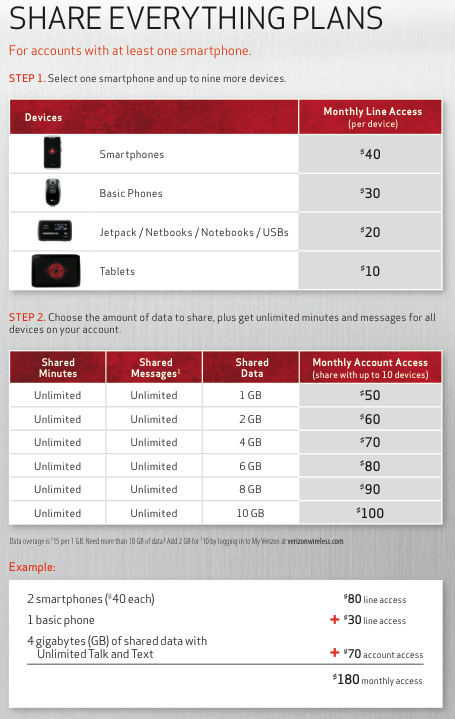
To get started on a Share Everything Plan, customers first select the devices they want on their accounts. That requires a $40 monthly access fee for smart phones. 


The next step is to choose a plan that includes unlimited minutes, unlimited messages and a shared data allowance that begins at 1 GB for $50.  


Customers adding a tablet on their Share Everything Plans can do so for an additional $10, with no long-term contract requirement. The following matrix shows pricing for an account with several different devices, such as a smartphone, a tablet and a basic phone, billed to the same individual.
Step 1Step 2
Monthly Line Access
(per device)
Shared MinutesShared MessagesShared DataMonthly Account Access (shared with up to 10 devices)
Smart phones - $40
Basic Phones - $30
Jetpacks/USBs/ Notebooks/Netbooks - $20
Tablets - $10
UnlimitedUnlimited1 GB$50
UnlimitedUnlimited2 GB$60
UnlimitedUnlimited4 GB$70
UnlimitedUnlimited6 GB$80
UnlimitedUnlimited8 GB$90
UnlimitedUnlimited10 GB$100


67% of Small Businesses Use Tablets

Nearly all small businesses (96 percent) surveyed on behalf of AT&T report they use wireless technologies in their operations, with almost two-thirds (63 percent) indicating that they could not survive — or it would be a major challenge to survive — without wireless technologies.

Some 43 percent of small businesses surveyed report all of their employees use wireless devices or technologies to work away from the office, a nearly 80 percent jump from three years ago.

Perhaps more surprisingly, 67 percent of small businesses surveyed indicate that they use tablet computers, up from 57 percent a year ago. AT&T says.

On the Use and Misuse of Principles, Theorems and Concepts

When financial commentators compile lists of "potential black swans," they misunderstand the concept. As explained by Taleb Nasim ...