Wednesday, September 26, 2012

People Don't Remember Mobile Ads: Duh!

Smart phone owners don’t really remember the promotions that appear on their devices, a study of U.K. phone owners has found. But that is completely in keeping with most studies of ad recall. Few human beings pay much attention to most ads, ever, in any medium. 

Azullo conducted a survey of 1,014 U.K. smart phone owners and found about 21 percent could recall an ad on their smart phone in the past six months. But look at matters another way, how many people could recall many details of any event with low emotional impact or involvement, at some point in the last half year?

When asked if they could recall brands, products or services promoted by these ads, 53 percent said no, Azullo says. 

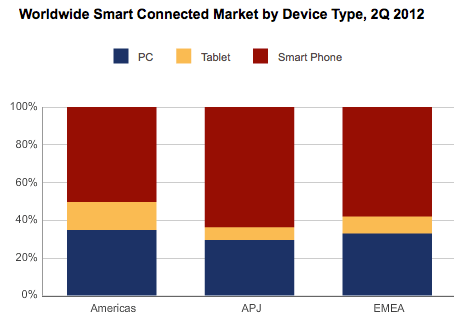
Smart Phones Will Grow Share of Smart Devices Through 2016

Smart phones now account for 59 percent of connected device shipments, and will grow 15.8 percent annually, to reach nearly 63 percent of smart device shipments by 2016, Forrester Research says.

Tablets will grow the fastest, though, rising from a 10 percent share in 2012 to 13 percent by 2016.

PC share will drop from 31 percent to 24 percent during the same time period. 

App Users Younger, Wealthier


Among U.S. mobile device users, those who use apps tend to be younger and more affluent than those who stick just to the web,  Forrester Research says
Nearly a third of those who use mobile apps fall between the ages of 23 and 31, and another third are in the 32 to 45 category. So roughly 66 percent of app users are younger than 46. 
Usage varies by OS, however, and Apple’s iPhone app audience are generally younger and better off financially, while those on Android tend to be older and less moneyed.

Tough Economy Affecting Cable, Mobile in Opposite Ways


Between 2007 and 2011, U.S. consumer spending generally shrank, as a response to the Great Recession and anemic recovery since 2008.

But though spending dropped overall, there was one area where spending actually rose: telecom services.

As you might guess, the growth was driven by mobile services, and most would attribute those gains to the attractions of smart phones such as the Apple iPhone. 

U.S. consumer spending on phone services rose more than four percent in 2011, the fastest rate since 2005, according to Department of Labor statistics. 

Families with more than one smart phone sometimes pay more for mobile service than they pay for cable TV and home Internet access. 


The tough economic conditions are not helping cable companies, though.

“The real important economic stats for us in terms of potential wind at our back really relate to improvements in occupied housing, improvements in the unemployment stats, increases in disposable income and increases in consumer confidence,” according to Time Warner President and Chief Operating Officer Robert Marcus. “To tell you the truth, we really haven’t seen a whole lot of meaningful improvement in those stats across our footprint.”


Of course, as happy as mobile service provider executives might be about the revenue growth, the cost of subsidizing those smart phones creates operating margin issues. Still, the numbers speak for themselves: consumers are making cuts elsewhere to fund mobile services.

Other purchasing categories, including cars, clothing, entertainment and food consumed away from home have suffered, in comparison.

The big issue is how long that growth trend in mobile spending can continue.


Tuesday, September 25, 2012

Kindle Fire HD Generates 11% of Kindle Fire Web Traffic After 1 Week

The new Amazon Kindle Fire HD was released Friday, September 14th, 2012 and seems quickly to have made a mark on bandwidth consumption. 

After only five days, the Kindle Fire HD represented 11 percent of all Kindle Fire Web usage, according to Chitika

Service Providers to Challenge Game Console Market

AT&T, Verizon Communications, Time Warner Cable Inc., Comcast and Cox Communications are gearing up for a push to deliver video games directly to televisions, Bloomberg :reports, a strategy shift that poses a threat to traditional consoles such as the PlayStation, Wii and Xbox, and shows how ecosystem partners increasingly find themselves competitors as well.

With cloud gaming, consumers will be able to avoid buying Sony’s PlayStation 3, Microsoft’s Xbox 360 or Nintendo’s Wii, and play using generic controllers connected to their set-top box or TV. Some carriers are looking at software that turns smartphones into controllers.

There still are a few technical upgrades required to set-top boxes, such as more powerful graphics processors. But none of that is a show stopper.

Media CEOS Bullish on Tablets, Mobile

CEOs from global entertainment and media companies are bullish on mobile and tablets for future growth, a study by Ernst & Young suggests.

Some 79 percent of CEOs said tablets would have the greatest impact, while 62 percent said smart phones would also be influential. 


Mobile devices also are expected to be the biggest drivers of
growth in content consumption over the next three years. 

How Long Can Separate Regulation of Broadcasting, Cable, Communications Continue?

It long has been a fixture of regulatory policy that different media have had distinct regulatory frameworks. In the U.S. market, the fundamental frameworks include unregulated “media,” partially regulated broadcasting and cable; and heavily-regulated common carrier services.

That “regulation by function” made sense at the time. As all networks become multi-purpose networks, the logic of regulating networks “by function or media type”  is subverted. That necessarily raises huge issues that affect the foundation of contestant business models.


In a simple way, the issue is whether stricter common carrier rules should be applied to "less regulated" media, or whether less regulation should be applied to common carrier services.

Also, some would argue, the growing instability of all legacy revenue models, across print, video, music, audio, television and communications industries means that regulation has to incorporate, as a primary objective, the fostering of innovation and investment in network facilities, as there is much less certainty than in the past. 

Greater risk, all other things being equal, means less investment.
A new International Telecommunications Union broadband report incorporates a healthy measure of those perspectives.

“Service providers have struggled with legacy inherited laws and regulations that award licenses per service, and many companies have taken the issue to court – for example, cable TV companies seeking to provide telephone service over their networks, and telephone companies wanting to upgrade their networks to offer video programming services and compete with the cable companies,” the ITU report says.

“More modern approaches to regulation may be needed – such as converged regulation, simplifications to the licensing regime or unified licensing, where one unified license can allow any telecommunication company to provide any service, as long as consumer rights are protected, and the competitiveness of markets is not threatened,” the International Telecommunications Union broadband report suggests.

The historic division between regulation of communications and separate regulation for broadcasting was acceptable in the past when spectrum and telecommunications were clearly divided, and regulation of content was a major focus of any broadcasting agency, the ITU says.  

With the shift of virtually all networks to Internet Protocol, virtually all networks can deliver any type of media. And that complicates any efforts to regulate media, broadcasting and communications separately.

The ITU study notes that policy-makers and regulators now must “stimulate”  demand for broadband and in promote investment in infrastructure. That also requires a “balance” of technologies and policy approaches appropriate to specific situations, including more wireless effort.

The growth rate in global mobile  data traffic is projected to grow 60 percent annually from 2011 to 2017, which will result in a 15-fold increase in traffic by 2017, mainly due to video traffic.

“Such an explosion in data traffic requires more spectrum,” the ITU says.  In this regard,
policy-makers and regulators can help to create a supportive environment and encourage
investment and ensure sufficient availability of quality spectrum, the ITU says.

Monday, September 24, 2012

Should all Internet Device User Interfaces be the Same?

Ask yourself whether it is especially helpful for all your digital devices to use a similar look and feel. How important is it that your PC, your tablet, your smart phone and possibly other devices have a similar user interface? Microsoft is about to find out, it appears, with the launch of Microsoft 8. 

Making radical changes to Windows poses a risk for Microsoft as enterprises and other large organizations prefer to reduce technology risk by deploying mature, stable, well-supported products, Gartner argues. 

Windows Vista, for example, never gained significant success in corporate environments, and its lack of success can be glimpsed in the market share statistics. Gartner estimates that just eight percent of PCs run by Gartner clients ran Vista at its peak. 

The bottom line is that IT leaders are questioning whether Windows 8 will suffer a similar fate, Gartner argues. 

"Microsoft's approach is very different from Apple's and Google's, where phones and tablets have much more commonality than PCs and tablets," Gartner says.  The new "Metro-style" user interface, which includes large buttons for touch and eliminates the ability to boot to the familiar Windows Desktop and have a traditional Windows start menu,  is probably the most controversial decision Microsoft has made in Windows 8, Gartner says. 

The result is an operating system that looks appropriate on new form factors of PC hardware including tablets, hybrids and convertibles, but has people questioning its appropriateness for traditional desktop and notebook machines, which comprise the majority of the existing PC market, Gartner notes. 


Telecom Italia Network Sale?

Telecom Italia SpA should sell its fixed-lined network, said Marco Fossati, whose family’s Findim Group SA owns about five percent of the company. 

“This opportunity should not be wasted as the right conditions may be now, in the next two or three months, or never.”


To be sure, the interests of major shareholders and end users or Telecom Italia do not always line up in the same way. Telecom Italia, like other European telcos, needs to reduce its debt load and make investments in newer lines of business. 

One can argue that what is good for Telecom Italia as an asset, and what is good for Italy, Italian consumers or Telecom Italia as a going concern, can be different. 

In a larger sense, there is a small but growing divergence of opinion among tier one service providers about the value of network asset ownership. 

In some cases, service providers have concluded that they can live with a future as non-facilities-based providers, or have traded their facilities ownership for other opportunities. That is the case in Australia, New Zealand, Singapore and Malaysiafor example. 

In a broader range of cases service providers have concluded they can do so out of region, while continuing to operate as facilities-based providers in region. Increasingly, there is understanding that specific elements of the network can safely be outsourced or shared. 

Telecom Italia might ultimately look for some way to bring in other investors, which would raise liquidity, while retaining management control of the network, though. 


TeliaSonera backs off plan to charge for VoIP

Swedish telecommunications company TeliaSonera has reversed an earlier decision to implement an additional fee plan for its customers who want to use over the top VoIP services, choosing instead to simply raise mobile data plan rates across the board. 

TeliaSonera first announced plans to charge for use of over the top mobile VoIP apps in February 2012, A plan similar to one it had already implemented in Spain. 

There, subscribers pay EUR6 a month for 100 megabytes worth of VoIP calls, equivalent to between five and 10 hours of talk time.

The problem is that VoIP "is likely to replace traditional phone calls," according to TeliaSonera Chief Executive Lars Nyberg. "Eventually, all voice calls will be made over IP."

"If all our customers suddenly decided to switch over to VoIP, and we charged them only for the data traffic usage, we would lose about 70 percent of our revenue," Nyberg said.

That's an obvious observation, as all service providers ultimately will face the diminution of the traditional voice calling revenue stream, at current levels of gross revenue and profit margin. The issue is how to transition to "data access" revenue models most elegantly. 

Lots of observers would note that charging extra for use of some apps is not elegant. In this case, TeliaSonera probably has chosen the better approach, namely simply matching value to pricing. 

More Smart Phone Users in Latin America than Developed Regions by 2017?

Telefónica has 208 million customers in Latin America, of which 173 million are mobile. Some would argue that in the next five years the region will surpass established markets by number of smart phones and their IP traffic will be multiplied by seven, with an annual growth rate of 49 percent.

In fact, Brazil has more smart phone users than Germany or France do.  In fact, with about 27 million and 23 million smart phone users respectively, Brazil and Mexico both have more smart phone users than Australia has people (Australia’s population is around 22 million).

Google's Mobile Planet also revealed that Argentina has 24 percent smart phone penetration.

These numbers defy the common perception that these large Latin American markets are far behind the rest of the world in smart phone adoption, Google argues. They in fact already possess larger absolute numbers of smartphone users than many other countries, and above-average usage patterns in many areas, Google says.

Some 65 percent of Mexican smart phone users search on their phones every day, compared to 57 percent in the U.S. market.

Some 90 percent of Argentine smart phone users use their phones to access social networks, compared to 63 percent in Japan, and 29 percent of Brazilian smartphone users have changed their minds about a purchase while in a store due to research conducted on their phone, compared to 15 percent in Canada.

Latin America’s smart phone sales picked up in 2010 when smart phone sales in the region grew 117 percent and total handset sales grew 17 percent.

In 2011 smartphone sales were predicted to represent 17.9 percent of total handset sales and will continue to be the fastest growing category, increasing at a compound annual growth rate of 30 percent in the next five years, compared with a seven percent CAGR for overall handset sales during the same period.

By 2016,  Pyramid Research expects smart phone sales to account for roughly 46 percent of total handset sales in the region.

Others might point to China as the driver of growth in emerging markets. Research firm Ovum says emerging markets in 2011 accounted for 160 million of 450 million smartphones sold worldwide. China accounted for about 66 percent of smartphones sold in developing markets, Ovum says.

Latin America smartphone sales as percentage of total handset sales, 2008–2016

Bango, Facebook Use Carrier Billing for Virtual Goods

Carrier billing is not new. It has been available since about 1983, as was made necessary by the breakup of the former monopoly AT&T into separately-owned and independent long distance and local businesses. Basically, local service providers needed a way to allow long distance carriers to bill local telephone service customers for their long distance calling. 

As a byproduct, carrier billing has been available to other third parties, and primarily has been used to support third party sales of content or virtual goods such as ringtones, songs and more recently, mobile apps or in-app products.  

Bango says it now is providing Facebook carrier billing services  in Germany, the United Kingdom and United States, and will be expanded to other countries during the remainder of 2012.

Bango now provides Facebook users the ability to easily purchase digital content without the use of premium text messaging services or credit cards. Instead, purchases appear on the mobile customer phone bills. 

Has BlackBerry Subscriber Base Gone into Decline?

A decade after Research In Motion Ltd. introduced its first smartphone, the tribe of BlackBerry users has stopped growing stopped growing. The bigger question is whether something worse than that has happened over the last quarter, namely an actual decline in the user base. 

Some would point that although it has faced huge challenges, Research in Motion has until recently been able to show sales growth, albeit at rates that do not match those of Apple iOS, Samsung or other Android devices.

In August, 2011 RIM had 70 million BlackBerry subscribers worldwide, and in June 2012 reported 78 million users globally. 

Some analysts now believe the total number of BlackBerry users is now declining, or about to start declining. This contrasts with first weekend sales of the new Apple iPhone 5 of perhaps five million units. And some analysts appear to be disappointed at that sales level, which is more than for the similar first weekend of any other version of the iPhone, but less than some had anticipated based on pre-order activity. 

iPhone 5 Sales and growth opening weekend

U.S. "Falling Behind" Rest of World in Spectrum Auctions?

One has to be skeptical at times about claims that a specific country is "falling behind" on some measure of communications intensity.

That might apply, in some ways, to claims the United States "has quickly fallen behind the world" in  auctioning off spectrum that can be used to support wireless communications.

It is argued that Germany and Spain have auctioned about 50 percent more spectrum for broadband than the United States has. It is said that France has auctioned about 40 percent percent more spctrum, while Italy and Japan have auctioned 30 percent more spectrum.

"Specifically, the U.S. has auctioned about 410 MHz, Germany about 615 MHz, Spain about 600 MHz, France about 560 MHz, Italy roughly 510 MHz, Japan an estimated 500 MHz, and the United Kingdom preparing to auction about 600 MHz, Precursor principal Scott Cleland says. 

Some skeptics will argue that one would expect Cleland to take that view, as one virtually always will find Cleland taking positions that are "against" Google and "for" telcos. And there is little doubt that mobile service providers virtually always seem to be looking for more spectrum as they add more customers. 

The new reality is that each of those new customers are starting to consume network bandwidth at unprecedented rates, compared to past usage of narrowband voice and messaging apps. 

That isn't to deny that more spectrum will be needed, in most countries, as mobile broadband adoption increases. Nor are U.S. regulators unmindful of the need to clear unused former TV broadcast spectrum for mobile use. So the "auction gap," like many other past "gaps," will close over time. 

Also, what isn't immediately so obvious is what other spectrum assets already exist that can be "re-purposed," as U.S. mobile service providers are decommissioning older 2G or iDEN spectrum for new use by fourth generation networks. 

And then there is spectrum Clearwire already has deemed surplus, the potential Dish Network, LightSquared and Nextwave spectrum, for example. 

Long term, most service providers will need more physical spectrum. What isn't so clear is that there really is a spectrum auction gap that means anything terribly important at the moment. 


Yes, Follow the Data. Even if it Does Not Fit Your Agenda

When people argue we need to “follow the science” that should be true in all cases, not only in cases where the data fits one’s political pr...