Tuesday, April 16, 2013

Will Softbank Respond to Dish Network Offer for Sprint?

At least so far, there has been no counter offer from Softbank for Sprint. That is not unexpected, given the surprise offer made by Dish Network , which apparently was learned of by Softbank directors only shortly before they began a scheduled board meeting. 

What remains now for Sprint directors is a tough assessment of the merits of each offer. Setting aside for the moment which offer is worth more, since that could change, which direction would give Sprint a greater chance to dramatically improve its fortunes in the U.S. market?

As most immediately would note, Dish Network has spectrum assets to contribute, and arguably is in a better position to reduce operating costs by eliminating "redundancies" and overlap in the Sprint and Dish Network operations. 

Dish argues such savings might result in more than a billion dollars. But Softbank would bring more scale in the mobile segment of the business. 

But either firm stands to gain something tactically, even if a strategic defeat occurs. Others would note that Softbank will be paid a $600 million breakup fee if its bid to buy Sprint were rejected. And Ergen has in the past managed to wring value out of other "bets."

Until recently, many observers were convinced Dish Network actually intended all along simply to acquire and then sell its spectrum holdings, and really had no intention of getting into the mobile business. 


image

Monday, April 15, 2013

One Other Way the U.S. Higher Education System is Failing its Students

About 48 percent of employed U.S. college graduates are in jobs that the Bureau of Labor Statistics (BLS) suggests requires less than a four-year college education, Center for College Affordaility and Productivity.

Some 11 percent of employed college graduates are in occupations requiring more than a high-school diploma but less than a bachelor’s, and 37 percent are in occupations requiring no more than a high-school diploma, a Center study finds

The proportion of overeducated workers in occupations appears to have grown substantially. In 1970, fewer than one percent of taxi drivers and two percent of firefighters had college degrees, while now more than 15 percent do in both jobs.

About five million college graduates are in jobs the BLS says require less than a high-school education.

The point is that most students go to school to get jobs, but the credentialing process is a massive waste of time and money for many. Apprenticeships would make more sense, for example. 

Mobile TV Not a Great Substitute for Linear TV Delivery, Study Finds

An analysis by researchers at the KTH Royal Institute of Technology suggests that it is not generally spectrum efficient to substitute use of mobile networks for delivery of linear video entertainment, assuming the goal is to replicate the same coverage and types of content now delivered by the local TV broadcasting network.

That will not come as a surprise to anybody who ever has pondered the network bandwidth implications of unicast and multicast video programming. 

On the other hand, the efficiencies could tip to mobile networks when the programming mix skews to specialized programming, localized content and on-demand viewing. 

By definition, unicast delivery is better suited to communications rather than traditional content delivery networks. 


The Mobile Web is 30% Faster Than a Year Ago, Study Finds

Since 2012, desktop Web access median and mean speeds have gotten better by a little, but in a context of typical Web pages getting 56 percent bigger.

Mobile access is around 30 percent faster compared to last year, a Google study has found


Verizon Adds New Device Installment Payment Plan

Verizon Wireless seems to have concluded that it makes sense to separate recurring service plans from device installment plans, and has launched a Device Payment Plan that offers the same advantages of phone subsidies, with the advantage of allowing Verizon Wireless to advertiser lower recurring monthly fees.

Under the new plans, consumers will buy their devices over a year, in installments, with a separate charge for service, as T-Mobile USA has done. It is not so clear that consumers actually will save money when using the new plans, especially if they change devices frequently.

But the marketing advantages are clear enough for Verizon. It will now be able to advertise lower monthly prices. 

Verizon Wireless Wants Clearwire Spectrum

It hasn't taken long for the ramifications of proposed deals by Clearwire, Sprint, Softbank, Dish Network, T-Mobile and MetroPCS became even more convoluted. Now it appears Verizon Wireless wants to buy Clearwire spectrum, but not all of Clearwire.

Verizon Wireless is said to be interested in additional spectrum in large cities, and is prepared to spend up to $1.5 billion to buy spectrum leases. 

Dish Tries to Buy Sprint

Dish Network is offering to pay $4.76 in cash and about $2.24 in Dish stock,  for every share of Sprint, in a bid to scuttle the Softbank purchase of Sprint. 

The Dish bid is not entirely unexpected, as Dish had been raising lots of cash and had made earlier efforts to combine, in some way, with Clearwire, for example. The $25.5 billion offer would not immediately affect market share in the U.S. mobile industry, and neither would a Softbank purchase. 

The one combination long rumored that could make an immediate difference is a combination between T-Mobile USA and Sprint. As improbable as a three-way deal might be, all three companies have been talking with the others in recent days. 

And many observers have argued, for some time, that eventually T-Mobile USA and Sprint would have to combine, to provide the critical mass to compete against AT&T and Verizon Wireless.


For Dish, the move would make the company a national provider of voice, video entertainment and Internet access service. 

Whatever the eventual outcome, either Softbank or Dish Network would carry a rather significant debt load. 

Among other issues, the Dish Network bid illustrates a belief on the part of Charlie Ergen, Dish Network CEO, that the video entertainment business, at least from where Dish sits in the market, is being a problem. 

Ergen is among those in the video subscription business who have relatively more publicly suggested the future lies with online video and mobile video. 

Observers will differ on which bid is better, long term, for consumers in the U.S. mobile market. Softbank is a known market disrupter. Dish Network would likely reshape Sprint in the direction of a lower-cost provider, over time. 

The other angle is that the combined companies, with Dish Network's spectrum as well as Clearwire's and Sprin't holdings, would immediately emerge as the U.S. service provider with the most spectrum. 

For reasons of where those frequencies lie, Sprint arguably would be in position to leverage the spectrum assets in ways others would find challenging (think video). 

On the other hand, Verizon Wireless and AT&T might have an advantage, in terms of signal propagation, in many rural areas. 

But none of the deals are done yet. And no matter what happens, either a Softbank or Dish Network or some other deal, T-Mobile USA will still be facing a tough challenge competing with the other three national providers. 

The issue now is whether we have seen the last of the offers, and whether other firms might decide to make a play for either Sprint or T-Mobile USA. When assets are in play, the outcomes rarely are completely predictable. 

Friday, April 12, 2013

71% of Twitter Users Tweet from a Mobile Device

Between March 2012 and October 2012, the proportion of people who used a desktop or notebook computer for tweeting fell from 77 percent to 64 percent. 

The percentage who used a mobile phone for tweeting rose from 53 percent to 64 percent, and those using a tablet rose from 9 percent to 18 percent. 

Overall, the proportion of Twitter users using a mobile device (either tablet or phone) rose from 56 percent to 71 percent.


1000 Times More Bandwidth Needed?

Nobody argues that end user bandwidth demand will keep growing. The issues are "how much" and "how fast" the demand will grow.

For many, the issue therefore is how to achieve a three order of magnitude increase in delivered end use bandwidth, over a relatively short time frame. the problem is most acute for wireless service providers, of course. 

Expand image to read by clicking lower right corner of document. 

userbandwidth.

“Transparency,” Not “Choice” or “Savings” is Value of “Non-Subsidized” Phones


O2 in the Unitted Kingdom has launched “O2 Refresh,” a new service plan that decouples a two-year service contract from the consumer purchase of a phone.


O2 Refresh therefore offers two separate plans, one for the phone and one for the airtime.
The issue really is “transparency,” not savings, as some have suggested would be the consumer value of moving to “unlocked phone” policies.

“By signing up to and paying separately for their phone and airtime, customers are given complete transparency, while paying the same overall as they would on a standard 24 month pay monthly tariff,” O2 says.

That’s the key. Some observers have argued that consumers should be able to buy fully unlocked phones and use them on any mobile network, or buy service without a contract.

With some technology constraints where both GSM and CDMA are used, ipeople generally can do that.

What O2’s new plan shows is that the “remedy” of separating device purchases from service plans doesn’t actually provide all that much consumer benefit. If consumers can afford full retail price for phones, they already are free to buy them. If they want service without contracts, they already can buy such service (prepaid, generally).

Under the O2 Refresh plan, users actually will not save money, and still will have a contract. The incremental advantage for O2 is that it can advertise lower monthly fees for service. The advantage for a consumer is the ability to upgrade a phone at any time.

“Increasingly our customers are telling us that they don’t want to be tied to the same phone for two years,” said Feilim Mackle, Telefónica UK sales and service director.

Customers will have a choice of three O2 Refresh Airtime Plans, which have been tailored to meet varying call, text and data requirements. For £12 a month, customers get 600 minutes, unlimited texts and 750MB of data; for £17, customers will have unlimited minutes, unlimited texts and 1GB of data and for £22 they receive unlimited minutes, unlimited texts and 2GB of data.

At launch, O2 Refresh will be available on a range of phones including the HTC One, Sony Xperia Z, Blackberry Z10, Samsung Galaxy S3 and Apple iPhone 5. Following the launch, O2 Refresh will be extended to include a wider range of phones, with a specific focus on high-end smartphones including the Samsung Galaxy S4.

In essence, that approach is what T-Mobile USA is doing with its “no-contract” approach to mobile service pricing. Consumers can buy a full-price retail phone or under an installment contract, with service then offered without a contract.

As you might guess, the actual out of pocket monthly payments for T-Mobile USA service might not change very much.

If one assumes most consumers still are going to opt for device installment plans rather than buying their devices outright, the savings are relatively slight, on a recurring basis, for purchases involving high-end devices.

T-Mobile USA has a $60-a-month 2.5 gigabyte data plan is more than $300 cheaper over two years than an AT&T plan that offers 3 gigabytes and 450 minutes of talk time with the same device. For a user who opts for the installment plan, that works out to about $12.50 a month lower bills than for the rival AT&T plan.

There is an argument that T-Mobile USA plans will save more, compared to service from Verizon Wireless. A user buying that same T-Mobile USA plan, and using the installment plan, would save perhaps $20.83 a month, over two years, compared to a single-user Verizon Wireless plan with 2 gigabytes of data (though the Verizon Wireless plan also would offer unlimited talking and text messaging).

Transparency is a good thing, of course. But the notion that phone unbundling and an end to contracts necessarily provides huge end user value is not so clear.

Thursday, April 11, 2013

Largest 10 Telecom Service Providers: 90% Own Mobile Assets


Of the 10 largest telecom service providers in the world, only one does not have a facilities-based, owned-spectrum mobility business. On the other hand, one of the 10 is a “cable TV company.”


Both of those trends--mobility and cable TV--tell the story of how the global telecom business has changed over the past several decades.

Can Distributors Force Video Channel Unbundling?

Distributors might think channel unbundling is a good thing. But it doesn't matter. Programming networks think unbundling is a bad idea, and they control the programming people mostly want to watch. Distributors might think sports programming costs are exorbitant. Program networks do not. 

Some video distributors are willing to consider letting consumers buy channels one at a time. Few networks would do so voluntarily. 

It isn't so clear how much leverage video distributors actually have, with one interesting exception, namely the efforts by Aereo and Aereokiller to disrupt the broadcast TV distribution system. What makes that a structurally different situation is that cable, satellite and telco providers, plus ISPs such as Google Fiber and others, must have direct contractual relationships with the programming networks.

Aereo and Aereokiller are trying to pioneer a way to deliver video without the need for a direct business relationship with the broadcaster. That's different, way different, in terms of the structure of the relationship. 

In a sense, Aereo and Aerokiller operate much as any third party application on the Internet, with no direct business relationship with an access provider. 

To be sure, there always is the theoretical possibility of government intervention to force unbundling, but that seems unlikely. 

But Aereo and Aerokiller conceivably could provide a breakthrough of sorts. Assume for the moment that the concept survives legal challenge (whether or not either firm emerges in the end to take advantage of the opportunity).

Assume Aereo, Aerokiller or others can then amass a content offering including local TV channels, plus some other popular "cable channels," but without sports networks which drive much of the cost of traditional video subscription packages. 

That could create a huge opportunity for lower-cost video services, and that in turn would increase pressure on programming networks to make some accommodations with distributors. Perhaps challenged by potential new lower-cost services, major programming networks would become more flexible about the ways they allow distributors to sell content, possibly including some forms of a la carte access. 


By 2023, 1/2 of all U.S. TV Viewing Will Use the Internet


By about 2023, half of all U.S. TV viewing will be of online video, Technology Futures predicts. In large part, that will be because virtually every household using the Internet will be watching Internet TV or Internet video.
By about 2020, half of all U.S. “television homes” will be “Internet TV homes” as well.
If you want to ask what households and users will be doing with all that bandwidth, the answer is “watching TV.” In fact, by about 2020, it is quite conceivable that 60 percent of all video being watched by an Internet-connected user will be viewed online.

Wednesday, April 10, 2013

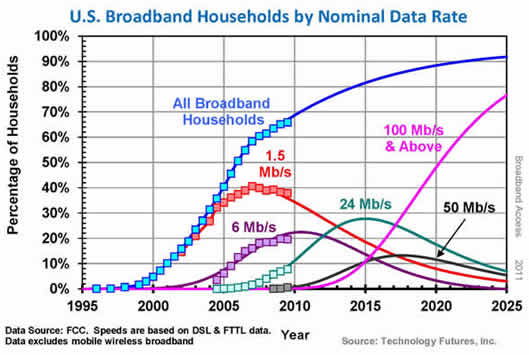
At Least 1/2 of Typical U.S. Consumers Will be Using 100 Mbps by About 2020, Really


Broadband Households by Nominal Data Rate*Wireless, either mobile or fixed, seems an inevitable solution for providing broadband access in rural areas, everywhere in the world.

Over time, the solution choices are likely to shift, if one assume gigabit access really is the future. 

In the meantime, to about 2020 or 2025, the issue really will be getting to a fairly widespread 100 Mbps.

In fact, a reasonable forecast would have about half of U.S. broadband access users buying 100 Mbps connections by about 2020.

About 10 percent will be buying 50 Mbps connections.

Nearly 24 percent will still be buying 24 Mbps service.

That might seem a crazy amount of bandwidth for “many typical users,” but standard technology forecasting techniques have, for more than a decade, actually suggested that would happen.

In 2001, for example, Technology Futures predicted that by year-end 2004, over 25 percent of U.S. households will have adopted broadband services, up from about five percent at the end of 2000. The actual U.S. broadband penetration rate was 30 percent, according to the Pew Internet and American Life Project.

“By 2010, we expect that the percentage will exceed 60 percent,” Technology Futures predicted in 2001. The actual penetration wound up being 66 percent.

“Our forecasts indicate that 1.5 Mbps will meet the typical user's expectations until about 2005, that 6 Mbps will do so until about 2010, then 24 Mbps until 2015, and finally 100 Mbps thereafter,” Technology Futures said in 2001.

There is at this point little reason to doubt that the forecast will continue to be substantially correct. Keep in mind that the 100 Mbps forecast by 2020 represents the “typical user’s” access speed, not the top “headline speed.”


PC Shipments Post the Steepest Decline Ever

PC shipments dropped the most in history (or at least since 1994, when IDC began tracking PC shipments) in the first quarter of 2013, according to IDC. That will surprise virtually nobody, given the clear shift of consumer demand to tablets.

Worldwide PC shipments totaled 76.3 million units in the first quarter of 2013, down 14 percent compared to the same quarter in 2012 and worse than the forecast decline of 7.7 percent, according to IDC

The results also marked the fourth consecutive quarter of year-over-year shipment declines.

"Fading Mini Notebook shipments have taken a big chunk out of the low-end market while tablets and smartphones continue to divert consumer spending," IDC says.

"At this point, unfortunately, it seems clear that the Windows 8 launch not only failed to provide a positive boost to the PC market, but appears to have slowed the market," said Bob O'Donnell, IDC Program Vice President, Clients and Displays. 

Goldens in Golden

There's just something fun about the historical 2,000 to 3,000 mostly Golden Retrievers in one place, at one time, as they were Feb. 7,...