Monday, April 22, 2013

Mobile Broadband Already Emerging as Key in India Market

India’s mobile services market will reach Rs.1.2 trillion in 2013, up eight percent from 2012 revenue of Rs. 1.1 trillion, according to Gartner analysts. As you might expect in a market where retail is quite important, the growth could prove challenging.

“The mobile market in India will continue to face challenges if average revenue per unit does not grow significantly,” said Shalini Verma, principal research analyst at Gartner. And there is no doubt competition and over the top apps are key challenges. Both are putting pressure on profit margins. 

Ironically, mobile broadband revenue already appears to be more important than voice revenue, as a driver of future growth. 

“As mobile voice services continue to get commoditized in the country with the increased use of voice over IP (VoIP) and the probable termination of national roaming charges, mobile broadband is the area of opportunity for operators,” said Ms. Verma. 

“If the prevailing conditions do not change in the Indian telecom market, India will account for 12 percent worldwide mobile connections, but just two percent of worldwide mobile services revenue (in constant USD) in 2013.”

Mobile connections will grow to 770 million in 2013, an 11 percent increase from 712 million connections in 2012. 


Friday, April 19, 2013

49% of South Africans Would Change Their Mobile Operator if They Could

A recent study commissioned by Comptel suggests that, among South African consumers, up to 49 percent would consider switching service providers. 

Those figures probably overstate churn potential. 

As always, one should take a consumer's responses to any survey with a bit of skepticism.

Consumers often say they will do something, when they really do not; or say they will not do something; and then do that. 

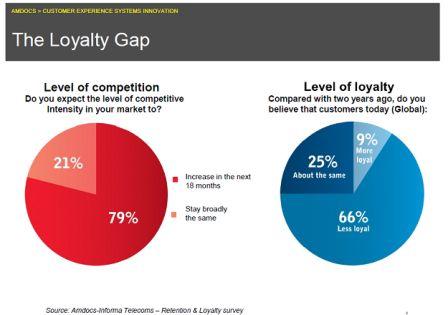
The conventional wisdom for most people, including executives at mobile service provider companies, is that there is a relatively direct relationship between "customer satisfaction" and customer churn. In other words, "happy customers" don't leave.

It doesn't appear that is the case. Perhaps perversely, even happy customers will churn (leave a supplier for another), and at surprisingly high rates.

Two out of three (66 percent) wireless and cable TV consumers switched companies in 2011, even as their satisfaction with the services provided by those companies rose, according to Accenture.

The paradox is that “customer satisfaction” does not lead to “loyalty.” Also, there are new precursors to churn, especially the growing pattern of consumers adding a second provider of a service, without dropping the original provider. That of course puts a potential full replacement provider into a relationship with a consumer.

The Accenture Global Consumer Survey asked consumers in 27 countries to evaluate 10 industries on issues ranging from service expectations and purchasing intentions to loyalty, satisfaction and switching.

Among the 10,000 consumers who responded, the proportion of those who switched companies for any reason between 2010 and 2011 rose in eight of the 10 industries included in the survey.

Wireless phone, cable and gas/electric utilities providers each experienced the greatest increase in consumer switching, moving higher by five percentage points.

According to the survey, customer switching also increased by four percent in 2011 in the wireline phone and Internet service sectors.

There is a new and apparently growing indicator of churn potential as well. In a growing percentage of cases, consumers are adding new providers, instead of switching entirely. That can disguise the danger of churn, as the original provider does not realize a new potential replacement provider also has established a relationship with a particular consumer.


“Companies are improving many of the most frustrating parts of the customer service experience, but they are facing a customer who is increasingly willing to engage multiple providers for a service and is apt to switch quickly,” said Robert Wollan, global managing director, Accenture Customer Relationship Management. “

Note the contradiction here: consumers were “more satisfied” and also “not loyal” because of that satisfaction.

Consumers reported increased satisfaction across each of 10 service characteristics evaluated. In fact, satisfaction rates on three customer service characteristics jumped by more than five percentage points from 2010.

However, only one in four consumers feels “very loyal” to his or her providers across industries, and just as many profess no loyalty at all. Furthermore, two-thirds of consumers switched providers in at least one industry in the past year due to poor customer service.


Spanish Mobile Market Shrinks

Some 245,000 Spaniards appear to have abandoned use of mobile phones in February 2013. 

In other words, the Spanish mobile market not only has stopped growing; it is shrinking. 

In February, 575,138 people switched suppliers, an 18 percent increase compared to the same month the year before, and only slightly lower than the record 633,616 changes recorded in January 2013.

Telefonica lost 85,161 customers to rivals, while 95,115 customers left Vodafone for other operators, the Spanish regulator reports 

Orange lost 5,757 customers to other companies. Low-cost Yoigo, the smallest facilities-based operator gained 32,424 mobile customers. 

But mobile virtual network operators gained 153,609 new customers, primarily taking them from the facilities-based suppliers.

EU Single Market Plan Accelerated

European regulators are planning to aggressively accelerate plans to create a single telecom market, releasing its plan in June 2013 instead of its original fall time table, in the hopes the plans can be put into place before the end of 2013. 

The European Commission still is working on a blueprint for a single telecoms market in the EC states, a move some tier one service providers want, but which national regulators and smaller service providers might fear.

The issue is how to create one market from 27 distinct national frameworks, as well as how to harmonize investment and operating rules across the different countries. It is not clear that such a move, if successful, actually would create a single regulator across all 27 countries. 

For a few tier one service providers, common rules and a single market would allow a more efficient and profitable approach to providing communications services across Europe. Many smaller providers would find they do not have scale to continue competing successfully, though. 

In fact, the plan might initially entail easier competitor access to tower sites, ducts and other forms of infrastructure. The objective would be to enable some European service providers to achieve greater scale


Android Notebooks Coming

Lenovo, Hewlett-Packard, Toshiba, Acer and Asustek Computer reportedly are launching Android notebooks, at least in part because Windows 8 machines have disappointing sales. 

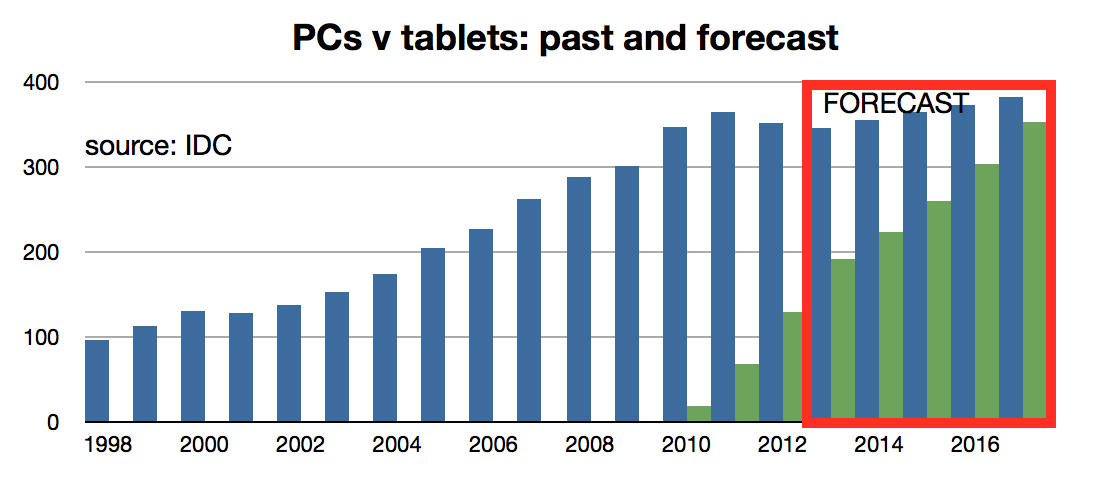
Given the displacement of PC sales by tablets, one almost wonders why. 

By 2017, total tablet shipments will hit nearly 353 million,  compared to 382 million PCs. Still, volumes will continue to shift in the direction of tablets and smart phones. Given Android's huge installed base and the likelihood that Android and Chrome sooner or later will be unified, the PC vendors are hedging their bets. 


android ios windows forecast 2016

DSL Net Additions Go Negative for First Time, Ever

Net digital subscriber line customer additions were negative in the fourth quarter of 2012 for the first time ever, Point Topic says. 
DSL lines 98 to 12
The total number of DSL subscribers worldwide fell from 366.95 million in September 2012 to 366.66 million by the end of the year.


Point Topic says that signals the gradual demise of "all copper" connections, but not necessarily of fiber-reinforced copper connections, including both cable and telco very high bit rate versions of DSL. 

Still, fiber and hybrid fiber connections now account for over 20 percent of the world’s fixed broadband lines, growing by more than 26 percent in 2012.


There were 643,770,042 broadband subscribers around the world by year-end 2012, according to Point Topic. FTTx is gaining ground on other technologies, including traditional DSL, which continues to be the most dominant technology in the market.

FTTx (including VDSL and VDSL2) showed the largest annual growth over the period between the fourth quarter of 2011 and the fourth quarter of 2012, growing 27 percent overall, compared to 7.2 percent for cable modem subscriptions and 3.6 percent growth  for DSL.

Fixed wireless grew 12 percent over the year.

Looking at the current market share, fiber technologies, at 21 percent, have overtaken cable modem’s 19 percent share, globally.

At least for the moment, it appears that global consumer demand tops out at around 70 Mbps, and that level of access speed demand seems to be driven by the desire to watch online video, Point Topic researchers say.

At least so far, there are no apps that drive consumers to buy much more than 40 to 50 Mbps access, says Oliver Johnson, CEO at Point Topic. But one might argue it is the number of people per household that drives “typical bandwidth consumption.”
According to an exercise conducted by Point Topic, bandwidth consumption is almost directly related to the number of people per household, and the number of Internet-connected devices each person tends to use.

If one assumes a household is consuming bandwidth literally 24 hours of every day, all seven days a week for a whole month, then a single-person household, using two Internet-connected devices, might consume 13 terabytes a month.

A four-person household with two adults and two children might consume 29 terabytes, assuming each person has a bit more than one device each.

A “hacker” household with at least five people, and each person using at least two Internet-connected devices, could consume 134 terabytes a month.


China SMS Usage Drops 11%: OTT is the Reason


SMS usage in China (person to person) has declined nearly 11 percent in 2012, a development that suggests substitution of over the top alternatives.


Mobile Data Now 42% of Total Among Leading North American Carriers


The percentage of postpaid service revenue related to data increased to 42 percent as of June 30, 2012, up from 38 percent for the same period in 2011, among 14 leading North American mobile service providers a study by
PwC has found.


Carriers with revenue greater than $5 billion increased data revenues six percent as of June 30, 2012, to 39 percent, compared with a smaller increase in the revenue generated by data services for carriers with revenue less than $5 billion, 45 percent as of June 30, 2012 compared with 44 percent as of June 30, 2011.

Data users on average contributed $23 of total average revenue per user as of June 30, 2012, which is up from the average of $21 at June 30, 2011, or about 40 percent of total monthly recurring revenues.


Bandwidth consumption by North American smart phone users continued to grow in 2012, but at an order of magnitude slower rate, compared to 2011.

In 2011, smart phone users, on average,  consumed about 114 percent more bandwidth, the study found. But the  increase on a per-subscriber basis averaged only 27 percent in June 30, 2012, compared to usage levels in June 30, 2011, the PwC survey found.
Bandwidth consumption is bound to grow, as sales of smart phones grows. The sale of smart phone devices to new postpaid subscribers represented 60 percent of device sales for fiscal 2011, up from 41 percent in fiscal year 2010.

Smartphone users on average consumed 632 MBytes of data per month as of June 30, 2012, compared with 431 MBytes of data per month at the same time in 2011.


Mobile Bandwidth Growth Drops 60%, Wi-Fi Likely the Reason

Overall traffic growth for 14 large North American mobile service providers has slowed significantly from the rapid rate of increase seen in recent years, with operators reporting
as much as a 60 percent reduction in their rate of traffic growth.

Where traffic grew in triple digits in 2011, growth was in double digits in 2012, a PwC survey has found.

Many will speculate about the reasons for the slowdown. Some will suggest the growing number of lighter users, as more and more people start using smart phones. PwC analysts speculate that market maturation and late adopters who do not use as much data as early adopters could explain some of the slowing rate of data consumption.

Some of us think users simply are switching much of their device data consumption to Wi-Fi. In fact, Cisco estimates that, in 2016, as much as 70 percent of mobile data consumption will use Wi-Fi.


By 2017, almost 21 exabytes of mobile data traffic will be offloaded to the fixed network by means of Wi-Fi devices and femtocells each month, Cisco estimates. 4G Americas says Wi-Fi offload of mobile traffic is at 35 percent today in the United States and is estimated to be 68 percent by 2016.

Without Wi-Fi and femtocell offload, total mobile data traffic would grow at a compound annual growth rate of 74 percent between 2012 and 2017 (16-fold growth), instead of the projected 66 percent CAGR (13-fold growth), 4G Americas says.

Cisco notes that tthe global average for daily data consumption over Wi-Fi is four times that of cellular, averaging 55 MBytes per day for Wi-Fi, and 13 MBytes for cellular.


 Average Daily Wi-Fi and Mobile Data Consumption


Even as mobile device data consumption grows, consumers rationally respond to incentives, such as the ability to shift consumption to Wi-Fi in ways that protects their data caps. Ignoring such changes in consumer behavior has been an issue before.

In March 2011, for example, AT&T projected that data bandwidth growth would be on the order of eight to 10 times over then-current levels between the end of 2010 and the end of 2015.

That forecast appears to be based on an expectation that volumes would roughly double in 2011 and then increase by a further 65 percent in 2012.

Instead, AT&T seems to be seeing something like 40 percent annual growth. To be sure, 40 percent annual growth is significant. It means bandwidth consumption doubles about every two to three years.

Cisco estimates mobile broadband grew about 70 percent in 2012, and will grow at a compound annual growth rate of 66 percent from 2012 to 2017.

Some believe Wi-Fi offload will slow the rate of mobile broadband growth. On the other hand, even such offloading, at high rates of perhaps 80 percent, would slow the rate of growth by about 50 percent.

Thursday, April 18, 2013

Google Fiber Seems to be Spurring ISPs to Upgrade, as Planned


Google Fiber, now operating or planned for Kansas City, Mo., Kansas City, Kan., Austin, Texas and Provo, Utah, seems to be having the intended effect of spurring other ISPs to move much faster in the area of access speeds.

AT&T now has said it will build a 1-Gbps network in Austin, while Wicked Broadband in Lawrence, Kan., which is close to Google Fiber in Kansas City, Kan., also says it plans to offer 1 gigabit service as well.

Wicked Broadband plans to offer 1-Gbps residential service for $99.98 per month; 100 Mbps service for $69.98 per month and 20 Mbps service for $49.98 per month.

None of the Wicked Broadband plans will have usage caps, nor will uploading speeds be reduced. The availability of nearby Google Fiber, also offering 1 Gbps service, clearly is a factor in the decision to move ahead with 1-Gbps service.

Wicked Broadband also will be offering business services at various prices and rates. The 1 Gbps service will cost $59.98 with committed rates.

A multi-tenant service operating at 100 Mbps will be sold for $12 a member. The 1-Gbps version of the multi-tenant service will be sold for $24 a member, per month.

Consumers or businesses that sign two-year contracts will have a free installation charge. Customers who sign a one-year contract will pay a $149 installation fee.

A 10-month contract will come with a $199 installation fee. Service on a no-contract basis will have a $300 installation fee. The latest expansions of Google Fiber likely will have further impact in the commercial segment of the  business, even as non-profit efforts also continue.

While less than a dozen U.S. cities offer ubiquitous municipal broadband, perhaps hundreds offer free Wi-Fi in certain public areas such as parks.

Petaluma, California is among the latest municipalities to offer municipal Wi-Fi, adding to the existing Wi-Fi hotspots it already provides as “CityGuest” in the Petaluma Community Center, at City Hall and the Senior Center. The Petaluma branch of the Sonoma County Library offers access to library patrons.

Where some municipal efforts concentrate on outdoor areas, at lower speeds, those efforts complement commercial ISP efforts that emphasize indoor coverage at medium to high speeds.

Also, there is movement on the “high end,” especially for university communities. The Federal Communications Commission wants to encourage creation of gigabit cities in every U.S. state, by 2015. That effort is better described as “gigabit communities,” built around “anchor institutions,” not full “cities.”

The general idea is that creating test beds is the best way to foster the creation of new applications that presume ubiquitous  gigabit communications. That is a demand side effort, intended to allow development of compelling new applications, rather than an effort to change the cost of supplying high speed access.

Likewise, Blair Levin, Gig.U executive director,  points out that by creating anchor communities built around universities, compelling new applications can develop, proving that more investment in very high speed access has a revenue driver.

The whole point of Google Fiber, the “Gigabit Cities” initiative and Gig.U are to try and change the math in a positive direction (lower cost, higher revenue) while changing the competitive climate (force incumbents to invest faster). But those efforts at at the other end of the barbell from the low speed outdoor access provided by 1 Gbps municipal Wi-Fi access.

Lawrence, Kansas Wicked Broadband Will Offer 1 Gbps

Wicked Broadband in Lawrence, Kan. plans to offer 1 gigabit residential service for $99.98 per month; 100 Mbps service for $69.98 per month and 20 Mbps service for $49.98 per month. 


None of the plans will have usage caps, nor will uploading speeds be reduced. The availability of nearby Google Fiber, also offering 1 Gbps service, clearly is a factor in the decision to move ahead with 1-Gbps service.

Wicked Broadband also will be offering business services at various prices and rates. The 1 Gbps service will cost $59.98 with committed rates.

A multi-tenant service operating at 100 Mbps will be sold for $12 a member. The 1-Gbps version of the multi-tenant service will be sold for $24 a member, per month.

Consumers or businesses that sign two-year contracts will have a free installation charge. Customers who sign a one-year contract will pay a $149 installation fee. 

A 10-month contract will come with a $199 installation fee. Service on a no-contract basis will have a $300 installation fee. 

Wicked Broadband customers whose dwellings already are outfitted with a optical network  interface do not have to pay a connection fee, but will pay a $50 charge for installer labor. 
As Google Fiber has done, Wicked Broadband will aggregate potential customers neighborhood by neighborhood, building fist in the areas where the greatest number of pre-committed users sign up. 

Will Cable Eventually "Merchandise" Video to Sell High Speed Access?


Fierce competition normally causes lower profit margins, and competition seems to be having that effect on video service providers. According to Strategy Analytics, profit margins on cable broadband services are 70 percent to 110 percent higher than those on video services (depending on whether or not advertising revenues are included in the calculation).

These days, overall video service profit margins for U.S. cable companies are likely in the 20-percent range, where once they routinely were in the 40-percent range. Profit margins for broadband access likely are closer to 60 percent.

It therefore is no surprise that a cable operator now can say that the anchor service is broadband, not video. It is not unreasonable to argue that, over time, video will be an application that is merchandised, in order to sell the access services to deliver the video.

That's a big change.

84% of U.S. Enterprises Have IP Telephony Deployed


About 84 percent of U.S. firms polled already have IP telephony deployed, where the global adoption is about 75 percent, a survey of U.S, enterprise personnel finds.


In the United States, 77 percent of IPT deployments are premises-based and managed in-house.

In the U.S. survey, 51 percent of respondents indicated they would seriously consider a premises-based managed solution for IPT, with 41 percent seriously considering such a “managed service” option for standard unified communications, a finding that suggests healthy interest in cloud solutions, even if most deployments now are premises based.

The study conducted by Ovum included results from 129 large businesses (at least 1,000 employees) with headquarters in the United States and 108 American employee users of
UCC solutions.


High Speed Broadband Matters, But "Why?"


Policy advocates are right to argue that broadband access matters. But “what” matters is likely more than simple matter of making high speed access widely available and affordable. What really matters is whether people and businesses figure out ways to use broadband in a productive way.

Faster broadband, and affordable broadband is important, most would agree. The issue is why faster broadband brings benefits, what the benefits are, and how they can be realized. “The other half of the story is usage, the extent to  which people are active with digital technologies and applications, incorporate them into their lives and work,  and gain benefit from them,” Booz & Co. analysts have said.

In other words, how broadband changes life and work is the issue, not simply the fact that broadband is available.  

That is not to say studies do not show a correlation. Some studies of broadband deployment have estimated that a 10 percent increase in broadband penetration (adoption by people)
contributes a per capita GDP gain of just 0.16 percent to 0.25 percent.

The Booz & Company Digitization Index, which measured both the direct and indirect economic impacts of “digitization,” found that an increase in the “Digitization Index” score of 10 percent correlates with a 0.50 percent to 0.62 percent gain in per capita gross domestic product. Note that the phrase is “correlation,” not “causation.”

But that is largely beside the point. The consensus is virtually unanimous that broadband is an “essential” sort of infrastructure, without which an economy cannot grow as fast. Whether the relationship is causal or only correlational cannot fundamentally be ascertained.

But it doesn’t really matter. People act as though broadband does matter, and people will act on that belief. What probably matters is the way the “acting” takes place.

If people use broadband to watch TV, that’s a rather trivial reason to invest too much in broadband access, especially when there are other compelling places to invest capital. Also, the history of technology innovations suggests it can take quite a long time for people and organizations to learn how to use new technology effectively.

In fact, studies of  productivity are a hazardous undertaking. Some would note, for example, that U.S. productivity growth has been in long term decline since the early 1970s. You might argue that application of computing slowed the rate of decline, but that is not what people generally think.

In fact, studies of productivity in the 1980s, when computers first became ubiquitous in U.S. businesses and organizations, do not show positive changes in productivity. The Internet, on the other hand, does arguably seem to have changed the productivity curve.

On the other hand, some might point to a productivity gain from 1996 to 2006, and there is some thinking that a shift to Internet processes might explain the temporary gain in productivity rates.  

In fact, the value of high speed broadband might be overstated, as an economic development driver.

How Much Does "Ditching Phone Subsidies" Actually Change?

As T-Mobile USA and Verizon Wireless move to decouple recurring service plans from sales of devices, one question some might have is how those policies will affect service providers and consumers.

It isn’t so clear, even though some service providers tout “savings.”

For the carriers, separating device sales from recurring service plans allows them to market service plans at “lower cost,” since any installment payments or “device subsidies” are separated.

If installment plans are substituted for “device subsidies” to any great extent, that move alone will not markedly affect service provider operating costs or potential profit margins, though, since the carriers still will have to purchase the devices and then recover the costs over time.

It isn’t even so clear that most consumers will save money when device installment plans replace sales of subsidized devices. Recurring out of pocket costs might not be less under the new plans, compared to the older plans


It’s hard to ascertain the real prospects for actual movement by the U.S. federal government to mandate mobile phone unlocking in the U.S. market. Some argue that the benefits to consumers would be significant, as “phone unlocking” would create a  competitive situation more analogous to Europe.

Some might say the European experience with device unlocking is less useful in the U.S. market simply because the U.S. market has two major and incompatible air interfaces.


Even if all devices were sold “unlocked,” users would have less choice than in Europe, where all carriers use the GSM air interface.

Unlike many other countries, subscribers and networks are at the moment split into GSM (AT&T and T-Mobile USA) and CDMA (Verizon Wireless and Sprint) air interface camps. An unlocked CDMA device cannot be used on the AT&T and T-Mobile USA neteworks, while a GSM unlocked device cannot be used on the Verizon or Sprint networks.

Presumably, the value of unlocked devices will becomes a bigger actual value to consumers only when Long Term Evolution fourth generation networks are fully established in the U.S. market, and all LTE devices can be used on all U.S. networks.

But the matter is more complicated than often seems to be the case, in part because sale of unlocked devices might, or might not, affect end user behavior all that much. Carriers seem to recognize this by switching to installment plans, instead of requiring outright retail purchase prices.

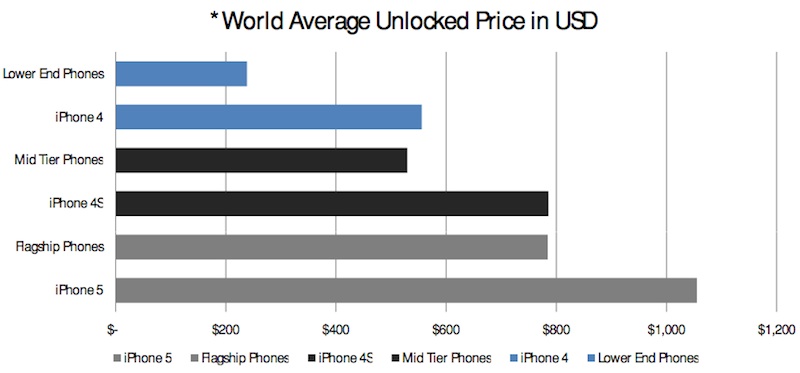
Not many consumers are going to prefer shelling out full retail price for the latest Apple iPhone, even if they can afford to do so.

If all devices must be sold at full retail, basic economics suggests that people will trade down to cheaper devices, or stretch the amount of time they keep an existing device, if a switch to fully unlocked phones were to occur.

Installment plans now available from T-Mobile USA and Verizon Wireless address that issue.

The point is that the assumption mandatory unlocking would lead to “more choice and lower prices” is not as clear cut as might seem to be the case. 

It is the ability to get a new and “better” device every 18 months that might be the value consumers get from subsidized phones, whether unlocked or not. The installment plans might provide such value, at the same time heading off pressure to mandate device unlocking.

Nor is it clear that consumer device replenishment rates or demand for “used devices” will change, either way.

ReCellular is said to be one of the largest U.S.-based mobile phone refurbishers, reselling or recycling 5.2 million mobile devices in 2010.  ReCellular sells about 60 percent of its phones in the U.S. market and the rest mostly to dealers in Asia, Africa, Latin America and Eastern Europe.

But global sales of used phones total only a few hundred million units a year, estimates Andy Castonguay, an analyst at consulting firm Yankee Group. That compares with the 1.6 billion new devices sold worldwide in 2012.

Also, according to one U.S. study, the typical mobile device is used 18 months before being replaced. Whether that would be different, with separated device and service plans, is unclear.

At least for the moment, demand for sales of “unlocked” devices should be dampened by the growing trend to separate device subsidies from the cost of mobile service. The theory behind sales of unlocked devices is that consumers would see lower prices, and gain more freedom to switch providers.

The former should happen, in one sense. Consumers will see lower retail prices, if only because the hidden device subsidies are removed. For a while, the ability to switch providers, in the U.S. market, will be sharply limited because of differences of air interface.

Perhaps in an attempt to head off regulation that would force sale of “unlocked” devices, service providers are shifting in a direction that could provide greater buyer transparency, potential for some cost savings and greater freedom to switch providers, though not as much as backers of unlocked devices would prefer.

Goldens in Golden

There's just something fun about the historical 2,000 to 3,000 mostly Golden Retrievers in one place, at one time, as they were Feb. 7,...