Tuesday, March 19, 2019

Are Telcos Like Airlines?

These days it seems just about every firm in every communications or computing industry segment touts its own relevance for either 5G or internet of things. That usually is a sign of big expectations for a growth wave.

It also can be interpreted as an indicator of something much darker: a grasping at flotation devices when a ship is sinking and passengers are in the water. That likely overstates matters a bit.

“It’s time the telecom companies embrace this new reality and rethink the key orthodoxies that have shaped their industry since the first phone call was made about 140 years ago,” McKinsey analysts argue. “If not, the alternative is dire.”

Among the problems is the relative shrinkage of connectivity provider role in the broader internet, communications and content ecosystems.

But the search for new sources of revenue is an urgent concern for an industry whose growth engines change over time, and which faces maturation and decline of all of its core legacy products.

There is more. The connectivity industry’s various segments have unclear positioning in financial markets, which means it is not so easy to value the assets. Nearly everyone would agree that the old valuation model--slow growth, dividend payers--is changing.

But what new positioning the industry eventually assumes is unclear. What if most connectivity providers cease to pay dividends? Aside from the danger of a massive turnover of investor base, what new position will telecom occupy? What other industries will it resemble? And what are the implications for valuation?

Classically, financial analysts have looked at equities are being either growth or value stocks, with high valuation multiples for growth stocks and low multiples for value. Telecom traditionally has been viewed in the value category.

Bu that is changing. To a growing degree, connectivity providers do not pay a dividend. In most cases, that is because cash flows no longer are sufficient to support such practices.

And that calls into question the whole notion of how to think about any connectivity provider’s equity.

Traditionally, if a firm does not pay a dividend, it adds value because it supplies growth. But what if a firm jetisons its dividend but also does not supply growth? What sort of asset is that, and how much should a rational investor be willing to pay for it?

The big question is why own any equity that has neither growth nor a dividend stream. That, in turn, affects ability to borrow money; make acquisitions and even survive as a public company.

Investors understand what a utility is; what a dividend growth company is; they understand cyclical and defensive sectors; growth vehicles as well as income plays.  

Perhaps distressingly, they also understand that some whole industries--including capital-intensive industries such as shipbuilding, some forms of transportation, mining, energy exploration and airlines--often have extreme difficulty maintaining profitable operations.

That affects their valuation. So what does that mean for the broad telecom business? We might have to look at analogies; industries that resemble the business much of telecom might become.

For decades, I have considered the airline industry a sort of analogy for telecom. It is a competitive, yet highly capital-intensive business with key governmental oversight and context.

Both industries suffer from periodic price wars, potential overcapacity and price-lead competition. Major waves of bankruptcies have occurred.

Business strategies also increasingly involve trade offs. No single firm can operate everywhere, supporting every product. So alliances form. Airlines do code sharing and co-marketing, telcos do interconnection agreements and roaming.

Like telecom, airlines have value that is intangible, though generated using quite-physical means. The value is perishable: once an airplane takes off, no more seats can be monetized. Once a minute of time has passed, the value of communications also passes, as well as the ability to monetize.  

Some argue telcos should emulate airlines, offering a basic service so bad that customers are willing to pay more to alleviate the pain. Some might argue that is precisely what most telcos already do, unwittingly.  

But the key lessons from the airline analogy are clear enough. Valuation multiples are low, as investors have no confidence long-term, stable profits are possible. The industry arguably has lost money much of the time since deregulation, in part because new competitors often enter the market with low price attacks that destroy profit margins.

“We’ve seen this before in other capital-intensive industries,” McKinsey consultants have said. “The airline industry, for example, despite incredible growth in travel during the early part of this century, destroyed economic value until 2015 when, for the first time, the industry-level average return on invested capital (ROIC) was just in excess of its cost of capital.”

So, like it or not, the connectivity industry is going to be looking an awful lot more like the airline industry, with related business problems and valuation assignments, in coming years. What might change what some would consider a trap is a fundamental change of industry business models and revenue sources.

As unpopular as AT&T’s move into content ownership has been, it mirrors the similar successful shift at Comcast, away from distribution and into content-based businesses. That could ease the transition as it means firm valuation has to be a complicated sum of the parts.

Some shrinking or slow-growing parts are matched with stable or fast-growing lines of business. Connectivity always will be key; it simply will not be the sole driver of results.

Monday, March 18, 2019

What Future for Telco Dividends?

S&P Global senior writer Sarah James takes a look at telco dividends, and the future for such payments. 

The problem is that an industry once characterized by slow growth and rich dividend-paying now is a mix of firms that do not pay dividends, firms that pay, but arguably cannot afford to do so, and a few that might eventually find their way to sustain the traditional model. 

The big challenge is what happens if big dividend payers discover they cannot sustain even slow growth, with moderately-high earnings and cash flow sufficient to pay the dividends. It will not attractive to be a negative-growth, no-dividend company.

It might prove difficult--maybe impossible--to make the transformation to high-growth, no-dividend status. That narrows options greatly, for the remaining dividend payers. 

Disappearing dividends deepen divide between AT&T, Verizon and smaller telcos.

Facebook to Sell Excess Capacity to 3rd Parties

Without making too much of the move, Facebook, which like other major app providers now drive deployment of wide areas optical fiber networks globally, now says it will sell excess capacity

“You’ll start to see a Facebook subsidiary, Middle Mile Infrastructure, operating as a wholesale provider (or, where necessary, as a telecommunications carrier).to third parties,” said Kevin Salvadori, Facebook director of network investments.


source: Broadband Now  

"Anxiety" at MWC2019

“Anxiety” is the word researchers at ABI Research use to describe the mood at MWC2019. Perhaps it would be more accurate to say connectivity providers were anxious, not the application suppliers that now are a fundamental part of the ecosystem, including suppliers of enterprise vertical market solutions.

That, in turn, largely reflects the saturation of consumer markets for mobile services, and the expectation that new enterprise use cases will drive new revenue sources in the 5G era.

It is hard to argue with that assessment, as the connectivity services market has been under pressure to change for decades already.

“There is widespread understanding in the sector that future revenue growth will come from vertical markets” (enterprise and business services) as the consumer market has nearly saturated,” ABI Research says.

Yes, there now is much hype about 5G, and hope that it will lead to discovery of big new revenue sources. The anxiety comes from the fear that this will not happen. It is not an unfounded concern.

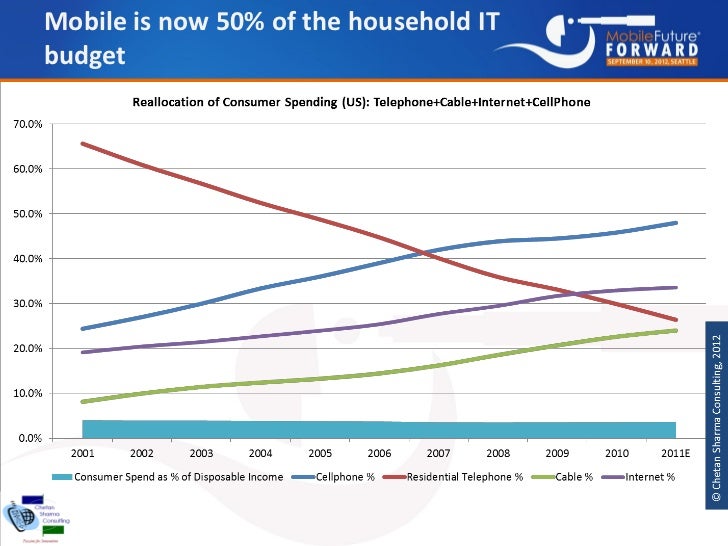
It is not metaphor to suggest that the connectivity industry has had to replace about half
its present revenue about every decade or so since the beginning of deregulation and privatization in the 1980s and 1990s.

In 2001, about 65 percent of total consumer end user spending for all things related to communications and video services went to fixed network "voice."


In 2011, fixed network voice represented only about 28 percent of total consumer end user spending. That is easily a reduction by half.

Mobile is now 50% of the household ITbudget
source: Chetan Sharma

Mobility then replaced fixed network voice spending. 

Private LTE Use Case: Allowing Firefighters to See Through Smoke


Qwake’s C-THRU uses computer vision and augmented reality to allow firefighters to see in a smoke-filled building. It's an example of a private LTE use case. 

Sunday, March 17, 2019

Intangible Products Become "Tangible" in the Process of Delivery


Selling services generally is more difficult than selling a product. By definition, services--including communications--are intangible. Like marketing advice, crisis management and other services, communications can be very hard for buyers to evaluate, in advance of purchase.

These sorts of goods are not physical objects consumers can see, hear, taste, smell or touch.

There is no physical object to inspect, so a potential buyer has to try and determine value some other way. Buyers must rely on evaluations, third party testimony, advertising or other proxies for value.

There being no way the buyer actually can determine “quality” in any direct way, until the services are provided. Consider the use of Amazon, for example. Customers might in that case be buying tangible products. But some important part of the experience is the delivery.

Was billing accurate? Was payment secure? Were delivery communications timely and accurate?

Did actual delivery happen when expected (within two or some other promised number of days), where expected (the right address) and how expected (on the day promised, within a four-window, at a place at the delivery location expected)?

Communication products likewise are mostly intangible, There arguably is no "product" until consumption begins. And that is why "trust" often looms so large in the sale of communication products. Customers do not actually know what they will get until after they buy and start using the product. 


The Last Frontier of Radio Communications

The U.S. Federal Communication Commission has adopted new rules allowing experimental licenses of 10-year duration for services in the 95 GHz to 3,000 GHz spectrum, intended to allow innovators to create potential new use cases.

The move might be deemed notable for several reasons. For starters, 3,000 GHz is about the absolute limit of the radio wave spectrum, the place where energy exists as infrared light, not radio waves. We can communicate using light, that is what fiber optics is about. The point is that we have been beyond widespread and cheap free space communication platforms once we are in the realm of light-based communications.

Among the other implications is the near-certainty that commercial use of frequencies this high will be part of the eventual 6 G standard, as every new generation of digital mobile platforms has added new spectrum higher in frequency.

And since communications in the radio domain start to become “particle-like” or “wave-like” as frequency increases, “line of sight” becomes a major constraint, suggesting the highest ranges of radio frequencies will be best suited for near-field communications, indoor communications and other settings where line of sight is not a big problem.

source: K.B. Kiran  

Friday, March 15, 2019

Ericsson, Telia, Volvo Operate Industrial 5G Network

5G might not be a full replacement for Wi-Fi in all settings, but it is likely to happen in at least some industrial settings where manufacturers want greater control over latency performance of their local area networks when using sensors, automated equipment and production processes.

Ericsson, Volvo Construction Equipment, and Telia, for example, now are operating Sweden’s first 5G network for industrial use, using 5G to control excavation equipment (loaders)


The 5G network uses Ericsson commercial hardware and software, including 5G New Radio (NR) and Core products from Ericsson’s 5G Platform,  at Volvo CE's research and development facility in Eskilstuna, a municipality approximately 90 kilometers west of Stockholm.

The partners aim to develop solutions for remote control of construction machinery and fully automated solutions.

It has been a couple of decades since serious questions were raised about the respective roles of Wi-Fi and mobile networks as platforms for consumer data access. But the debate is emerging again.

Two decades ago, observers debated whether Wi-Fi was a substitute for mobile access. The latest debate flips the question. Now we debate whether mobile is a substitute for fixed network internet access, or whether 5G can replace Wi-Fi.

To be sure, many are sure that will not happen on a widespread basis, just as Wi-Fi and mobile became complements, not substitutes.


But it seems almost certain that, in some use cases, 5G networks will displace Wi-Fi networks. Private networks using 5G seem attractive to some industrial customers because of the built-in latency performance, for example. Some auto manufacturers also are looking at 5G as a replacement for Wi-Fi.  

Others believe 5G could replace consumer home internet access, as yet the latest form of mobile substitution. To a large extent, the feasibility of using mobile platforms to replace fixed internet access, or 5G to replace Wi-Fi, hinge on tariffs and bandwidth.

Until 5G (especially using millimeter wave assets; spectrum aggregation and other tools), it would not have been feasible--either for reasons of capacity or prices--to consider using mobile networks as a full product substitute for fixed networks.

Bulk access at low prices is among the key issues. Many would still argue that mobile substitutes (including fixed wireless) cannot match the cost-per-bit profiles of fixed networks. But mobile data prices have been dropping steadily, though some fixed network services continue to hold an order of magnitude advantage in cost-per-bit.

Of course, all cost-per-bit metrics are statistical. The effective price per bit actually depends on the actual amount of data consumed by any particular customer.

Others argue that price, capacity and speed of 5G networks could in fact offer competitive offers for many customers.

The most-reasonable assumption is that 5G will displace Wi-Fi or fixed networks in specific use cases, and not generally. There will be some industrial settings where 5G might well substitute for Wi-Fi.

Some consumers will find they can "cut the cord" on fixed network access because mobile offers enough speed and usage, at the right price, for the actual use cases some customers have.

In other cases, 5G fixed wireless might offer a full product substitute for some households.

Where Might 5G be a Replacement for Wi-Fi?

What strategic challenges does Wi-Fi face from 5G? Dean Bubley, founder of Disruptive Analysis examines the opportunities and threats. 

Do Telecom Brands Matter? If So, How Much?

It is not clear how much brands matter in business, but few would dispute the argument that perception matters quite a lot, at times. What often is harder to ascertain is the degree of correlation between estimates of brand value and other metrics such as market share or profit.

Few might argue that brands are irrelevant in telecom or any other business. What is harder to ascertain is the degree of correlation and the degree of business value.

Nor are consumer surveys necessarily so helpful. Some polls have shown that U.S. consumers believe Apple is leading in 5G handsets, when Apple has yet to announce any specific devices, and likely will not do so for perhaps two more years, though Motorola and other suppliers are selling 5G devices now.

A recent PCmag poll (unscientific) found respondents believe Verizon will lead in 5G, though at this point it is not clear anybody actually does.


But such associations are complicated. Some studies have shown that market share and customer satisfaction are not correlated, for example.  Neither, it turns out, are satisfaction scores directly correlated with loyalty.

In other words, satisfied customers are not necessarily loyal customers, willing to keep buying.

But brand perception sometimes is correlated with market share gains or declines.

Some will note that Verizon often leads in surveys of consumer perceptions of value or quality. On the other hand, some surveys of global telecom firms have found AT&T surpassing Verizon in brand value, with the caveat that it always matters what methodology is used.

That points to the business value of branding, which firms such as Nielsen continue to insist are correlated with business success. A recent Nielsen survey of retailer brands and share of wallet (consumer spending) showed there is a direct correlation between buyer perception of a retailer brand and consumer spending.

So the arguably harder to assess matter of leadership perceptions around 5G services and devices might represent the same sort of correlation between buyer perception of leadership and eventual spending.


Consumer perceptions are not always easy to correlate with brand value or supplier market share. Nor is the relationship between brand and market share always so clear. Nor is it always easy to correlate customer satisfaction with customer loyalty, or market share with profitability.

It might be reasonable to expect a correlation between brand value, market share, retention, profitability or other quantitative metrics most of the time. But it does not always seem linear, though research and common sense suggest there should be clear correlations.

The even-harder question is the degree to which correlation exists because there is causation.  

Thursday, March 14, 2019

AI is Practical and Here Now, Google Scientist Says


The message is that artificial intelligence is practical and already happening, to support core business processes, according to Cassie Kozyrkov, Google Cloud Chief Decision Scientist. 

Wednesday, March 13, 2019

Will AT&T Capex Decline in 2019 or 2020?

Though many had feared runaway capex spending for 5G, more recent evidence suggests some mobile operators might not see a material increase in capex, even as 5G gets built. In fact, AT&T now says it could have lower capex in 2019 or 2020, in part because network virtualization now allows the firm to operate its network more efficiently.

But there are lots of other interesting ways AT&T might operate its platforms more efficiently. Consider the classic argument for upgrading all-copper telco networks to fiber to the home, fiber to the node or very high speed digital subscriber line networks: video entertainment.

At the risk of losing additional internet access market share, AT&T could hold or increase its linear video share by selling an OTT streaming service that can be bought by any household, bringing its own broadband.

To be sure, that risks the loss of, or inability to regain, millions of internet access accounts from cable and other competitors. But that might be a calculated risk AT&T is willing to take.

Consider that AT&T now gets 49 percent of its earnings from the mobile network; 18 percent from its content ownership interests; about 17 percent from enterprise services using the fixed network and about 15 percent from all consumer voice, internet and video subscription sources.

Looking at the 15 percent of revenue AT&T earns from its consumer fixed network operations, AT&T earns 72 percent of revenue from entertainment video (largely from out of region), 17 percent from internet access and six percent from voice.

The point is that AT&T actually earns relatively little revenue from fixed network consumer internet and voice accounts. Likewise, AT&T earns relatively little linear video subscription revenue in region, on its own network.

Perhaps 3.7 million of AT&T’s total 24.5 million video connections are supplied using the U-verse fiber to node network, while nearly 21 million use the DirecTV satellite constellation.

FTTN or FTTH represent perhaps 17 million internet access connections out of 17.5 million total broadband accounts, and possibly 29 million passings, by about mid-year 2019.

Keep in mind that AT&T is going to transition its DirecTV satellite video service to an over-the-top streaming service that runs over any broadband network. So, in principle, AT&T does not “need” to upgrade its own fixed network access lines to sell linear video.

It could, in fact, sell the service to competitors operating in its own fixed network territories. So one way of quantifying the upside from new FTTH facilities is that if AT&T could boost its internet access share 20 percent to 30 percent in areas where it adds FTTH.

Whether that is sufficient to justify an FTTH build is the question, since voice is almost negligible and shrinking, while video arguably can be delivered OTT. That is how AT&T makes most of its linear video revenue already.

The other issue is whether alternative means would provide a better financial case, such as using fixed wireless or even mobile 5G to gain internet access account share.

The big takeaway is that AT&T’s business case for new FTTH is fairly narrow, given the potential upside from incremental revenue based mostly as gaining broadband share.

$36 Billion in AI Spending in 2019

Firms and agencies in the United States will represent nearly 66 percent of all spending on artificial intelligence systems in 2019, or about $23 billion, led by the retail and banking industries, IDC analysts predict.

Western Europe will be the second largest region in 2018, led by banking, retail, and discrete manufacturing, IDC says.

The strongest spending growth over five years will be in Japan (58.9 percent compound annual growth rate) and Asia/Pacific (excluding Japan and China) (51.4 percent CAGR). China will also experience strong spending growth throughout the forecast (49.6 percent CAGR), according to IDC.


Worldwide spending on artificial intelligence (AI) systems is forecast to reach $35.8 billion in 2019, an increase of 44 percent over the amount spent in 2018, IDC predicts.

IDC also expects spending on AI systems will more than double to $79.2 billion in 2022.

Global spending on AI systems will be led by the retail industry where companies will invest $5.9 billion this year on solutions such as automated customer service agents and expert shopping advisors and product recommendations.

Banking will be the second largest industry with $5.6 billion going toward AI-enabled solutions including automated threat intelligence & prevention systems and fraud analysis & investigation systems.

The industries that will experience the fastest growth in AI systems spending over the 2018 to 2022 period are federal/central government (44.3 percent CAGR), personal and consumer services (43.3 percent CAGR), and education (42.9 percent CAGR), IDC believes.

The AI use cases that will see the most investment in 2019 are automated customer service agents ($4.5 billion worldwide), sales process recommendation and automation ($2.7 billion), and automated threat intelligence and prevention systems ($2.7 billion).

Five other use cases will see spending levels greater than $2 billion in 2019: automated preventative maintenance, diagnosis and treatment systems, fraud analysis and investigation, intelligent process automation, and program advisors and recommendation systems.

Software will be the largest area of AI systems spending in 2019 with nearly $13.5 billion going toward AI applications and AI software platforms. AI applications will be the fastest growing category of AI spending with a five-year CAGR of 47.3 percent.

Hardware spending, dominated by servers, will be $12.7 billion this year as companies continue to build out the infrastructure necessary to support AI systems.

By the end of the forecast, AI-related services spending will nearly equal hardware spending.

AT&T Shift to Streaming Linear TV Has Numerous Advantages

As some had speculated or feared, AT&T’s purchase of DirecTV is leading to a major change in video entertainment delivery, away from linear service based on the fixed network, away from satellite delivery, and towards streaming.

There are all kinds of implications. Not the least of the advantages are operating cost reductions. “The biggest cost we have it that is so to speak, the truck role and getting that installation out,” said John Stephens, AT&T CFO. So AT&T has been testing a self-install decoder “called Osprey,”  which is a “self-installed, full linear product.”

So “the only truck roll is the UPS truck,” he quipped. “It dramatically reduces our install cost; dramatically reduces our subscriber acquisition costs.”

So the standard linear video product shifts from U-verse to DirecTV to DirecTV Now, using a self-install decoder and “bring your own broadband.”

The Osprey is said to be an Android-TV-powered streaming player that will offer the same linear service contracts and channels but without the use of a satellite dish.

That deployment model keeps DirecTV’s national footprint, but shifts the platform to streaming. In principle, that also gives AT&T more options about how to upgrade internet access bandwidth inside its fixed network footprint.

The shift to streaming eliminates the need for a dedicated linear video network. By unbundling access and app, AT&T also gains the ability to use any access platform (its own, or others) to support linear streaming video. Where U-verse video segregates linear video from internet access, the streaming platform shares the access pipe.

Oddly enough, AT&T might have to provision less bandwidth for linear streaming than for U-verse video, as U-verse video used separate logical networks over the same access cable.

As was the case for cable TV operators migrating from analog video to digital video, one important advantage was that additional bandwidth was freed up for internet access purposes.

Yes, Follow the Data. Even if it Does Not Fit Your Agenda

When people argue we need to “follow the science” that should be true in all cases, not only in cases where the data fits one’s political pr...