Thursday, February 7, 2013

LTE Prices Dropping, Globally

Up to this point, 4G prices have been higher than 3G . But that could already be changing.

Comparing retail prices between the second quarter of 2012 and the fourth quarter of 2012, service providers in 73 percent of countries have reduced the “effective cost” of their 4G tariffs  to a significant degree, according to ABI Research.

The effective cost in terms of “dollars per gigabyte” has dropped by 30 percent, overall.  In United States, service providers kept fees the same but offered larger data quotas.

In Australia, Sweden, Japan, Singapore and Saudi Arabia the operators lowered the monthly fee but have data quotas unchanged.

​India currently offers the lowest priced plan, ABI Research says. India’s lowest priced mobile data plans decreased 29.4 percent year-over-year in the fourth quarter of 2012.

And some mobile service providers are pricing 4G at a discount to 3G. “In Norway, Telenor has introduced 4G tariffs that are cheaper than 3G,” ABI Research says.

Mobile broadband services using Long Term Evolution will experience a substantial 60-percent price drop  in retail prices between 201 1and 2016, according to Tariff Consultancy, on the way to gaining 250 million users worldwide by the end of 2016.


Average monthly user data allowances for LTE mobile broadband services in 2011 were about 22 GBytes per month, in some cases ranging as high as 80 GB per month in the case of Tele2 Sweden.

The average mobile broadband price globally for a top of the range LTE mobile broadband service was 50 Euros per month, for two-year postpaid contract service.

The study showed that average LTE broadband prices ranged from 0.5 Euro (Tele2 Sweden) up to 9.9 Euro (Omnitel Lithuania) per GByte of data mobile usage.

But retail prices started dropping at least by 2011. . Telstra (Australia) “BigPond” offered an 8 GByte monthly data user allowance for the equivalent of 30 Euro per month,

BigPond had launched offering 4 Gbytes for 38 Euro. In Singapore M1 (Mobile One) was offering customers a 40 percent discount off the monthly list price.


The price trends might not be so obvious in all markets. U.S. service providers, so far, have generally tried to price at a premium for LTE services.

Vodafone Earnings Woes Spur Talk of Sale of Verizon Wireless Assets

Vodafone’s latest quarterly financial report illustrates the reasons why some analysts, and executives at Verizon, might be weighing some action to change the current ownership status of Verizon Wireless, majority owned by Verizon, but with a big minority intBut erest held by Vodafone.

To be sure, Verizon says no such talks are underway. Well, to be specific, Verizon says no talks about a full purchase of the 45 percent Vodafone stake in Verizon are underway. That would still leave some room for less complicate measures, such as a gradual purchase by Verizon of Vodafone shares.

In fact, most observers have noted for a decade that Verizon would prefer to own all of Verizon Wireless. But talk about a Verizon purchase of Vodafone has heated (again) recently. Earnings weakness at Vodafone could be a factor.

Vodafone posted a worse than expected drop in group revenue for the last three months of 2012. The biggest declines came from Europe operations.

Vodafone service revenue dropped by 2.6 percent to £10.37 billion in the fourth quarter of 2012.

Southern Europe services were hit the hardest, dropping nearly 12 percent to £2.3 billion.

In Italy service revenue tumbled 13.8 percent, partly caused by lower mobile termination rates.

Spain revenue was down 11.3 percent. Significantly, that hit was caused at least in part by the ending of handset subsidies.

Africa, Middle East and Asia Pacific service revenue grew 2.7 percent to £3.14 billion.

Verizon Wireless service revenue grew 8.7 percent. Verizon Wireless also paid Vodafone £2.4 billion in dividends,

So the issue for Vodafone is whether the value of the dividend stream is more important than the monetization of Verizon Wireless equity value.

How Much Does Fiber to Customer Really Help Service Providers?

Though there are not too many developed nation markets where a new national fiber to the cabinet network will change the market, Italy might be the exception to the general rule.

In January 2012, the penetration rate of fixed broadband in Italy was 22.2 percent of the population, up by 0.5 percentage points year-over-year but 5.5 percentage points below the EU average of 27.7 percent.

Italy, in other words, might be said to represent an “under-penetrated” market, in terms of fixed network broadband.

Italy also lags behind in the penetration growth rate with a 0.5 percent increase, compared to the EU average of 1.2 percent annually.

Fastweb is the only provider in Italy to offer “fiber to the cabinet” fixed-line broadband, to around two million households in Italy’s urban areas.

Fastweb generally says its network supports 100 Mbps right now, with the ability to increase speeds to 300 Mbps to 400 Mbps over the next several years.

Fastweb plans to invest some EUR 130 million in fiber expansion by the end of 2013.

And Fastweb obviously thinks its fiber network will have resonance with Italian consumers. Italy has 8.2 percent of fixed lines providing speeds of 10 Mbps and above.

There are no subscriptions with speeds greater than 30 Mbps, according to an EU analysis of broadband in Italy  Around 90 percent of broadband lines in Italy are in the range of 2 Mbps and below 10Mbps,

Mobile broadband penetration of all kinds of devices (both handheld devices and computers) is 31.3 percent, up by 3.1 percent, year-on-year, but still 11.8 percent below the EU average penetration level.

At the same time, penetration of dedicated data services cards, modems and keys only is 10.2%, which is by 2.6 p.p. higher than the EU average.
read more

Most other places, optical fiber, though a key means, long term, for boosting access speeds, is a somewhat difficult financial proposition.

The problem is that, in many developed nation markets, optical access revenue basically only cannibalizes cable modem and digital subscriber line revenue, for the most part.

In such markets, broadband access is nearly a zero-sum game. Adding an optical subscriber generally means losing a cable modem, digital subscriber line, satellite broadband or fixed wireless subscriber. There could be market share shifts, but likely little growth in the overall broadband access market.

The other issue is average revenue per user. Globally, broadband average revenue per user has continued to decline across all broadband platforms, says Jake Saunders, ABI Research VP.

But Fastweb might be said to be operating in a favorable market, where adding an optical access subscriber does not necessarily mean taking a DSL subscriber out of service. Nor are cable operators much of a factor in the Italian broadband access market.

Globally, that might not be the biggest part of the story.

Global fixed broadband services generated $188 billion worth of service revenue in 2012, a seven percent increase from 2011, according to ABI Research.

Fixed broadband service revenue will grow to $251 billion by 2018, ABI Research also predicts.

If one assumes 2012 global fixed network revenue as about $1 trillion, then broadband would represent about 19 percent of total fixed network revenue.

Assume video entertainment revenues such as IPTV represent about eight percent of telco revenues, on a global basis. That implies that 70 percent of global telco revenue still is being earned from voice services.

And if you assume global fixed network growth in developed and developing regions will be flat to negative, there is a big revenue problem developing that everybody already recognizes, namely that replacing perhaps half of the voice revenue over perhaps a decade is the main challenge facing executives at many firms.

That might imply replacing about $350 billion. If ABI Research estimates prove accurate, broadband access will grow by about $63 billion between 2011 and 2018. For the sake of argument, assume fixed network broadband continues to grow at that same volume for the next five years, implying a decade-long increase of about $126 billion.

That roughly suggests the revenue shortfall fixed network operators will face is about $224 billion in current voice revenue that will be lost over 10 years.

Except in markets such as Italy, optical fiber services are not going to help most service providers too much, where it comes to replacing lost voice revenues.

Wednesday, February 6, 2013

Liberty Global Buys Virgin Media

Liberty Global is spending $23.3 billion to buy Virgin Media, the U.K. cable operator, a move that makes Liberty Global a much bigger player in the European cable TV and Internet access markets. 

Liberty Global would serve about 25 million customers, assuming the transaction is approved by regulators.

Liberty Global also owns cable assets in Germany, Belgium, and other countries across the continent.

Among other implications, the deal might suggest that low interest rates and somewhat depressed equity valuations could drive a wave of acquisition activity in the communications and entertainment video space, while such conditions exist. 

Though some of us would not say the deal necessarily changes competitive dynamics in the U.K. market, we might be more inclined to say that the expected wave of acquisitions could have such impact, eventually. 

Low interest rates, limited organic growth opportunities and attractive equity valuations are going to spur more thinking about "growth by acquisition" strategies. The downside, some might also say, is an increase in leverage for the acquiring firms. 

That, in turn, might have unpleasant consequences for some acquirers, several years down the road. depending on the direction and magnitude of interest rate movements. 

Microsoft Initiative Explores White Spaces in Kenya

There there might yet be some confusion about white spaces spectrum as a new way to provide Internet access using unlicensed spectrum, the approach remains of high interest to application providers and device suppliers, if generally opposed by established mobile service providers, for obvious reasons.

The Microsoft 4Afrika Initiative hopes, by 2016, to have placed tens of millions of smart devices in the hands of African youth, put a million small and medium businesses online, and have helped 200 000 Africans develop skills for entrepreneurship and work, says Ali Faramawy, corporate VP, Microsoft Middle East & Africa.

The project plans to train 100,000 members of the existing workforce and 100,000 recent graduates, 75 percent of whom the project intends to help place in jobs.

You can watch a video about the project, which features satellite services provider  
Indigo Telecom, which will be providing the Internet access.

Using solar-powered base stations together with TV white spaces, the project will deliver high-speed Internet access to areas currently lacking even basic electricity.

Microsoft says it will launch similar pilot projects in East and Southern Africa to further explore the commercial feasibility of white space technologies.

These pilots will be used to encourage other African countries to accelerate legislation that would enable white spaces technology.


"Voice Isn't Dead Yet," Optimist Says

Some have argued that mobile VoIP will grow mobile service provider revenues, an argument that makes more sense if one assumes the mobile VoIP is provided by a third party “over the top,” or by a new entrant without a significant legacy customer base.

In most other cases, a rational person would argue that mobile VoIP is more likely to harm mobile service provider revenues.  Mobile VoIP might represent less than 0.5 percent of overall service provider mobile voice revenues, according to ARCchart.

ARCchart sees similar issues for mobile service provider messaging. ARCchart expects that instant messages will exceed text messaging volumes by 2014 and continue growing rapidly, accounting for 65 percent of all message traffic pushed over mobile networks by 2016.

In 2012, global mobile VoIP service revenues might be about $2.5 billion. But mobile voice revenue overall could be in the range of roughly $1 trillion.

So the problem is that mobile VoIP represents a very small percentage of the legacy mobile voice revenue stream. To be sure, mobile VoIP is in its early stages, so a direct comparison of revenue means very little. So far, mobile VoIP probably has been important mostly as it reflects the loss of high-margin and high volume legacy voice call volumes.

But that is not likely to be the case, always. There will be 1.1 billion mobile VoIP clients in use by 2017, over half of which will be over the top apps, analysts at Juniper Research now estimate. Just how much revenue those mobile VoIP users will generate is the issue.

"As with Skype on the desktop, only a very small proportion will pay for the service," Juniper Research said.  “Wi-Fi mobile VoIP is potentially the most damaging of all VoIP traffic, as it bypasses the mobile networks altogether."

“We forecast that mobile VoIP over Wi-Fi will cost operators $5 billion globally by 2015,” said Anthony Cox, Juniper Research analyst.

In fact, a recent forecast by Visiongain suggests 2012 mobile VoIP revenues would reach only about $2.5 billion to $4 billion, globally.

“Many subscribers sign up to an OTT service without ever planning to pay a cent for it, and some industry players do not have a short-term revenue model at all,” said Cox.

Still, researchers at Analysys have in the past predicted that, as early as 2012, mobile VoIP services would generate revenues of $18.6 billion (EUR15.3 billion) in the United States and $7.3 billion (EUR.6.0 billion) in Western Europe, compared with fixed VoIP revenues of $11.9 (EUR9.8 billion) in the United States and $6.9 billion (EUR5.7 billion) in Western Europe.

It seems doubtful those levels of revenue have been realized, though. In fact, analysts seem to have overestimated the revenue mobile VoIP would represent, rather consistently. Though service providers are not without options, the direction is clear. As one self-proclaimed optimist said recently, “voice isn’t dead yet.” And that’s the optimistic view.

Tuesday, February 5, 2013

Smart Phones Drive Mobile Data Consumption, Globally

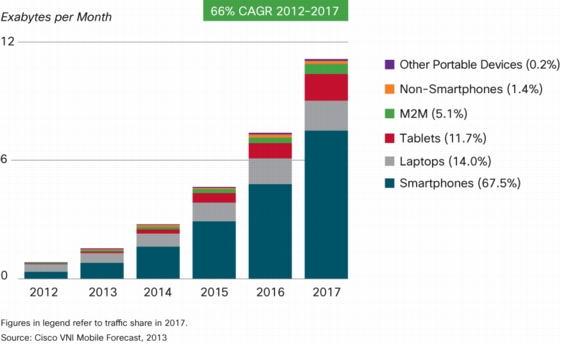
In 2012, global mobile data traffic grew more than 70 percent year over year, to 855 petabytes a month, according to Cisco.

Mobile data traffic growth varied by region, with the slowest growth experienced by Western Europe at 44 percent, and the highest growth rates experienced by Middle East and Africa (101 percent) and Asia Pacific (95 percent).


There are three key reasons for the lower mobile data traffic growth in Europe in 2012, Cisco says. Tiered mobile data packages are one reason, as most “unlimited” plans have been eliminated.

In Europe, there also has been a slowdown in the number of mobile-connected laptop net additions. The number of mobile-connected  laptops in Europe declined from 33.8 million at the end of 2011 to 32.6 million at the end of 2012.

Per Device Usage, MByes per Month
Device Type
2012
2017
Non smart phone
6.8
31
M2M Module
64
330
Smart phone
342
2,660
4G Smart phone
1,302
5,114
Tablet
820
5,387
Laptop
2,503
5,731

In Europe, there also has been an increase in the amount of mobile traffic offloaded to the fixed network. Operators have encouraged the offload of traffic onto Wi-Fi networks. Tablet traffic
that might have migrated to mobile networks has largely remained on fixed networks, as well.

By 2017, global mobile data traffic will reach 11.2 exabytes per month, or a run rate of 134 exabytes annually.

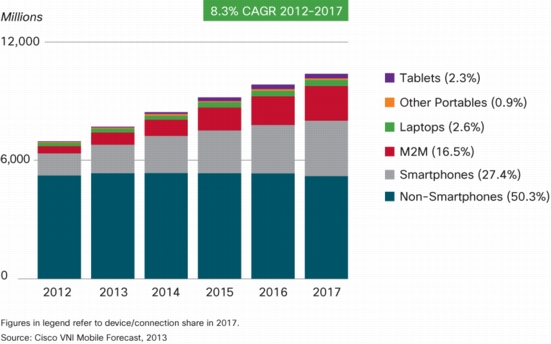
Smart phones will be 68 percent of total mobile data traffic in 2017, compared to 44 percent in 2012. LTE 4G connections will be 10 percent of total mobile connections in 2017, and 45 percent of mobile data  traffic.


Global mobile network connection speeds doubled in 2012 and will increase seven fold by 2017, reaching 3.9 Mbps.

As much as 46 percent of global mobile data traffic will be offloaded in 2017, up from 33 percent in 2012, Cisco forecasts.

By 2017, 66 percent of the world’s mobile data traffic will be video, up from 51 percent in 2012.

The Middle East and Africa will have the strongest mobile data traffic growth of any region at 104 percent compound annual growth rates, followed by Asia Pacific at 84 percent and Central and Eastern Europe at 83 percent.

On the Use and Misuse of Principles, Theorems and Concepts

When financial commentators compile lists of "potential black swans," they misunderstand the concept. As explained by Taleb Nasim ...