Sunday, February 10, 2013

Has "Peak SMS" Been Reached?

Spain is in many ways an exemplar of what is happening to text messaging revenues in the European and some other markets.

After peaking at the end of 2008 at about €450/quarter, Spanish text messaging revenues have fallen by six percent to about €171 million in the third quarter of 2012.

As some would note, text messaging represents nearly 100 percent operating profit for mobile operators, so losing volume in such a high-margin revenue stream is a particular problem.

The reason for the declines is substitution by users of IP-based messaging for text messaging.

According to asymco, 97 percent of Spanish smart phone users have Whatsapp installed, allowing users to send free instant messages to other users.

That is cannibalizing text messaging. Use of SMS was down about 30 percent in the third quarter of 2012, for example.


Globally SMS traffic is still rising, but Informa Telecoms & Media forecasts that mobile operators will still generate a total of US$722.7 billion in revenues from SMS between 2011 and 2016.

But text messaging share of global mobile messaging traffic will fall, from this point forward, analysts suggest.


By some estimates, we are close to the point where over the top message volume should exceed that of text messaging.

In the U.S. market, for example, text messaging revenues and volume fell for the first time ever in the third quarter of 2012.

The only surprising fact is that text messaging revenue has fallen, even in the U.S. market, which has been relatively more protected from such losses, to this point.


Saturday, February 9, 2013

What Long Run Mobile Broadband Growth Rate?

In 2012, global bandwidth growth slowed to about 40 percent, from about 70 percent annual growth in 2008. But keep that in perspective. Growth rates always slow when any organism, business or trend reaches an adult stage, garners a much larger installed base or achieves high penetration. In other words, there is a “law of large numbers” at work.

And that seems the case for Internet bandwidth growth as well. While the pace of growth is slowing, international Internet bandwidth continues to grow rapidly, more than doubling between 2010 and 2012, to 77 Tbps, according to TeleGeography.

Average international Internet traffic grew 35 percent in 2012, down from 39 percent in 2011, and peak traffic grew 33 percent, well below the 57 percent increase recorded in 2011, TeleGeography says.

International Internet traffic and capacity growth rates are declining due to slowing broadband subscriber growth in mature markets, and the expansion of content delivery networks (CDNs) and local caching technologies, which reduce the need for new long-haul capacity by storing popular content closer to the end-users.

Some think the same sort of trend ultimately will characterize mobile broadband bandwidth growth rates as well, In fact, there is little reason to doubt that future trend, given historical precedents.

In March 2011, for example, AT&T projected that data bandwidth growth would be on the order of eight to 10 times over then-current levels between the end of 2010 and the end of 2015.

That forecast appears to be based on an expectation that volumes would roughly double in 2011 and then increase by a further 65 percent in 2012.

Instead, AT&T seems to be seeing something like 40 percent annual growth. To be sure, 40 percent annual growth is significant. It means bandwidth consumption doubles about every two to three years.

Cisco estimates mobile broadband grew about 70 percent in 2012, and will grow at a compound annual growth rate of 66 percent from 2012 to 2017.

Some believe Wi-Fi offload will slow the rate of mobile broadband growth. On the other hand, even such offloading, at high rates of perhaps 80 percent, would slow the rate of growth by about 50 percent.

Utilities Look to "Field Area Networks"

Add “field area network” (FAN) to the list of acronyms we use to describe communications networks of various functions and coverage areas, ranging from wide area network to metropolitan area network to local area network.

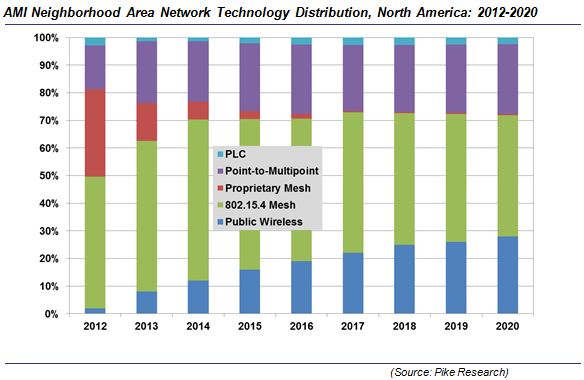
By 2020, annual global shipments of wireless communications nodes to support FANs will reach 14.3 million units, according to Pike Research.

The market for private utility FANs--which generally will be private networks--will be led by North America, which represented about 82 percent of world shipments in 2012.  

That share will decline steadily to 2020, but North America will still account for 44 percent of world shipments by 2020.  

The fastest growth in the decade will come in Latin America, where shipments will increase at a compound annual growth rate (CAGR) of 48 percent.

FANs will use a variety of wireless networks, ranging from radio frequency mesh and Wi-Fi to WiMAX or LTE technology.

A FAN is a network used to connect various devices located in a utility’s “field” of operations, which can include smart meters, concentrators, distribution assets, control and protection equipment, and substation equipment, according to Pike Research.

Some field area networks will use the 802.15.4 standard for fixed terrestrial radio networks. Others might use Long Term Evolution, Some also predict systems using the 802.15.4 standard, with point-to-multipoint fixed wireless, will dominate the networks used to support FANs.

But LTE networks operated by leading mobile companies could be a growing factor in the FAN market.

ABB, GE, S&C and Eaton are some of the established firms selling systems for the field communications market


Friday, February 8, 2013

Google Nexus 1 to Control Satellite, XBox Kincet Next, Seriously

A standard issue Nexus One smart phone will be controlling a new satellite to be launched by the end of February 2012. Granted, it is a "nano satellite" just  30 cm long and weighing 4.3 kg.

Still, using a consumer smart phone as a satellite controller is novel. 

Strand-2 satellite is under development. For that generation of satellites, two cubesats will use the motion-sensing technology in Microsoft's XBox Kinect devices to locate each other in space and dock together.

Huawei, ZTE, Lenovo Among Top 5 Smart Phone Suppliers in 4Q 2012

Huawei, ZTE and Lenovo ranked among the top-five suppliers of smart phones in the fourth quarter of 2012. You might expect Samsung and Apple to top the list, and they do.

In the fourth quarter of 2012, Samsung provided 63 percent of smart phone shipments while Apple had 48 percent. Huawei shipped about 11.5 percent of all smart phones globally in the fourth quarter of 2012, while ZTE shipped 10 percent. Lenovo shipped about 9.5 percent of smart phones in the quarter.

For some of us, the surprise continues to be that BlackBerry and Nokia do not appear among the top five. We sometimes become myopic and assume that Nokia and BlackBerry are fighting Samsung and Apple. In one sense, that is true. Nokia and BlackBerry will have to fight for a spot among the “high end” providers in the market.

In a larger sense, it appears the situation is that Nokia and BlackBerry have to catch Huawei, ZTE and Lenovo, all of which seem to be gobbling up the low end that Nokia once dominated.


Thursday, February 7, 2013

Mobile Broadband Grows 18% in OECD Region

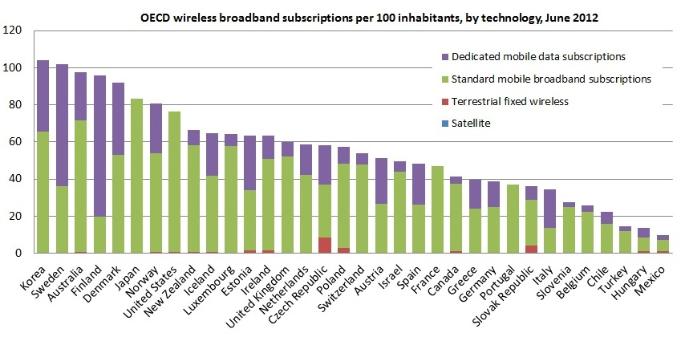
Mobile broadband subscriptions have reached nearly 700 million in OECD countries, the Organization for Economic Cooperation and Development reports.

Mobile broadband has grown at about an 18 percent rate from June 2011 to June 2012, largely driven by continuing strong demand for tablets and smart phones.

The average broadband penetration in the OECD area is 56.6 subscriptions per 100 inhabitants, OECD says.

Korea (104.2) and Sweden (101.8) are the only two countries with more mobile broadband subscriptions than inhabitants.
‌‌‌
Fixed wired broadband subscriptions reached 321 million in the OECD area in June 2012, for an average penetration of 26 subscriptions per 100 inhabitants, a 1.7 percent increase over the previous six months. Keep in mind that penetration per home depends on your assumptions about housing density in each country.

As a rough assumption, you might assume average households of two people each, so fixed broadband penetration might be 52 percent of homes.

Digital subscriber line  subscriptions are being replaced by fiber connections, though slowly.  The share of fiber subscriptions in fixed broadband has increased to 14.2 percent, while DSL represented 54.7 percent of the total fixed wired broadband subscription.

Since DSL and fiber represent 69 percent of connections, That could mean roughly 30 percent of connections.

Will LTE Be Complementary to Fixed Broadband, or a Substitute?

Will Long Term Evolution remain a complementary form of broadband access, or will it become a functional substitute? And, if so, for which sets of consumers will this be a logical choice?

AT&T and Verizon Wireless certainly believe there are some significant percentage of customers for whom broadband access supplied by mobile networks, though in a “fixed” basis, will be a viable substitute for fixed network broadband access.

Up to this point, the amount of such mobile substitution for broadband access has been fairly limited, and nothing like the substitution of mobile voice for fixed voice. But fourth generation networks, offering high speeds, which some liken to “digital subscriber line” speeds, should provide greater potential for substitution.

Still, some do not believe mobile broadband is a substitute for fixed broadband. Some of us doubt that. There might be many ways to infer meaning from the fact that fixed network broadband adoption has not changed much since 2009.

Some might say that is because later users value broadband access less, or because tough economic conditions are forcing consumers to make choices, or simply that people who use the Internet mostly already buy broadband access. It is hard to disagree with the logic.

But some of us would argue that there is a growing trend for some users to substitute mobile broadband for fixed broadband because most of what those users do can be done on a smart phone.

Some might argue, with reason, that such preferences remain a single digits kind of development, and that probably is quite true. On the other hand, a couple of important market drivers are operating, and should grow in importance.

As tablets have shown, most people, most of the time, consume content, instead of creating it. This is what is contributing to the “post-PC” era we seem to be entering.

But that very fact means a greater number of users might conclude that they can get by with smart phone broadband, and really do not need a fixed broadband connection. That might be more true for single person households and households of younger and unrelated persons.

On the other hand, the other angle is that a fixed connection might increasingly have the most value as a way of offloading traffic from smart phones and tablets, not so much to enable use of PCs. That might account for the finding that 83 percent of smart phone users also have access to fixed broadband at home.

In other words, despite growing “smart phone only” access, the vast majority of smart phone users also have fixed access services. But the market can change. If fixed broadband tariffs start to rise, and if LTE 4G tariffs start to fall, many more users could opt for a different mix of spending than they have shown in the past.

Up to this point, 4G prices have been higher than 3G . But that could already be changing.

Comparing retail prices between the second quarter of 2012 and the fourth quarter of 2012, service providers in 73 percent of countries have reduced the “effective cost” of their 4G tariffs  to a significant degree, according to ABI Research.

On the Use and Misuse of Principles, Theorems and Concepts

When financial commentators compile lists of "potential black swans," they misunderstand the concept. As explained by Taleb Nasim ...