Monday, October 19, 2015

Competition is Top Service Provider Concern

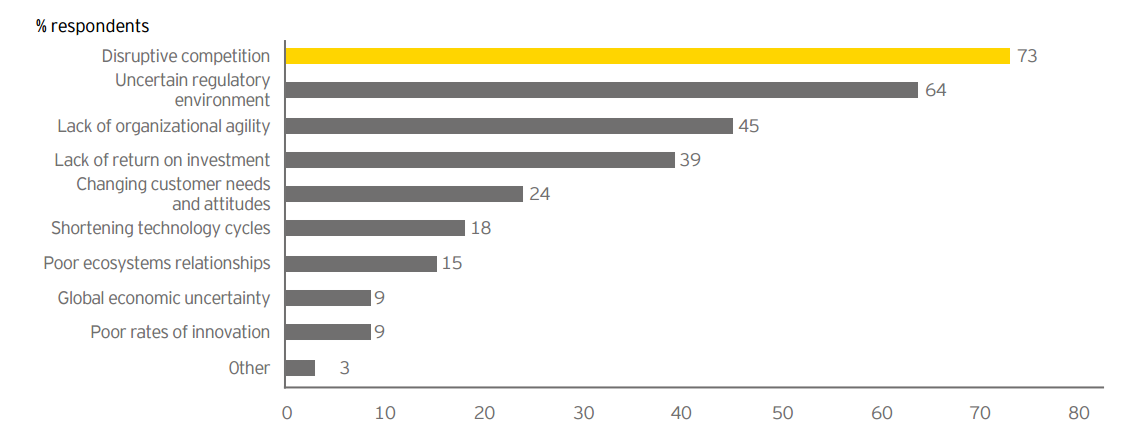
Competition in general, and competition from over the top providers in particular, are the top two challenges global telecom executives say they face.

Fully 73 percent of service provider executives surveyed by E&Y say disruptive competition is the leading industry challenge.

But 64 percent of respondents also say regulatory uncertainty is an issue, as well. No other concerns are cited by more than 45 percent of respondents.

Of regulatory issues, access to new spectrum is cited by 78 percent of executives as the top concern.

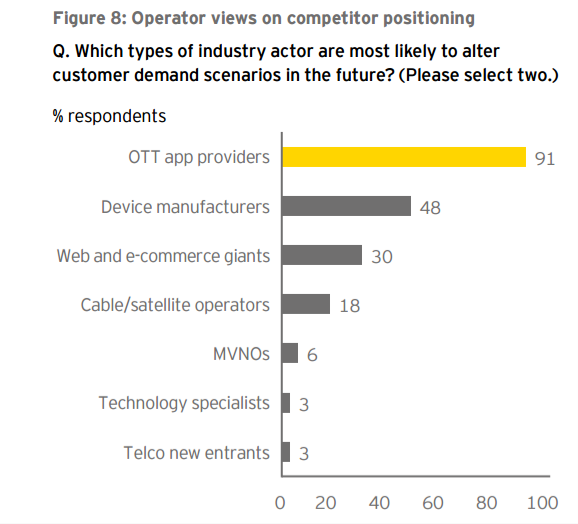
OTTs (app providers) represent the chief competitive challenges--even more than traditional firms within the telecom business--the study finds. The reason is that app providers now set pricing environments, cannibalize legacy revenues and create new consumer expectations.

App providers, such as WhatsApp, are viewed as the top driver of new consumer demands by 61 percent of respondents.

In developing regions, 67 percent of executives say device suppliers are likely to be key shapers of end user demand.


Service providers overall get about 55 percent of ecosystem revenue.

Survey respondents believe that app provider share of industry value chain revenues reached the 10 percent mark in just a few years according to EY estimates. That underestimates impact, however.

The challenge is that OTT apps redefine consumer price expectations. So the revenue impact on legacy providers is not so much loss market share but lower profit across the board.

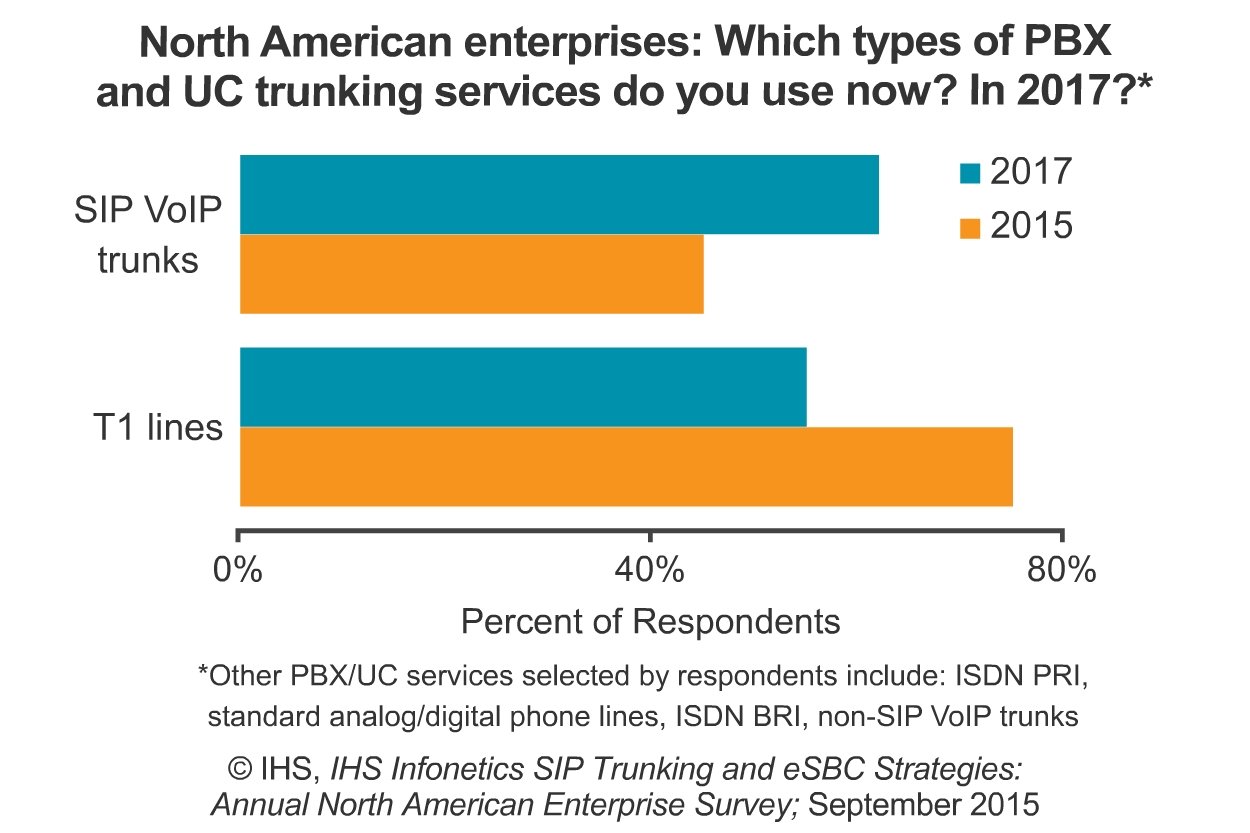
SIP Trunking at 45% in North America

About 45 percent of North American respondents use Session Initiation Protocol (SIP) today for a portion of their voice connectivity requirements, a survey conducted by IHS finds.

By 2017, the number of enterprises using SIP should rise to 62 percent.

Though businesses are migrating to SIP trunking, few have done a full cutover. Of those surveyed who already use SIP trunking, SIP represents about 50 percent of voice trunk capacity.

“SIP trunking’s been around for a while, but our survey shows inertia on the part of businesses tied up with existing contracts and services is inhibiting growth,” said Diane Myers, IHS research director.

The supplier market is fragmented and no single provider dominates. SIP trunking connections also are currently dominated by native support on the PBX rather than edge equipment such as enterprise session border controllers (SBCs) or gateways

Special Access Battle Heats Up, Again

Some of us cannot remember a time when “special access” was not a contentious issue. The reasons--irrespective of all valid public policy concerns--are that special access has been, and remains, a major product for business customers.

The other issue is that most sellers of special access do not own their own facilities, and lease access--for their own use or for resale--from a few companies that do own facilities. So disputes over wholesale pricing typically are at the center of dispute.

So it is not surprising that special access once again is on the docket of the U.S. Federal Communications Commission, and not surprising that prices are at the center of the dispute.

By some estimates, annual sales of special access circuits (T1 and DS3, for example) are about $24 billion.

To be sure, access is transitioning to Ethernet, but smaller customers and sites frequently rely on time division multiplexing (TDM) access.

In some ways, continuing debates about legacy TDM access, at a time when everybody agrees the legacy network needs to be shut down in favor of modern IP infrastructure, is curious.

In fact, some might argue it is silly to stupid to delay rapid network modernization to protect a $24 billion business that is shrinking and as much a part of the legacy infrastructure as “all copper” access media.

To be sure, many advocate a logical approach, namely preserving TDM access as IP infrastructure is turned on, at the legacy prices. There is room to debate the notion of fair” prices.

After all, new optical infrastructure and all-copper legacy infrastructure have different cost recovery requirements. New infrastructure is not fully amortized. Copper infrastructure might be nearly fully amortized.

There is less room to argue about the scarcity of high-capacity access, as access networks are scarce, and only one of two ubiquitous fixed network access suppliers in each market is subject to mandatory access requirements in most markets (some telcos, not any cable TV companies).

In 2013, incumbent local exchange carriers sold roughly 75 percent of the approximately $20 billion in annual revenues from the sales of DS1 and DS3 channel terminations, and received nearly 66 percent of all revenue from TDM sales.

That finding, in and of itself, might not be surprising, since only one provider in each market has both ubiquitous access assets and mandatory wholesale obligations (the underlying carrier makes money from its own retail sales and wholesale sales as well).

Only special access sales made by cable TV companies or independent providers with their own owned networks do not create revenue for the underlying carrier.

The latest inquiry centers on contract terms competitors say are unfair.

Some might also note that, no matter what is done, TDM-based access is going to keep declining, as do all legacy access methods do, when the next-generation network becomes ubiquitous and as end users switch from legacy to next-generation access equipment and software.

That is not to deny a transition period of some length. But TDM-based special access is going away, as IP access takes its place.

At one level, the issue is how to create policies that encourage faster transition while not disrupting legacy operations too much. At another level, the dispute is over relative commercial advantage. All valid public policy disputes always involve considerations of private interest.
Sunday, October 18, 2015

Will Telcos Be Able to Compete in Triple Play Markets?

High speed access based on all-copper--and even fiber-reinforced hybrid networks--now poses a greater threat to AT&T and CenturyLink, says says Morgan Stanley analyst Benjamin Swinburne.

The reason is growing consumer dissatisfaction with slower speeds available on such networks, compared to services sold by Comcast and other cable TV firms, says Morgan Stanley.

That could be a growing strategic factor in many markets, though it appears mostly an issue in North America, at the moment. In most markets, there is no established cable TV alternative.

Keep in mind that cable TV providers already are the dominant providers in the U.S. market. Should a couple of proposed cable TV industry mergers get approval, no U.S. telco would rank higher than fourth among the largest providers of Internet access in the United States.

Cable TV firms are winning the overwhelming share of  net new accounts, as well. In the first quarter of 2015, for example, cable companies won 86 percent of the new accounts.

The other market change is the shift to gigabit speed access as the headline offer, even when most of the actual net additions come for services at lower speeds. Cable companies often can upgrade to gigabit speeds without a major physical revamp of their access networks.

That is not the case for telcos, who (in the U.S. market) will have to switch to fiber to home networks to compete.
If one believes high speed access is the strategic service in a triple play bundle, that has serious implications. In fact, some might even question whether telcos can compete, long term, in triple play markets.

In fact, it is conceivable that just three U.S. cable TV companies--Comcast, Charter and Altice--will soon have 75 percent to 80 percent share of the “25-Mbps and faster” portion of the market.

So it is that Swinburne argues there is yet further upside for Comcast, Charter, Time Warner Cable and Cox Communications. They already dominate the broadband market, but are positioned to gain even more market share.
Morgan Stanley surveyed 2,500 U.S. households during August 2015 and September 2015 on broadband and TV services, and found "U-verse and AT&T DSL had especially weak satisfaction results, and satellite pay-TV subscribers' broadband satisfaction fell materially year over year."

Cable customers reported an average speed of 38 megabits per second, while DSL subscribers said they had 21 Mbps service on average.

Verizon Communications FiOS customers on average had nearly 30 Mbps service and were happier, despite price hikes, says Morgan Stanley.

Two decades ago, one could have gotten a robust debate about the merits of fixed network access architectures using all-copper, hybrid copper-fiber or all-fiber access. The issue then, as now, was not over capacity as such, but the scalability of the business model.

Depending on typical loop lengths, it might still be possible to make a business case for all-copper access, but less so in the United States than in Europe.

Hybrid still works, but fiber-thin hybrid approaches do not work as well as fiber-rich hybrids. It is easier, in many cases, to make the case for all-fiber access, the Morgan Stanley survey suggests.

But in much of the world, the issue is not so much capacity as it is coverage. Any type of fixed access does not compete too well with a mobile approach.

Still, in some markets, one can fairly ask whether telcos will be much of a factor in tomorrow’s consumer markets.

If high speed access trends continue, if the voice business continues to dwindle and then the linear video market shrinks as over the top replacement markets grow, telcos lose even more.

Saturday, October 17, 2015

Proposed India Call Drop Rules Already Have Produced Financial Damage

Whatever else happens as a result of new proposed dropped call credits for consumers, and penalties on mobile operators, equity prices for public Indian mobile firms initially have taken a hit, falling about three percent.


Concerned about call drop rates, Telecom Regulatory Authority of India has proposed a credit of about one rupee (about one U.S. cent) for as many as three call drops per day, paid to customers. In addition, there are penalties for the mobile service provider as well.


"Taking an average four-percent call drop rate, our analysis shows that the penalty could have three-percent hit on revenues and seven to eight percent hit on mobile EBITDA for Bharti and Idea," says Sunil Tirumalai, Credit Suisse research analyst.

Some might argue the potential damage could be higher than that. Though it is virtually impossible to quantify, the cost of billing operations to identify which calls actually dropped, and then apply service credits, might cost more than the one-rupee penalty itself.

Friday, October 16, 2015

EPB Fiber Optics Sells 10-Gbps Service Across Whole Footprint

Chattanooga’s EPB Fiber Optics is introducing a consumer 10 Gbps service for “every home and business in a 600 square mile area”.

The 10-Gbps residential service is available for $299 per month with free installation, no contracts and no cancellation fees.

EPB also is launching 5-Gbps and 10-Gbps Internet access services for small businesses as well as 3-Gbps 5-Gbps and 10-Gbps products for larger enterprises.

The existing consumer gigabit service sells for $70 a month.

For Fixed Network Operators, Competition Really Has Changed Everything

In the telecom business, competition changes everything, a realization that has grown over the decades as increasing portions of the market are exposed to robust competition.

You might think competition matters primarily because market leaders face rival providers who often use the “same product, less cost” marketing platform. That is an issue, but not the biggest issue.

Instead, what really matters is a change in fundamental cost structure for any facilities-based service provider--especially fixed network operators.

In a monopoly environment, the provider of a highly-popular service (voice or video entertainment) might reasonably expect that 85 percent to 95 percent of locations actually will be customers.

In other words, most locations generate revenue. In a duopoly market, assuming two competent providers, each contestant can reasonably expect to split the available market. That might mean a theoretical limit of about 43 percent to 47 percent of locations will generate revenue, for each contestant.

Add a third competent provider and the numbers shrink further. In that scenario, maximum customer locations might be 28 percent to 31 percent.

In other words, a fixed network could well find that fewer than one in three locations passed by its network will generate revenue. That obviously affects and shapes the business model. The reason there is so much emphasis on triple play services is that the strategy helps contestants compensate for the tougher business model of a two-provider or three-provider market.

Internet Protocol makes matters worse for facilities-based providers, since the separation of apps from access means any potential customer can, in principle, buy any key service from any lawful third party service, once a suitable Internet access connection is in place.

At least in principle, widespread availability of over-the-top services further stresses the business model for any facilities-based access provider.

If you want to know why incentives for investment are so important, that is the reason. Even if it is the responsibility of each discrete operator to manage and “right size” costs, it has gotten progressively harder to earn a sustainable return from an effectively-dwindling number of potential customers.

Consider AT&T, which now reports revenue in four buckets: business solutions, consumer mobility, entertainment and Internet services and international.

Business solutions represents 54 percent of total revenue. Consumer mobility represents 27 percent. Entertainment and Internet Services generates about 18 percent of revenue, while International produces only about one percent of revenue.

In other words, 81 percent of revenue is generated by business solutions and consumer mobility. That also is the case for some other fixed network providers that formerly earned most of their revenue from the consumer segment, but now rely on business customers for half or more of revenue.  

The operating income story is more skewed. Business solutions represents 66 percent of total operating income. Consumer mobility represents 38 percent of operating income. Entertainment and Internet Services has negative operating income, as does the International segment.

In terms of operating income, it all comes from business solutions and consumer mobility.

One suspects that will change when AT&T starts reporting results that reflect DirecTV operations, with the entertainment and Internet operations segment assuming both a higher role in revenue, but also contributing operating income.

But that noted, consider the implications. AT&T generates 81 percent of revenue from business customers and its mobility network. By definition, comparatively little revenue is earned from consumers using the fixed network.

The other problem for AT&T is that cable TV companies are the leading providers of high speed access in the U.S. market, especially at 25 Mbps and higher speeds.In fact, by some estimates, fiber to the home is feasible in less than half of all locations globally.  

Fully 54 percent of total AT&T revenue is generated by business customers, on the mobile and fixed network. Stranded assets are not really a problem for the mobile network. But low-earning or stranded assets are a big and growing issue for the fixed network.

AI Music Revenue Models Will lean on Business-to-Business Use Cases

Automation seemingly always tends to redefine job functions and value, and artificial intelligence is unlikely to be different. Past automa...