If you combined Kinect, the Microsoft motion-sensing device, plus Google Analytics, the dashboard for website usage statistics, you'd understand Shopper Tracker.
Shopper Tracker uses spatial recognition software, heat sensors and proprietary algorithms to analyze customer movements, such as which store shelves are most popular, which items are most touched, which taken and then put back. Spying on Your Buying
Shopper Tracker: tracking real world conversions like web analytics
Sunday, December 18, 2011
Cross motion sensing and analytics and you'd get Shopper Tracker

 Gary Kim was cited as a global "Power Mobile Influencer" by Forbes, ranked second in the world for coverage of the mobile business, and as a "top 10" telecom analyst. He is a member of Mensa, the international organization for people with IQs in the top two percent.
Technology Reshapes Software, Marketing
 One often hears it said that "content marketing" has "been around forever" in the form of newsletters, brochures and custom publishing. So what accounts for the explosion of interest in "content marketing" now?
One way or the other, though it would be a mistake to attribute everything to widespread changes in technology, that would seem to be the best answer.
In the software business, it often is said that dramatic changes in computing technology now mean a new start-up can launch with about 10 percent of the capital investment required a decade ago. Dramatically lower startup costs
In fact, some venture capitalists say underlying computing costs, resulting from a combination of lower hardware and software tools, mean a software company can be launched for 10 percent of what would have been required in 2000. Venture capitalist Mark Suster says that when he built his first company in 1999 it cost $2.5 million in infrastructure just to get started and another $2.5 million in team costs to code, launch, manage, market and sell our software.
“So it’s not surprising that typical “A rounds” of venture capital were $5 to $10 million,” Suster says. “We had to buy Oracle database licenses, UNIX servers, a Sun Solaris operating system, Web servers, load balancers, EMC storage, disk mirrors for redundancy and had to commit to a year-long hosting agreement at places such as Exodus.”
With the introduction of open-source software, most notably what was called the “LAMP” stack, including Linux (operating system), Apache (Web server software), MySQL (instead of Oracle) and PHP.
“Suddenly infrastructure software was nearly free,” he notes. “We paid 10 percent of the normal costs for the software and that money was for software support.” The point is that a 90-percent disruption in cost spawns innovation. Infrastructure costs 90 percent lower
At the risk of oversimplifying matters, those same technology trends explain why content marketing has gained new prominence.
You may not be able to afford to buy a television network, but nothing's stopping you from creating your own YouTube channel, the argument legitimately can be made.
The cost of launching a newspaper or magazine is prohibitive, not to mention risky. But blogs can be set up for free or very affordably. And every trend in media represents a vast multiplication of channels and sources. All mass medium have been fragmenting for decades, starting with cable TV, then satellite radio, then, most importantly, Web-based media.
Consider the role of “search.” Some 90 percent or more of buying decisions begin with a Web search. Throughout the purchase cycle, users are searching for information, recommendations, research, reviews, authority and credibility.
And once they find the information they seek, they're sharing it with others involved in the purchase decision: a friend, a spouse, a colleague, or their boss, or perhaps they're throwing that information out to a trusted network to vet it, or to validate their position in the decision-making process. Why PR is Poised to Own Content Marketing
Now you can add tablets and smart phones to the list of reasons why fragmented media environments, explosive amounts of new content and always-with-you content consumption devices mean the role of content in all marketing processes has suddenly assumed such new importance.
Not only is it harder to get attention, and keep it, the cost of “going direct” to the audience, without using gatekeepers, is easier than ever. It would not be inappropriate to argue that technology platforms are the fundamental enablers for content marketing’s rise, as technology advances likewise account for new global interest in mobile payments, mobile wallets, mobile commerce and mobile banking.
Marketing, no less than telecommunications, television, audio, print media, banking and retailing are being reshaped and disrupted by fundamental technology changes.
Gary Kim was cited as a global "Power Mobile Influencer" by Forbes, ranked second in the world for coverage of the mobile business, and as a "top 10" telecom analyst. He is a member of Mensa, the international organization for people with IQs in the top two percent.
U.S. Broadband Penetration Unchanged at 84% of Internet Households
Internet use in the United States seems to have remained flat at 82 percent of Americans, the Center for the Digital Future at USC Annenberg School for Communication & Journalism reports. Also, broadband penetration remains at 84 percent of U.S. homes who use Internet access services.
The expense of using the Internet is cited as a reason for not going online by seven percent of respondents to the latest Center for Digital Future study.
Internet use dipped slightly to an average of 18.3 hours per week, the first time the weekly use has declined, but for the first time, home use of the Internet has passed 12 hours per week
The largest percentages of users reported going on the Internet at least weekly (several times a day, daily, or weekly) to browse the Web (79 percent), use online banking (47 percent), get product information (46 percent), visit social networking and video-sharing sites (46 percent), play games (39 percent), download or watch videos (39 percent), download or listen to music (38 percent), listen to online radio (22 percent), and pay bills (22 percent). Study of Internet behavior
A large majority of respondents report more than one computer in their home; the households with three or more computers (17 percent) and four or more computers (15 percent) reached an all-time high.
In seven years, the percentage of computer owners who have a laptop has increased from 18 percent to nearly 75 percent of users.
The number of hours that Internet users report they are online at work remained unchanged from the previous study, at 12.9 hours per week. But Internet users continue to report increasing active use of the Internet at work. For the third year in a row, the hours that users said they are actively using the Internet at work has increased to 9.2 hours per week, a new high for the Digital Future Project.
The expense of using the Internet is cited as a reason for not going online by seven percent of respondents to the latest Center for Digital Future study.
Internet use dipped slightly to an average of 18.3 hours per week, the first time the weekly use has declined, but for the first time, home use of the Internet has passed 12 hours per week
The largest percentages of users reported going on the Internet at least weekly (several times a day, daily, or weekly) to browse the Web (79 percent), use online banking (47 percent), get product information (46 percent), visit social networking and video-sharing sites (46 percent), play games (39 percent), download or watch videos (39 percent), download or listen to music (38 percent), listen to online radio (22 percent), and pay bills (22 percent). Study of Internet behavior
A large majority of respondents report more than one computer in their home; the households with three or more computers (17 percent) and four or more computers (15 percent) reached an all-time high.
In seven years, the percentage of computer owners who have a laptop has increased from 18 percent to nearly 75 percent of users.
The number of hours that Internet users report they are online at work remained unchanged from the previous study, at 12.9 hours per week. But Internet users continue to report increasing active use of the Internet at work. For the third year in a row, the hours that users said they are actively using the Internet at work has increased to 9.2 hours per week, a new high for the Digital Future Project.
Gary Kim was cited as a global "Power Mobile Influencer" by Forbes, ranked second in the world for coverage of the mobile business, and as a "top 10" telecom analyst. He is a member of Mensa, the international organization for people with IQs in the top two percent.
43% of Firms Will be Blogging in 2012

Those blogs are used for a variety of business purposes, including the creation of content marketing that can be propagated on social media.
Some 70 percent of respondents say they use social media as a way of assessing what people think about a company.
About 61 percent say they use social media to prospect for new customers.
Breaking such forecasts out by firm size, some 65 percent of small business owners now publish a blog for their company, for example. Small business blogging
Gary Kim was cited as a global "Power Mobile Influencer" by Forbes, ranked second in the world for coverage of the mobile business, and as a "top 10" telecom analyst. He is a member of Mensa, the international organization for people with IQs in the top two percent.
Saturday, December 17, 2011
Apple Patent Infringement Strategy Backfiring?
Motorola won the first of two patent-infringement cases against Apple’s European sales division based in Ireland, granting Motorola an injunction against all of the infringing products in Europe.
The products Apple can no longer sell in Germany include the:
- iPhone
- iPhone 3G
- iPhone 3GS
- iPhone 4
- iPad 3G
- iPad 2 3G
- function
Motorola filed the suit in April 2011, which is likely the only reason the iPhone 4S is not included in the injunction, as it wasn't launched at that point. Europe-wide injunction
At issue is a Motorola patent for cellular data transmission, part of wireless data transmission standards that are encumbered by an agreement to license the patent on "fair, reasonable, and non-discriminatory" terms.
The ruling suggests that, at least in Germany, raising a "FRAND" defense against standards-essential patent infringement claims could be a difficult proposition, and may force Apple to accept Motorola's licensing terms for "past infringement."
The FRAND defense has worked for Apple elsewhere, including in lawsuits brought by Samsung in The Netherlands and France.
The basic argument is that suing over standards-essential patents instead of working out a FRAND agreement amounts to violation of anti-competition laws. Without some legal barrier to suing over such patents, they could potentially be used as a club to thwart any would-be competitors once they have built products incorporating a particular technology standard. Motorola wins lawsuit
The European patent in suit, EP1010336 (B1) "Method for Performing a Countdown Function During a Mobile-Originated Transfer for a Packet Radio System," is part of the General Packet Radio Service standard upon which 2G and 3G data services operate.
Basically, that means that all Apple products that use 3G data, including all iPhones and all 3G-capable iPads, use the patented technology.
Gary Kim was cited as a global "Power Mobile Influencer" by Forbes, ranked second in the world for coverage of the mobile business, and as a "top 10" telecom analyst. He is a member of Mensa, the international organization for people with IQs in the top two percent.
Sprint orders all OEMs to Remove Carrier IQ
Starting with the high-volume and high-profile devices on the network, each of the OEMs has been asked to quickly release binaries that do not contain Carrier IQ so that over-the-air updates can be pushed to those devices as quickly as possible.
The eventual plan is to remove Carrier IQ from all of the devices on Sprint’s network.
This is being done as soon as possible and, according to our source at HTC, anyone who is working with Sprint in testing labs have even had their vacation time over the holidays seriously restricted. Sprint orders all OEMs to remove Carrier IQ
With other handset suppliers and carriers backing away from Carrier IQ, you have to wonder what the prospects for the company are, in the future. Apple dropped Carrier IQ
Carrier IQ also faces government scrutiny, which almost certainly means the company will have to drastically revise its revenue model, once restrictions, voluntary or otherwise, start to become a business factor.
Once again, we see how much impact regulatory actions now are having on the shape of the communications business.
Gary Kim was cited as a global "Power Mobile Influencer" by Forbes, ranked second in the world for coverage of the mobile business, and as a "top 10" telecom analyst. He is a member of Mensa, the international organization for people with IQs in the top two percent.
Friday, December 16, 2011
Live TV On Android Devices in-Home, for Some Time Warner Cable Subs
 Time Warner Cable expects to let subscribers watch live TV on Android devices over in-home Wi-Fi early next year, as it does today for Apple iOS phones and tablets.
TWC Eyes Live TV On Android Devices
The application is available to video customers with standard or higher subscriptions, and can only be used by customers with a compatible Navigator set-top or DVR.
Analog users and owners of Motorola set-tops cannot use the application. The app allows users to view up to seven days of content and can also turn the Android phone into a remote control.
Gary Kim was cited as a global "Power Mobile Influencer" by Forbes, ranked second in the world for coverage of the mobile business, and as a "top 10" telecom analyst. He is a member of Mensa, the international organization for people with IQs in the top two percent.
Isis Weighing Europe Launch?
 Isis, the mobile wallet venture owned by AT&T, Verizon Wireless and T-Mobile USA, is looking to expand internationally. Jaymee Johnson, an Isis spokesman, says potential deals could involve use of the brand or the platform.
“The underlying equity partners in ISIS give us some degree of visibility and awareness beyond the U.S.,” Johnson says, obviously referring to Vodafone Group Plc, which owns a large minority stake in Verizon Wireless, and is based in the U.K., while T-Mobile USA is owned by Germany’s Deutsche Telekom AG. Isis looking to Europe?
Gary Kim was cited as a global "Power Mobile Influencer" by Forbes, ranked second in the world for coverage of the mobile business, and as a "top 10" telecom analyst. He is a member of Mensa, the international organization for people with IQs in the top two percent.
Apple to launch eight-inch iPad in 2012?
 Though former Apple CEO Steve Jobs is consistently on record as belittling the idea that a tablet with a screen less than 10 inches is desirable, Apple is likely to launch a 7.85-inch iPad prior to the fourth quarter of 2012, DigiTimes argues.
That might be one of the first tangible examples of "post-Steve" thinking at Apple. As fastidious as Steve Jobs always was about every little detail of Apple products, it is impossible to conclude anything else.
Global shipments of tablet PCs are expected to reach 60 million units in 2011, of which 70 percent will be Apple's iPads.
Some might even argue that a seven-inch e-book reader is not actually a "tablet." There arguably some differences in lead applications, with e-books obviously weighted towards consumption of print style content, and larger tablets more optimal for video consumption and web browsing.
Some might argue that the apparent sales success of the seven-inch Kindle Fire from Amazon, and some might argue, large-screen smart phones, Apple might now think it has to have a product in the seven-inch to eight-inch form factor. Apple to launch 7.85-inch iPad in 2012?
Gary Kim was cited as a global "Power Mobile Influencer" by Forbes, ranked second in the world for coverage of the mobile business, and as a "top 10" telecom analyst. He is a member of Mensa, the international organization for people with IQs in the top two percent.
Verizon Strikes Spectrum, Resale Deal with Cox Communications
Verizon Wireless and Cox Communications have agreed to a deal that would give Verizon Wireless all of Cox’s advanced wireless spectrum in exchange for $315 million and an agreement to sell each other’s services.
Verizon Wireless will get a 20MHz block of wireless spectrum from Cox, while Verizon Wireless and Cox will resell each others residential and commercial services. The deal is similar in scope to one Verizon Spectrum Co., owned by Comcast, Time Warner Cable, and Bright House Networks.
The deal is said to be very similar to one that Verizon struck with Comcast, Time Warner Cable and Bright House networks in early December 2011. Verizon, Cox in spectrum, resale deal
Aside from the other potential ramifications, such as a bigger move by those cable operators into the wireless services market, the deal essentially changes the strategic landscape which since 1994 or so has had Sprint aligned most closely among the mobile companies with leading cable operators.
The deals also would seem to remove the leading U.S. cable companies from the list of potential investors or buyers of assets including Sprint and Clearwire, as well as from the ranks of potential wholesale customers of LightSquared, Sprint or Clearwire.
The deal also means a significant strategic change for the leading cable companies, which since 1994 have worked with Sprint as a wireless partner. The deal seems to signal that the leading cable firms are "changing horses" for reasons that have to be related to both long-term strategic concerns and evaluations of the respective strengths of potential partners.
At a fundamental level, the deals seem to signal a belief by U.S. cable executives that it simply is too late, too hard, too unrewarding to create a "cable-owned" wireless company. The way the deals appear to be structured also imply that cable companies will simply resell Verizon Wireless for a period of years before considering any further retail branding under their own brand names, if indeed that ever is seen as the better and more logical approach to the market.
For Verizon Wireless, the deals also seem to signal a willingness to use the cable partnerships to create new quad-play services "out of fixed network region," to the extent that Verizon Wireless would have the right to bundle cable partner video, fixed broadband or fixed network voice in areas where Verizon does not operate its own fixed networks.
Verizon Wireless will get a 20MHz block of wireless spectrum from Cox, while Verizon Wireless and Cox will resell each others residential and commercial services. The deal is similar in scope to one Verizon Spectrum Co., owned by Comcast, Time Warner Cable, and Bright House Networks.
The deal is said to be very similar to one that Verizon struck with Comcast, Time Warner Cable and Bright House networks in early December 2011. Verizon, Cox in spectrum, resale deal
Aside from the other potential ramifications, such as a bigger move by those cable operators into the wireless services market, the deal essentially changes the strategic landscape which since 1994 or so has had Sprint aligned most closely among the mobile companies with leading cable operators.
The deals also would seem to remove the leading U.S. cable companies from the list of potential investors or buyers of assets including Sprint and Clearwire, as well as from the ranks of potential wholesale customers of LightSquared, Sprint or Clearwire.
The deal also means a significant strategic change for the leading cable companies, which since 1994 have worked with Sprint as a wireless partner. The deal seems to signal that the leading cable firms are "changing horses" for reasons that have to be related to both long-term strategic concerns and evaluations of the respective strengths of potential partners.
At a fundamental level, the deals seem to signal a belief by U.S. cable executives that it simply is too late, too hard, too unrewarding to create a "cable-owned" wireless company. The way the deals appear to be structured also imply that cable companies will simply resell Verizon Wireless for a period of years before considering any further retail branding under their own brand names, if indeed that ever is seen as the better and more logical approach to the market.
For Verizon Wireless, the deals also seem to signal a willingness to use the cable partnerships to create new quad-play services "out of fixed network region," to the extent that Verizon Wireless would have the right to bundle cable partner video, fixed broadband or fixed network voice in areas where Verizon does not operate its own fixed networks.
Gary Kim was cited as a global "Power Mobile Influencer" by Forbes, ranked second in the world for coverage of the mobile business, and as a "top 10" telecom analyst. He is a member of Mensa, the international organization for people with IQs in the top two percent.
UK Consumers Not Buying "Super-Fast" Broadband
 There are two distinct, and different "problems" nations and policymakers face when promoting use of very-fast broadband access. First, the physical capabilities must be put into place.
But an equally-important issue is consumer demand for such services, especially when high-speed services already are widely available.
In the United Kingdom, for example, the government is pushing new fiber-to-cabinet networks supporting speeds roughly defined as access at 24 Mbps or so. U.K. Super-Fast Broadband
However, just four percent of U.K. households subscribed to superfast services in June 2011, compared with 40 per cent in Japan and 10 per cent in the United States, although higher than in Germany (three percent), Italy (1.5 percent) and Spain (2.2 percent). Lagging adoption
To be fair, the networks still are under construction, so not every potential consumer is able to buy such services.
But 25Mbps or faster services already are available to the 48 percent of UK households passed by Virgin Media's cable service and about 20 percent of premises passed by BT's fiber to the cabinet superfast services.
Overall availability of high-speed fixed-line broadband networks in the United Kingdom does compare favorably to other European countries, though, so mere ability to buy is not the issue. By June 2011, 59 per cent of households had access to Virgin Media or BT’s superfast services. Ofcom: UK consumers not buying super-fast broadband
Gary Kim was cited as a global "Power Mobile Influencer" by Forbes, ranked second in the world for coverage of the mobile business, and as a "top 10" telecom analyst. He is a member of Mensa, the international organization for people with IQs in the top two percent.
10 Key Mobile Trends of 2011

One of the big trends of 2011 was “more powerful devices,” such as the HTC Edge, the first quad-core mobile phone with a quad-core 1.5GHz processor, says Josh Lovison, a digital strategy consultant.
That, in turn, is leading to the leading edge of the “docking” trend, where smart phones will be able to use various peripherals that make smart phones usable in some of the ways notebook PCs are used. Motorola’s Atrix phone is an example.
ASUS also has designed a keyboard dock for its upcoming tablet, the Transformer Prime, which allows it to operate much like a laptop in both form and function.
Changes in data plans and the advent of Long Term Evolution, as well as patent wars and Android’s rise, are other notable developments.
Mobile apps being rendered dynamically also was a new trend. Facebook, for example, made a recent update that retains some static user interface elements are native code specific to a device, but almost all of the dynamic content displayed is a rendered page of its website, within the app. It's a hybrid between "app" and "web app."
Mobiles also are displacing dedicated gaming devices as the preferred way to engage with gaming content and games.
According to stats from Flurry, 2011 will be the first year that gaming revenues on mobile devices (iOS and Android) exceed revenues from specialized gaming handhelds such as Nintendo's 3DS or Sony's PSP.
Voice search, which got attention because of Apple’s “Siri,” has been available on Android devices for nearly two years as well, and represents an advance for ease of use on mobiles when searching. Easier search will mean “more search.”
Near field communications remains a buzzword and hype generator, but it will take some time to become a useful mainstream capability for payments and other mobile apps. Key mobile trends
Gary Kim was cited as a global "Power Mobile Influencer" by Forbes, ranked second in the world for coverage of the mobile business, and as a "top 10" telecom analyst. He is a member of Mensa, the international organization for people with IQs in the top two percent.
Free Gaming Explodes

New data released by Pando Networks, a leading game delivery network for free-to play mobile games, indicates a huge increase in the number of people downloading free-to-play game games, growing 450 percent from 2009 to 2011.
More than 38 million people will download an online game using Pando services in 2011, and more than 70 million people have done so since 2009.
The increase in people downloading games is being driven by several industry factors including the transition from a “paid” to a “free-to-play” business model. Free gaming explodes
 Gary Kim was cited as a global "Power Mobile Influencer" by Forbes, ranked second in the world for coverage of the mobile business, and as a "top 10" telecom analyst. He is a member of Mensa, the international organization for people with IQs in the top two percent.
LTE Prices Will Drop 60%
Mobile broadband services using Long Term Evolution will experience a substantial 60-percent decline in retail prices between now and 2016, according to Tariff Consultancy, on the way to gaining 250 million users worldwide by the end of 2016.

Alastair Brydon says the most expensive LTE tariffs are between EUR39 and EUR67 in numerous European markets. These services provide download speeds up to 50 Mbps to 80 Mbps, with a 30GB monthly data allowance. While these prices are higher than equivalent so-called ‘superfast’ fiber-to-the-cabinet (FTTC) fixed broadband services, there is not a huge price premium. LTE pricing
These tariffs correspond to a minimum price per gigabyte that varies between EUR1.78 (in Denmark for a 30GB data allowance) and EUR2.67 (in Germany for a 15GB data allowance).
The price per GB is generally lower than most HSPA mobile broadband services, where operators provide significantly lower monthly allowances in general. For example, in the UK, where mobile network operators are facing significant capacity challenges, O2 now offers just a single HSPA mobile broadband service, with a 1GB monthly allowance for £10.21, which corresponds to a price per GB of EUR11.49. This is around five times greater than the price per GByte of these LTE services.
TCL research finds that the average price worldwide for a top of the range LTE Mobile Broadband service is currently 50 Euro per month, typically based on a post-paid, 24-month contract term.
The study shows that the average LTE Mobile Broadband price in Euro per gigabyte ranges from 0.5 Euro (Tele2 Sweden) up to 9.9 Euro (Omnitel Lithuania) per GB of data mobile user allowance.
But already there is evidence of price erosion from selected LTE Mobile Broadband providers. Telstra (Australia) currently offers its BigPond USB 4G Mobile Broadband product with an 8 GByte monthly data user allowance for the equivalent of 30 Euro per month, against 38 Euro for a 4 GB monthly data user allowance reported at the time of launch.
And in Singapore M1 (Mobile One) is offering its Next Generation Mobile Network equivalent LTE service to existing M1 customers with a 40% discount off the monthly list price.
Tariff Consultancy anticipates that LTE mobile broadband pricing will decline as more operators worldwide adopt the technology worldwide. LTE prices will respond to competition
That might be consistent with pricing trends for broadband access generally, in virtually all markets. But the local patterns might vary, one could argue. In the U.S. market, buckets of usage and typical speeds are relatively limited, compared to what seems to be offered elsewhere.
That creates at least some possibility that pricing could increase, for some packages, in the U.S. market, particularly as family mobile data plans are introduced, or as some providers upgrade from “pre-LTE” networks to more fully-compliant LTE networks.
LTE Mobile Broadband Pricing 2012 evaluates pricing from around 30 fourth-generation LTE mobile broadband providers which are mainly located in Europe, North America and the Asia-Pacific regions of the world.
LTE is currently promoted as a premium product, with an average theoretical download access speed across all LTE providers is in excess of 80 Mbps, with the most common download speed cited being 100 Mbps.
Average monthly user data allowances for LTE Mobile Broadband services are currently 22 GBytes per month, but can be as high as 80 GBytes per month, with allowances for LTE operators in North America being typically far lower.
LTE is currently promoted as a premium product, with an average theoretical download access speed across all LTE providers is in excess of 80 Mbps, with the most common download speed cited being 100 Mbps.
Average monthly user data allowances for LTE Mobile Broadband services are currently 22 GBytes per month, but can be as high as 80 GBytes per month, with allowances for LTE operators in North America being typically far lower.
Alastair Brydon says the most expensive LTE tariffs are between EUR39 and EUR67 in numerous European markets. These services provide download speeds up to 50 Mbps to 80 Mbps, with a 30GB monthly data allowance. While these prices are higher than equivalent so-called ‘superfast’ fiber-to-the-cabinet (FTTC) fixed broadband services, there is not a huge price premium. LTE pricing
These tariffs correspond to a minimum price per gigabyte that varies between EUR1.78 (in Denmark for a 30GB data allowance) and EUR2.67 (in Germany for a 15GB data allowance).
The price per GB is generally lower than most HSPA mobile broadband services, where operators provide significantly lower monthly allowances in general. For example, in the UK, where mobile network operators are facing significant capacity challenges, O2 now offers just a single HSPA mobile broadband service, with a 1GB monthly allowance for £10.21, which corresponds to a price per GB of EUR11.49. This is around five times greater than the price per GByte of these LTE services.
TCL research finds that the average price worldwide for a top of the range LTE Mobile Broadband service is currently 50 Euro per month, typically based on a post-paid, 24-month contract term.
The study shows that the average LTE Mobile Broadband price in Euro per gigabyte ranges from 0.5 Euro (Tele2 Sweden) up to 9.9 Euro (Omnitel Lithuania) per GB of data mobile user allowance.
But already there is evidence of price erosion from selected LTE Mobile Broadband providers. Telstra (Australia) currently offers its BigPond USB 4G Mobile Broadband product with an 8 GByte monthly data user allowance for the equivalent of 30 Euro per month, against 38 Euro for a 4 GB monthly data user allowance reported at the time of launch.
And in Singapore M1 (Mobile One) is offering its Next Generation Mobile Network equivalent LTE service to existing M1 customers with a 40% discount off the monthly list price.
Tariff Consultancy anticipates that LTE mobile broadband pricing will decline as more operators worldwide adopt the technology worldwide. LTE prices will respond to competition
That might be consistent with pricing trends for broadband access generally, in virtually all markets. But the local patterns might vary, one could argue. In the U.S. market, buckets of usage and typical speeds are relatively limited, compared to what seems to be offered elsewhere.
That creates at least some possibility that pricing could increase, for some packages, in the U.S. market, particularly as family mobile data plans are introduced, or as some providers upgrade from “pre-LTE” networks to more fully-compliant LTE networks.
Gary Kim was cited as a global "Power Mobile Influencer" by Forbes, ranked second in the world for coverage of the mobile business, and as a "top 10" telecom analyst. He is a member of Mensa, the international organization for people with IQs in the top two percent.
Thursday, December 15, 2011
Can Google Make Money selling Broadband Access?
"It’s not a nonprofit. It’s not a dot.org initiative,” said Lo. “We expect to make money at it. It’s a business we expect to be in.” Google’s high-speed gamble in KC
Perhaps the U.S. company whose commercial activities are most similar to Google Access is Sonic.net, an ISP that over time has concentrated mostly on broadband access as its business, though it now also sells voice services. Sonic 1-Gbps network
Perhaps the U.S. company whose commercial activities are most similar to Google Access is Sonic.net, an ISP that over time has concentrated mostly on broadband access as its business, though it now also sells voice services. Sonic 1-Gbps network
Gary Kim was cited as a global "Power Mobile Influencer" by Forbes, ranked second in the world for coverage of the mobile business, and as a "top 10" telecom analyst. He is a member of Mensa, the international organization for people with IQs in the top two percent.
6 Million Homes Now Use Wireless As Only Broadband Service
 By the end of 2011, six million U.S. households will depend on a wireless or mobile platform (including 3G or 4G) as their only means of accessing the Internet, according to Strategy Analytics.
That means seven percent of U.S. homes are wireless-only for broadband, up about 430,000 homes over 2010 levels.
These “mobile-only” customers typically connect to broadband using 3G or 4G-enabled smartphones or PC dongles, and are unable or unwilling to use a wired broadband service such as cable, DSL or fiber, Strategy Analytics says.
These “mobile-only” customers typically connect to broadband using 3G or 4G-enabled smartphones or PC dongles, and are unable or unwilling to use a wired broadband service such as cable, DSL or fiber, Strategy Analytics says.
The firm says there are two primary markets for such consumers. First, there are users in remote or underserved areas where dependable fixed broadband is unavailable. Secondly, there are cost-conscious casual users who use relatively small amounts of data, and for whom mobile data rates are ‘good enough.
Strategy Analytics forecasts that cable operators will claim a bit more than 50 percent of U.S. household broadband connections over the next five years, while telco-provided Digital Subscriber Line subscriptions will gradually decline in favor of fiber to home and mobile-only connections. 6 Million Homes Now Using Wireless As Only Broadband Service
Gary Kim was cited as a global "Power Mobile Influencer" by Forbes, ranked second in the world for coverage of the mobile business, and as a "top 10" telecom analyst. He is a member of Mensa, the international organization for people with IQs in the top two percent.
Wednesday, December 14, 2011
LightSquared Proposes to Operate at Lower Power
In an effort to mollify concerns about signal interference with GPS systems and users, LightSquared now has proposed operating at lower power for a period of time. To the extent that transmitter power is what causes the interference, the lower mobile tower transmission power levels should help. Just how much help that move will have, has to be tested.
Also, LightSquared only proposes to operate at lower power for a period of time, then would ramp power levels back up. Some might consider that an odd proposal. Perhaps the thinking is that GPS receiver manufacturers and end users would then have a transition period to wean themselves off devices that currently experience interference. LightSquared proposes lower-power solution
Some might doubt this will help LightSquared. In principle, the new user has to demonstrate it does not interfere with other existing users. If interference again becomes a problem in the future, LightSquared could be barred from operating. Permanently lower power levels would seem to be a different matter.
Also, LightSquared only proposes to operate at lower power for a period of time, then would ramp power levels back up. Some might consider that an odd proposal. Perhaps the thinking is that GPS receiver manufacturers and end users would then have a transition period to wean themselves off devices that currently experience interference. LightSquared proposes lower-power solution
Some might doubt this will help LightSquared. In principle, the new user has to demonstrate it does not interfere with other existing users. If interference again becomes a problem in the future, LightSquared could be barred from operating. Permanently lower power levels would seem to be a different matter.
Gary Kim was cited as a global "Power Mobile Influencer" by Forbes, ranked second in the world for coverage of the mobile business, and as a "top 10" telecom analyst. He is a member of Mensa, the international organization for people with IQs in the top two percent.
Yelp More Important than Facebook?

First of all, Yelp is all about local businesses, things to do, places to eat and be entertained. You can assume that when a user goes to Yelp, that user is trying to find someplace to go, or something to do, and wants information before making a choice.
In other words, the odds of converting a prospect into a customer arguably are higher than for a typical search.
Yelp combines social networking with community-generated reviews. Online since 2004, Yelp helps people find and share the best (and worst) of businesses. Yelp can help build exposure, allow businesses to monitor public opinion and research what potential buyers are looking for.
Yelp can support posting of discount offers, announcements and news about events.
Gary Kim was cited as a global "Power Mobile Influencer" by Forbes, ranked second in the world for coverage of the mobile business, and as a "top 10" telecom analyst. He is a member of Mensa, the international organization for people with IQs in the top two percent.
Tuesday, December 13, 2011
Clearwire Raises $715.5 Million
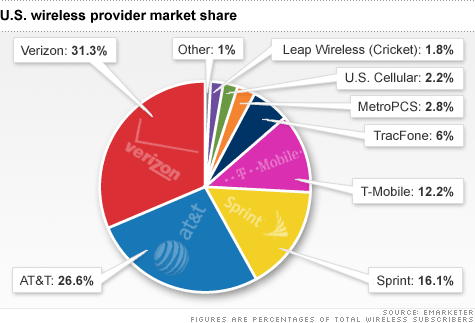 Clearwire Corporation has raised $715.5 million in new capital, including a public offering of 201,250,000 shares of Class A common stock at $2.00 per share, raising net proceeds of $384.1 million, after underwriters' discounts and commissions.
In addition, Sprint has purchased 173,635,000 shares of Class B Common Stock and a corresponding number of Class B units in Clearwire Communications LLC, which will provide Clearwire with an additional $331.4 million in net proceeds. The total net new capital available to Clearwire following today's closings is $715.5 million.
"This equity raise is a critical step for Clearwire to achieve its long-term business plan of creating the first wide-channel TDD-LTE 4G network in the U.S.," said Erik Prusch, president and CEO of Clearwire. Clearwire raises fresh capital
Some might have been skeptical Clearwire could raise that much, so quickly, or that Sprint would again up its investment in Clearwire. But all that has happened.
Gary Kim was cited as a global "Power Mobile Influencer" by Forbes, ranked second in the world for coverage of the mobile business, and as a "top 10" telecom analyst. He is a member of Mensa, the international organization for people with IQs in the top two percent.
Is Distribution King?
At various times, it has been argued that content, distribution, context or some attribute actually is the crucial bottleneck, choke point or nexus of value in the media business.
Sometimes it has seemed that distribution was king; at other times content appeared to the gating partner in the ecosystem; while during the wildness of the Internet bubble it was argued that "context" was king.
All absolute observations are likely wrong to some degree, no matter what the prevailing view. Some might argue that in some ways, especially where it comes to online video, that "ubiquity" is king.
There is an argument to be made. Consider Netflix, which seems to have an for virtually every popular Internet-connected digital device you can think of. Is distribution still king?
It is true that consumers now are more in charge of when and how they watch video content than ever before. That increasingly means that getting convenient gateways to content on the widest possible number of devices is an important strategy for distributors. In many cases, that means an app.
As a result, the distribution companies that will win are those that recognize the need to be everywhere.
When it comes to capturing consumers’ attention now, a piece of content is only as good as its distribution, some will argue. That is true.
It also is true that even extensive distribution is of modest help unless the distributor has the "good content" most people want. So, as usual, you can make an argument that distribution is king, or that content is king.
Sometimes it has seemed that distribution was king; at other times content appeared to the gating partner in the ecosystem; while during the wildness of the Internet bubble it was argued that "context" was king.
All absolute observations are likely wrong to some degree, no matter what the prevailing view. Some might argue that in some ways, especially where it comes to online video, that "ubiquity" is king.
There is an argument to be made. Consider Netflix, which seems to have an for virtually every popular Internet-connected digital device you can think of. Is distribution still king?
It is true that consumers now are more in charge of when and how they watch video content than ever before. That increasingly means that getting convenient gateways to content on the widest possible number of devices is an important strategy for distributors. In many cases, that means an app.
As a result, the distribution companies that will win are those that recognize the need to be everywhere.
When it comes to capturing consumers’ attention now, a piece of content is only as good as its distribution, some will argue. That is true.
It also is true that even extensive distribution is of modest help unless the distributor has the "good content" most people want. So, as usual, you can make an argument that distribution is king, or that content is king.
Gary Kim was cited as a global "Power Mobile Influencer" by Forbes, ranked second in the world for coverage of the mobile business, and as a "top 10" telecom analyst. He is a member of Mensa, the international organization for people with IQs in the top two percent.
Subscribe to:
Posts (Atom)
U.S. Productivity is Rising, but AI Doesn't Seem the Reason
U.S. productivity has been rising for several years, but artificial intelligence is probably not the reason, at least, not yet. According t...

-
We have all repeatedly seen comparisons of equity value of hyperscale app providers compared to the value of connectivity providers, which s...
-
It really is surprising how often a Pareto distribution--the “80/20 rule--appears in business life, or in life, generally. Basically, the...
-
Financial analysts typically express concern when any firm’s customer base is too concentrated. Consider that, In 2024, CoreWeave’s top two ...

