Friday, August 5, 2011

Gaming Firms Need 10GigE?

Providers of cloud-based infrastructure and application hosting services, as well as bandwidth suppliers, might want to pay attention to recent moves by gaming companies, which are finding that, at least in some cases, cloud services providers cannot provide the network bandwidth gaming applications require, leading to performance issues.

Digital Chocolate, provider of social games such as Millionaire City and Pro MMA Fighter, is following Zynga by launching games in the cloud, then bringing them back in house when demand levels off.

Alfred Tsai, Digital Chocolate’s director of global IT and network operations, says Digital Chocolate was operating entirely in Amazon Web Services, but decided to bring some games back in-house when performance issues got to be too much. In other words, the backbone optical network was not running fast enough, with enough capacity.

Gamificiation Culturally Specific to U.S.?

Gamification"Gamification" is seen as a growing technique for increasing user application engagement Mayorships, stickers and badges are examples.

“There is a huge trend in the US that has fuelled the likes of GetGlue, Miso, YapTV, Intonow and all the rest, all leveraging off Foursquare,” Zeebox CEO Ernesto Schmitt says. The consumer variant of "gamification" is the "check-in."

But many think "gamification" is, and will be, an important loyalty mechanism.  Read more here.
But Schmitt thinks the notion is culturally specific to U.S. users. “Americans and all of American society have a big thing about competitions about everyday activities," he argues. “We don’t see gamification as being anywhere near that importance or acceptance in Europe."

Thursday, August 4, 2011

Will You Give Up Facebook for Google+?

It might be a bit of a waste of time to worry about whether Google+ will "displace" Facebook or Twitter. There probably is room for several leading social networks.

And there is some evidence that many people already are thinking they will use, or will try to use, both Facebook and Google+.

Read more here.

Digital Loyalty Matters

Loyalty always matters in business, for the simple reason that acquiring new customers is expensive, compared to retaining and cultivating long-time and repeat buyers. That is true for social media as well as for all other marketing activities of a business. Read more here.


One rule of thumb is that it costs six to seven times as much to acquire a new customer as to retain a current customer. The other important metric is that customers any retailer or brand has had for a longer time tend to buy more, represent higher profit margins and cost less to support (they know the product, know how to use it and don't have as many questions in the billing, delivery or other operational areas).


Ft-existing-customers-10-16-520x980


Digital Goods Have Been Purchased by 31% of All Gamers

U.S. gamers, whose online purchases of digital goods were once paid for largely by credits earned from advertiser offers, now say they are migrating to “real world” payment for digital goods using debit, credit and prepaid cards, according to a new study of online gamer behavior commissioned by PlaySpan, a Visa company.

According to the study, 31 percent of the general gamer population has used real world money to purchase virtual content. Of those gamers who use real world money, 57 percent said they make purchases of virtual items using real world money at least once every month.

Console games with online play account for the majority (51 percent) of virtual purchases using real world money, with social networking games (30 percent) and massively multiplayer online games  coming in at second and third respectively.

Overall, 72 percent of respondents indicated they expect to spend the same or more money on games in 2011 as they did in 2010.  About 67 percent of those who intend to spend more said they were playing more online games than last year, with 42 percent saying they have more money to spend.

Download the full report here.

Apple, Google Gain; RIM, Microsoft, Symbian Lose in 2nd Quarter

The U.S. mobile operating system was a tale of two markets in the quarter ended June 2011, as Google's Android ranked as the top smartphone platform with 40.1 percent market share, up 5.4 percentage points. Apple strengthened its #2 position with 26.6 percent of the smartphone market, up 1.1 percentage points from the prior reporting period. Those were the winners.

Research in Motion, Microsoft and Symbian all lost share.

Top Smartphone Platforms
3 Month Avg. Ending Jun. 2011 vs. 3 Month Avg. Ending Mar. 2011
Total U.S. Smartphone Subscribers Ages 13+
Source: comScore MobiLens
Share (%) of Smartphone Subscribers
Mar-11Jun-11Point Change
Total Smartphone Subscribers100.0%100.0%N/A
Google34.7%40.1%5.4
Apple25.5%26.6%1.1
RIM27.1%23.4%-3.7
Microsoft7.5%5.8%-1.7
Symbian2.3%2.0%-0.3

T-Mobile Still Losing Customers

T-Mobile launches The recent round of quarterly earnings reports for mobile service providers doesn't bear directly on prospects for approval or rejection of the AT&T bid to buy T-Mobile USA, despite the fact that T-Mobile became the fifth smaller carrier to post disappointing results in the last two weeks.

Sprint, MetroPCS, Leap Wireless and Clearwire all reported subscriber losses, as did T-Mobile USA. The reason the quarterly results do not necessarily lend credence to either the argument to approve or deny the transaction is that the results can be seen as support for either position.

Most observers have been expecting consolidation in the market, simply because of the competitive pressures. That might tend to support the argument for a consolidation, even though there will be room for legitimate concern about market structure.

The other argument is that smaller competitors already are finding it difficult to compete with AT&T and Verizon, and that the market is in danger of being dangerously concentrated. That argument will be clearer if (when) Verizon Wireless itself grows by acquiring Sprint.

Facebook Looking at Changes to News Feed

The changes should make it easier for brands to run campaigns on Facebook.

IT Buyers Like White Papers, But Many Want "Local" Content

A survey of 3,217 information technology professionals in 114 territories by IDG Connect suggests that vendor content is a remarkably powerful marketing tool. Worldwide, 72 percent of IT professionals say they find content of this kind “extremely useful” or “useful”. In Africa, Asia and South America, the numbers rise sharply, to encompass nearly all IT professionals.

But IT professionals outside North America say they want localized studies. What they often get are white papers that are heavily influenced by North American perspectives. In Asia, 74 percent of IT professionals say they would prefer localised content, but 79 percent say they “struggle” to find it. In Europe, half of IT professionals prefer to read localised content. Yet 55 percent “struggle” to find it.

The preference for local information is widespread, but runs deepest in South America, Australia and North America. In Europe and the Middle East, the preference for local information is real, but less pronounced. By contrast, Asia, dependent on raw material imports and the export of finished goods, emerges as a stand-out exception. Here, IT professionals find local and global perspectives equally useful.

But white papers might not be the best venue. IT professionals around the world demonstrate a strong appetite for white papers. But how engaged are those potential readers?

We asked IT professionals whether they are “always interested in consuming IT white papers”, or whether they seek them out “when it is relevant to a specific project”. IDG Connect describes these separate groups as “mavens” and “searchers”.

The study found that "mavens" are less plentiful than "searchers." Despite much enthusiasm for white papers in principle, the proportion of mavens dwindles to around a third of respondents in Europe and the Middle East, and to a quarter in South America. In other words, demand for white papers is less robust than often is thought.

Read more here.

Smart Phone, Freemium Games Competing With Console Games?

Shifts of consumer demand always are important, and a shift seems to be happening in the video game arena. Sales of video games fell by 10 percent in June 2011 according to NPD Group, from $1.15 billion in June 2010 to $1.03 billion. The decline is worst among publishers of traditional console games.

The industry currently garners about 75 percent of its revenue from packaged sales, although some industry leaders expect that to drop to just 50 percent within the next five years. Changing user expectations probably play a part, as there is growing evidence gamers think $40 is too much to pay for a single title.

But something else also seems to be happening. Users are spending more time playing simple games on their smart phones and tablets, instead of using dedicated gaming devices.

Even the pre-teen market, the largest for hand-helds, is perfectly happy to play games on an iPhone or other smartphones, NPD says.

Google runs 900,000 servers, uses 0.01% of world's electricity

Google runs 900,000 servers that possibly consume u0.01 percent of worldwide electricity, compared to data centers as a whole, which account for up to 1.5 percent of worldwide electricity use, and as much as 2.2 percent of U.S. electricity.

To be sure, those figures represent a "best guess" made by Stanford professor Jonathan Koomey.

Wednesday, August 3, 2011

Windstream Purchase of PAETEC Has Broader Lessons

Windstream Corp.'s acquisition of PAETEC Holding Corp. illustrates one key element of business strategy for most service providers of any size in the U.S. and other global markets. The $2.3 billion deal gives Windstream a bigger profile in business customer services, arguably a more-important revenue source for any fixed-line service provider, given the cable industry's growing success in the consumer services market.

The acquisition also illustrates the generally paltry returns available to most service providers in their legacy geographic footprints. Generally speaking, the largest tier-one telcos, mobile service providers, small rural telcos and competitive local exchange carriers have been able to get significant growth in subscribers and revenue over the last decade largely by growing outside their original service territories. Read more here.

The need to go "out of region" is not just a strategic imperative for tier-one global providers. It applies to small telcos, competitive local exchange carriers and mobile service providers as well.

Few remember it, but Rochester Telephone, an independent telco operating in Rochester, N.Y., once wanted to get into the competitive long distance business badly enough to trade away its local access monopoly, breaking itself up into a "wholesale" infrastructure company and a separate retail entity that bought network service from the wholesale company just like any other competitor in the market.

More recently, SingTel decided to give up its local monopoly in the same way Rochester Tel did, in exchange for freedom to deploy its capital in other international markets. But note the business driver: SingTel cannot achieve the growth it expects and wants if it stays a provider of services in Singapore. Perhaps 90 percent of current revenue already comes from "out of region" operations.

Windstream says the deal provides more opportunity in strategic growth areas for Windstream, including IP-based services, data centers, cloud computing and managed services. A stronger presence in the important business market is key. But the acquisition also gets Windstream into new geographic markets as well.

Mobile Operator Radio Costs to Grow 7 Times to 2016

According to Juniper Research, even after adding more-efficient Long Term Evolution networks, global mobile operator costs to deliver user data could surpass $370 billion annually by 2016, a seven-fold increase on their 2010 level of $53 billion.

That might be a generalized problem for fixed networks as well, on both capital and operating cost fronts.

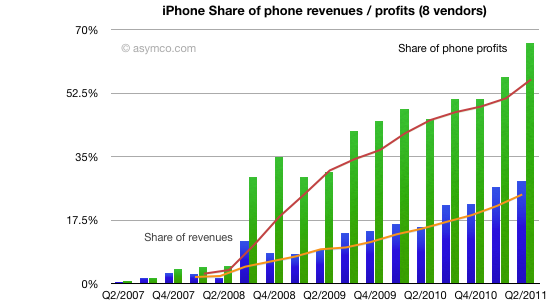
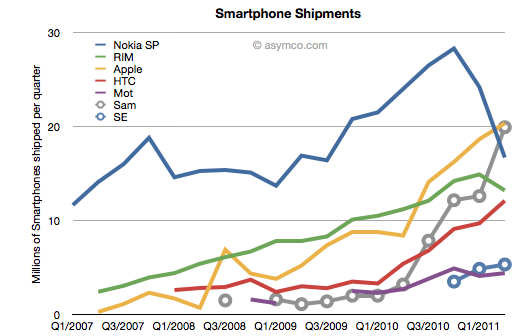
Apple Gets 66% of Handset Profits

Apple gets two thirds of total industry profit share in the handset arena, despite getting only about 28 percent share of device sales. Apple share of phone revenues increased to 28%

Read more here as well. 


Low ROI Blunts Mobile Marketing Adoption

A new study conducted by The Relevancy Group in June 2011 and commissioned by Pontiflex, finds that lack of return on investment from mobile advertising is the biggest deterrent for marketers when it comes to increasing mobile ad spending in 2011.

Mobile Marketing Survey: Low ROI Cited As Main Reason For Not Increasing Mobile Advertising SpendSome 43 percent of marketers who aren't planning to increase their mobile ad spending this year say low ROI from mobile advertising is the top reason that they won't increase spending. The survey also found that 93 percent of marketers said they would increase mobile ad spending if they realized a higher return on their investment.

Other survey results indicate that marketers are dissatisfied with click-based mobile advertising. The Relevancy Group survey found that 56 percent of Fortune 500 marketers are dissatisfied with or don't use click-based mobile advertising.

Can Netflix Become Disney Faster than Disney Can Become Netflix?

To a larger degree than might be immediately obvious, the new Netflix challenge might be whether “ Netflix can become Disney faster than Dis...