Wednesday, December 28, 2011

Facebook was Made for Mobile

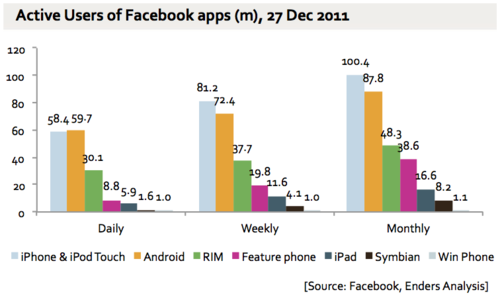
Sometime in the last couple of days, the monthly active users of Facebook’s mobile apps passed 300 million, says analyst Benedict Evans.


That is 37.5 percent of the 800 million total monthly active users Facebook disclosed in September 2011, when Facebook said there were 350 million monthly active mobile users, making Facebook one of the most mobile-centric online services out there.


Facebook's 300 million app users

"Latency" Issues Not Under Full Service Provider Control

Network service providers can do many things to optimize bandwidth and latency on their networks. But it also is true that networks cannot optimize most end points on their networks, nor can they control peak load.


That means that latency as a problem can be remedied only partially by steps network service providers can take. 

First person shooter games such as Call of Duty rely on low network latency in order to keep pace with players’ reaction times, and can offer a competitive advantage in multiplayer games.


"Hardcore gamers" often recognize latency as a key criterion when selecting their network provider. That, in turn, poses questions for service providers. How gaming is changing the data center

There are some known ways to reduce latency, such as reducing distance packets travel, for example. Beyond that, one might argue that most latency results from the devices and servers used in sessions, which are, by definition, not under the control of a network operator.

Still, minimizing distance packets must travel, or unnecessary protocol conversions, will help improve latency performance. Peak bandwidth demand, on the other hand, has to be approached differently. Adding new capacity, convincing users to regulate their usage or traffic shaping are potential tools in that regard. But adding capacity does not always automatically improve latency performance.

That implies that the techniques used to improve performance of a network under congestion are different from the tools used to manage latency performance. Caching and other techniques that put server resources "closer" to users are one way networks can be designed to minimize latency issues.


But those decisions have to be made by application providers. 

Amazon Gains, Netflix Loses, on Satisfaction Scores

Amazon appears to have made major gains on Netflix in the “customer satisfaction” area, as  Netflix dropped six points (from 85 to 79); while Amazon gained two points to achieve a score of 88, for a net swing of eight percentage points, in ForeSee’s survey of Christmas and holiday period customer satisfaction in December 2011.

The two companies, who have long been together atop the Index, are starting to diverge, signaling a strong year to come for Amazon and a difficult one for Netflix, ForeSee predicts.

The survey data is based on more than 8,500 customer surveys collected during prime holiday shopping time between Thanksgiving and Christmas of 2011.  Amazon gains, Hulu loses in satisfaction scores

Google+ Surpasses 62 Million Users


Google+ is adding new users at a very rapid pace, and seems to have surpassed 62 million users, according to Paul Allen, who has been estimating Google+ usage since the summer of 2011. 


In the summer of 2011, Google+ users were unusually weighted in the direction of technology, especially software-related job titles. That might be expected for an "early adopter" product.
“Each week my team from elance runs hundreds of queries on various surnames which we have been tracking since July,” he says.  “We revised our model based on the actual user announcements made by Google on July 13th and Oct 13th.” Google+ subscribers
 
July 13 - 10 million
August 1 - 20.5 million
September 1 - 24.7 million
October 1 - 38 million (Larry Page announced "more than 40m users" on Oct 13th)
November 1 - 43 million
December 1 - 50 million
December 27 - 62 million
January 1 - 65.8 million (forecast)
February 1 - 85.2 million (forecast)

Tuesday, December 27, 2011

894 Million Mobile Banking Users by 2015

Mobile banking and related services are expected to grow from 55 million users in 2009 (at a CAGR of 59.2 percent) to reach 894 million users in 2015, according to Berg Insight, The Asia-Pacific region is expected to become the most important market region, accounting for more than half of the total user base. 894 Million Mobile Banking Users by 2015

Monday, December 26, 2011

Are 4G Sales Slow or Not?


What adoption curve will fourth generation mobile networks take, especially the new Long Term Evolution networks? Right now, only one service provider in the United States, Verizon Wireless, has a full year of operation to talk about. 

Of course, Clearwire has been in operation since 2005, but key differences in business model and markets render the comparison inexact.
Clearwire, which mostly has grown on the strength of its WiMAX 4G network, ended the second quarter 2011 with approximately 7.65 million total subscribers, up 365 percent from 1.64 million subscribers in the second quarter 2010. Clearwire subscribers 

But some would note that Clearwire has made significant changes in its business plan, from fixed to mobile, from rural markets to all markets, and from a mix of retail and wholesale to wholesale-only. Along the way, Clearwire also has merged its spectrum with that of Sprint. All of those changes make an "apples to apples" comparison challenging.

So keep in mind that Clearwire had a five year to six year period where its growth was rather measured, not to mention that it began life offering a fixed-only wireless alternative to fixed network broadband. The inflection point for growth didn't come until 2010, when a variety of factors, ranging from Android adoption to overall smart phone growth to arguably better marketing seem to have made a difference.


The Clearwire subscriber base consists of 1.29 million retail subscribers and 6.36 million wholesale subscribers. The key point is that although the analogy is not precise, since Clearwire started out as a fixed network alternative, and only later changed to mobile broadband, early demand might not be reflective of what might have happened if it had focused on mobile broadband, or if Clearwire had been able to focus on mainstream mobile customers rather than largely-rural potential customers.

The initial focus on smaller and more-rural markets would, in and of itself, been the cause of slower growth than a nationwide smart phone mobile service, at a time when smart phone adoption is robust.
One year after its launch, Verizon Wireless's 4G LTE network has failed to capture the imagination of the public, who still seem to prefer the slower-connecting Apple iPhone by large margins, argues Paul Kapustka of Sidecut Reports. Sidecut report

With data-download speeds up to 10 times faster than previous technologies, it might seem that Verizon's "fourth generation," or 4G wireless network, would be a hot commodity in a mobile device-crazed world, says Kapustka.

But lack of a compelling new "4G-only" application is one possible reason why Verizon had sold fewer than two million 4G LTE-capable smart phones during the first nine months of 2011. he argues. Some of us also would argue that 3G is quite good enough for most smart phone users, at the moment.

The other complicating issue is that it is in most cases the rule that devices drive subscriptions, and the popular Apple iPhone only works on 3G networks. As it has been the case that ability to get the iPhone seems to drive the subsidiary choice of service provider, so it might continue to be the case that overall demand for iPhones, which only work on 3G networks, is affecting the choice of network, though less so service providers, these days.

By way of comparison, more than four million people bought the new Apple iPhone 4S the first weekend it went on sale, from Verizon as well as from AT&T and Sprint, Kapustka argues.

One might not consider Verizon 4G sales "slow," in the context of rather-slow 3G adoption, and the long run-up of Clearwire 4G sales.

SMBs Have Embraced Online Marketing Channels, Local Will Grow

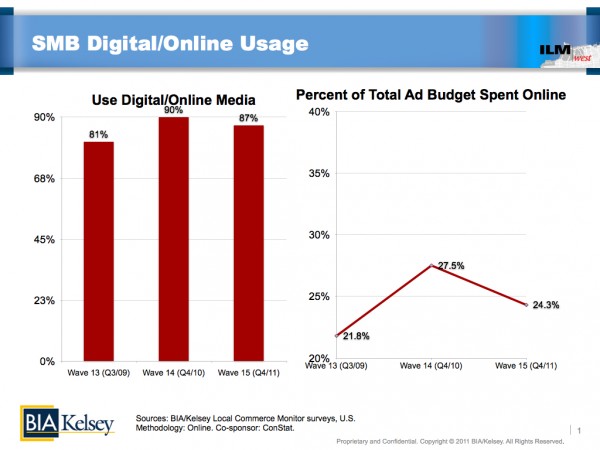
Small businesses are not unlike other businesses where it comes to using various online and web-based marketing channels, with 81 percent to 90 percent of respondents surveyed by BIA/Kelsey saying they use those channels.


One would suspect that the volume of efforts could change, over time, though. As more users on smart phones make active use of web-based information when about to shop, or while shopping, it is going to become more important for many local and smaller businesses to maximize their ability to found easily by users who have access to location information.


Also, the usefulness of information will become more important, as will promotion efforts. 


Mobile Apps Now Top Web Use

Chart MobileApp vs DesktopWeb Consumption resized 600Smart phones are changing how people use "web" resources. For the first time ever, daily time spent in mobile apps surpasses desktop and mobile web consumption, according to Flurry. Also, it took less than three years for native mobile apps to achieve this level of usage. Mobile apps used more than web

All of that is going to significantly change the ways people use applications and devices, from navigation to web behavior. For starters, smaller screens and out of the home usage mean that the types of information people are looking for, when mobile, are different from desktop modes. More purposeful searches are one example.

When out and about, people are more likely to be looking for someplace to go, something to do, places to eat and drink or shop. So one consequence is that mobile users are more directly interested in commerce apps than PC users. The latency between search operation and "buying" is more direct, and more frequent.

That explains why there is so much more activity around mobile commerce, mobile payments, mobile banking and mobile wallets.
Sunday, December 25, 2011

For our Jewish relatives and friends....

A humorous look at the Christmas holiday, from a Jewish perspective.

Glory to God in the Highest...

Thursday, December 22, 2011

Tim Tebow Interview

 In the first minute, he answers some questions about his touchdown celebration and pre-game routine. About a minute in, a bit of comedy.
.

Financial Advisors Think Social Media Doesn't Work


Financial advisers in the United States are seeing fewer benefits from their use of social media, a survey by Aite Group suggests.

Out of the 437 advisers surveyed, only 19 percent said social media was useful for reaching new prospective clients, roughly half the number from two years ago, when it was considered a leading benefit.

"Social media has been over-hyped and the benefits just aren't there for a lot of advisers," said Aite senior analyst Ron Shevlin. Fewer leads?

In fact, there seem to be no benefits ranked more highly in 2011 than in 2010 by the surveyed respondents. 

The most frequently cited objective for using social media was to build brand awareness and differentiation. But the percentage of advisers who credit social media with helping them differentiate their practice from competitors dropped to nine percent this year, from 21 percent in 2009.

Are business social media users really becoming “fatigued,” have they simply reaped most of the rewards, or is there some other explanation for why “results” seem to be slipping, at least in this one survey?

One can think of all sorts of reasons why social media doesn't always "work."  Poor execution, inadequate resources, lack of executive support and fuzzy business objectives can cause issues, no doubt.

There also are lots of reasons why it would be difficult to measure success, even if social media did “work.” All the metrics measured by Aite Group are subjective. Also unknown is whether the same executives were interviewed in both years. It is conceivable that a new sample population held different views than the former sample. 

The one social media tool that saw an increase in advisers' professional use was LinkedIn, up 10 percent since 2009. Comparatively, professional use of Facebook fell 10 percent, Twitter dropped eight  percent and personal blogging declined nine percent.

There was a Time Before the Internet....

And who knows how people were able to get anything done at work, research and write their papers or communicate!
 

Some Retailers Use QR Codes; Others Might Ask Why


Quick response codes are used by retailers and others to turn an "offline" experience into an "online experience." Smart phone users can point their cameras at the codes and then be taken directly to a website.

According to new research by Nellymoser, 7.2 percent, or about 1 in 14 stores are using QR codes during the 2011 Christmas and holiday shopping season, with fashion retailers the heaviest users.

Nellymoser looked at more than 700 individual stores and 318 brands in the five largest shopping malls in the greater Boston area, including Best Buy, J.C. Penney, Macy, Neiman-Marcus, Nordstrom and Sears.

When it comes to placement, Nellymoser found a majority of the 23 chains using QR codes displayed them in their front store windows to lure shoppers with the prospect of a special deal or discount. Typically, the QR codes were applied in the form of a decal in the lower right or left corner of a window. Retailer use of QR codes

But QR codes failing to gain consumer acceptance or traction, some would say. In fact, most people probably don't even know what they are. It might be that the rapid adoption of smart phones is obviating the reason QR codes were thought to be an advantage.

There was a time when QR codes made some sense: feature phones without keyboards made typing universal resource locators quite difficult. So the QR code was supposed to allow users to go straight to a website without fumbling around typing.

As more users get smart phones with better browsers and keyboards, the need for the QR code as a shortcut is undercut.

To have gotten huge traction, one might argue, feature phones would have had to remain the staple of user mobile web access. But smart phones rapidly are becoming the devices of choice for most people, making the QR a rather less useful way of getting to a web page.


Web Pages Getting "Bigger"

Typical page size seems to be growing, according to data supplied by HTTP Archive.

Over the last year the typical web page seems to have grown from about 700 kilobytes of data to nearly 1 megabyte.

The data also suggests that, for any given amount of pages viewed by a typical web browsing consumer, total bytes consumed will keep climbing.


On the Use and Misuse of Principles, Theorems and Concepts

When financial commentators compile lists of "potential black swans," they misunderstand the concept. As explained by Taleb Nasim ...