Tuesday, April 10, 2012

Too Early to Say Much about New iPad Behavior

On the opening day, the iPad represented 0.52 percent of total iPad network traffic. That figure peaked at 2.28 percent on day three, and then declined to 1.92 percent of traffic by day six. In contrast, the iPad and iPad 2 each had 45 percent or more of total iPad traffic, Jumptap says in its latest MobileSTAT Report. 

But it's too early to conclude much of anything about either iPad traffic or users. Still, observers will be watching for any signs of new user behaviors, especially any related to the higher-definition Retina display, which could have important ramifications for online and mobile video, as well as mobile and Wi-Fi network usage. 


A slight dip in iPad 2 traffic immediately after the new iPad was released might indicate that many early buyers of the new iPad also own iPad 2 devices. The suggestion is that they started using the new iPad and so were not using their iPad 2 tablets. 


Monday, April 9, 2012

North American FTTH: Good and Bad News

The number of North American households connected directly into optical fiber networks grew by 13 percent over the past year, indicating that telecommunications companies of all sizes are continuing to upgrade to next-generation fiber to the home technologies, according to the Fiber to the Home Council


The Council 900,000 households across the United States, Canada, Mexico and the Caribbean were upgraded to FTTH service since April 2011, as the total number of North American homes subscribing to all-fiber connections topped eight million. FTTH is now being offered to 19.3 million homes on the continent, the Council says. 


In the United States and Canada there are about 161 million fixed network access lines, so FTTH represents less than 12 percent of potential lines in service, and less than five percent of subscribers. 

Legacy Revenue Still Drives Business Results in Global Industry

The most-obvious take away from the latest data on global telecommunications published by the Telecommunications Industry Association is the dominance and importance of wireless services. Globally, about 63 percent of all revenue, from all sources, is driven by wireless.


About 25 percent of total revenue is produced by fixed line voice services. Fixed network broadband produces about 10 percent of total revenue. IPTV is about one percent of total revenue.


What might strike you about the latest report is the non-existent discussion of the impact of over the top VoIP services. One reason might be that over the top VoIP actually doesn’t generate much revenue, one way or the other, for an incumbent service provider or an over-the-top app provider.


In 2010, operators made on average only $13.21 per user per year from mobile VoIP services. In other words, VoIP turns out not to be such a great product for incumbent service providers. That isn't true for all fixed network providers, though. 


U.S. cable operators have found that voice services using VoIP technology have been a major revenue contributor, in fact the fastest-growing new revenue source, in recent years. Growth in consumer voice has leveled off, though, so attention now will switch to business voice customers. 

Legacy revenue still drives the business, one might easily conclude. 

Telecom Conventional Wisdom Often is Wrong

 In the global telecom business, conventional wisdom” sometimes is quite wrong. SIP trunking, hosted IP telephony and VoIP provide examples. The conventional wisdom is that SIP trunking saves end users money, that hosted IP telephony is a bigger business than Centrex was, or that VoIP is a business tier-one telcos “need” to aggressively pursue. But all three might be “wrong.”


The point is that business strategy and activities have to be based on correct assumptions, and that many common assumptions are incorrect. Consider the conventional wisdom that SIP trunks save businesses money when used to support IP telephony traffic. But there now are arguments that this might not always be true.


Depending on whose research you look at, the penetration rate of SIP trunking in the US is somewhere between five percent and 30 percent of all trunk lines. Zeus Kerravala estimates penetration is right around five percent in the United States, with Europe being about half of that and adoption being almost non existent in Asia at the moment.


The reason, some would argue, is that SIP trunking does not always save enterprises money, especially if the traffic mix changes to video telephony, or when enterprises own lots of distributed phone systems that are not fully depreciated. 

Smart Phone Penetration 56% in 2013?

US Smartphone Users and Penetration, 2010-2016If current trends continue to hold,  the number of U.S. consumers with a smart phone will more than double from 93.1 million at the end of 2011 to 192.4 million by 2016, when 58.5 percent of the total U.S. population will have a smart phone, eMarketer projects


One obvious caveat is that current adoption trends are driven by heavily-subsidized smart phones. Logic suggests an end to such subsidies would drastically reduce the smart phone adoption rate.


A more likely development is reduced subsidies for high-end phones, with a shift of end user demand to the more-subsidized smart phones, which undoubtedly would  not be the high-end devices. 


New iPad Drives 10% of all iPad Traffic

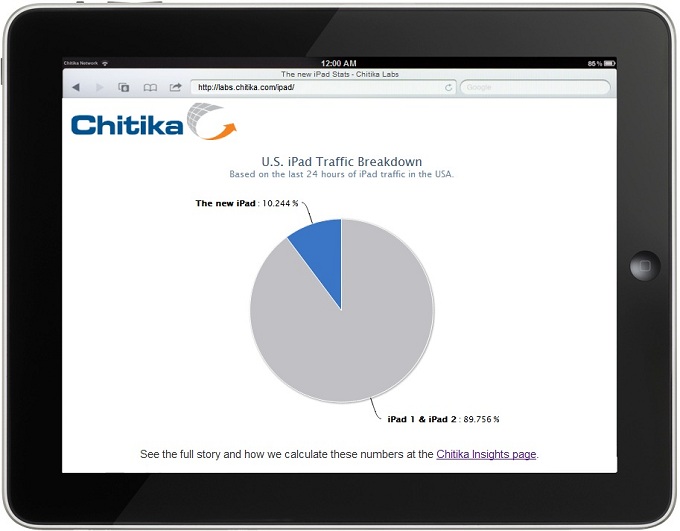
After about three weeks, the new Apple iPad apparently was driving 10 percent of all iPad traffic, Chitika reports


That might imply one of two things, either that after less than three weeks the new iPad has gotten about 10 percent share of the iPad market, or that users of the new iPad are using bandwidth at a higher rate than owners of the older models. 


Most people would instinctively guess it is the latter, not the former, which accounts for the bandwidth intensity. 

The Lumia 900 Becomes Amazon’s Best Selling Phone

Even though the Nokia Lumia 900 just launched a day ago, the phone quickly skyrocketed to the top of  Amazon’s best sellers list.  The Lumia 900 appears at the moment to be the best-selling device sold by Amazon


Part of the instant popularity likely comes from Amazon’s price of $50 with a two-year service plan. That’s $50 less than AT&T’s price and $150 less than the previously most popular phone from Amazon, the Droid RAZR MAXX.


AT&T to Spend More Heavily on Lumia than iPhone Launch

AT&T appears to be gambling that it can achieve market advantage by offering the Nokia Lumia 900 for the period in which AT&T has an exclusive.


AT&T reportedly is going to spend as $150 million to help launch Nokia's Windows Phone Lumia 900, more than it spent to launch the iPhone. Is it a gamble? Some would say so. Microsoft's operating system does not register much more than three percent market share in the U.S. market,  though many expect the tie-up with Nokia might make a difference.


But the Lumia might have key market share and operating cost implications. It might require less spending on AT&T's part in the form of device subsidies. Also, Nokia and Microsoft have limited enough market share that the possibility of upside arguably is far greater than the downside. 


We will see. Consumers will be weighing a lower retail price for the device with the different user interface, as compared either with the Apple iPhone or Android devices. 


Device exclusivity, for a time, remains a key carrier objective. But it remains to be seen whether any future devices, other than the original iPhone, will ever have the length of time where exclusivity holds. Nor is it clear any devices since the iPhone have had similar perceived value. 


AT&T loses

Even Libraries Face Mobile Ecosystem Conflict

The 2012 State of America’s Libraries study illustrates the widespread nature of potential disturbances in the mobile, tablet and application ecosystems between ecosystem participants. 


Over 67 percent of U.S. libraries now offer downloadable e-books and 28 percent lend out e-readers “and other mobile devices” to patrons, but “when Random House increased its e-book prices by 100 percent to 200 percent” the “dialogue between the publishing and library communities concerning ebooks…moved to a front burner,” the report says. 


The report also notes that four of the big-six publishers offer no e-books to libraries at all. “No one is quite sure where the ebook–library relationship is going,” the report says.


Penguin, for example ,no longer provide e-books or digital audiobooks to libraries. 


In November 2011 when Penguin stopped offering new e-books to libraries, it also stopped offering e-books to library patrons using Kindles.


A few days later Penguin restored Kindle access, but also noted, “Penguin informed suppliers to libraries that it expected them to abide by existing agreements to offer older digital titles to libraries only if those files were held behind the firewalls of the suppliers.” 

Who would doubt that Penguin business interests with Amazon have much to do with that decision?


Such conflict is par for the course in virtually all business ecosystems affected by mobility. And that increasingly seems to include retail commerce, online commerce, banking, payments, online and mobile advertising, communications, music, video, movies, books and other printed media products. 


Changes in "who" makes money, "how" therefore now affect many products, processes and services that touch any consumer or business in the ordinary conduct of life, in other words.

Consumers Love Google, Even if Some Pundits Possibly Don't

Google and Apple are highly regarded by consumers, even if some pundits and technologists sometimes discount Google, a new ABC News/Washington Post poll indicates.


About 82 percent of Americans express a favorable opinion of Google overall, while 53 percent have a “strongly” favorable opinion.


About 74 percent of respondents view Apple favorably.  

What Impact Will Declining Smart Phone Subsidies Have on Penetration, Innovation?

It is a fundamental economics insight that when suppliers raise the price of any product, demand drops.


So it takes no particular insight to predict that if mobile service providers start reducing the subsidies they now offer to spur smart phone adoption, adoption rates will fall. And there is growing opinion that smart phone subsidies in the U.S. market are about to become less generous. 


Analyst Walter Piecyk of BTIG, in fact, already has cut his earnings projections for Apple, on the assumption that lower subsidies will lead directly to lower sales of Apple iPhones. The same will be true for suppliers of other devices that also are subsidized less.


 The subsidies can't last, he argues, in part because the ever-growing cost of the devices is putting a strain on operating revenue. 

In addition to fewer sales of smart phones, any abandonment of subsidies would slow replacement rates and arguably slow the rate of innovation for any application or feature that requires new handset functionality.


Any such change also would provide benefits for providers of lower-cost smart phones, as well. On the other hand, an end to subsidies would likely also mean an end to multi-year contracts, which would tend to increase customer churn. 


Hand set subsidies are a double-edged sword, in other words. As much as service providers would like not to provide the subsidies, there are negatives to be faced, including higher churn, slower smart phone adoption and a shift of sales toward less-expensive models. 

Global LTE: by 2016, Growth Will be in Asia-Pacific Region

Though the United States has dominated the Long Term Evolution market so far, other regions are poised to boom over the next five years, according to Signals and Systems Telecom


According to Signals and Systems Telecom, the Western Europe and Asia Pacific Regions will see the highest growth rates during the next five years.


Why There is No Need for "Interactive TV"

An overwhelming number of respondents surveyed by Nielsen suggests the reason why "interactive TV" not only has failed, but likely has little future. 


Connected device owners in the United States, United Kingdom, Germany and Italy overwhelming use their smart phones and tablets devices for interactions and multitasking while watching television.


In the United States, 88 percent of tablet owners and 86 percent of smart phone owners said they used their device while watching TV at least once during a 30-day period, according to Nielsen.


For 45 percent of tablet-owning Americans, using their device while watching TV was a daily event, with 26 percent noting simultaneous TV and tablet use several times a day. U.S. smartphone owners showed similar dual usage of TV with their phones, with 41 percent saying their use their phone at least once a day while tuned in.


simultaneous-tablet

Microsoft Buys 800 Patents from AOL, Issue is Why

Mircrosoft is buying 800 patents from AOL, covering online communications, browsers, search engines, multimedia, network routing, security and voice. The obvious question is "why," and less "why now?" 


The "why now" is simply that AOL was going to sell the patents to somebody, and Microsoft concluded that is was a reasonable way to spend about a billion dollars. The "why" isn't so clear, yet. 


One would have to assume Microsoft expects to be in some businesses, or to have a bigger role in some businesses, where such patents will ward off attacks based on patent infringement. In other cases firms also use patent portfolios to gain cross licensing of patents from other competitors. 


The point is that Microsoft would not be spending about a billion dollars without expecting some business use of the patents. 


The deal also includes Microsoft licensing of about 300 additional patents from AOL. Those presumably include patents related to advertising, search, content management, social networking and mapping. 


AOL has a license to use technologies covered by the 800 patents sold to Microsoft, as well. About 140 of the patents relate to online communications, with the majority of these patents focused on instant messaging and email technology.  These patents cover many features that are now standard in online chat, mobile messaging, and social in-network messaging applications.
  
For example, AOL has  patents covering contact list management, status indicators and visibility settings, group messaging, the use of avatars and icons associated with chat profiles, as well as interoperability technology between various online messaging platforms. 


Regarding email technology, AOL has a number of patents related to spam filtering, group message opt-in systems, and unified messaging (i.e., conversion of email to text and audio).  AOL has also patented technologies for cross-language communications, both via email and online messaging. AOL owns 81 patents related to browser technologies and user interfaces. 


   AOL sells more than 800 patents to Microsoft in $1 billion+ cash deal

Sunday, April 8, 2012

"Why" an iPad "Nano?"

There are several questions that have to be answered, from Apple's perspective, about why it would want to release a smaller iPad, such as the rumored eight-inch device. 


Even if there is a perceived market,  there are some technology questions, such as battery life, or the ability to support Retina display. Perhaps the biggest issue is whether Apple believes there is a substantial incremental opportunity, though. 


The precedent is the iPod, of course. For all rival suppliers, it will matter greatly whether the tablet market develops on the iPod or iPhone model. If the former, Apple "owns" and "defines" the market. In the latter case, there is room for other suppliers. 


For everybody but Apple, the issue is whether competing with Apple is actually feasible, not in the sense of ability to produce and sell a tablet, but whether any other supplier will be able to displace Apple in the "tablet" market in terms of mind share or market share. 


Today, Apple has about 78 percent market share in the MP3 market. 

On the Use and Misuse of Principles, Theorems and Concepts

When financial commentators compile lists of "potential black swans," they misunderstand the concept. As explained by Taleb Nasim ...