Sunday, June 3, 2012

How Well Will Communications Fare in Next Recession?

The communications business might be more resistant to economic downturns that many other more-cyclical industries, but it is not by any means immune. 


During and after the Great Recession of 2008, it appears consumers shifted their spending on video and communications, with some of the biggest reductions occurring in the purchase of "premium" video channels such as HBO and fixed network voice lines. But even the "hot" mobile business saw reversals. 


Figures compiled by Informa Telecoms & Media suggested the number of net new mobile phone subscribers fell sharply in the fourth quarter of 2008 and growth of mobile data revenue stalled for the first time. 


Figures from Informa Telecoms also sugested that the total number of new users for mobile phone services fell by 15 percent to 162 million in the fourth quarter of  2008. 


So it is not necessarily reassuring that, as Europe apparently heads toward another recession, service provider revenues generally were hit in the first quarter of 2012. That might be an early indicator. 


It isn't clear whether the U.S. market already is in recession, or is headed there. But there are enough serious warning signs to wonder whether another period of consumer stringency is coming. 


The Bloomberg Consumer Comfort Index, for example, has dramatically retraced ground from its April 15 high point of minus 31.4. In just a short period of a month's time, it has consistently deteriorated, reaching negative 43.6 in the just reported week ending May 13. That may in fact be offering an early signal of recession.


If so, neither telecom, mobile or video service providers will escape some damage. 


Some of the issues are structural, though. USA Inc. provides a good overview of the structural issues. 


A few decades ago, some smart economists argued that federal deficits "didn't matter." Of course, those statements were made under vastly-different economic conditions. Deficits were far smaller and financing was largely internal, not external.


To put the matter bluntly, when U.S. citizens were funding the deficits, a default on those obligations would have been an internal matter. Today, with sovereign debt being the way those deficits are funded, default would be vastly more dangerous. 


In other words, we might default on obligations "we owe to ourselves." It is quite a different matter to default on "obligations we owe lenders in other sovereign nations." These days, deficits most assuredly matter. 


The other problem, aside from the structural deficits, is anemic job creation. Labor force participation rates, the percentage of people of working age who actually are working, is at dreadful levels.


3G Infrastructure is Where Mobile Operators Spend Capex Now, But LTE is Coming

The global 2G, 3G, and 4G mobile network equipment market dropped 14 percent to just under $10 billion in the first quarter of 2012, following an eight percent increase the previous quarter, Infonetics Research says


Most seasoned observers would caution that a sharp quarter-to-quarter change, especially where unusually high fourth-quarter spending is followed by lower first-quarter spending, often is caused by an acceleration of orders in one quarter that is followed by lower spending the following quarter because planned expenditures were accelerated in the prior quarter.


Also, given the high amount of growth coming from China's operators, a sharp drop on the part of China Mobile can have significant impact on global spending. 


“The overall mobile infrastructure market took a beating in the first quarter of 2012,” notes Stéphane Téral, principal analyst for mobile infrastructure and carrier economics at Infonetics Research. “We saw weak 2G and 3G activity across the board, exacerbated by China Mobile’s dramatic GSM pause on the heels of extraordinary shipment levels in the previous quarter. 


Long Term Evolution (LTE) and WIMAX equipment revenue also declined sequentially. But LTE spending is up 128 percent from the 2011 first quarter. 


The LTE equipment market to grow to $17.5 billion in 2016.


Some 319 mobile operators have committed to LTE, and 72 LTE operators have launched commercial services in 37 countries, according to the Global Mobile Suppliers Association, That naturally will drive the increase in LTE infrastructure spending.

Saturday, June 2, 2012

Can Any Incumbent Reverse Legacy Product Trends?

Comcast Chairman and CEO Brian Roberts is trying to do something few telco executives have formally attempted, namely reversing the declines in the key legacy revenue stream. 


Telco voice revenues, which historically have driven revenue in the business, are under pressure as much as cable TV operators face losses in their once-core basic video subscription business. But Roberts is trying to do something novel.


Comcast says it is on a "mission" to reverse the trend of declining video subscriber accounts.
Comcast has in fact lost fewer video subscribers in each of the past six straight quarters. 


At least up to this point, telco executives have been more focused on growing new revenue streams, a task made easier by strong growth in wireless services. 


In some key ways, Comcast is trying to change the market share dynamics for a legacy product, hoping that it also can manage the larger transition to a future where today's distribution methods might not be quite so important. 


Telco executives seem to have concluded that the "future" version of their legacy product already exists--wireless voice--and have secured a commanding lead in that business. 

AT&T Expects Toll-Free Data Plans in a Year

AT&T CEO Randall Stephenson says "toll free" data plans, which would exclude certain types of content from counting toward a customer's monthly data allotment, likely will catch fire in the next 12 months. 


In fact, he says content providers already are asking about whether they can partner with AT&T to do so. "I think you'd be stunned if we weren't getting those phone calls," Stephenson says.  "The content guys are asking for it."


Amazon pioneered that basic concept when it got deals to buy download bandwidth on behalf of customers buying book content for their Kindles. 


And given the extreme bandwidth consumed by video, expected to the application which drives bandwidth consumption the most, that is a likely development. 


Will Apple Become an MVNO?

There are more than a thousand mobile virtual network operators (MVNOs) in operation globally, as of May 2012, according to Wireless Intelligence.


MVNOs are most prevalent in mature markets where market penetration has surpassed 100 percent, and has been especially prevalent in Europe.


Europe, in fact, has about 66 percent of all MVNOs. The Asia-Pacific region has 125 MVNOs while North America has 90 MVNOs. 


One has to wonder what the situation will be in another decade, when it is conceivable many application providers might have launched new types of MVNOs, perhaps based solely on mobile broadband, perhaps tightly integrated with devices and possibly using different revenue models.


The nearly-continual speculation about whether firms such as Apple, or Google or Amazon might someday want to launch their own MVNO services are examples of that sort of thinking. 


Apple's next big move will be to provide wireless service directly to its iPad and iPhone customers, according to veteran wireless industry strategist Whitey  Bluestein, who argues the business model will be different. 


As would be the case for other application or device manufacturers, the service would be part of a business model that relies on revenues from sales of content, other products, advertising or commerce. 


Has the Social Media Bubble Popped, or is the Real Bust Coming?

Whether we have been in a new Internet bubble like that of the years leading up to 2001 is a matter of huge dispute. Some might argue, based on the Facebook initial public offering, that the bubble already has popped. Others might argue the bursting bubble is yet to come. 


The argument that Facebook being the worst IPO of the last decade is a harbinger, but not the bursting bubble. That will happen only when valuations of most other firms with a social element also crash and burn. 


To be sure, some have been sounding the alarm for a year or more. "We’re now in the second Internet bubble," said Steve Blank, a serial Silicon Valley investor. 


The signals were that "seed and late stage valuations are getting frothy and wacky, and hiring talent in Silicon Valley is the toughest it has been since the dot.com bubble."


"The most telling indicator [of a bubble] is the $1 billion-dollar valuation," Gartner's vice president Ray Valdes recently argued about Facebook's purchase of Instagram. "Two- and three-person Silicon Valley startups [are] getting venture capital funding within days or weeks, rather than months, for stuff that is more of a feature than an actual product," he noted. 


Some of us would argue the bubble hasn't burst yet. You'll know when it does; it won't be a debate. 

Verizon 300 Mbps Will Cost $205 a Month

Verizon's new 300 Mbps high-speed access service, to be launched on June 17, 2012, reportedly will cost $205 a month, when bought on a two-year contract, according to the Verge


Non-contract service adds $5 a month to the cost, and customers who do not buy a bundled phone line will pay another $5 a month. 


Verge-verizon-fios-pricing_560

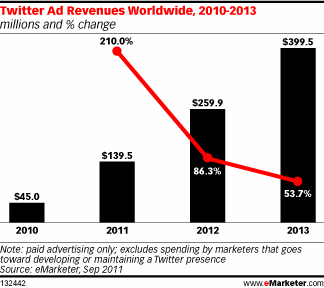
When Will Twitter Reach $1 Billion in Ad Revenue?


Researchers at EMarketer Inc. have said that in 2014, Twitter will reach $540 million in ad sales, which make up virtually all of its revenue, up from $139.5 million last year. The obvious question is how long it might take before Twitter reaches $1 billion in annual revenue.


The answer might be important if you think Twitter is a valuable service that needs a big revenue source to continue to operate. 

NimbleTV Wants to "Outsling" Slingbox

In some ways, Slingbox has been a key motivator behind thinking about "TV Everywhere" and other services that allow consumers to view at least some of the programs they have purchased as part of a video subscription service on their PCs, tablets and smart phones.


With TV Everywhere, customers must first buy the video subscription, and only then add on the streaming feature, which, depending on revenue model, is either an additional feature or an incremental fee service. 


A new service called NimbleTV, which is said to be testing in the city of New York, apparently allows full placeshifting of the full package of television channels that a customer buys through a video subscription service. 


That "sell through" approach is intended to sidestep any copyright issues, as users must first buy  a video service, and then are using NimbleTV only as a virtual digital video recorder. The big issue could arise later, if NimbleTv succeeds, and then wants to be able to sell a Comcast service to a customer where the local provider is Verizon or Time Warner Cable. 


You might think video distributors would fear services such as NimbleTV or Slingbox, but Time Warner Cable actually gives a Slingbox, free, to customers who buy its $100 broadband access service, on the assumption that such users are heavy streaming video consumers. 


Also, Sling is owned by EchoStar, the sister company to Dish Network. 


NimbleTV also seems to be offering the content providers and distributors a revenue share, so there is incremental revenue involved the key stakeholders. 


Placeshifting, of course, has been the key value of Slingbox. As with any copying and viewing of network content, copyright law can become an issue, though courts have ruled that a consumer who only slings content to himself or herself at a different location is not violating copyright. 


NimbleTV itself says the service 'is based on the simplest idea: customers should be able to access the TV they pay for wherever they happen to be." As NimbleTV takes a "sell through" approach, meaning customers buy the content first, then are able to use NimbleTV.


"We also stand behind the idea that providers and content producers should be paid, so we view NimbleTV as a solution that’s both consumer friendly and industry friendly," the company says. 


Those of you with a technical bent might be wondering how NimbleTV will manage a process that conceivably could require capturing and storing an enormous amount of content, in real time, 24 hours a day, for every single customer. 


In other words, does NimbleTV "actually" capture and save in the cloud each unicast subscriber stream? Undoubtedly not. It is probably hoping to get contracts with each major provider in a local market, and then revenue share with those providers.


That will "solve" the content capture and storage problem. In essence, NimbleTV would store a "single" instance of each program, and then grant access only to those channels a subscriber has as part of his or her programming service. 


In other words, if it gets permission from the leading cable, satellite and telco providers in New York, it can capture and store "one copy" of each network program, but allow users to watch only  programs on channels each subscriber already has purchased from a supplier. 


Also, the service is geographically "tagged," so that today beta test customers get New York programming to a New York address, according to  BTIG Research.


NimbleTV hopes to escape legal problems by acting only as an agent for each subscriber, for "private performance" purposes. Also, NimbleTV will operate on a "single stream at a time" basis. 


In appears NimbleTV will capture distributor video centrally, at a data center, and not at a local subscriber location, where the content then is uploaded over the subscriber's own broadband connection. 


The destabilizing potential might come if a subscriber in one region wants to subscribe to a service package from a provider in another region. It isn't completely clear whether the video distributors and content owners will continue to work with NimbleTV if it were to allow a person in Denver to buy a service offered locally in Miami, for example. 


But NimbleTV is another example of how cloud-based architectures are potentially enabling new services that could start to challenge today's video ecosystem. And that could happen even with the support of the content owners and distributors who might ultimately be affected. 


Friday, June 1, 2012

Should Mobile Service Providers Embrace Over the Top Voice?

Telecom service providers face big challenges when deciding what to do about over the top applications. In some cases, especially in highly-competitive markets where over the top apps have gained significant share, it will make sense to compete with carrier-owned over the top apps. 


In other cases, OTT will make sense, but as a way of getting customers in out-of-region markets. In other words, a mobile service provider might launch a branded app, but mostly to gain revenue from OTT users who are not already "customers." In that scenario, OTT apps are less a response to in-region competition, and more a growth strategy for out of region.


In other cases, "not competing" might be seen as a safer approach. 


AT&T CEO Randall Stephenson, for example, thinks data-only pricing plans for mobile handsets are "inevitable."  As with "naked DSL (digital subscriber line) plans, AT&T would sell mobile broadband without voice service and then let users choose their own VoIP and messaging providers. 


"I don't think we'll see a big flash cut, but you'll see that propagate into the marketplace," Stephenson said, citing a 24-month time frame for doing so.


AT&T might guess, probably correctly, that such plans will appeal to a segment of the customer base. Keeping a "data only" customer is better than losing the whole account. 


So the "right" response to over the top competition can vary. In some markets, branded OTT apps might be the right tactic, especially when there is perceived upside from out of region sales. In other cases a "go slow" approach might be preferable. 

Amazon Bets Right on Kindle Pricing

Some observers understandably have worried that Amazon faces financial risk by pricing Kindle Fire devices at cost, or slightly below cost. The contrast is provided by Apple, which makes healthy margins (30 percent or so) on its devices.


But Amazon has a different business model. It wants to populate the market with Kindles that drive content sales. Apple creates content capability only to sell devices. 


The early evidence suggests that Amazon made a good bet. Device sales are driving higher content purchases. 


E-Reader Infographic - 600

Verizon Buys Hughes Telematics, a "Real" M2M Business

Verizon Communications is acquing Hughes Telematics, a supplier of automotive location-based services including sensor and telemetry services, vehicle diagnostics, GPS tracking and emissions monitoring system for wireless fleet vehicle management.


A majority owned subsidiary of HTI, Lifecomm, also plans to offer mobile personal emergency response services through a wearable lightweight device with one-touch access to emergency assistance.


The transaction will expand Verizon's capabilities in the automotive and fleet telematics marketplace and accelerate growth in key vertical segments, including emerging machine-to-machine (M2M) services.


This is important for Verizon since machine-to-machine services are expected to be a key growth driver for mobile service providers. Also, M2M services such as these are the "real" M2M revenue sources, though many consider services for  "connected devices" such as tablets to be part of the "M2M" business.


That definition is used by the GSM Association, for example. Some of us consider connected devices and M2M to be separate markets. 


Video Gets Watched on PCs at Work, on Tablets at Home

Tablet video viewing rises on weekday mornings as people prepare for the day and commute to work, then falls off during work hours as PC viewing picks up. 


On weekday evenings, tablet video surges as people watch streaming video to end their day. 


A third of tablet video plays occur between 7pm and 11pm, while only about 17 percent of PC plays take place over that same window. Ooyala says. 


It is only an incipient trend, but a trend, nevertheless: tablets are becoming a prime time vehicle for watching video. 

AT&T Mulls Upgrading Rural Lines Without New Fiber

AT&T has about 15 million lines in rural areas that company management might have preferred to sell, but the company apparently cannot find buyers. So AT&T now is considering a plan to upgrade those lines, Bloomberg reports. 


In a possibly-significant move, AT&T apparently is looking at ways to upgrade the all-copper lines without installing new optical fiber in the transport portions of the access network, using IP Digital Subscriber Line Access Multiplexers. 


Two decades ago, before mobility became the growth engine for the global telecom industry, it might have seemed inevitable that fiber "to where you can make money" was the future. These days, the problem is that the "fiber to where you can make money" equation has changed for the worse. 


If AT&T can figure out how to upgrade all-copper lines using only new DSLAMs, that would be a major innovation, as the business case for U-verse or fiber to the home in its rural areas is beyond challenging. 

“Extreme” Shoppers Use Mobiles Throughout Purchase Process

Among consumers with a smartphone or tablet, 50 percent used a mobile device to compare prices while shopping, 44 percent looked for a coupon, 33 percent  "liked” a retailer on Facebook, and 17 percent bought a product using an app, a new study by GfK shows.

In addition, nearly one-fourth of mobile-enabled shoppers have used brick-and-mortar stores for "showrooming,” checking out a product in person, and then purchasing it online.

Younger adults – ages 18 to 34 – are the primary drivers of these mobile shopping behaviors; these consumers are more than three times as likely to report using a smartphone or tablet for shopping (34 percent compared to 10 percent), compared to those ages 50 to 64.    

Is Private Equity "Good" for the Housing Market?

Even many who support allowing market forces to work might question whether private equity involvement in the U.S. housing market “has bee...