Tuesday, June 12, 2012

Video Charging is the Big Issue to be Solved

It is hard to escape the notion that video applications are the key issue for access providers, especially mobile access and service providers. As has been true on the global backbone networks for some time, video is the predominant traffic type.

And since video bandwidth is between one and two orders of magnitude more intense than any other application (voice, for example), the transition to a largely video-driven usage mode has serious implications for access providers.

You don't have to agree with any particular method for cost recovery to note that video really is the preeminent bandwidth problem, going forward. Up to this point, end users have paid the charges. But there are other obvious models. No subscriber to a video entertainment service pays for "bandwidth" in a direct sense.

Consumers pay for access to content, and the bandwidth costs are simply part of the overall cost of creating and delivering the experience. Someday, that principle might have wider application.


Top European Regulator Calls for Telco Mergers

It isn't every day that one hears a major telecom regulator call for significant consolidation of providers in a market. But that is precisely what Europe's top technology regulator, Neelie Kroes,European Community commissioner for the "Digital Agenda," says is necessary in Europe.

Further mergers would create  a handful of strong cross-border telecom leaders, which can invest more in mobile and broadband networks to close the gap with the United States and Asia, Reuters reports.

To be sure, Europe's market is more fragmented than that of the United States, China, Canada or Australia, larger countries where a relative handful of leading firms already is the pattern. To the extent that communications is a scale business, larger size makes a difference.

What might not be so clear is the extent to which a wave of mergers and consolidation necessarily would provide a better climate for investments in fiber to home facilities the EC wants to see built.

At a tactical level, current calls for even-lower wholesale rates for leasing copper access facilities to competitors will create a worse climate for fiber investments.

Entertainment Spending Grows, Digital Grows Faster

               The communications and major media businesses are alike in some ways. The economics of the businesses favor firms that can operate at scale.


Both have a business-to-consumer as well as a business-to-business component. Among the differences is the advertising revenue models that are more important for much of media. 


Communications still is dominated by subscription sales.


But the "media" business is fundamentally unlike the communications business in one sense. It is based on "scarcity" to a much greater extent than the communications business.


Media also is about "audiences," not "subscribers" or "users." That is not to say subscribers and users are unimportant.


It is to say that media succeeds only when it creates engagement and attention. And that turns out to be a matter of "art," not science.


There is plenty of "media" produced and consumed, but precious little of it attracts any significant amount of advertising support.


That scarcity accounts for the different pricing mechanisms in media and communications. 
Where retail prices can, and do, rise every year in media, prices tend to decline in communications, even as both types of industries shift to a digital format.


Global entertainment and media spending on digital advertising and consumer formats increased by 17.6 percent in 2011, for example, according to PwC.


Digital's share of total spend will grow from 28 percent in 2011 to 37.5 percent in 2016, and digital spending will account for 67 percent of total entertainment and media spending growth to 2016.


That includes both consumer spending on content as well as advertising.


Global spending on digital recorded music formats will overtake physical distribution in 2015, reaching 55 percent of total revenues in 2016.


And global spending on online and wireless video games will overtake console and PC games revenues in 2013.


By contrast, the digital component of consumer magazines will account for only 10.4 percent of spending by 2016, up from 3.1 percent in 2011.

Monday, June 11, 2012

Wi-Fi Overhead Becoming an Issue?

Wi-Fi, the well-known standard for wireless internet, is reaching its technical limits in areas of high usage, a study suggests. Wi-Fi efficiency, measured as a percentage of theoretical ability to handle "bearer" traffic, compared to signaling overhead,  drops significantly in busy surroundings where many different networks and numerous wireless internet enabled devices are operating, the study suggests.

In some cases, the amount of bearer traffic that can be carried can drop to less than 20 percent.

Handheld Gaming Devices in Downward Spiral Because of Smart Phones, Tablets

Over 38 million handheld gaming devices from Sony and Nintendo are expected to ship in 2013, a maximum that is significantly lower than the previous peak of 47 million units in 2008, according to ABI Research.

That is one sign that casual gaming has shifted to smart phones and now tablets, and away from dedicated mobile game consoles.

Unit shipments following 2013 are expected to decline slightly, but dedicated handheld gaming devices are a sustainable niche, ABI Research argues, with forecasts relatively flat through 2017.

Do Mobile Data Plans Reflect or Shape Usage?

What is the relationship between the structure of a data plan and usage? Do people adapt behavior to the plans, or does the choice of a data plan reflect existing behavior? It’s a harder question than might first appear, as several processes likely are at work.

Over time, people tend to consume more data. Use of video-based applications is growing. But virtually all studies show that, even in instances where bandwidth usage actually is “unlimited,” or so generous that no typical user ever approaches a limit, only a small percentage of users actually push the limits.

It is an unquestioned fact that a small percentage of broadband users, on virtually any network, use vastly more data than typical users do. The top one percent of data consumers account for 20 percent of the overall consumption, for example, a fact the study by Benoît Felten, Yankee Group analyst,  confirms.

But users also seem to be able to adjust their behavior and expectations. When bandwidth usage carries direct financial implications, people adjust by changing their behavior, switching their smart phones to Wi-Fi access when at home, for example.

Also, data from 
Ericsson suggests a bit of both processes might be at work. It appears that, over time, virtually all users consume more bandwidth.


But “typical usage” remains a far different issue from “average” usage. Even as overall usage grows, a small percentage of very-heavy users represents a disproportionate amount of usage. In that sense, choice of data plans follows behavior. Heavier users will seek the biggest plans. Lighter users will choose plans with less capacity, when available.

On the other hand, usage patterns are also related to the data plan that comes with a device. That is significant because it suggests people actually modify their behavior based on plan policies. In other words, the Ericsson study suggests, people use more when their plan allows it.

If so, service providers have a wide range of options for shaping end user demand, using price and other packaging mechanisms. Generally speaking, people use more data when they buy bigger buckets of usage.

But it is a nuanced matter. It can’t be precisely determined whether people use more data because they have bigger plans, or have bigger plans because they use more data over time.

Also, since new devices aside from phones  tend to get used over time (notebooks and tablets), and since usage profiles for those other devices are different from phones, consumer usage and shaping of retail plans also will tend to change over time.

On the other hand, one might argue, given any set range of plans, users will virtually always fall into a distribution that is stable and predictable.


“Nearly all communications traffic, including Internet traffic, can be approximated with high accuracy by the log-normal distribution,” says Phoenix Center Chief Economist Dr. George S. Ford. That’s important, as it means we generally can predict overall end user behavior when we actually know only a couple of key data points.

Among the practical implications are estimates of what is likely to happen when  a broadband service provider imposes a monthly usage cap of 250 gigabytes. The log-normal distribution suggests how many customers would hit the limit.

The log-normal distribution also generally allows some estimation of how consumption will vary across the entire customer base, knowing only the consumption of the top one percent, and the consumption of the top 10 percent of users, an analysis by Dr. Ford suggests.

The point is that “averages” (the arithmetic mean) don’t tell an observer very much when any service has an asymmetric distribution, as always seems to be the case for Internet consumption by consumers.

Cisco’s Visual Networking Index reports that the top one percent of users accounted for more than 20 percent  of Internet traffic and that the top 10 percent of users accounted for 60 percent
of traffic.

That means a Pareto distribution, which would ideally show that 20 percent of instances account for 80 percent of the impact would also likely hold.

Ford notes that Comcast’s 250 GByte  per month usage cap on its residential broadband
customers, taken with Comcast’s own statements that 99 percent of its residential customers will not approach that cap suggests that only one percent of Comcast’s residential users consume 250 GBytes per month or more.

Comcast also indicated that its median customer consumes about 8 GBytes to 10 GBytes per month.

The log-normal distribution could well inform many other sorts of policies, such as what amount of consumption a “typical” user requires.

“My approach to approximating usage patterns may be useful for variety of policy issues,” says Ford. “ For example, when addressing universal service for broadband, the level of service that qualifies as ‘broadband’ will have to be parameterized.”

Knowledge of the usage distribution may aid in establishing these service level definitions that can be described as “reasonably comparable to those services provided in urban areas, for example.

The relationship between “typical” usage and “heavy” usage seems to be internally consistent, no matter what the “heavy” consumption levels might be.

Answer, Send to Voicemail, Reply with Message, Remind me to Call Back Later

Apple's latest operating system roughly doubles the typical inbound call handling options most people will use, especially for those of you who, for any reason, think call waiting is not something to be used.

asa

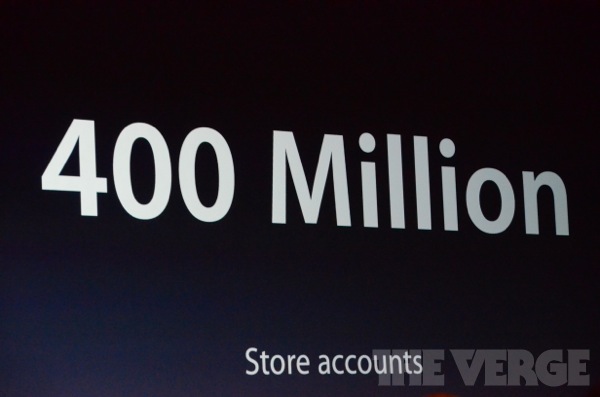
Apple has 400 Million Payment Accounts

Apple now has 400 million active payment accounts, according to Apple CEO Tim Cook. That doesn't necessarily mean Apple is interested, at the moment, in doing much beyond supporting content payments on its own devices.

But all of those 400 million active accounts have active credit cards that can be used on  iTunes and the App Store.

PayPal has 110 million active accounts and Amazon.com has 152 million customer accounts.

At least for the moment, Apple seems content to use its payment system in a closed-loop way, as does Starbucks.

Apple's iOS 6 Will Launch Apps on iPads

Apple's iOS 6  mobile operating system will be made available on iPads, and will include the ability to  its  launch apps, Apple says. Siri now also answers real-world questions about sports, movies and restaurants.

siri-ios-6

What Does it Mean that "Cloud Computing" is Growing 28% a Year?

Cloud computing was the fastest-growing category of U.S. service provider infrastructure spending in 2011, with a 28.4 percent increase, according to the Telecommunications Industry Association.

The TIA also expects cloud computing will continue to be the fastest-growing category of network and facilities investment during the next four years, averaging 20.3 percent compounded annually.

But it is end user spending that arguably drives most of the revenue, so one might argue that much of the opportunity will be reaped by firms that sell enterprise applications, not firms that sell infrastructure services more centrally related to hosting, for example.

TIA argues that end user spending on cloud apps will more than double to $12.1 billion in 2015 from $5.8 billion in 2011, according to the TIA. Separating out what that could mean for providers of cloud “data center facilities” is harder to assess.

In fact, most of the revenue upside appears likely to accrue to hardware and software suppliers, at least initially, according to a Morgan Stanley analysis.

In the infrastructure end of the business, telecom service providers might make a business out of  rental of computing cycles, storage and ancillary services. But what has to be done to market and support that business, and should effort be put elsewhere?

In the telecom space, the analysts expect key winners to include Rackspace, Equinix and competitive local exchange carriers and metro bandwidth suppliers. In other words, hosting and access will be where the telecom revenue lies, possibly not in the infrastructure, platform or software as a service businesses.

The point is that assessing cloud computing revenue contributions for various ecosystem participants is complicated.


That forecast suggests why cloud computing initiatives by telcos will have to be targeted. There actually isn’t as much revenue in cloud computing as some tend to think. Nor is the space uncontested.

Companies such as Google, Amazon Web Services, Hewlett-Packard Development Co.,  Microsoft Corp. and Salesforce.com are themselves already leaders in the cloud infrastructure space, and already are displacing traditional infrastructure outsourcing alternatives, one might argue.

North America, specifically the U.S., currently represents the largest opportunity for SaaS, and it is the most mature of the regional markets. SaaS software revenue is forecast to total $9.1 billion in 2012, up from $7.8 billion in 2011.

But keep in mind that most of that revenue is earned providing expense management, financials, email and office suites. Though Web conferencing also is a SaaS application, few telcos are players to any major extent.

In Western Europe, SaaS revenue is forecast to surpass $3.2 billion in 2012, up from $2.7 billion in 2011, while SaaS revenue is Eastern Europe is projected to reach $169.4 million, up from $135.5 million last year.

SaaS revenue in Asia/Pacific is on pace to reach $934.1 million in 2012, up from $730.9 million in 2011.

SaaS revenue in Latin America is forecast to total $419.7 million in 2012, up from $331.1 million last year. None of those revenue streams are terribly large, by tier one service provider standards, nor are telcos the most logical providers. 


In addition to the possibility that cloud-delivered enterprise apps compete most centrally with distributors of "shrink wrapped" apps, it can be argued that cloud infrastructure also competes with traditional "outsourcing" services.
Cloud infrastructure services are an alternative to traditional IT outsourcing services, often reducing the IT costs of their clients by at least 40 percent, according to livemint.com.

Likewise, you might argue that enterprise or other "app stores" might also compete with other software delivery channels.
What you will note about the enterprise app store concept is that it disintermediates nearly all of the premises networking infrastructure. There is no need for the enterprise local area network, except perhaps to switch to Wi-Fi access at times.

You can imagine this will have serious implications for firms that traditionally make a living selling gear and services for enterprise LANs. Just as easily, you can see the upside for traditional communications providers who now could have an expanded role in the information technology business.

What products would be “natural” parts of a communications and information technology bundle? How much easier would it be for traditional telco sales organizations to sell key business software?

In fact, non-technical sales forces of all types might find there are new opportunities to sell products that might have been “too technical” in the past. Firms outside “IT” might find they can create bundles almost on the fly, customized for vertical markets or businesses of various sizes and types.

A shift to some new computing architecture based on cloud resources and mobility could have huge implications for any number of businesses in the information technology and communications businesses.

Although growing interest has been observed in vertical-specific software, the most widespread use is still characterized by horizontal applications with common processes, among distributed virtual workforces and within Web 2.0 activities.


Cloud computing will have implications for most firms in the business applications, information technology support and data center businesses. Whether that impact is large or relatively small is hard to say, at the moment.

Africa Mobile Market Fastest Growing in World

If you can remember 1970s and 1980s policy discussions in the global telecom community about how to provide basic telephone service to the billion or more people who had never made a phone call, you will be astonished at how powerful mobile services have been. A problem thought too expensive to solve now is well on the way to vanishing.

Africa, for example,  is the fastest-growing mobile market in the world and the largest after Asia, according to the GSM Association.

The number of subscribers on the continent has grown almost 20% each year for the past five years, according to the GSM Association GSMA report on the African mobile market. The GSMA expects there will be more than 735 million subscribers by the end of 2012.

Among the changes mobility is bringing is a new access to banking services. Africa already has 51 mobile money systems in place, serving more than 40 million African users.

Total African Mobile Connections and Penetration Rate

iPad Owners will Double in 2012

US iPad Users and Penetration, 2010-2015For most people, it appears, an Apple iPad will remain the preferred tablet, despite growing numbers of Kindle and other devices being purchased.

In fact, eMarketer predicts the number of iPad users in the US will rise by over 90 percent in 2012 to 53.2 million, as users replace older models and new consumers purchase the device. This year, the iPad will continue to be in the hands of more than 75 percent of all tablet users in the country, eMarketer predicts.

Of course, no product or service can sustain triple-digit growth forever, so the 2011 growth of iPad sales of  143.9 percent will slow over time.  On the other hand, Apple does not appear likely to lose its commanding market share lead.

Sunday, June 10, 2012

Mobile, Web Commerce Use Drastically-Different Payment Methods

A study by ShopVisible suggests mobile payments use different methods than online payments.

Some 67 percent of customers used PayPal or an alternative payment method when buying something from their mobile, while 33 percent paid by credit card, a ShopVisible study of 23,000 transactions has found.

For Web transactions over the same period, the results were reversed, the study found. Some 62 percent of buyers paid by credit card, 12.9 percent by Amazon Payments, 8.1 used Google Checkout, and just 16.8 percent used PayPal.

It might be too early to extrapolate too much from the results. It probably remains the case that mobile shopping is for different products than online shopping.

It might be that a typical transaction amount is significant enough to influence the choice of payment method.

There could be other reasons why credit cards make sense for PC-based shopping. Perhaps entering a long string of credit card numbers is viewed as a feasible and convenient operation on a PC and not so much on a mobile, leading to a preference for payment methods that do not require such operations.

Saturday, June 9, 2012

"Senior" Internet Gap is Smallish, Will Disappear

Some 60 percent of U.S. seniors are online, according to Forrester Research. While they trail behind younger generations when it comes to device ownership and online usage, their usage of apps is not dramatically different from younger demographics or Internet users as a whole. 


The other problem is that "seniors" comprise a relatively smaller portion of the total U.S.population than you might think. Millennials and Generation X represent 46 percent of the total U.S. population. Younger boomers between 45 and 54 represent about 20 percent. Most people would not consider people in that age bracket to be "seniors."


Those 55 to 63 represent about 13 percent. You might, or might not, consider these people to be the "seniors" who don't understand or want to use the Internet. But think about whether you actually know many people that age who do not use the Internet. Many of us cannot think of anybody we actually know, in that age bracket, that does not use the Internet. 


Most might agree that people 64 and above qualify as "seniors." But all those people, at any age 64 or older, represent about 18 percent, in total. 


At some point, there will might not be many significant differences in Internet usage, in any demographic. Someday, all Millennials will be seniors. 


Slow Traction for Google Wallet Isn't Surprising

The possibility that Sprint is launching its own mobile wallet platform, and might, as part of that effort, have to displace Google Wallet on its devices, will add yet one more provider to a chaotic mobile wallet environment. Neither Google Wallet nor Isis, for example, have gotten significant traction yet, nor, in truth, should have that been expected. 


Both Isis and Google Wallet require creation of a huge new infrastructure of near field communications point of sale terminals and end user devices, plus new end user behaviors and a clear value proposition. Those would be difficult under the best of circumstances. 


Google will do what it always does: keep working on the next version. It is far too early to declare any long-term winners in the NFC mobile wallet business. Consumer adoption of important new technologies can take some time. 


Products such as tablets can reach significant penetration rather quickly because the rest of the infrastructure, including widespread Wi-Fi, apps, end user behavior, business models, quality broadband (at least for purposes of supporting video apps, a key tablet app) and even familiarity with the touch interface are established. 


Near field communications has almost none of the infrastructure requirements well established. For that reason, many of us would caution that patience is needed. It might take as much as a decade before there is significant penetration. 


ATM card adoption provides one example, where "decades" is a reasonable way of describing adoption of some new technologies, even those that arguably are quite useful. 


“Mobile proximity payments will remain in infancy for at least five years,” said Jim Van Dyke, Javelin Research president. In other words, payment systems based on near field communications, and others, might take that long to begin getting serious traction.

On the Use and Misuse of Principles, Theorems and Concepts

When financial commentators compile lists of "potential black swans," they misunderstand the concept. As explained by Taleb Nasim ...