Tuesday, November 6, 2012

1000-Fold Improvement in Mobile Bandwidth Requires Multiple Changes

Though some might question the assumptions, many in the mobile industry would argue that a 1,000-fold increase in mobile bandwidth is going to be needed, over time, and some think that will be necessary as early as 2020.

That assumption tends to rely on typical mobile consumers downloading a gigabyte every day. You can make your own assumptions about whether that is a reasonable assumption. 

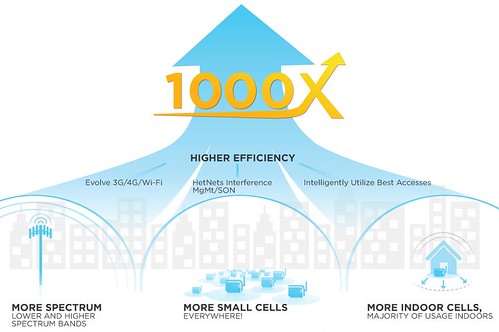
No single technique is likely to provide an improvement of three orders of magnitude in mobile bandwidth, though. So most think several different approaches will be needed, in tandem. 

One promising example is the “Neighborhood Small cells” model — a network of extremely low-cost, plug-and-play, open, indoor small cells, Qualcomm argues.

What makes the approach unusual is that the subscriber hosting the cell supplies the backhaul, which also bleeds out into the neighborhood to reinforce mobile coverage for other neighbors.

Studies show potential capacity increases of up to 500 times with a mere nine percent penetration of households and up to 1,000 times with 20 percent penetration, when combined with 10 times more spectrum.

Qualcomm is among firms that see three basic ways to get to a 1,000-fold increase
 in effective bandwidth. Virtually all the ways to get to 1,000 involve more spectrum, more small cells and use of offload strategies or better coding techniques.

Mobile broadband trends and data usage


Is 1-Gbps a "Hail Mary Pass"for Burlington Telecom?

Financially troubled Burlington Telecom, a municipally-owned communications provider, has decided to sell 1-Gbps Internet access services. 

The symmetrical 1-Gbps service will sell for $150 to $200 a month. The issue at this point is whether the new superfast access is capable of turning around revenue enough to stave off a financial collapse. 

A 2010 study concluded that “BT is not viable in relationship to its current debt load of $51 million and its ability to generate earnings to repay this debt."

"BT cannot meet its principal and interest obligations at this time,” the study concluded, noting that the company’s current business plan can’t meet future financial challenges either.

An agreement with pirmary lender Citibank in March 2012 stipulates that the first 60 percent of BT profits are to be paid to Citibank, which means taxpayers now are second in line to protect their investment. 

At current rates, it will take 96 years for BT to pay off the Citibank loan. 

Soon We'll Start Seeing 2013 Global Telecom Revenue Forecasts...

Though we should expect to continue to see higher growth rates in parts of the Asia-Pacific, Latin American and African regions, expectations might be more challenging elsewhere. 

Purchasing managers indexes (PMI)  gauge the activity of thousands of companies, and are considered a leading indicator of coming economic activity.

The latest eurozone PMI reading from survey compiler Markit indicates that the eurozone economy is shrinking at a quarterly rate of around 0.5 percent, according to the purchasing manager surveys. That should also translate into reduce or constricted communications and information technology spending by business customers, probably indicates lower spending by consumers, and therefore will lead to lower capital investment by service providers. 

U.S. enterprises also are cutting spending. And on top of all that are declining text messaging, voice and other legacy revenues. 

So if global industry revenue grows, it will likely be because of China, India, activity in other developing regions and results from operators in a few developed countries. You should expect trouble in European markets, for the most part. 

Fight or Flight is the Fundamental Service Provider Choice

Many global service providers now face a classic “fight or flight” choice. Faced with an immediate threat to life, humans experience physiological changes that prepare them to respond to an immediate stress by fighting or fleeing.

Some might argue that service providers now face similar choices. The “fight” response can be seen in service provider efforts to create their own over the top apps and otherwise invest in upgrading existing legacy services.

The “flight” response has more tactical expressions, but basically amounts to a “harvest and invest elsewhere” effort. The determination is that, fundamentally, no matter what a contestant does, the revenue stream cannot meaningfully be “saved.”

The fundamental assumption for the “fight” strategy is that a product category can be revitalized and sustained by investment. The fundamental assumption for the “flight” strategy is that the product category either cannot be revived, or that the financial returns will not match the returns from investing elsewhere.

That is the challenges posed by over the top messaging and voice apps, for example. As customers increasingly use services such as Skype, BlackBerry Messenger and WhatsApp, service providers must decide whether fight or flight is the proper response.

“Joyn” is an example of “fighting,” as it attempts to create a carrier-owned substitute for over the top mssaging services. But much service provider attention now seems to be in the “flight” direction.

New pricing plans instituted by Verizon Wireless as one example of flight. Share Everything essentially creates a flat-fee “use the network fee” that includes unlimited domestic calling and texting. That’s a defensive measure to keep some voice and messaging revenue while revenue growth occurs elsewhere.

But most flight strategies entail finding new sources of revenue. That is why Telefónica set up its "Digital" division in September 2011, to develop new products and services that create new customer value.

The flight response also is one reason tier-one service providers around the world are taking a look at growth opportunities such as advertising, banking and machine-to-machine initiatives. Some might include cloud computing businesses among the top possible new areas as well.

Capital investment also is another example the “fight or flight” choice. How much capital should be invested in fixed networks, if investment in mobile networks is a viable alternative? So far, most service providers with a real choice have favored mobile networks.

One Thing Everybody Can Agree On: UN Shouldn't Control the Internet

The International Telecommunication Union (ITU) plans to hold a treaty conference, the World Conference on International Telecommunications, in December 2012, which will revise a 1988 treaty. 

At stake are the ways communication network owners compensate each other for terminating international voice calls through the payment of settlements. But that is but one of many huge implications. Observers say the danger is direct controls on freedom of Internet expression.


The ITU is seeking to gain more control over Internet content. One reason is that countries such as Russia have called for restrictions over the internet where it is used to" interfere in the internal affairs of a state."

Opponents rightly say this represents a dramatic threat to the openness of the internet, where countries could regulate content not just within their own borders but globally.

But there are many practical business implications as well. The ITU proposes to change the way the Internet is governed, in ways that will harm the Internet by raising the cost and complexity of exchanging traffic, Analysys Mason researchers argue. 


In part, the ITU wants to create a new Internet traffic “settlements regime” modeled on voice precedents that will be difficult to administer and raise overhead costs.

But there could be other significant effects. First, operators might be induced to maintain their customers‘ websites abroad. One of the significant benefits of establishing an internet exchange point is to make it attractive for domestic websites to be hosted at home, in order to increase their performance and lower costs, Analysys Mason notes.

However, given that foreign websites will generate a source of incoming settlements revenue, the incentive to keep them abroad would increase.

At the same time, foreign operators, in order to compensate for the higher settlements costs, would likely raise the price of hosting websites serving countries with high settlement rates.

While this could be seen to increase the incentives to locate content in the target country in order to avoid settlements, that is often not efficient, particularly for small or undeveloped markets from which access to a regional server may be sufficient, Analysys Mason argues.

In addition, it is likely that infrastructure investment decisions would be affected, as providers would be reluctant to invest in providing infrastructure to a particular country to which it is expensive to deliver traffic. In other words, there will be financial reasons not to build more undersea links to certain countries, for example.

Also, huge volumes of Internet traffic could be artificially generated in order to arbitrage a rate-regulated model, to generate inbound payments, alter traffic balances, or otherwise unfairly leverage any accounting rate regime that may be applied to the Internet.

Entities that believe they would be net recipients of settlements, based on current projections of traffic flows, might find themselves net payers as a result of the manipulation of traffic flows by other players. In other words, the incentives for arbitrage will increase.

Consider the flows of traffic. The notion of settlements is that a carrier that terminates traffic incurs costs to deliver that traffic. So a sending carrier pays the terminating carrier. In many cases, the traffic flows should largely balance each other, so the net payments are relatively small in magnitude.

But there are scenarios where traffic is unbalanced, and that causes problems. In the voice settlement regime, carriers that accept more traffic than they send wind up paying money. Carriers that send more traffic than they receive make money.

Some of you will remember, or even be able to point to, instances where revenue arbitrage was possible precisely because of such asymmetrical traffic flows. Server farms and “free conference calling services” in the United States provide examples.

In the proposed ITU framework, it is server farm traffic that could be troubling for some carriers.

Multimedia content, for example, might represent as much as 98 percent of Internet traffic. Right now, where those servers are located does not have implications for inter-carrier settlements.

For cost reasons, many of those servers are located in Africa. In 1999, 70 percent of international Internet bandwidth originating in Africa went to the United States. In  2011, less than five percent goes to the United States.  

These days, content is stored at African server farms, for distribution largely to Africa, Analysys Mason notes. In some ways, that is helpful to African consumers, for quality and cost reasons. In other ways, high cross-border charges are unhelpful.

While it is true that IXPs are emerging to facilitate local exchange of traffic in Africa, the cost of cross-border connectivity between many African countries is still quite high, and this is hindering the emergence of regional IXPs to help exchange traffic and distribute content.

The bandwidth from Latin America presents the same broad picture. Between 1999 and 2011, the percentage of bandwidth going to the United States fell from just under 90 percent to 85 percent, replaced by more intra-regional traffic.

The main similarities between Africa and Latin America are that over 80 percent of their Internet bandwidth is connected to another region (Europe and the US respectively). At the same time, little bandwidth goes between countries within the region. Intra-Latin American traffic is 15 percent of total, while intra-African traffic is two percent.

In ways directly related to human freedom, the free flow of information and the cost of getting information anywhere on the planet, U.N. governance of the Internet would be harmful.

By 2016, 66% of Workers Will Use Smart Phones

“In 2016, two-thirds of the mobile workforce will own a smart phone, and 40 percent of the workforce will be mobile,” sayts Crolina Milanesi, Gartner VP.

Gartner estimates that in 2012 purchases of tablets by businesses will reach 13 million units and will more than triple by 2016, to reach 53 million units. 

Some 821 million smart devices (smart phones and tablets) will be purchased worldwide in 2012 and pass the billion mark in 2013, Gartner says. Smart devices will account for 70 percent of total devices sold in 2012.

“For most businesses smart phones and tablets will not entirely replace PCs, but the ubiquity of smart phones and the increasing popularity of tablets are changing the way businesses look at their device strategies and the way consumers embrace devices,” said Milanesi. 

Gartner estimates that 56 percent of smart phones purchased by businesses in North America and Europe will be Android devices in 2016, up from 34 percent in 2012 and virtually no penetration in 2010. 

Android Adoption Ramping Up 6X Faster Than iPhone, Mary Meeker Says

Meeker Android AdoptionAndroid phone adoption is growing six times faster than the Apple iPhone, says Kleiner Perkins Caufield & Byers Partner Mary Meeker

Android also surpassed Windows as the number-one operating system for Internet-enabled devices in the first quarter of 2012, Meeker says. 

Apple iPad adoption also is growing five times faster than the  iPhone did. In fact iPad adoption rates have accelerated. In May 2012, Meeker said the iPad ownership was growing three times faster than did the Apple iPhone. 

In fact, it appears that Android has been adopted faster than Google itself had expected. In this Asymco estimate, the blue line is Google's forecast, while the yellow line is actual adoption. 


Google cares about devices, operating systems, faster Internet access and browsers because alll of those are tools that get the Intenet in front of more people, who can see more ads. In fact, Google arguably is the first very-large software company in history to make a business model out of providing technology while earning its revenue indirectly, from advertising. 

In the past, Google has tweaked its mobile browser and tried to show website owners see the connection between their sites’ performance and sales. In fact, Google search ranking depends, in part, on loading speed. 

But the "need for speed" even has lead Google to invest some money in higher-speed access experiments designed to prod others to invest more, and invest faster. 

Faster mobile Web loads could increase mobile commerce sales in the United States by 10 percent, or about $600 million a year, said Forrester Research analyst Sucharita Mulpuru.

Almost half of mobile users are unlikely to return to a website at all if they had trouble accessing it from their phone, a 2011 study by Equation Research found.

Monday, November 5, 2012

Business Process as a Service Estimates are Going to Be Huge, For Obvious Reasons

It typically is difficult to estimate the size of a big a new market when that new market essentially cannibalizes existing businesses in the process.

Something like that probably is going to happen with cloud computing. Cloud-based services will cannibalize other existing functions and revenue streams. 


Consider the notion of “business process as a service.” What’s a business process? Business process management is said by IBM to include such functions as

  • Web analytics
  • Enterprise marketing management
  • Business-to-business integration
  • Supply-chain management
  • Security governance, risk management and compliance
  • Business service management

BPaaS clearly has potential to shift customer buying, the supplier base and revenue streams as cloud alternatives develop and displace legacy alternatives.

Email management, communications management or shopping cart services and catalog processes might be other examples of possible candidates for BPaaS displacement.

Estimating how big the BPaaS market actually is will be a tough exercise, though. What counts as a business process “as a service?” Is it only the value of the contract to use a retail checkout system, a catalog or a fulfillment process? Is it partly the value of the transactions, or the value of the products traded?

For any cloud-supported mobile or Internet advertising system, what should be counted? Is it the value of the advertising, or only the commissions an exchange might earn? The same question can be asked for any cloud-based payment system.

The point is that it is possible cloud services markets might be bigger than currently envisioned, only partly depending on “what” gets counted.

The reason is that more and more business processes using software, processing and storage are shifting to cloud mechanisms, even though we traditionally have viewed software delivery, computing resources, storage and development environments are the primary cloud markets

That might be one reason why BPaaS, already represents the largest segment of what analysts at Gartner now tabulate in the cloud services realm,  accounting for about 77 percent of the total market, Gartner now argues.

BPaaS is the largest segment primarily because of the inclusion of cloud advertising as a sub-segment.


But you might also argue that BPaaS is so big because it basically represents a redefinition of the traditional outsourcing business. And that is a larger business than simple computing, storage and applications delivery.

One expects to see big numbers for cloud revenues. But one reason those estimates can get so large is that traditional outsourcing and advertising, both substantial businesses, logically can be counted as a BPaaS.

Voice Erosion Now "Alarming" in Some Markets?

Though the trend is not always quite so obvious in the U.S. and Canada telecom markets, erosion of fixed network voice lines is assuming alarming proportions in some markets, including the United Kingdom.  

Some 65 percent of 500 U.K. chief information officers surveyed by Vanson Bourne on behalf of Virgin Media Business believe fixed network telephones “will disappear from everyday use within five years,” Virgin Media Business says.

Separately, analysts at STL Partners estimate that, with 2009 representing an index point of 100, U.K. fixed network voice revenues will have shrunk by 50 percent by 2014. Keep in mind, that is an estimate that use of fixed network voice lines will be cut in half in just five years.

That wouldn’t be an unusually damaging occurrence, if new revenue sources can offset the losses. But STL Partners says new data services will fail to keep pace, with a net overall result of declining fixed network revenues of possibly 24 percent by 2014, compared to 2009.


The latest report on U.S. fixed network voice connections by the Federal Communications Commission suggests that voice connections declined three percent between June 2010 and June 2011. That raises an obvious question: will number of fixed voice connections continue to drop, without end, to zero?

That seems highly improbable. There would seem to be some good reasons for predicting a perpetual demand for fixed voice connections, not the least of which is that voice quality likely always will be higher, and more consistent, on fixed connections, compared to mobile or forms of VoIP that do not use managed connections.

But that isn’t the only reason. Much might hinge on how voice services are packaged and priced.

In principle, service providers can package fixed network voice service in ways that impose little incremental cost over not buying the service, or in fact tie the purchase of another network service to the voice service. That is not to discount the “add value” approaches, but simply to note that the easiest path forward is simply to make fixed voice service so affordable there is no reason to drop it.

Service providers will not like the gross revenue implications, but the simple matter is that if the value of fixed voice keeps dropping, compared to mobile voice, erosion will continue. On the other hand, if voice and perhaps other features are bundled with the “lead” broadband access service in ways that users find reasonable, massive erosion might be avoided.

Under the new Verizon Wireless pricing scheme, for example, though users can still use over the top messaging and voice, there is no financial incentive to do so, at least for domestic calling.

At some point, fixed network providers will probably reach the same conclusion, and package “broadband access” with voice features in ways that make paying for fixed network voice a reasonable and preferable option. You might argue that Charter Communications and Verizon’s landline business already have moved in that direction.

If the executive opinions wind up being correct, whether the magnitude or timing of the changes are accurate, there will be huge shifts of opportunity for suppliers of voice services, unified communications, business phone systems, mobile and fixed network service providers alike.

Obviously, voice will become--even more than it already is--the preferred way for people to use voice services. The only real surprise is that this could be true for enterprise employees, not just consumers.

Of course, for every “loser,” included fixed network telcos or suppliers of premises-based  business phone systems, there will be “winners,” including mobile service providers and possibly some providers of unified communications services.

Call center functions obviously will continue to require a high level of voice and unified communications support. But collaboration functions could shift to other media types, for many other enterprise workers.

But if the CIOs are accurate, business voice rapidly is shifting to mobile modes, for most workers, with obvious architectural implications. By the end of 2012, 70 percent of the U.K. population is expected to have a smart device reliant on mobile connectivity, Virgin Media Business argues.

Already, in the past year the amount of data consumed on the Virgin Media Business network jumped to 765 billion individual bits of data being transferred every second, erasing the previous mark for the Virgin Media Business network by 27 percent, Virgin Media Business says.

The big problem in the U.K. fixed network business now appears to be that the legacy voice business is declining faster than the broadband access business is growing. 


VCs See Cloud, OTT as the Place to Invest


It probably comes as no surprise that venture capitalists have shifted telecom start-up investment to software, services that are cloud based and run over the top. Hardware investments are viewed as having development and sales cycles that are too long. 

 “The lifecycle of infrastructure and services is very different. Services that run over-the-top of our networks can be quickly prototyped and co-created with innovative companies with less risk and smaller investment compared to infrastructure," says Ursula Oesterle, Swisscom (Palo Alto) VP.

The new business models are usually based on services that can be hosted on standard data center server hardware and software stacks and delivered to enterprises and consumers by carriers through Internet-leveraged sales campaigns.

All of that means "over the top" apps are getting much of the attention. In addition, consumer appetite has been building. 


Verizon Shuts Own its App Store

Verizon will in January of 2013 start removing the Verizon Apps application from all compatible Android and Research in Motion devices.

Verizon expects to have all apps shut down by March 27, 2013. Most of those apps already are available on multiple app storefronts, such as Google PLAY, Amazon and BlackBerry App World.

That does not necessarily mean that no mobile service provider, or consortium of providers, can operate a high-volume mobile app store. But the hurdles are tall. Telefonica also earlier in 2012 shut down its branded app store. 

The Wholesale Applications Community was intended to help service providers gain more scale, faster, but most observers say that initiative has foundered. Most people assume their device supplier, their operating system supplier or an independent app store will have what they want. 

Smart Phone Screen Size Now Matters

It is starting to look as though screen size matters, where it comes to consumer preferences for smart phones. 

The reason is that smart phones increasingly are becoming content consumption devices.

True, smart phones are used mostly for communications-related tasks while people are out and about or on the go. 

But smart phones are used heavily as content consumption devices when people are stationary, such as at home or at work. And for that application, a bigger screen is valuable. 

Few devices have gone as far as the Galaxy Note 2, a device intentionally positioned somewhere between a smart phone and a small-screen tablet.

But most users who routinely have used an iOS device and a bigger-screen smart phone have noticed how small the iOS devices have started to feel since Android devices have started sporting bigger screens in the four-inch diagonal range. It is therefore no surprise that the latest iPhone sports a bigger screen.

It likewise is not an accident that the rumored Microsoft branded smart phone reportedly is looking at a screen size between four and five inches in diagonal. As smart phones increasingly get used as content consumption devices, people are showing the same behavior they show when buying any other content consumption device, namely a preference for the largest screen.

Which Tablet Market Structure Will Emerge?

The big question for tablet device suppliers is whether the market eventually will take the shape of the MP3 player or the smart phone markets. In the former, nobody ever was able to rival Apple, where in the latter market that is not the case. In smart phones, Apple remains a leading player, but not a dominant supplier in the same way Apple dominated the MP3 player market.

Why the difference? Some would point to the way mobile service providers affect phone device success, compared to an MP3 device. Carrier preferences, device subsidies and retail pricing can shape device adoption trend in a way that was not true in the MP3 device market, for example.

Some might argue that, ultimately, it might not matter what specific market share Apple holds, over time, in the smart phone market, as that market is large enough to support huge Apple success, even with less than “dominant” market share.

The Apple iPhone accounts for over half of Apple’s revenue, even though the iPhone has “only” 24 percent market share.

Still, the question of which shape the tablet market could take is germane. Some might argue that Android-powered devices ultimately will create a highly competitive market. Others might argue that, as a content consumption device, the iPad more nearly resembles the iPod.

The iPod is essentially a single-content consumption device while the iPad is a multiple-content consumption device that is not subject to “control” by mobile service providers. In that sense, the iPad potential tilts more to the MP3 model than the smart phone model, some would argue.

Worldwide tablet shipments totaled 27.8 million units in the third quarter of 2012, according to International Data Corporation (IDC).

The tablet market grew 49.5 percent year over year in the third quarter of 2012 and 6.7 percent over the second quarter of 2012.

Android shipments, led by Samsung and Amazon, surged during the quarter, at the expense of Apple, which saw its share slip notably during the quarter, the IDC study found. Still, the question some will ask is whether the tablet market will resemble the MP3 device market or the smart phone market.

Apple simply dominates the former, but is not so dominant in the smart phone market. Looking at operating system share also yields a different sense of market share, as there Apple competes against multiple suppliers.

Looking only at  the original equipment manufacturer share, Apple currently competes most with Samsung.

But current OEM not the big question, for the tablet market.

Saturday, November 3, 2012

“Untethered” Access is the New Network Foundation

If you have been in the telecom business for a while, it is normal to think of the “fixed network” business and the “mobile” business as two distinct fields of endeavor, and from a provider perspective, that often makes sense.

Mobile services are sold, provisioned and maintained  by one organization, fixed services often by another. The features of each service are distinct in some ways and those features are priced differently. Business success is tracked separately.

From the standpoint of an end user, customer, application or device supplier, the distinction is blurring, though. Most of today’s computing devices can use a range of connections, and increasingly it is Wi-Fi that is the common access capability.

Whether one looks at smart phones, tablets or PCs, “access” typically is “untethered,” without the need of a cable connecting to a network. To be sure, mobile devices sometimes are used while a customer is actually “moving” about. But, most often, that is true of voice or messaging, with some light use of data services.

By volume, though, most use of Internet services and apps is conducted while users are stationary. And most of that usage happens inside the home or at the office, not while people are out and about.

The long term implications are not yet clear. But there already are glimmerings of how the value of Wi-Fi is changing mobile executive thinking. At a very basic level, mobile network executives wish to encourage their mobile users to offload traffic to the Wi-Fi (fixed) networks.

Fixed network executives want to create Wi-Fi capabilities for their fixed Internet access customers, adding a “nomadic” feature to a fixed location service.

Increasingly, small cell sites serving high-density urban locations will be equipped both with mobile and Wi-Fi radios, allowing users access to either access mode.

Some entrepreneurs are creating “mobile” services that default first to Wi-Fi, then use the mobile network only if Wi-Fi access is not possible.

Consumers already have embraced Wi-Fi as a primary access model for smart phone and tablet use, if only to save money on their mobile data plan charges.

A study conducted by Cisco of more than a thousand U.S. mobile users suggests that the amount of Wi-Fi usage each day is so prevalent that smart phone, tablet and e-reader device usage now is more “nomadic” than mobile; more untethered than mobile; less “on the move” than just “unplugged.”

What’s more, the Cisco survey also suggests 25 percent of users “see no difference” between the mobile and Wi-Fi networks. The implied 75 percent of users who do see differences perhaps is the measure of the importance of voice communications and quick Internet operations or use of social networks and other communications apps.

At some point, such trends could lead to some specialized revenue models within the broader mobile and untethered access business, focusing purely on “data connections,” not mobile voice, much as the Wi-Fi hotspot business has been a specialized “data access” service.

That could ultimately be more important in developing regions where full mobile access is relatively expensive and bandwidth constrained, and might well rely on use of unlicensed spectrum and well as “self organizing” network nodes of some sort.

By some estimates, for example, about 90 percent of all tablets sold use Wi-Fi-only connections, meaning those devices are used untethered, but not in fully-mobile mode.

In many ways, that underscores the enduring value of a fixed network connection, albeit with a Wi-Fi tail. In other words, “fixed” and “mobile” networks are both ways to get access to the Internet from an untethered computing appliance. And fixed networks always will have a price per bit advantage over the mobile networks.

On the other hand, a shift of end user demand to “broadband access” will require key shifts of fixed network business models. With voice services receding, new revenue sources will be required, and it likely also will be necessary to further pare operating costs.

A new analysis by NPD illustates the widespread use of Wi-Fi access by users of Android smart phones. In fact, Android device users on Verizon Wireless, AT&T, Sprint, T-Mobile USA and MetroPCS networks consume more data using Wi-Fi than they do on the mobile networks.

In some cases, as on the AT&T network, about 80 percent of all consumption is on a Wi-Fi network. Verizon Android users consume nearly two thirds of their data on a Wi-Fi network.

The point is that data consumed on a mobile data plan can represent far less than half, and in some cases as little as 20 percent,  of all data used on a smart phone


A separate study conducted by Ipsos  suggests the typical employed person, in a wide range of countries, is connected to the Internet nearly 10 hours a day, often by Wi-Fi, with mobile devices used inside the home about 2.5 hours a day, as well. The detailed tables are here.

All consumers use their mobile devices at home, the Cisco study found, averaging more than 2.5 hours of usage in a typical day, more than double the time that “mobile” devices are used “on the go,” which is about half an hour a day, the study also found.

A quarter of consumers surveyed by Cisco “see no difference” between the mobile and Wi-Fi networks. Consumers consider Wi-Fi easier to use and more reliable than mobile.

“We may be on the verge of a “New Mobile” paradigm, one in which Wi-Fi and mobile networks are seamlessly integrated and indistinguishable in the mobile user’s mind,” the Cisco study says.

Almost 60 percent of consumers were “somewhat” or “very” interested in a proposed offer that provides unlimited data across combined access networks for a flat monthly fee.

The survey conducted by Cisco’s Internet Business Solutions Group (IBSG) suggests
mobile users are connecting their devices predominantly using Wi-Fi. In fact, most mobile users are connecting their devices using Wi-Fi at some point, including 70 percent of smart phone owners.

About 50 percent of tablets, laptops, and e-readers are connecting exclusively through Wi-Fi. Although 30 percent of smartphone owners are connected only using the mobile network, the remaining 70 percent are supplementing mobile connectivity with Wi-Fi, the Cisco study suggests.

In fact, on average, smart phone users use Wi-Fi a third of the time to connect their devices to the Internet.

With the exception of smart phones, users would prefer to connect all of their devices using Wi-Fi. More than 80 percent of tablet, laptop, and e-reader owners either prefer Wi-Fi to mobile access or have no preference.

Just over half of smart phone owners would prefer to use Wi-Fi, or are ambivalent about the two access networks.

If given a choice between access networks, mobile users choose Wi-Fi over mobile across all network attributes, with the obvious exception of coverage. That leads Cisco researchers to conclude that “we may be on the verge of a ‘New Mobile’ paradigm, one in which Wi-Fi and mobile networks are seamlessly integrated and indistinguishable in the mobile user’s mind.”


                                          Network Connectivity Type (by Time)

                                       Source: Cisco IBSG, 2012

It might not be clear for some time what the full ramifications will be. But it might not be unreasonable to argue that the value of Wi-Fi access is beginning to rival that of “mobile” access in new ways.

That is not to say that Wi-Fi access is a full substitute for mobile access. Still, it is hard to ignore the conclusion that Wi-Fi now satisfies a wider range of use cases than once was the case.

In that sense, “untethered” access is emerging as a key feature of local distribution networks. Among other implications, we should expect to see more consumers relying on Wi-Fi, compared to the “mobile network,” for a wider range of applications, in a wider range of settings.

The point is that, for a growing range of computing appliances and applications, the point of all networks is support of devices and experiences consumed in an untethered mode. Full mobile access remains important for many apps. But where it comes to Internet apps, untethered access is most significant.

Friday, November 2, 2012

Is Future of Email Twitter, IM, or Something Else?

Some think the future of email is Twitter, while others think it is instant messaging. Some might argue the future of email, if not in total message volume, is some upgraded version of today's product. 

For the moment, though channels are proliferating, email is likely to remain in use because none of the other newer channels have some of the advantages of today's email. But email increasingly is one channel of many people use for communicating and collaborating. 


How Electricity Charging Might Change

It now is easy to argue that U.S. electricity pricing might have to evolve in ways similar to the change in retail pricing of communication...