Wednesday, November 14, 2012

Apple, Samsung Earn 99% of Smart Phone Profits

Samsung is making huge gains in the global smart phone market. But the story is more than a tale of growing market share. In the area of smart phone profits, Apple and Samsung earn about 99 percent of profits from sales of smart phones.

Apple, Samsung and HTC are now the only three profitable companies in the mobile industry. Not just that, Apple and Samsung together combined to grab 99 percent of all mobile profits, according to Asymco.

HTC got one percent of industry profits, according to analyst Horace Dediu of Asymco.

Why Tablets are Important for Fixed Network Service Providers

Tablets are important devices, for virtually all fixed network service providers. Though mobile service providers will do their best to convince users that tablets are more useful when they have their own mobile connections (Verizon Wireless “Share Everything” plans are an example), most people have learned to save money on their mobile data plans by using Wi-Fi for tablet, smart phone, iPod touch and other Internet-capable devices.

That’s a key business development for fixed network Internet service providers. It means the value of a fixed connection now is higher than it used to be, when just one or two PCs were connected. Now the single fixed connection supports multiple users and multiple devices.

Also, given the pricing of bundles, it often makes sense to buy video entertainment plus broadband, instead of only broadband access. Even when this is not the choice a consumer makes, it is easier to justify buying broadband because it enables use of PCs, tablets, smart phones, game consoles, TVs and other devices.

Depending on the number of users or devices that can be supported by a single fixed broadband connection, the justification for buying broadband never has been higher. Where once it only made sense to buy broadband access if a home used computers and the Internet, now it makes more sense to buy broadband because tablets, smart phones and other devices also can take advantage of the single connection.

In fact, the increase in number of devices using the home networks is one reason why “median monthly usage” (half of consumers use more, half use less) on North America’s fixed access networks has increased from 10.3  GB to 16.8 GB in the second half of 2012, some might argue.

Over the same period, “mean monthly usage” (arithmetic average)  grew by over 70 percent increasing  to 51.3 GB from 32.1 GB. Growing subscriber consumption is not limited to North America or fixed networks, either.

Relatively slow growth of mobile data consumption probably is a direct result of the shift to offloading of mobile data demand to the fixed network.

In North America, monthly usage on mobile networks has experienced only minor growth, Sandvine says.  In the second half of 2012, Sandvine has observed mean monthly usage increasing moderately from 312.8 MB to 317.2 MB.

What is the Future of the Fixed Network?

Anybody familiar with the underlying trends in the communications business, and who looks at the business dispassionately, sooner or later has to wonder what the future of the fixed network actually will be. That is not to say the fixed network has no obvious role.

Bandwidth, and affordable bandwidth, is the chief advantage a fixed network has, and always will have, over a mobile or wireless network. But that isn't a terribly comforting thought for a fixed network executive, or any of the ecosystem partners. For saying "bandwidth is the enduring value" is tantamount to saying that "dumb pipe" is the enduring value.


That is not to say that applications are unimportant. Video entertainment and voice are key revenue generators for fixed networks. But the irreducible core of value is the "access to the Internet." At the moment, the U.S. Federal Communications Commission even enforces the "dumb pipe" model by barring fixed networks from providing quality of service distinctions.


In other words, fixed network service providers specifically are prohibited from creating and selling "smart pipe" Internet access that can prioritize voice and real-time applications over others. "Managed services" such as carrier voice or entertainment video thankfully are exempted from those rules, but the point remains: dumb pipe is the unique and enduring value provided by a fixed network.

 No other network--satellite, fixed wireless or mobile--can claim to match the theoretical bandwidth of an optical fiber network. And no other network can match the price-performance of a fixed network at very-high speeds. You don't hear proponents talking about mass deployment of gigabit per second wireless or satellite networks, for example, because it is not technologically or economically possible. 


Some think that could change in some decades, but for the moment fixed networks have the strategic advantage. Some of us would argue that growing use of Wi-Fi-supported devices such as tablets and smart phones will enhance the value proposition for fixed networks.


The increase in number of devices using the home networks is one reason why “median monthly usage” (half of consumers use more, half use less) on North America’s fixed access networks has increased from 10.3  GB to 16.8 GB in the second half of 2012.

Over the same period, “mean monthly usage” (arithmetic average)  grew by over 70 percent increasing  to 51.3 GB from 32.1 GB. Growing subscriber consumption is not limited to North America or fixed networks, either.

Relatively slow growth of mobile data consumption probably is a direct result of the shift to offloading of mobile data demand to the fixed network.

In North America, monthly usage on mobile networks has experienced only minor growth, Sandvine says.  In the second half of 2012, Sandvine has observed mean monthly usage increasing moderately from 312.8 MB to 317.2 MB.

More noticeable change can be seen in the median which has increased to 32.9 MB from 25.5MB just six months ago. But it also is possible that new smart phone consumers account for some of the slower growth of mobile data, as newer users tend to consume less data than experienced users.

As you would guess, consumption of entertainment video and audio remains the largest
traffic category on virtually every network examined. North America continues to lead in adoption of this traffic category, with almost two thirds of downstream traffic during peak period being streaming audio or video.  

Netflix now accounts for 33 percent of peak period downstream traffic, Sandvine notes.

Mobile data consumption increased only slightly, very likely a direct consequence of people using at-home Wi-Fi. From a traffic distribution standpoint, the top one percent of mobile data subscribers account for 23.9 percent of total upstream traffic.  

The top one percent of downstream users account for 18.7 percent of bandwidth consumption.

The mobile network’s lightest 50 percent of users account for only 0.8 percent of total traffic.


So the value of fixed networks is assured. What is not clear is how the economics of operating a fixed network business might have to evolve, though. Video and high speed Internet access are two apps that the fixed network is ideally suited to supply.


The unique value proposition drops sharply after that, as voice and messaging would seem better supported by mobile devices. Fixed mobile substitution therefore is a key issue. But mobile offload is the countervailing development.


If telcos can get their cost structures revamped, broadband would seem to offer the highest profit margin of any potential service, long term.


Video entertainment margins will be lower since gross revenue has to be shared with program suppliers.


Still, the move to use of "untethered" devices does not mean a move to use of "mobile" networks in a linear fashion.

Once upon a time, consumers and businesses primarily used fixed networks for all communications. These days, mobile networks are used as much, or more. But even "mobile" devices are used mostly at home, or at the office, on Wi-Fi networks that are a logical and direct extension of fixed network service.

That provides one obvious clue about the future value of the fixed network. Though mobile broadband and voice might be sufficient for many people, much of the time, the value-price relationship will, in all likelihood, "always" favor untethered use of the fixed network.


Global Telecom Revenue to Grow 6% or More, Annually

According to International Telecommunications Union forecasts, global communications revenue will grow at least six percent annually through 2015. 

Nearly 80 percent of that revenue will be generated by mobile services in 2015. In 2012, perhaps a third of total revenue will be generated by fixed network services. 

In other words, as some of us are fond of saying, communications now is a mobile business with a fixed component. 

Tuesday, November 13, 2012

Mobile Data Will Reach 22% of Total Mobile Service Revenue by 2016

Mobile broadband is the biggest single revenue opportunity in Africa in the immediate and longer term, according to the results of a recent Industry Outlook survey commissioned by Informa Telecoms &Media. By way of contrast, data service revenues represent about 43 percent of service provider revenue in the North American markets.

Informa forecasts that annual mobile data revenues in Africa will reach $18.5 billion by 2016. In 2011 mobile data represented 12 percent of service provider revenue. 

Legacy Regulation a Barrier to Network Modernization?

Nothing is more normal in the communications business than contestants lobbying for regulations that support their own business interests, whatever the "public policy" implications might be. Equally normal is the "lag" between regulatory frameworks that represent a technology neutral approach to getting citizens and consumers the "best" services at the lowest possible price.

It might be tempting to blame regulators for being "behind the curve," but that isn't quite fair. Regulators work in a highly political environment where substantial political pressures have to be accommodated. Many competitive communications providers simply acknowledge that larger enterprises in the communications business have more employees, hence voters, hence influence.

Likewise, small rural telcos have incumbency in their favor: they are the established providers of "last resort" communications services in isolated or rural communities, and regulators are loathe to upset them. None of that has prevented upstart competitors, including satellite, fixed wireless and even "dominant" mobile service providers from making the argument that the best way to provide advanced services in rural areas is to support efficient providers that can deliver services the fastest, at the lowest cost. 

But there always are political issues. Economic issues are a factor as well. Though the Federal Communications Commission has in past years given subsidies to mobile and fixed network providers, few argue that such disbursements, supporting two or more providers in an area, make as much sense as choosing one provider and targeting resources.

State regulators increasingly agree, and are regularly granting wireless providers status as carriers of last resort, meaning mobile service providers are eligible for subsidies that in past years have gone exclusively to landline telcos. 

Beyond that, competing providers are governed by industry-unique rules. Satellite, cable TV, competitive local exchange carriers and fixed wireless providers, for example, operate under distinct regulatory frameworks, though providing the same services. 

In a world without politics, that might not happen. But we do not live in a world without politics. And for that reason, virtually all competitors will complain, from time to time, that the rules are unfair. They are. 

Mobile Data Now 43% of Total U.S. Mobile Revenue

The U.S. mobile data market grew three percent quarter over quarter and 17 percent year over year to reach $19.9 billion worth of revenue in the third quarter of 2012, according to mobile analyst Chetan Sharma. 

That’s the good news: mobile data continues to drive revenue growth as messaging and voice revenue matures.

Data is now almost 43 percent of U.S. mobile industry service revenue. But the possibly troubling implication is that the industry is about half way to saturating the mobile data market.

If you want to know why mobile service providers are launching mobile payments, mobile wallet, mobile banking or mobile commerce initiatives, or machine-to-machine services, that is the reason. Another wave of revenue growth, big enough to displace voice, messaging and even mobile broadband, is necessary.

Most western markets have seen messaging revenue decline, though up to this point the U.S. market has resisted the trend. But in the third quarter, for the first time, there was a decline in both the total number of messages sent and received, as well as total messaging revenue.

Voice traffic will dip below 10 percent of the overall traffic in 2012 (revenue is another matter).

For much of the last three decades, voice has dominated the revenue streams for almost all operators, Sharma argues.


In 2013, global voice revenues will fall below 60 percent. So far, the drop in voice revenues has been matched by the rise of messaging revenues and mobile data. But mobile data also will reach saturation at some point, raising the question of what comes next.

The answer to that question is not yet clear. But most observers believe some combination of new applications, using network resources as an input, must be a large part of the answer.

Monday, November 12, 2012

Technology Shifts Can Take 10 to 20 Years

Being late to get into a market can be dangerous, but being too early might be the more prevalent mistake.

Though the tablet might be the fastest-growing consumer appliance of all time, most devices and appliances take quite a long time to reach ubiquity. Consider smart phones, which many rightly consider to be among the faster-growing devices of all time.

BellSouth launched the IBM Simon, with its rudimentary touch screen, in 1993. It didn’t catch on. About 2002, personal digital assistants started to have the ability to make and receive phone calls. RIM shipped its first BlackBerry about that time.

In late 2006 only 715,000 smart phones were sold, though, representing just six percent of U.S. mobile phone sales. Up to that point, the smart phone was spreading not much faster than personal computers had done, according to Technology Review.

Still, keep in mind that It took landline telephones about 45 years to get from five percent to 50 percent penetration among U.S. households, and mobile phones took around seven years to reach a similar proportion of consumers. Smart phones have gone from five percent to 40 percent in about four years.

But it likewise took about 11 years for use of mobile phones to reach 10 percent penetration, so it took about 18 years for use of mobile phones to reach about half of people in the United States.

Since it took about eight years for smart phone penetration to reach 10 percent of people, and then another seven years to reach half of users, it took about 13 years for smart phones to reach half of U.S. consumers. And that has been about the fastest adoption rate of any appliance, in the U.S. market.

Global adoption of mobile phones in the developing world has been stunningly rapid, as well.

In 1982, there were 4.6 billion people in the world, and not a single mobile-phone subscriber.

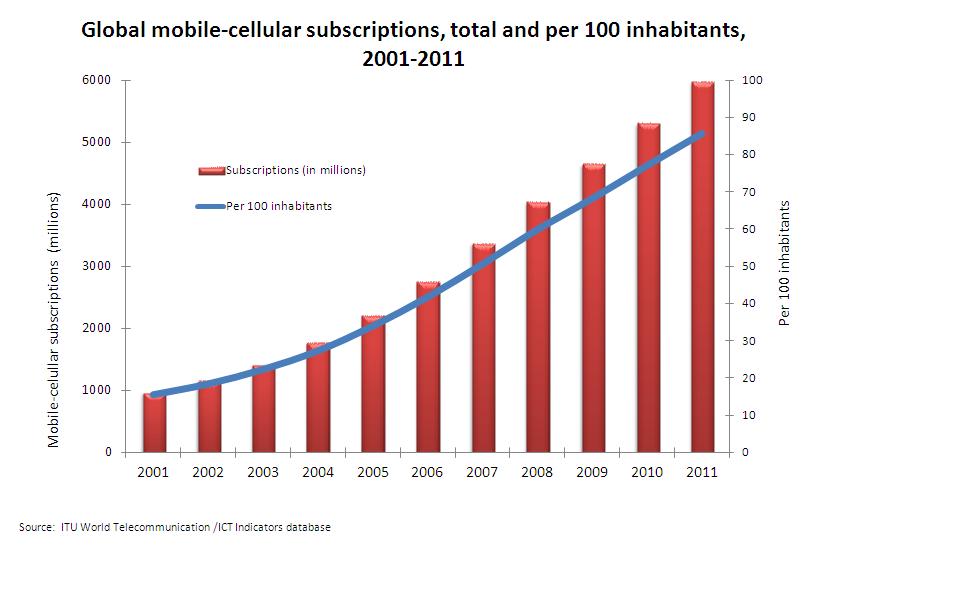
Today, there are seven billion people in the world and six billion mobile cellular-phone subscriptions. In other words, the world has gone to about 86 percent penetration in about 30 years.

From the standpoint of human progress, that is fast. From the standpoint of any single company, that is a long time. And that is worth keeping in mind. Most truly important consumer technologies take time to reach ubiquity. Would-be market leaders have plenty of time to misjudge market progress, and fail before “ubiquity” is reached.


U.S. LTE Arms Race Heats Up

U.S. mobile service providers are in the midst of a major “arms race” aimed at getting new Long Term Evolution fourth generation networks up and running, as customer adoption shows strong growth.

Verizon Wireless, the market leader, says it will complete its national network by mid-2013.

AT&T recently reiterated a timetable that some might call accelerated. T-Mobile USA likewise has stepped up its own efforts to build a nationwide LTE network. And Sprint likewise has purchased significant new assets in the U.S. midwest to support its planned LTE network.

LTE is not a commercial reality many other places in the world, in 2012, though, TeleGeography says.


Oddly Enough, Some Think Apple's Relationship With Consumers is "Not" Sticky

Most people likely think Apple has a very sticky relationship with its customers. 

But Alec Ellison, chairman of technology investment banking at Jefferies & Company, thinks Apple is more vulnerable to changing consumer tastes than Amazon, Facebook or Google.

Ellison says that although Jeffries is “bullish” on all four companies, Apple has the least “stickiness” with consumers. What he means is that Apple has to continue rolling out hot new products if it wants to keep its lead. It would be much harder for a competitor to unseat Amazon, Facebook, or Google, even if they don’t offer any new innovations.

U.K. 4G Auctions Might Cost Order of Magnitude Less than 3G

The U.K.’s 3G auction raised £22.5 billion ($35.7 billion) in 2000, amounts that nearly bankrupted most of the firms that won the bids

Long Term Evolution 4G auctions are expected to cost a lot less, despite more spectrum being auctioned in 2013 in the United Kingdom, at least in part because Ofcom has set relatively low minimum purchase prices. But carrier reluctance to overpay again also is key. 

The minimum reserve prices for the 4G auction suggest the licenses will cost far less than was the case for 3G spectrum, which has been called a winner's curse

Professional services firm PwC expects the auction to raise between £2 billion and £4 billion, TechCrunch reports.

Who Wins From Big Data?

History often offers useful lessons about the development of new markets. Ask yourself what happened in the enterprise software business for a glimpse of what is going to happen in the "big data" business.

A couple of decades ago, there were perhaps 200 companies creating and marketing enterprise resources planning software to automate business processes.

What were the odds an investor would have picked SAP or Oracle as the eventual market leaders? Less than half a percent. Similarly, what are the odds an investor can pick the eventual leaders of the "Big Data" business?

However, if an investor had purchased stock in the 30 components of the Dow in 1990 that were all deploying ERP, that investor would have benefited from a 35 percent decline in overhead costs as a percentage of revenues, a 500-percent increase in revenues as automation enabled massive scale, and an almost 800-percent increase in market cap, say analysts Peter Goldmacher and Joe del Callar of the Cowen Group. 

"We believe the biggest winners in the Big Data world aren’t the Big Data technology vendors, but rather the companies that will leverage Big Data technology to create entirely new businesses or disrupt legacy businesses," they say. 

Big Data, in that sense, is a bit like broadband access. Investors probably will make more money betting on the enhanced fortunes of businesses that use broadband, rather than the suppliers of broadband. That isn't a criticism of the fortunes of broadband access suppliers; just a recognition that the value of all businesses supported by electricity is far greater than the value of firms that produce and deliver energy. 

Sunday, November 11, 2012

"Fourth Wave" of Mobile Industry Revenue Models Will be Challenging

Some believe the way forward for mobile service providers in the next era is to embrace and own over the top apps and services. There is little doubt that there is risk

The logic is simple enough: in the future most apps will be used by consumers in an "over the top" manner. It also is not surprising that at least some providers of over the top, particularly those with a "partner" business strategy, make that argument.

But "over the top" parallels existing industry practices in crucial respects. First, assume that it is the carrier which "owns" the application. In principle, that is no different than a carrier owning voice, video entertainment or messaging services. Quite often, carriers are resistant to OTT apps in large part because they are not "carrier owned," an therefore generate no revenue. 

But there are some strategic issues. If you look at the mobile industry as having been through three distinct waves of revenue leadership, it was voice, then messaging, then data access. 

But it already is clear that, at some point, the era of revenue driven by data access is going to end, as well. That leaves open what the next era will feature as a lead revenue driver. 

Aside from that, there are profit margin issues. Voice and messaging have had high profit margins, but that is changing with the increasing competition from over the top services. Broadband access margins still are reasonable, but the concern is what happens as customers start to consume more data, if retail packaging does not shift from "unlimited" plans, something that largely already is characteristic of most mobile service plans in the U.S. market. 


Consider telco IPTV. Gross margin of 30 percent would not be unreasonable. But that is not "net" revenue, as the service provider has to share those proceeds with the content suppliers. 

For the sake of argument, assume that programming costs represent as much as 50 percent of distributor revenue. That means net profit margin for a distributor could be as little as 15 percent.  Some might make 20 percent margins, while the largest U.S. cable operators, with the greatest volume could earn more. 

It still is not clear what particular apps and services will arise, after mobile data has reached saturation. 

But it is possible that many such services will not have profit margins as high as carrier-originated services have had in the past, if only because some of the margin and revenue has to be shared with partners. The entertainment video example shows why. 

2/3 of Kenyans Use Mobile Money, So Government will Tax It


Some estimate that in Kenya, more than 66 percent of all people send money to each other using their mobile devices.

By such standards, mobile Internet access, though growing, is not as life changing as the simple ability to use a mobile phone as a way to send and receive money, in a nation where banking is not so easy as elsewhere. 

Unfortunately, it now appears that the Kenyan government is going to institute a 10-percent tax on the mobile money transaction fees, a move that logically will slow use of the innovation, as the imposition of a tax normally raises the cost of a product, and therefore leads to less consumption. 

It's a good thing that Kenyans can use mobiles to send and receive money: it makes banking services a reality for them. But governments had get in the way. Making such transactions 10 percent more expensive is one such way. 

Over the past couple of decades, government policies have helped, in part, by "getting out of the way" (deregulating) and "enabling competition." It worked. 

Many are too young to remember a time when policy makers and advocates had to grapple with the question of how to enable voice services for a third to a half of humans who had "never made a phone call."

These days, it is question with an answer. By International Telecommunications Union estimates, at least 87 percent of all people used mobile phones in 2011. 

Some might argue, with reason, that the actual number is lower, since some users have multiple phone identities (subscriber information modules).

Adjusting for that fact, the GSM Association estimates that mobile penetration actually is closer to 68 percent in 2012. 

The urge to levy new taxes is everywhere understandable. But lawmakers often seem to forget that a vibrant economy typically is a better way to increase tax revenue than essentially penalizing a growth driver. 


"Zero Sum" is Not a Viable Long Term Strategy

A threatened French law that would require Google and other search engine providers to pay content owners for snippets of content shown in search engines actually illustrates a growing issue in many new and changing industries, namely that new revenue relationships have to be built n something other than a "zero sum" basis.

In other words, when legacy suppliers see their revenue threatened by new contestants, the natural tendency is to fight back by getting the new applications, devices or services barred by legal means, when possible. 

If you think about the ways some countries have banned the use of VoIP, cable companies were barred from importing distant TV signals or the way the media deals with search engine, streaming or downloaded versions of their products, you get the idea. 


But that sort of zero sum approach winds up harming both legacy and new contestants. 

In this case, Google would likely stop indexing French media properties. How that is beneficial to the affected media is unclear. But Google's business also suffers, as it loses completeness, and is exposed to rivals who might be willing to pay such fees. 

Media economics have changed since the Internet arrived, as have the economics of communications and retailing. It's disruptive, to be sure. But the shift from physical to online consumption changes more than distribution, as disruptive as that is for "distributors."

In the shift from physical or legacy to online, overall consumption often can fall. That means less volume. But unit prices also tend to fall, and that dramatically changes profit margins for every unit sold, as total sales can fall. 

But zero sum approaches to industry revenue will fail, over time. The rational assumption has to be that products have life cycles.


Like it or not, fixed network voice, mobile voice, messaging, video entertainment services, newspapers and music on compact discs are products with a life cycle. Fighting over what is going to decline is understandable, but destined to fail. 
A common problem is that what once was scarce becomes abundant, with predictable effect on unit prices and profit margin for suppliers. 

So everything hinges on creating new products, revenue sources and industries. 

Sparring over revenue streams is understandable. But a zero sum approach is going to fail. 

How Electricity Charging Might Change

It now is easy to argue that U.S. electricity pricing might have to evolve in ways similar to the change in retail pricing of communication...