Tuesday, December 11, 2012

News Consumption Shifting to Mobile Devices

News consumption ranks high among activities people conduct on mobile devices, a study by the Project for Excellence in Journalism has found.  

Over a third of respondents report getting news daily on the tablet and the smart phone, putting it on par with other activities such as email and playing games on tablets and behind only email on smart phones. 

None of that should come as a surprise, given the dominant role of content consumption on tablets, and the growing role of content consumption on smart phones. 


Fully 43 percent of male tablet owners consume news daily on their device versus 32 percent of female tablet owners. The gap is nearly identical on smartphones (41 percent compared with 30 percent among women).


As you might guess, younger users are heavier users. On the tablet, male news users under 50 are more likely than female news users under 50 (and both genders over 50) to check news more than once a day. 

Nearly half of male tablet news users under 50 (48 percent) get news on their tablet multiple times during the day compared to 33 percent of women under 50 and 31 percent of men and women 50 and over.


Male news users under 50 are more avid readers of in-depth news articles on the tablet. Fully 84 percent do so at least sometimes, compared to 70 percent of women under 50 and 65 percent of both genders over 50.

Computing Goes Mobile, Untethered, Content Oriented

Debates about whether tablets will displace personal computers are nearly pointless. Tablets clearly are driving sales of computing appliances as much as are smart phones.

The desktop PC market has for some time been shrinking, compared to the notebook part of the PC market, but even notebook sales probably will be displaced to a large extent by tablets  and smart phones, as well, IDC says. 

Those changes speak to changes in the ways people use computing appliances, as much as anything. As it turns out, most people do not require a PC, as much as they used to, to work or play. At work, most applications involve either light communications activities (email, messaging) and consuming content of various types, rather than creating it. 

In other words, more people most of the time, read or view documents, presentations and videos, rather than needing to create them. Tablets and smart phones work passably well for such activities. 


If Apple Does Sell an "Internet TV," How Much Would You Pay for It?

A survey conducted by AlphaWise and Morgan Stanley suggests at least some consumers are willing to pay a 20-percent premium for a hypothetical "Apple TV," compared to other standard TVs.

The survey found that 11 percent of respondents said they would be "extremely interested" in purchasing a so-called "iTV" from Apple, while 36 percent said they are "somewhat interested."


Some 46 percent of respondents said they are willing to pay over $1,000, while 10 percent are willing to pay over $2,000.


On average, respondents said they would pay $1,060 for an "iTV," which is a 20 percent premium over the $884 paid for the current average television set. Respondents ages 18 to 29 showed the most willingness to invest in an Apple television, indicating they would pay a 32 percent premium for such a device. 

With the caveat that consumers often say they will do things they actually do not, the survey suggests Apple continues to have a "cachet" for many consumers. 

The survey polled 1,568 heads of U.S. households regarding the "smart TV" market and found that just 18 percent of homes have a smart TV, while 13 percent of respondents said they didn't know whether their TV is considered "smart," the study found.


The poll also shows that those who own smart TVs connected to the Internet actually spend less time accessing Internet content through their TV than those who do not own a smart TV. That presumably suggests an "ease of use" problem that Apple likes to solve.


The question is whether the TV interface is a big enough irritant to convince lots of consumers to buy an appliance that promises much-better ease of use. The reason is that "content" is a huge part of the TV experience, and unless Apple can dramatically change that part of the end user interaction, the benefits might not be so large as Apple might hope.

It might be one thing to ease navigation between "broadcast" or "linear" TV and online sources, or to make "finding" interesting online content easier. It might not be so easy to revolutionize the TV experience if Apple cannot change the way Hollywood licenses programs. 

If a hypothetical Apple TV or iTV enables viewing and purchase of single TV shows, at reasonable prices, that would be a huge deal.  But Hollywood is unlikely to license content on such terms, at least not now. 

For that reason, some of us are not so sure Apple can transform the TV experience as much as it changed music consumption or the mobile phone experience or PC interface. 


Morgan Stanley

Will Data Demand Keep Growing at 60% a Year?

Forecasting the future is a tough business, at least in part because people respond to changes in incentives, which in turn reshapes their behavior in non-linear ways. Many of you who follow trends in bandwidth are familiar with a basic rule suggesting that bandwidth consumption grows about 60 percent a year, globally or in most market segments.

It therefore is logical to assume continued growth at about that magnitude. But that might not be a safe assumption. One might assume that later users are less heavy consumers of data than the early adopters.

Retail pricing is shifting in ways that provide clear incentives for users to make choices about which networks they use when connecting to the Internet.

And service providers also have new incentives to encourage offloading of data demand. Wi-Fi is more prevalent, all the time, and service providers have a vested interest in convincing their own customers to use Wi-Fi when possible, in part to relieve strain on mobile networks, and in part to provide a better end user experience.

To be sure, the percentage of data-using devices also is growing steadily, adding more users. So any attempt to predict future usage has multiple moving inputs.

So it is reasonable to ask whether smart phone consumers are making significant changes in behavior that could slow the rate of mobile broadband data consumption. Given trends that show substantial  use of Wi-Fi connections in place of mobile network access, that is a possibility.

A recent study by NPD Connected Intelligence, for example, tracking usage on 1,200 smart phones, shows a mixed pattern. Android users on the Verizon, AT&T and Sprint networks seem to have decreased their use of mobile data networks between April 2012 and October 2012, while T-Mobile USA Android users seem to have increased usage.

Apple iPhone users on all of the networks except AT&T seem to have increased usage.
Fierce Wireless notes that the iPhone sample is small, so the results might be an anomaly.

But at least a couple explanations could explain the data. It is conceivable that users are learning to economize by shifting to Wi-Fi access whenever possible. And even where mobile network usage is growing, it is possible the greater consumption is less than it would have been had users not begun shifting access to Wi-Fi.

It is conceivable that new Android users are more budget conscious. And it remains possible that the demographics of Android and iPhone users are different in some material way. A number of surveys have shown that Apple iPhone users are, in fact, wealthier than Android users.

Other studies suggesting iPhone spend more than Android users likewise might be related to differences in disposable income. That pattern was upheld, some studies suggest, on Black Friday of 2012 and also Cyber Monday of 2012.

The NPD data is a snapshot in time, and one ought to be circumspect about what it really means. Nor are consumer preferences, demographics, disposable income or device type the only key variables.

Some of the service providers might be deliberately creating greater incentives for users to switch to Wi-Fi, in some cases allowing users to default to Wi-Fi automatically, which would increase use of the Wi-Fi access method.

With mobile service providers having clear financial incentives to shift users to Wi-Fi, and with a greater move to use of small cell access (especially when those small cells also feature Wi-Fi access), it seems reasonable to assume at least a possibility that smart phone mobile network bandwidth consumption might not grow as fast as some have predicted.


That will have key implications for any number of other elements of business strategy, such as new spectrum policies, the value of new spectrum, the amount of undersea cables that must be built, and the lit capacity on those cables. 

How fast to deploy Long Term Evolution will be an issue in many markets, especially where 3G might meet demand in the near term. And service providers might have to rethink the pace of infrastructure upgrades, at least in terms of network elements that can handle higher speeds and more capacity.
It bears watching.


Solid Lines represent Android data. Dashed Lines with square markers represent iOS/iPhone data.

Monday, December 10, 2012

Smart Phone Penetration in Africa Growing Faster than You Might Think

Wikipedia founder Jimmy Wales has been spending the past couple of years working on Wikipedia Zero, a way to make Wikipedia available to users who don’t own a computer or can’t get access to 3G mobile data.

On the other hand, Wales says the pace of smart phone adoption in Africa is happening much faster than people typically think.

The pace of change in Africa was surprising enough that Wikipedia Zero, which formerly had been focusing on India, now is paying a lot more attention to Africa, thanks to the growth in ownership of cheap, Android-powered handsets. 

The African mobile market in the third quarter of 2012 served 1.08 billion people using 821 million subscriber information modules, representing subscription penetration of 76.4 percent. In the first quarter of 2013, mobile penetration will eclipse 80 percent, according to ABI Research.  

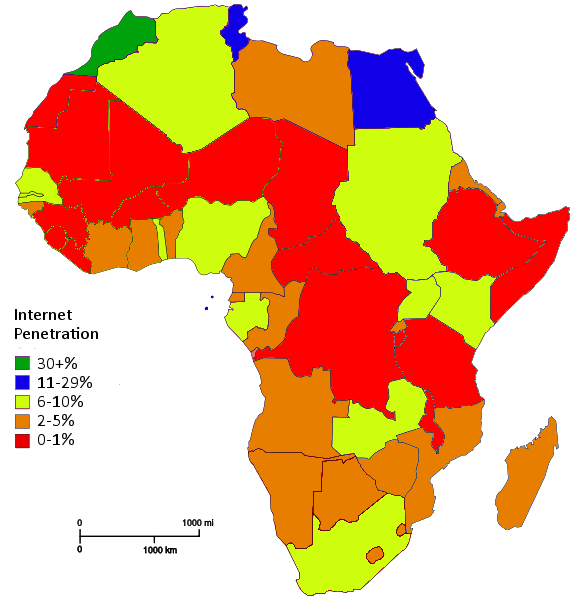
One might predict that, even though Internet usage remains low, and broadband as well, that likewise will change dramatically over the next decade. 


Fixed Broadband Growth in Africa

How Do Tablets Get Used at Work?

Tablet users spend 2.1 hours daily on their tablet for work purposes, a survey of 600 workers has found. Tablet users say they gain 1.1 hours in daily productivity by using their tablet, CDW says

Some 84 percent of tablet users say tablet use makes them better multi-taskers, while 71 percent of tablet users say tablet use makes work more enjoyable.

Tablet Time

Digital Device Market Growth Will Shift to Emerging Markets by 2017

The global connected device market, including PCs, tablets, and smartphones, grew 27.1 percent year-over-year in the third quarter of 2012, reaching a record 303.6 million shipments valued at $140.4 billion dollars, and a rapidly-growing share of such sales will occur in "emerging" markets in the coming years. 

Expectations for the holiday season quarter are that shipments will continue to reach record levels rising 19.2 percent over the third quarter and 26.5 percent over the same quarter a year ago, IDC estimates. 

Smart Connected Device Market by Product Category, Shipments, Market Share, 2012-1016
(shipments in millions)
Product
Category
  
2016 Unit
Shipments
  
2016 Market
Share
  
2012 Unit
Shipments
  
2012 Market
Share
  
2016/2012
Growth
Desktop PC  151.0  7.2%  149.2  12.5%  1.2%
Portable PC  268.8  12.8%  205.1  17.2%  31.1%
Smartphone  1405.3  66.7%  717.5  60.1%  95.9%
Tablet  282.7  13.4%  122.3  10.2%  131.2%
Total  2107.8  100.0%  1194.0  100.0%  76.5%
Source: IDC Worldwide Quarterly Smart Connected Device Tracker, December 10, 2012.

By perhaps 2017, more tablets will be sold in "emerging" countries than in "developed" or "mature" countries, according to NPD


Also, there is significant awareness and appetite on the part of "emerging market" firms to use the latest collaborative and digital technologies. In fact, appetite for cloud computing, business intelligence, mobile services and devices, collaboration tools, social media and telepresence is significantly higher in emerging countries than in developed nations. 


Sunday, December 9, 2012

U.S. Delegation Takes Tough Stand Against ITU "Takeover" of Internet

The U.S. delegation to the International Telecommunication Union talks about regulation of the Internet has threatened a veto if proposals seen as posing a danger of censorship. 

New Money, Old Problems

Would-be innovators in the virtual currency business face a problem other entrepreneurs in the Internet ecosystem also have faced, but with even-higher obstacles. 

The problem is that there now are many ways "money" or its equivalents can be exchanged between people, and lots of new ways people can use "banking" functions involving the receipt or sending of money. 

But what can be done, in terms of technology, is not always legal. Banking, everywhere, is among the most regulated of all industries, and always is viewed from a "national interest" perspective.


"A digital payment can move between two people as they pass each other on the street, or between two people on opposite sides of the Earth, with no difference between the character of the two payments,” says Erik Voorhees, a Bitcoin entrepreneur who works at Bitinstant

So technology alone will not dictate how "money" and "banking" will change. Regulators will be quite vigilant about protecting existing ways of doing things, not specifically to safeguard incumbent business interests, but everywhere to "protect the public."

One might note that mobile payments already have run into a "post-hype" period where muted expectations will be the rule. Virtual money or virtual currency has not yet even emerged into a full-blown hype phase. 


2013 Could be a Big Year for Internet Access in the United States

A U.S. Court of Appeals finally will hear a Verizon challenge to Federal Communications Commission network neutrality rules. How the court rules could lead to big changes for the broadband access business. 

Specifically, if the court sustains the network neutrality rules, it is possible the "best effort only" rules that now apply to fixed access providers likely will be extended to mobile service providers as well. 

It is conceivable that new rules could be considered that extend FCC rules over terms and conditions of service, including such items as prices or data caps. 

The case, which is before the Court of Appeals for the D.C. Circuit, is Verizon's challenge to the FCC's controversial net neutrality rules. The case has been winding its way through the courts since 2010.

The regulations, adopted by the commission in late 2010, mandate that the only class of service a consumer Internet service provider can offer is "best effort," with no quality of service policies or traffic shaping.

The intent is to bar ISPs from charging application providers for expedited delivery or class of service features. The logic there is that such business practices could lead to invidious business practices where an ISP either favors its own services, or a situation where larger app providers are able to afford a better end user experience than their smaller rivals.

But if the FCC loses, some FCC commissioners will be tempted to reclassify broadband Internet as a "telecommunications service" under the Communications Act, which would give the FCC more authority to regulate it.


On the other hand, some observers think the same court, which upheld  the Federal Communications Commission’s data-roaming rules, has sent a signal it will upheld in the net neutrality case as well.
In the earlier decision, the U.S. Court of Appeals for the District of Columbia ruled against a Verizon Wireless challenge to the FCC’s rules requiring wireless operators to provide roaming access. 
Up to this point, the legality of the network neutrality rules as applied to mobile service providers has been unclear, as the FCC has said it has the authority to apply net neutrality rules, but simply has avoided doing so. 
If the FCC wins the appeals court case, some members of the FCC might be emboldened to extend rules over broadband access that make it a common carrier service. Many observers think that would lessen innovation and reduce investment in the business, on the part of access providers. 
So 2013 could be a big year for the broadband access business. 

Saturday, December 8, 2012

Broadband Growth Should Shift Beyond BRICS

IDC predicts that emerging markets will contribute for 53 percent of 2012’s global information and communications technology growth. And a poll of 675 global IT and business professionals suggests Indonesia, Vietnam, Qatar and Myanmar are the countries to lead that growth.

But Israel, Iraq, Uganda and Cambodia were other countries also viewed as countries where growth could occur.

Notably, just five percent of respondents chose Brazil, Russia, India, China or South Africa as among the nations having the strongest growth, though the so-called BRICS nations have been at the top of global growth lists for some years.

Regionally, Asia-Pacific (exclusive of China and India) was cited by compared to 61 percent of survey respondents as the region most likely to lead revenue growth.

Even the Middle East seems a more promising market, with 15 percent of respondents
choosing it as the next boom region.

In part, the shift of growth expectations is a logical consequence of rapid development in the BRICS nations over the last decade. The International Monetary Fund has cut its 2012 and 2013 growth expectations for China, India and Brazil, for example. Those countries have made large
investments in their technology and telecom infrastructure. Though not yet at a saturation
point, those countries are fast approaching saturation, at least for mobile and computing infrastructure.

In Indonesia, for example, there are around 55 million internet users. But that’s just a tiny fraction (22 percent) of its 245 million population. But growth is going to be rapid. The number of internet users grew 29 percent in the most recent year.

Predictions point to 76 million users by 2015. Perhaps ironically, the majority of Internet users are accessing the web while on the go, and not from a desk. While mobile penetration is at 54 percent, PC penetration is just five percent.

But PC sales are grew 36 percent in the most recent year.

In Vietnam, 2012 information technology spending will have increased by 19 percent, IDC says. The total number of smart phones in Vietnam is expected to rise by five percent in 2012 to 21 percent.

The number of people using mobile phone services is expected to reach 90 percent of its population by 2015 and 95 percent by 2020.

By 2015, about 45 percent of the population will be using the Internet by 2015, up from about 30 percent in 2012.
Tablet penetration currently stands at two percent, but it’s expected to rise 92 percent by the end of 2012.

IDC is expects 15 percent year-over-year growth of information technology and communications spending in Myanmar in 2012. Internet usage is quite low, probably in low single digits, while mobile penetration rates likely are similar.

Around 80 percent of the Myanmar population of about 60 million people live in rural areas, pointing out the challenges of getting Internet service to most people.

Qatar’s state-backed Qatar National Broadband Network Company plans to build a fiber to home network reaching 95 percent from the current five percent, reaching 30,000 homes by the
end of 2012 and 300,000 by 2015.

In most emerging markets, wireless will be the preferred access method.  For example, in a recent project that Analysys Mason undertook involving nine countries in the Middle East and North Africa, Analysys Mason found that in Algeria it would be commercially viable to roll out fiber to the home to around 12 percent of the population and wireless technologies to around 70 percent of the population.

                                    Economic Viability of Various Access Technologies

Retail cost of service remains a key business issue, though. A study by Ovum found that South Africa had the most expensive broadband tariffs of 19 studies countries. Entry-level services in South Africa cost as much as $1,443 per year, with the prices of high-end services up to $6,000 per year.
Ovum found that lower end entry-level services cost as much as $1,211 per year in Nigeria.

In the countries that Ovum looked at, broadband services using HSPA (mobile 3G) technology were the cheapest option for entry-level users, with an average price of $223 per year.

Still, since broadband penetration in the developing world is only about  six percent , there is lots of room for growth. 


Friday, December 7, 2012

Google Cannot Afford to Become a National Fixed Access Provider

Google’s Kansas City, Kan. and Kansas City, Mo. 1-Gbps access network naturally tends to
encourage speculation about what else Google might have in mind, including the notion that Google might try something on a wider scale.

It isn’t a completely wild notion, given earlier Google investments in municipal Wi-Fi, Clearwire and even a commitment to make a minimum bid on 700-MHz spectrum. Add in Google’s production of its own Nexus smart phones and tablets, as well as tests of a mobile virtual network operator network in Spain (albeit only as a closed test using Google employees), and one can understand the speculation.

Also, new European Union rules might encourage new providers to think about becoming specialized providers of service that is “roaming only.”

An analysis by Goldman Sachs should reassure potential “victims” that Google would not actually undertake an expansion of Google Fiber on a major scale in the U.S. market. The simple reason is excessive cost.

The analysis suggests that if Google really wanted to build out a new national 1-Gbps networks in most major U.S. cities, it would cost more than $140 billion. Most experienced telecom or cable executives would say it could easily cost that much, and take many years.

A more modest goal, of becoming a service provider for 50 million households, less than half of all U.S. homes, would cost perhaps $70 billion.

Ignore for the moment the likelihood that Google has lots of other users for its cash. Assume Google wanted to do so, and was willing to proceed by using internal funds, rather than borrowing money.

Goldman Sachs Telco analyst Jason Armstrong noted that if Google devoted 25 percent of its $4.5 billion annual capital investment,  it could build network out to about 830,000 homes each year, or 0.7 percent of U.S. households.

Armstrong estimates Verizon has spent roughly $15 billion building out its FiOS fiber network covering an area of approximately 17 million homes, by way of comparison.

At such a pace, Google would find it had to replace its first networks long before it even finished the first round of construction on the initial 25 million sites.

Also, if Google really wanted to do something about the economics of broadband access, you might argue the timetable and cost would be more amenable if Google spent money on mobile or at least wireless infrastructure instead.

Some estimate it will cost T-Mobile USA about $9 billion to build a national LTE network, for example.

The point is that 1-Gbps networks are expensive and time-consuming to create. Google’s primary interest likely is creating new market pressures for all other providers to match its own services in Kansas City.

The only issue is whether Google can do so by building in one city only, or would have to threaten building in other key cities as well.

But in all likelihood, Google would never want to waste capital by building a national network of fixed access networks. It is simply too expensive, and too limited, in terms of return from other investments it could make with that capital.

On the other hand, it is clear why speed matters to Google: speed matters for users and consumers.

Some 64 percent of consumers surveyed by Brand Perfect say slow loading was among the top two irritations when shopping online. Fast loading improves end user satisfaction, and also allows more ad inventory to be displayed.

PT Telkom to Deploy 100,000 Wi-Fi Access Points in Indonesia

Time has a way of settling old debates. 

So it is that PT Telekomunikasi Indonesia Tbk (PT Telkom), Indonesia's largest communications service provider, is deploying 100,000 Wi-Fi hotspots across Indonesia, to help PT Telekomunikasi Indonesia cope with rapidly-growing mobile data demand.

No more do service providers "worry" about whether Wi-Fi competes with, or complements, mobile data access.

Cisco says the new network of access points will create the largest Wi-Fi network operated by a single service provider in Asia.

PT Telkom expects mobile data traffic to double each year through at least 2016. The Cisco Visual Networking Index also predicts that mobile data traffic in Indonesia is expected to grow 32 times from 2011 to 2016, with an average per user consumption at 716 megabytes of mobile data traffic per month in 2016, a staggering 2,387 per cent increase from 30 megabytes per month in 2011.

Indonesian mobile data traffic will grow four times faster than Indonesian fixed IP traffic from 2011 to 2016.

And though Indonesia's mobile data traffic was two percent of total IP traffic in 2011, mobile data will represent 17 percent of total Indonesian IP traffic in 2016.

Tablets Have Rapidly Hit an Inflection Point

Within a two-year period, almost 20 percent of U.S. homes have become tablet owners, according to Nielsen Wire. That's fast. It is not uncommon for a consumer innovation to take as long as seven years to reach just 10 percent penetration.

Nielsen data still shows that entertainment video is the overwhelming choice of a screen used to consume video. Between 77 percent and 86 percent of all video consumed uses a standard TV screen. 

But tablets and smart phones both are heavily used while people are watching TV screens.

Is TV Becoming "Irrelevant?"

Perceptions of "irrelevance" are not helpful to any would-be supplier of a product. But at least for some segments of the U.K. population, TV is becoming irrelevant.

Some 17 percent of U.K. teens would miss television if they did not have it, but 53 percent of female respondents would miss their mobile phones if they did not have them, according to Ofcom.

There are potentially significant implications for the video entertainment ecosystem, if those behaviors on the part of teens become adult habits.


Conversely, TV is among the most-favored media used by older adults. When asked what media would be missed the most, people over 75 are far more likely to miss their TVs the most (65 per cent), followed by radio (15 per cent) and newspapers/magazines (eight per cent).

The picture is very different for young adults aged 16 to 24 who would most miss their mobile phone (28 per cent), followed by the internet (26 per cent) and TV (23 per cent). 


Kids spent 17 hours each week accessing the Internet, about the same amount of time they spend watching TV. Nearly all (90 percent) of 12 - 15 year olds in the U.K. access the Internet every day, and weekly Internet usage continues to rise steadily. 


The point, obviously, is that television, as a product, already is less popular among younger consumers than among older consumers. Internet and mobile seem to be essential. 

So television marketers have a big problem: how to change the product to create more relevance for some consumer segments who, at present, don't find they want the product.

Packaging and pricing won't matter if it is the basic product some consumers find irrelevant. 

Yes, Follow the Data. Even if it Does Not Fit Your Agenda

When people argue we need to “follow the science” that should be true in all cases, not only in cases where the data fits one’s political pr...