Wednesday, December 12, 2012

FreedomPop Launches Wireless Fixed Service

freedom-hub-burst-01-300FreedomPop, which already has launched its mobile broadband service, now is launching a "fixed" service offering 1 Gbytes of free data in nearly all of the the 80 largest urban markets across the United States. 

Orders for the new modems will be filled in January 2013, it appears. 

The services requires a refundable $89 deposit that covers the cost of the modem. 

FreedomPop is trying to disrupt U.S. broadband pricing, and in addition to the free allotment of 1 Gbyte, compared to the free 500 Mbytes offered with the mobile version of the plan. 

If early reports are correct, the fixed service will offer perhaps shocking prices of 10 Gbytes for $10 a month. Users who are comfortable with speeds that some will compared to lower-speed digital subscriber line, and who do not watch lots of video, might find that a very-attractive offer.

The mobile service features higher tariffs, as typically is the case for mobile broadband. A 2-Gbyte plan would cost $17.99 per month. After that, each additional 1MB costs just $0.01 (which works out to $10 per 1GB). 


That works out to about $28.99 per month for 4GB of data, $34.99 for 5GB and $59.99 for 10GB, all with the same $0.01 charge for each additional megabyte you go over your plan. Most users will consider that a mild overage charge, indeed. 

What Percentage of U.S. Household Income Does Apple Get?

In 2011, the average amount U.S. households spent on Apple products was $444, according to Morgan Stanley analyst Katy Huberty, Reuters reports. Some might find that a "large" number, while others might consider it a rather small percentage of total spending. What is clear is that "average" households are spending more on Apple products.

In 2010 the "average" household spent $295 on Apple products. Back in 2007, U.S. households spent  $150. If you assume median U.S. household income of $50,054, that suggests some households are spending a modest amount on Apple products, about 0.9 percent of household income. 

Compare that with other spending percentages, based on an average American household income of $63,000.

Dry cleaning, storage of clothing, rental of clothing, jewelry and watch repair represent 0.5 percent of spending.

Tobacco products might represent about 0.8 percent. 

Entertainment, including such items as sports equipment, photographic equipment and supplies, hunting and fishing equipment, bikes, boats, balls and other sports equipment, might represent . 0.8 percent. 

Alcoholic beverages might consumer about 0.9 percent of income. 
Admission fees constitute about 1.3 percent of income. Vacation lodging represents 1.4 percent of income.

Spending on hobbies, toys and pets takes about 1.4 percent of income, while television, radio and audio equipment, cable TV subscriptions claims two percent of income.
Gifts represent 2.2 percent of income. 

Some might say U.S. residents spend "too much" on Apple products, but that is a subjective call. Looking at the other common spending categories, one could easily argue that purchases of Apple products are not uncommonly high, and that there are lots of other places spending might be shifted to account for Apple spending. 

Tuesday, December 11, 2012

Netflix ISP Ranking Shows Modest Differences Between ISPs

Google Fiber is now the most consistently fast ISP in America for watching Netflix streamed content, according to Netflix. But keep it in perspective: Netflix streaming only happens so fast. 

Is Sprint Moving to Take Over Clearwire?

Many observers were convinced Softbank would not have taken control of Sprint without a clear path to own Clearwire as well, and that might be the impetus for a Sprint bid to buy the remainder of Clearwire it does not already own. Reuters reports that Sprint is in talks with Intel Corp. and Comcast Corp. to buy out their stakes in  Clearwire.

Intel and Comcast own a combined basis roughly 12.4 percent of Clearwire's total shares. Aside from plans Sprint might now have for a new assault on the U.S. mobile market, something most expect Softbank to attempt,   the U.S. market is showing other signs of instability or attempted disruption.

There are growing signs that the U.S. mobile service provider market is unstable, in terms of market structure, and on the cusp of changes that could include a significant wave of provider restructuring, despite the failure of the AT&T bid to buy T-Mobile USA.

"What is clear for now, in our view, is that the current strategy, indeed the entire current business, isn't working," said Craig Moffett, an analyst at Sanford C. Bernstein. Moffett seems to be referring to the whole business operated by regional U.S. wireless carriers.

To be sure, Moffett has been saying that the U.S. mobile business is saturated since at least 2009.

Oddly enough, to some of us the new stresses resemble the earlier transition from dial-up Internet access to broadband access. In this case, the transition is from feature phone to smart phone business models.

In that earlier transition, many suppliers that had made a business of supplying dial-up access found they no longer could compete in the broadband business. Now, in mobile, it appears that the cost of supporting handset subsidies is pinching operating revenue, while the cost of building fourth generation networks likewise will hit earnings.

Of the "big four" U.S. mobile carriers, only T-Mobile USA seems to have experienced a subscriber loss.

In its second quarter of 2012, AT&T added 1.5 million net new customers. Verizon Wireless added 1.2 million net new subscribers. Sprint added postpaid net additions of 442,000 postpaid net additions. But T-Mobile USA, one the "big four" U.S. mobile service providers, lost 510,000 subscribers in the first quarter.

The immediate stress is heavy for the regional mobile providers, often using prepaid models.

Regional or prepaid service providers clearly have had a tougher 2012 than had been the case in the mid-2000s, for example. Leap hasn't been profitable since 2005, for example. MetroPCS profits dropped 63 percent during the first quarter of 2012.

A study undertaken by Tellabs suggests that mobile service provider profitability could become extremely challenging for some mobile operators within three years, with costs surpass revenues for many operators.

In North America that could happen by the fourth quarter of 2013 or as early as Q1 2013. Developed Asia Pacific service providers could see problems by the third quarter of 2014. In some cases this could happen as early as Q3 2013, Tellabs said.

Service providers in Western Europe could run into trouble by the first quarter of 2015. In some cases this could happen as early as the first quarter of 2014.

Vivendi's SFR mobile operation reportedly has been talking to Iliad (owner of Free Mobile) about a merger. SFR also apparently is in talks with French cable operator Numericable about a merger of SFR with Numericable as well, Reuters reports.

Those talks indicate that, after a period of relative stability, mobile market structure, in France and elsewhere, might be changing, because of market saturation and competition.

In many Western European markets there are four, and sometimes five facilities-based mobile  service providers. That was sustainable in an earlier period where the mobile market was growing.

But the issue has been whether four to five contestants are  "too many" suppliers for a stable market. In the United Kingdom, the formation of EE is another example, while in the U.S.market Sprint and T-Mobile USA are the contestants seen as inevitable parts of a future market consolidation.

With the recent mergers of T-Mobile USA and MetroPCS, and the purchase of Sprint by Softbank (assuming both transactions pass regulatory muster), there is once again an active discussion in many quarters about the future shape of the U.S. mobile service provider business.

What seems a safe observation, though, is that the number of successful mobile service providers will be few in number. The only question is “how few?” In many markets, there are four to five major providers, in terms of market share. But just how stable a market that is is questionable.

The Rule of Three holds nearly everywhere. While the percentage market share might vary, on an average, the top three mobile service providers control 93 percent of the market share in a given nation, irrespective of the regulatory framework.

Some might argue that scale effects account for the relatively small number of leading providers in many capital-intensive or consumer electronics businesses.

At some point, the access business can have only so many facilities-based providers before most companies cannot get enough customers to make a profit. Consolidation is the result.


The point is that mobile markets are heading for a period of greater instability and possible change than we have seen for some time.

How 4G LTE Might TransformiThe Mobile Ecosystem

Will Long Term Evolution 4G transformthe mobile ecosystem? Possibly, Business Insider says. In fact, mobile service providers hope that will happen, much as 3G was thought to be the foundation for new applications user experiences and revenue streams.

Of course, the 3G experience also suggests that it sometimes can take quite a while for those new applications, experiences and revenue streams to materialize. So what does Business Insider think could happen?

LTE is about ten times faster than 3G wireless connections. In fact, many consumers have found LTE faster than their home broadband connections, Business Insider argues. That might lead more users to evaluate substituting LTE for a fixed broadband connection. So there could be changes affecting service providers.
bii

LTE might encourage application developers to create, and people to use,  video-based or video-enhanced applications.

These categories most notably include video sharing, video chat, augmented reality, games, and apps.

Both consumers and app developers might therefore find that 4G creates the foundation for qualitatively different experiences, not just "faster" experiences.

Advertisers might find that LTE creates more engagement and more monetization opportunities. That might mean more advertising, and more immersive experiences, more often and in new locations. Google, Facebook and others are betting big that will happen.

On the other hand, some circumspection is probably in order. Mobile service providers were initially convinced that 3G likewise would create massive new revenue streams, apps and experiences, and for quite some time, none of that happened.

Only with the emergence of mobile email did lead applications of value to lots of people finally emerge. That was followed by mobile Internet access as a lead value. Most observers think video will play a key role in underpinning 4G-unique experiences. Others think the "personal hotspot" could emerge as a major new app as well.

News Consumption Shifting to Mobile Devices

News consumption ranks high among activities people conduct on mobile devices, a study by the Project for Excellence in Journalism has found.  

Over a third of respondents report getting news daily on the tablet and the smart phone, putting it on par with other activities such as email and playing games on tablets and behind only email on smart phones. 

None of that should come as a surprise, given the dominant role of content consumption on tablets, and the growing role of content consumption on smart phones. 


Fully 43 percent of male tablet owners consume news daily on their device versus 32 percent of female tablet owners. The gap is nearly identical on smartphones (41 percent compared with 30 percent among women).


As you might guess, younger users are heavier users. On the tablet, male news users under 50 are more likely than female news users under 50 (and both genders over 50) to check news more than once a day. 

Nearly half of male tablet news users under 50 (48 percent) get news on their tablet multiple times during the day compared to 33 percent of women under 50 and 31 percent of men and women 50 and over.


Male news users under 50 are more avid readers of in-depth news articles on the tablet. Fully 84 percent do so at least sometimes, compared to 70 percent of women under 50 and 65 percent of both genders over 50.

Computing Goes Mobile, Untethered, Content Oriented

Debates about whether tablets will displace personal computers are nearly pointless. Tablets clearly are driving sales of computing appliances as much as are smart phones.

The desktop PC market has for some time been shrinking, compared to the notebook part of the PC market, but even notebook sales probably will be displaced to a large extent by tablets  and smart phones, as well, IDC says. 

Those changes speak to changes in the ways people use computing appliances, as much as anything. As it turns out, most people do not require a PC, as much as they used to, to work or play. At work, most applications involve either light communications activities (email, messaging) and consuming content of various types, rather than creating it. 

In other words, more people most of the time, read or view documents, presentations and videos, rather than needing to create them. Tablets and smart phones work passably well for such activities. 


If Apple Does Sell an "Internet TV," How Much Would You Pay for It?

A survey conducted by AlphaWise and Morgan Stanley suggests at least some consumers are willing to pay a 20-percent premium for a hypothetical "Apple TV," compared to other standard TVs.

The survey found that 11 percent of respondents said they would be "extremely interested" in purchasing a so-called "iTV" from Apple, while 36 percent said they are "somewhat interested."


Some 46 percent of respondents said they are willing to pay over $1,000, while 10 percent are willing to pay over $2,000.


On average, respondents said they would pay $1,060 for an "iTV," which is a 20 percent premium over the $884 paid for the current average television set. Respondents ages 18 to 29 showed the most willingness to invest in an Apple television, indicating they would pay a 32 percent premium for such a device. 

With the caveat that consumers often say they will do things they actually do not, the survey suggests Apple continues to have a "cachet" for many consumers. 

The survey polled 1,568 heads of U.S. households regarding the "smart TV" market and found that just 18 percent of homes have a smart TV, while 13 percent of respondents said they didn't know whether their TV is considered "smart," the study found.


The poll also shows that those who own smart TVs connected to the Internet actually spend less time accessing Internet content through their TV than those who do not own a smart TV. That presumably suggests an "ease of use" problem that Apple likes to solve.


The question is whether the TV interface is a big enough irritant to convince lots of consumers to buy an appliance that promises much-better ease of use. The reason is that "content" is a huge part of the TV experience, and unless Apple can dramatically change that part of the end user interaction, the benefits might not be so large as Apple might hope.

It might be one thing to ease navigation between "broadcast" or "linear" TV and online sources, or to make "finding" interesting online content easier. It might not be so easy to revolutionize the TV experience if Apple cannot change the way Hollywood licenses programs. 

If a hypothetical Apple TV or iTV enables viewing and purchase of single TV shows, at reasonable prices, that would be a huge deal.  But Hollywood is unlikely to license content on such terms, at least not now. 

For that reason, some of us are not so sure Apple can transform the TV experience as much as it changed music consumption or the mobile phone experience or PC interface. 


Morgan Stanley

Will Data Demand Keep Growing at 60% a Year?

Forecasting the future is a tough business, at least in part because people respond to changes in incentives, which in turn reshapes their behavior in non-linear ways. Many of you who follow trends in bandwidth are familiar with a basic rule suggesting that bandwidth consumption grows about 60 percent a year, globally or in most market segments.

It therefore is logical to assume continued growth at about that magnitude. But that might not be a safe assumption. One might assume that later users are less heavy consumers of data than the early adopters.

Retail pricing is shifting in ways that provide clear incentives for users to make choices about which networks they use when connecting to the Internet.

And service providers also have new incentives to encourage offloading of data demand. Wi-Fi is more prevalent, all the time, and service providers have a vested interest in convincing their own customers to use Wi-Fi when possible, in part to relieve strain on mobile networks, and in part to provide a better end user experience.

To be sure, the percentage of data-using devices also is growing steadily, adding more users. So any attempt to predict future usage has multiple moving inputs.

So it is reasonable to ask whether smart phone consumers are making significant changes in behavior that could slow the rate of mobile broadband data consumption. Given trends that show substantial  use of Wi-Fi connections in place of mobile network access, that is a possibility.

A recent study by NPD Connected Intelligence, for example, tracking usage on 1,200 smart phones, shows a mixed pattern. Android users on the Verizon, AT&T and Sprint networks seem to have decreased their use of mobile data networks between April 2012 and October 2012, while T-Mobile USA Android users seem to have increased usage.

Apple iPhone users on all of the networks except AT&T seem to have increased usage.
Fierce Wireless notes that the iPhone sample is small, so the results might be an anomaly.

But at least a couple explanations could explain the data. It is conceivable that users are learning to economize by shifting to Wi-Fi access whenever possible. And even where mobile network usage is growing, it is possible the greater consumption is less than it would have been had users not begun shifting access to Wi-Fi.

It is conceivable that new Android users are more budget conscious. And it remains possible that the demographics of Android and iPhone users are different in some material way. A number of surveys have shown that Apple iPhone users are, in fact, wealthier than Android users.

Other studies suggesting iPhone spend more than Android users likewise might be related to differences in disposable income. That pattern was upheld, some studies suggest, on Black Friday of 2012 and also Cyber Monday of 2012.

The NPD data is a snapshot in time, and one ought to be circumspect about what it really means. Nor are consumer preferences, demographics, disposable income or device type the only key variables.

Some of the service providers might be deliberately creating greater incentives for users to switch to Wi-Fi, in some cases allowing users to default to Wi-Fi automatically, which would increase use of the Wi-Fi access method.

With mobile service providers having clear financial incentives to shift users to Wi-Fi, and with a greater move to use of small cell access (especially when those small cells also feature Wi-Fi access), it seems reasonable to assume at least a possibility that smart phone mobile network bandwidth consumption might not grow as fast as some have predicted.


That will have key implications for any number of other elements of business strategy, such as new spectrum policies, the value of new spectrum, the amount of undersea cables that must be built, and the lit capacity on those cables. 

How fast to deploy Long Term Evolution will be an issue in many markets, especially where 3G might meet demand in the near term. And service providers might have to rethink the pace of infrastructure upgrades, at least in terms of network elements that can handle higher speeds and more capacity.
It bears watching.


Solid Lines represent Android data. Dashed Lines with square markers represent iOS/iPhone data.

Monday, December 10, 2012

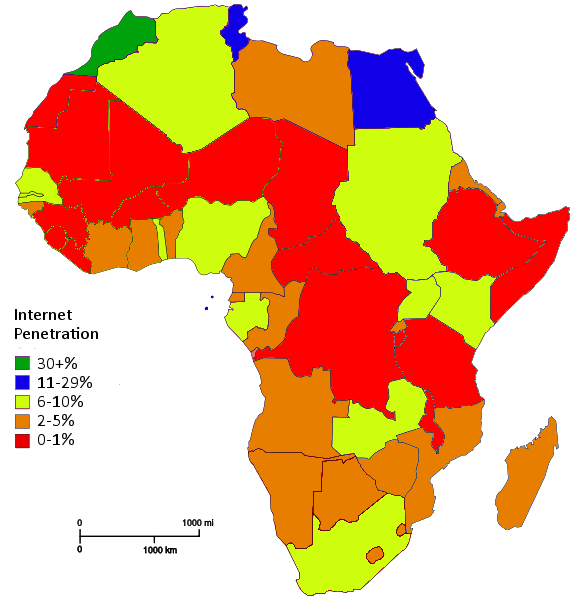
Smart Phone Penetration in Africa Growing Faster than You Might Think

Wikipedia founder Jimmy Wales has been spending the past couple of years working on Wikipedia Zero, a way to make Wikipedia available to users who don’t own a computer or can’t get access to 3G mobile data.

On the other hand, Wales says the pace of smart phone adoption in Africa is happening much faster than people typically think.

The pace of change in Africa was surprising enough that Wikipedia Zero, which formerly had been focusing on India, now is paying a lot more attention to Africa, thanks to the growth in ownership of cheap, Android-powered handsets. 

The African mobile market in the third quarter of 2012 served 1.08 billion people using 821 million subscriber information modules, representing subscription penetration of 76.4 percent. In the first quarter of 2013, mobile penetration will eclipse 80 percent, according to ABI Research.  

One might predict that, even though Internet usage remains low, and broadband as well, that likewise will change dramatically over the next decade. 


Fixed Broadband Growth in Africa

How Do Tablets Get Used at Work?

Tablet users spend 2.1 hours daily on their tablet for work purposes, a survey of 600 workers has found. Tablet users say they gain 1.1 hours in daily productivity by using their tablet, CDW says

Some 84 percent of tablet users say tablet use makes them better multi-taskers, while 71 percent of tablet users say tablet use makes work more enjoyable.

Tablet Time

Digital Device Market Growth Will Shift to Emerging Markets by 2017

The global connected device market, including PCs, tablets, and smartphones, grew 27.1 percent year-over-year in the third quarter of 2012, reaching a record 303.6 million shipments valued at $140.4 billion dollars, and a rapidly-growing share of such sales will occur in "emerging" markets in the coming years. 

Expectations for the holiday season quarter are that shipments will continue to reach record levels rising 19.2 percent over the third quarter and 26.5 percent over the same quarter a year ago, IDC estimates. 

Smart Connected Device Market by Product Category, Shipments, Market Share, 2012-1016
(shipments in millions)
Product
Category
  
2016 Unit
Shipments
  
2016 Market
Share
  
2012 Unit
Shipments
  
2012 Market
Share
  
2016/2012
Growth
Desktop PC  151.0  7.2%  149.2  12.5%  1.2%
Portable PC  268.8  12.8%  205.1  17.2%  31.1%
Smartphone  1405.3  66.7%  717.5  60.1%  95.9%
Tablet  282.7  13.4%  122.3  10.2%  131.2%
Total  2107.8  100.0%  1194.0  100.0%  76.5%
Source: IDC Worldwide Quarterly Smart Connected Device Tracker, December 10, 2012.

By perhaps 2017, more tablets will be sold in "emerging" countries than in "developed" or "mature" countries, according to NPD


Also, there is significant awareness and appetite on the part of "emerging market" firms to use the latest collaborative and digital technologies. In fact, appetite for cloud computing, business intelligence, mobile services and devices, collaboration tools, social media and telepresence is significantly higher in emerging countries than in developed nations. 


Sunday, December 9, 2012

U.S. Delegation Takes Tough Stand Against ITU "Takeover" of Internet

The U.S. delegation to the International Telecommunication Union talks about regulation of the Internet has threatened a veto if proposals seen as posing a danger of censorship. 

New Money, Old Problems

Would-be innovators in the virtual currency business face a problem other entrepreneurs in the Internet ecosystem also have faced, but with even-higher obstacles. 

The problem is that there now are many ways "money" or its equivalents can be exchanged between people, and lots of new ways people can use "banking" functions involving the receipt or sending of money. 

But what can be done, in terms of technology, is not always legal. Banking, everywhere, is among the most regulated of all industries, and always is viewed from a "national interest" perspective.


"A digital payment can move between two people as they pass each other on the street, or between two people on opposite sides of the Earth, with no difference between the character of the two payments,” says Erik Voorhees, a Bitcoin entrepreneur who works at Bitinstant

So technology alone will not dictate how "money" and "banking" will change. Regulators will be quite vigilant about protecting existing ways of doing things, not specifically to safeguard incumbent business interests, but everywhere to "protect the public."

One might note that mobile payments already have run into a "post-hype" period where muted expectations will be the rule. Virtual money or virtual currency has not yet even emerged into a full-blown hype phase. 


2013 Could be a Big Year for Internet Access in the United States

A U.S. Court of Appeals finally will hear a Verizon challenge to Federal Communications Commission network neutrality rules. How the court rules could lead to big changes for the broadband access business. 

Specifically, if the court sustains the network neutrality rules, it is possible the "best effort only" rules that now apply to fixed access providers likely will be extended to mobile service providers as well. 

It is conceivable that new rules could be considered that extend FCC rules over terms and conditions of service, including such items as prices or data caps. 

The case, which is before the Court of Appeals for the D.C. Circuit, is Verizon's challenge to the FCC's controversial net neutrality rules. The case has been winding its way through the courts since 2010.

The regulations, adopted by the commission in late 2010, mandate that the only class of service a consumer Internet service provider can offer is "best effort," with no quality of service policies or traffic shaping.

The intent is to bar ISPs from charging application providers for expedited delivery or class of service features. The logic there is that such business practices could lead to invidious business practices where an ISP either favors its own services, or a situation where larger app providers are able to afford a better end user experience than their smaller rivals.

But if the FCC loses, some FCC commissioners will be tempted to reclassify broadband Internet as a "telecommunications service" under the Communications Act, which would give the FCC more authority to regulate it.


On the other hand, some observers think the same court, which upheld  the Federal Communications Commission’s data-roaming rules, has sent a signal it will upheld in the net neutrality case as well.
In the earlier decision, the U.S. Court of Appeals for the District of Columbia ruled against a Verizon Wireless challenge to the FCC’s rules requiring wireless operators to provide roaming access. 
Up to this point, the legality of the network neutrality rules as applied to mobile service providers has been unclear, as the FCC has said it has the authority to apply net neutrality rules, but simply has avoided doing so. 
If the FCC wins the appeals court case, some members of the FCC might be emboldened to extend rules over broadband access that make it a common carrier service. Many observers think that would lessen innovation and reduce investment in the business, on the part of access providers. 
So 2013 could be a big year for the broadband access business. 

On the Use and Misuse of Principles, Theorems and Concepts

When financial commentators compile lists of "potential black swans," they misunderstand the concept. As explained by Taleb Nasim ...