Wednesday, October 23, 2013

Tablets, U-verse Drive AT&T 3Q 2013 Results

“Connected devices” (tablets, principally) drove net mobile additions at AT&T during the third quarter of 2013, as did U-verse broadband services in the fixed network segment.

AT&T added nearly one million net mobile subscribers, including 63,000 mobile postpaid accounts and 192,000 prepaid accounts.

But connected device net adds were 719,000, or 73 percent of net additions.

In the fixed network segment, overall consumer revenue grew 2.4 percent, year over year, principally because of U-verse services.

About 70 percent of AT&T U-verse TV subscribers take three or four services from AT&T, driving average revenue per user  for U-verse triple-play customers to more than $170 a month.

Also, In the third quarter, more than 90 percent of new U-verse TV customers also signed up for U-verse high speed Internet services, showing the growing importance of the broadband double play (high speed Internet access plus video entertainment).

U-verse TV penetration of customer locations continues to grow and was at 20.8 percent at the end of the third quarter, AT&T said.

U-verse revenues grew 28.1 percent, on the strength of 655,000 high speed Internet subscribers and 265,000 U-verse TV subscribers. AT&T also added 97,000 U-verse business customers.

For the quarter ended September 30, 2013, AT&T's consolidated revenues totaled $32.2 billion, up 2.2 percent year over year.  Total third-quarter fixed network revenues were $14.7 billion, down one percent, year over year.

AT&T’s fixed network operating income totaled $1.5 billion, down 13.7 percent versus the third quarter of 2012.

Third-quarter fixed network operating income margin was 10.6 percent, compared to 12.1 percent in the year-earlier quarter, down primarily due to customer growth-related costs and costs incurred as part of Project VIP, AT&T’s network upgrade program.

Mobile segment revenues grew 5.1 percent, with service revenues up 3.7 percent, year over year.

Mobile data revenues grew 17.6 percent compared to the year-earlier period, and mobile operating income margin was 26.4 percent, while mobile EBITDA service margin was 42.0 percent.

One might draw several conclusions from those figures. First, the sharply-reduced rate of net additions confirms that the mobile phone market is saturated. In past years the U.S. mobile industry added 300,000 to 800,000 net new customers every quarter, most added by just two carriers, Verizon Wireless and AT&T Wireless.

So for AT&T to add just 63,000 postpaid customers is a huge reduction of about an order of magnitude.

Also, prepaid now accounts for an order of magnitude more net new adds than postpaid, showing where growth now is occurring, at least for AT&T.

The new development is the commanding role of tablet connections, even if the average revenue per device is going to be far lower than for phones.

The third quarter results also showed continued movement towards usage-based plans. About 72 percent, or 36.4 million, of all AT&T postpaid smart phone subscribers are on usage-based data plans, up from 64 percent, or 28.5 million, a year ago.

The newer trend is a shift of connections from the new “Mobile Share” plans, which also likely accounts for the surge of tablet connections. More than 16 million connections, or more than 22 percent of postpaid subscribers, have moved to Mobile Share plans.

The number of Mobile Share accounts reached 5.3 million in the third quarter with an average of about three devices per account.

Take rates on the higher-data plans continue to be strong with 30 percent of Mobile Share accounts choosing 10 gigabyte or higher plans. About 15 percent of Mobile Share subscribers came from unlimited plans.

In the third quarter, postpaid churn was down slightly to 1.07 percent compared to 1.08 percent in the year-ago quarter. Total churn was 1.31 percent versus 1.34 percent in the year-ago quarter and 1.36 percent in the second quarter of 2013.

About 90 percent of postpaid subscribers are on FamilyTalk, Mobile Share or business plans. Churn levels for these subscribers are significantly lower than for other postpaid subscribers, which is one reason service providers such as AT&T like them.


Mobile and Fixed Network ISPs Face Different "Key Challenges"

You likely could get a good argument about whether fixed network or mobile network operators face tougher financial challenges balancing revenues and network costs, over the next decade.

Both types of networks will have to be upgraded to handle expected bandwidth demands, and yet both fixed and mobile network businesses are likely to face significant revenue challenges, at the same time.

You might be tempted to argue mobile service providers are better situated, even if the financial pressures on mobile operators have to “tear apart their network economics,”  along with their network architectures, Maravedis-Rethink.

“Operators will slash costs by leaving only ultra-low cost equipment at the cell site, eventually driving the equipment cost down below $100 by 2020,” Maravedis-Rethink analysts argue.

New mobile network architectures will rely much more extensively on huge numbers of smaller cells, where today the network is characterized by a smaller number of macro cells, says Caroline Gabriel, Maravedis-Rethink research director.
The big story here is the $100 cell site radio infrastructure, part of the deconstruction of the transmission infrastructure to radically reduce costs.

A 2011 study by Juniper Research predicted that global operator-billed revenues will exceed $1 trillion annually by 2016,  but that operator costs would exceed revenue within four years unless changes are made.

Many would argue that service providers are smart enough to revamp cost structures even as they work on generating higher revenues. Some might argue that users already have learned to shift as much as 80 percent of data consumption on their smart phones to Wi-Fi networks.

Small cells are seen as one way to offload even more traffic, in outdoor spaces, from the mobile network.

Fixed network operators arguably face a different sort of problem. The ability to reduce the capital intensity of a fiber to home network argubly is vastly less than what a mobile operator could do.

But the big challenge probably is not “network cost” so much as a destabilizing change in end user expectations about value and price relationships, namely the challenge of a competitor selling 1 Gbps service for $70 a month. To be sure, few ISPs actually face the problem today.

AT&T, which says it is beginning construction of its gigabit network in Austin, Texas, might reach the gigabit standard at some locations by mid-2014.

AT&T says it is starting with “tens of thousands” of customer locations throughout Austin and the surrounding areas at the end of 2013 (300 Mbps), with additional local expansion planned in 2014, though no specific targets were immediately revealed.

But AT&T also faces a problem Google Fiber does not, namely an installed base of customers whose perception of what a reasonable Internet access offer looks like will change, if AT&T starts selling gigabit connections for prices anywhere close to what Google Fiber offers.

The problem is the same as AT&T and other telcos faced when VoIP began to get traction in the market. Telcos had scores of millions of legacy voice accounts sold for healthy premiums compared to many of the upstart VoIP providers.

So the strategic challenges was simple: match VoIP prices and features, or essentially refuse to match those offers and face erosion of accounts. One might argue that is not smart, but the math works.

Instead of taking an across the board revenue hit on all existing lines, telcos mostly decided to lose market share over time, while maintaining prices on a dwindling customer base. To be sure, customers were deserting in any case for mobile alternatives.

AT&T will face the same issue with gigabit networks, as the new value-price relationships will be reset, by its own gigabit offer and Google Fiber and other offers that are hovering around a 1-Gbps for $70 to $80 retail pricing range.

That of course has implications for the value-price relationship for the 300-Mbps service and all other slower speed services, which essentially will be priced in relation to the 1-Gbps service.

Google Fiber, for example, already has done so. Customers can sign up for free 5 Mbps service, guaranteed for seven years.

In other words, the big problem for a growing number of ISPs is different expectations on the part of consumers. Few consumers may want to buy a gigabit service costing $300 a month or more.

Many will pay for a gigabit service costing $70 to $80 a month. One survey suggests 50 percent will buy Google Fiber at rates in that range.

So while the bigger problem for mobile service providers might be new ways to dramatically boost capacity while controlling cost, fixed network ISPs can do only so much on the capital investment front, but face unprecedented pressures on the retail pricing front.

Where today fixed network customers expect to pay $50 for service up to 15 Mbps or 20 Mbps, or perhaps $80 for 50 Mbps access, that obviously will have to change when the ISP is confronted with a rival ISP selling gigabit connections for $70 to $80.

For mobile service providers, the key challenges arguably are related to network cost. For fixed line providers, the key challenge is pricing pressure.

LinkedIn: 38% of Visits are From Mobile Devices

In the third quarter of 2013, mobile accounted for 38 percent of LinkedIn unique visiting members the company says. 

In some markets, mobile visits are higher than 50 percent of all visits and members who use LinkedIn on mobile and desktop are 2.5 times more active than those that use desktop only.

The mobile access rates have been significant for some time, though. 

Mobile statistics from facebook

Are Tablets Now Driving Net New Mobile Service Provider Account Gains?

It is starting to look as though tablet connections are the new near-term growth driver for at leaset a couple of the top-four U.S. mobile service providers. Specifically, Sprint probably still is losing phone accounts, Verizon Wireless is still gaining them, while T-Mobile US and AT&T Wireless are growing on the strength of tablet connections.


And that might explain why T-Mobile US to offer U.S. tablet owners up to 200 MB of free 4G LTE data every month for as long as they own their tablet, even if they're not yet a T-Mobile customer.

T-Mobile US is banking on those users adding mobile network service for their tablets, and offers a trade-in program allowing users to get a mobile-capable device instead.


Indeed, the growing importance of tablet connections is about the only way to explain recent net addition trends at the big four national carriers.


If T-Mobile US and Verizon Wireless each gain nearly a million net customers in a quarter, AT&T adds half a million and Sprint loses half a million, in a context where 90 percent of net adds must come from some other carrier’s market share, the numbers do not add up. Simply, there are more accounts being added than are possible, counting only phones.


The only clear implication is that other service providers took about half a million Sprint customer accounts. Beyond that, the only significant change in U.S. mobile market dynamics is that T-Mobile, has moved from losing customers to gaining a significant number of them.


What seems to be happening is that most of the net new additions are driven by tablets and other machine-to-machine connections of various types, such as alarm connections. 


Analysts say AT&T has lost some phone accounts to T-Mobile US. Of 551,000 net postpaid wireless subscribers AT&T added in the second quarter, 398,000 were for tablets.


UBS estimates 160,000 were for other connections, such as home security or wireless home-phone service. AT&T lost a net 7,000 mobile-phone customers.


AT&T had not reported its third quarter results at the time this story was filed, but UBS analysts expected net additions of 350,000, virtually all from tablet connections , with 200,000 other net new connections canceling out a net loss of 200,000 phone subscribers.


That new tablet trend is especially crucial as overall mobile service provider net additions have been shrinking since the end of 2011, and perhaps 90 percent of all new net additions now are taken from another service provider.


And though we will have to wait for a full answer, a reasonable question for the future, when Sprint launches its expected effort to recapture market share, is which carriers will take share from which other carriers.


Will Sprint and T-Mobile US take market share from each other, from AT&T or from Verizon Wireless?


Verizon Wireless has been outpacing AT&T, Sprint and T-Mobile US at adding net new “customers” since about 2010.


Verizon Wireless, for example, added 1.1 million net retail connections, including 927,000 retail postpaid net connections, in the third quarter of 2013, to grow total retail connections to 101.2 million connections, up 5.5 percent year over year.


Some 95.2 million of those retail connections were postpaid connections. If AT&T, T-Mobile US and Sprint report third quarter results in line with their second quarter reports, we might expect T-Mobile US to add a million customers, AT&T to gain half a million and Sprint to lose about half a million.


So we might expect about 2.5 million net adds at Verizon, AT&T and T-Mobile US, with Sprint losing about half a million. In other words, about two million net accounts would be added, of which possibly 1.8 million represent market share shift.


If the market is mostly a zero-sum game, where 90 percent of all net adds are taken from a competitor, the net adds are greater than the net losses, and they should balance, if we are looking at a market that is 90 percent zero-sum.


That net adds exceed those figures illustrates the impact of tablets being added.

Fon Launches New Router to Help Build U.S. Fon Network

A new router available from Fon, the global Wi-Fi network, is designed to increase Fon’s U.S. Wi-Fi network.

Because Wi-Fi passcodes are not always handy and often not memorable, the new router allows users who are Facebook friends of the owner to connect without a password.

It also has the benefit of separating the hotspot owner’s traffic and that of friends by segregating traffic using different Wi-Fi channels.

The new Fonera router also can be used to extend an existing Wi-Fi router's signal. The Fonera router can be set up as a Wi-Fi bridge.

"When we defined the new Fonera, we were specifically thinking of the Wi-Fi needs of U.S. households,” said Martin Varsavsky, founder and CEO of Fon.

The new Fonera router will be available in the Fon Store and on Amazon for $59 in the United States and euros 39 in Europe starting in November 2013.

The U.S. effort will be aided by a deal signed between AT&T and Fon allowing Fon users to access AT&T hotspots in the United States.

Walmart Launches Tablet Trade-In Program

Smart phone and tablet “trade in” policies are seen by mobile service providers as a way of enticing consumers to upgrade their devices. Such policies also can shift upgrade activity from mobile service provider stores to mass market retailers, with revenue implications for the retailers.

That is one reason why Walmart today announced customers can now trade in their tablets at more than 3,600 stores and Sam’s Club locations nationwide.

Similar to its new smart phone trade-in program, customers and members can receive up to $300 for their current tablet, which will then be applied toward the purchase of a new tablet.

The reason for the new policy is clear: consumers increasingly are upgrading to new devices, service providers and service plans when they can trade in their existing device. So the trade-in policies help drive traffic to retail outlets, and away from mobile service provider retail stores.

“Trade-ins, in their many variations, are the new competitive battlefield for carriers, retailers and OEMs,” said Eddie Hold, NPD Connected Intelligence VP. “The consumer may not necessarily shop at the carrier store for their next device, but instead may look to big box retailers if the trade-in price is right.”

More than 60 percent of smart phone consumers are aware of their trade-in options for a new device and 55 percent of them plan to take advantage of it the next time they upgrade, according to NPD.

In the past, only 13 percent of smart phone owners say they traded in their last mobile device, but the growing awareness and trade-in options have the potential to shift carrier and retailers loyalty.  

Among smart phone consumers, 30 percent said they would switch carriers if a different carrier offered a better trade-in deal, and almost 62 percent said they are willing to go to a different retailer (but not necessarily switch carriers) for a better trade-in price, NPD says.

The trade-in value is applied to a new tablet of their choice. If a customer’s new tablet costs less than the trade-in value of the old tablet, he or she will receive the balance on a Walmart gift card.

In part, the trade-in policies also are important as the bulk of new device sales become replacement sales.

A Lost Decade of Revenue in Europe

Despite current revenue issues, the European telecom business, including fixed line and mobile segments, will grow from 2013 to 2025, analysts at IDATE now predict. 

The challenging part of the prediction, though, is that in 2020, revenue levels only will reach 2010 levels.


By 2025, industry revenue will be at about 2009 level, which was higher than 2010 revenue.  


You might call that a “lost decade” of revenue. As you might guess, revenue growth in both fixed network and mobile segments will be driven by non-voice revenues, according to researchers at IDATE.


Of course, IDATE researchers also note that performance could be worse, leading to a negative 24 percent revenue performance, or better, in which case revenue could grow 28 percent more than the scenario IDATE considers most likely.


The most likely outcome is based on an assumption that revenue growth for the top five European markets, or EU-5 (France, Germany, Italy, Spain, United Kingdom), will start to grow again in 2016, after shrinking by about four percent in 2013.


In part, IDATE believes the worst case scenario is not the most likely, since it is a simple extrapolation of current trends, with declining voice revenues not matched by growth of new revenue sources.


The optimistic scenario assumes service providers are successful efforts to generate more money from tiered Internet access (pricing based on consumption) as well as significant new revenue sources. That optimistic scenario has revenue growth of three percent, starting in 2013, something IDATE suggests is not likely.
But even the most likely outcome would require some structural change, one might argue. If you assume new services revenue is likely to be quite modest for the next five or so years, a reversal of revenue patterns would require an ability to charge more largely for existing products.


That would tend to suggest service provider consolidation at a level that significantly reduces the amount of competition, less stringent regulation that allows service providers to raise prices, an ability to tie consumption to pricing, retail packaging policies that raise more revenue per account, growth by acquisition or some elements of each, one might argue.


Up to this point, European service providers have not have notable success boosting prices even for the latest fourth generation Long Term Evolution networks. Mobile data plan retail prices have been dropping, in many countries, since early 2013, according to ABI Research.


ABI Research now has found that Long Term Evolution 4G network tariffs also are falling, either in actual posted prices or as measured by “cost per bit.”  


Comparing mobile Internet access pricing between the second quarter of 2012 and fourth quarter of 2012, 73 percent of countries surveyed have reduced the “effective cost” of their 4G tariffs to a significant degree.


The effective cost, measured in terms of “dollar per Gigabyte,” has dropped by 30 percent. In the U.S. market, service providers generally have maintained retail prices, but  introduced larger data quotas.


In Australia, Sweden, Japan, and Saudi Arabia the operators lowered the monthly fee but have kept data quotas unchanged.


That state of affairs poses questions, such as whether mobile service providers actually will be able to drive higher revenue, in the near term, from LTE access services.


“ABI Research is concerned that a number of operators have introduced 4G pricing plans at the same, or even lower, price points than 3G,” stated Jake Saunders, VP for forecasting. “In Norway, Telenor has introduced 4G tariffs that are cheaper than 3G.


But one might argue that either the “return to growth” scenario and the “three percent annual growth” scenarios must involve something more than “acquisition by growth.”

Some amount of structural change to reduce the number of suppliers, and retail policies that allow service providers to raise prices (probably requiring regulator policies to change) also seems necessary.


Tuesday, October 22, 2013

If Airlines are Targeting Bus Travelers, What Can Communications Service Providers Do?

Every now and then, it is helpful tto ask, and answer, the question of “what business am I in?” You might say a low-cost airline is in the transportation business, which is true enough. But so are operators of bus, train, commuter rail, ferry or subway systems.


The more detailed and helpful follow-on questions start when a manager asks “who are my competitors?”


The reason is that the answers to that question can lead to new business models or sometimes even industries. In Latin America, for example, discount airlines are competing with long-distance bus service, not other airlines.


It isn’t so clear how that will play out in the communications business, but we might already argue that Skype does not so much compete with traditional carrier voice as it does with Internet messaging or email.


Google Hangouts in a similar sense does not so much compete principally with carrier voice or traditional videoconferencing as chat services. WhatsApp might not so much compete with carrier text messaging as with Facebook and other popular social networks.


The point is that new opportunities sometimes do arise by redefining the business a firm believes it is in, who its customers are, and what those customers require and want.


Most service providers think of “prospects and customers” as people who live in certain geographic areas where the provider has a license, franchise or certificate to provide services.


Other providers, especially those using cloud-based approaches, do not define prospects or customers in geographic terms, typically. Even a local telco who sells hosted IP business telephony could, in principle, create a cloud-based service sold to users outside a licensed service area for common carrier services.


The point is that as low-cost airlines in Latin America target long-distance bus travelers as their market, not “air travelers,” some clever entrepreneurs likely are going to figure out new ways to identify customers and services for communications-related services that are non-traditional. 


The iPhone is a Proxy for the Smart Phone Market, it Seems

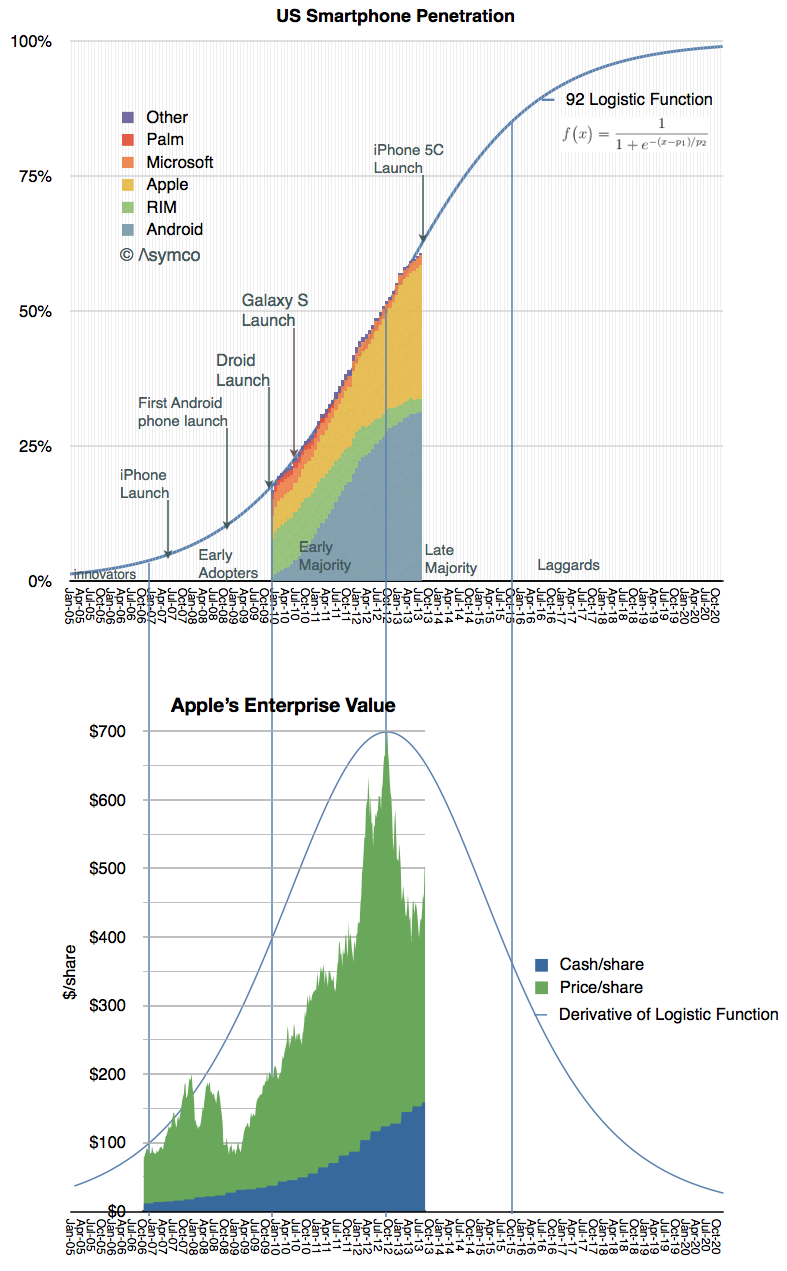
Screen Shot 2013-10-17 at 10-17-4.01.35 PMThe iPhone seems, by one analysis, to be a proxy for the smart phone business, at least in terms of smart phone adoption.


iPad Drives 81% of U.S. Tablet Data Consumption

Apple iPad drives 81 percent of U.S. tablet data traffic, according to Chitika. 

North America Mobile Data Forecast: At Inflection Point

If analysts at Information Gatekeepers are correct, North American mobile data traffic has just hit a key inflection point. 

Monday, October 21, 2013

When "Carrier Class" is a Bad Idea

By definition, an Internet service provider cannot offer service to users who cannot afford to pay very much unless that ISP's costs also are low, even if that ISP might have other revenue streams than direct subscription or usage fees. 

Over the past decade, that has lead many smaller ISPs, serving hard to reach populations, to build and operate networks that are not "carrier class," on purpose. The reason is simple: carrier class networks would cost enough that end user costs could not be kept at reasonable levels.

That will be an even-tougher challenge in many parts of the world where monthly cash income is low enough that people can not afford to pay much more than cents a day. 

That is one problem Google's Project Loon is trying to solve, using some principles similar to low earth orbit satellite fleets. A LEO satellite fleet moves constantly through the sky, requiring tracking satellite dishes. 

As you might guess, that is too expensive for low-cost ISP service in many  to reach, low income areas around the world. So Project Loon is testing fleets of wind-blown balloons.

This is an early earth station, or antenna. Some of you won't be surprised if inside is found a Ubiquiti radio, which has become a mainstay of the wireless ISP business. 

Sometimes, people talk about "carrier class" as a good thing, and it is, in many communications contexts. Just as certainly, "carrier class" is not a good thing when a key objective is to provide service at historically low costs. 

When that is the objective, "carrier class" networks are in fact precisely what is not wanted. 

Despite the service issues that represents, "carrier class" also imposes cost. So one design foundation, for ISPs truly wanting to serve "underserved populations," is not to build carrier class networks, with all the reliability issues that will come with that approach.  

Goldens in Golden

There's just something fun about the historical 2,000 to 3,000 mostly Golden Retrievers in one place, at one time, as they were Feb. 7,...