Saturday, December 7, 2013

Video Traffic is Moving from "North-South" to "East-West"

A recent Bell Labs study forecasts total metro traffic will increase 560 percent by 2017, largely driven by IP video and the increasing adoption of cloud/data center services and applications.


IP video and data center (DC)/cloud traffic are the largest drivers for growth. According to the study, metro video traffic (including subscription TV and Internet video) will increase 720 percent.


Metro cloud and data center traffic will increase 440 percent by 2017, the study predicts.


As the demand for video content increases, video caching is now being implemented within metro networks, moving content caching deeper into the network.


As a direct consequence, traffic between data centers in metro areas will grow, keeping much traffic off the backbone networks. That’s a significant change.


Until recently, metro traffic had a “north-south” flow from a content source to the end user with content sources typically located at a national central location and delivered over the wide area
backbone network.


But there is a change coming, Alcatel-Lucent says. The north-south flows increasingly will be replaced by “east-west traffic  flows for traffic flows from data center to data center, increasingly located within metro centers.

There are revenue implications for providers of high-capacity metro networks.

Friday, December 6, 2013

Rare Earth Elements Underpin Modern Electronics, and Really are Rare

Rare earth elements really are rare, in the sense that replacements are difficult to non-existent, according to a study. Rare earth elements are used in smart phones and other modern electronics. 

In looking at substitution potential for 62 different metals, researchers found that, for a dozen different metals, the potential substitutes for their major uses are either inadequate or appear not to exist at all.

Those 12 elements are rhenium, rhodium, lanthanum, europium, dysprosium, thulium, ytterbium, yttrium, strontium, thallium, magnesium, and manganese.

Further, for not one of the 62 metals are exemplary substitutes available for all major uses.


U.S. Auction of Broadcast TV Spectrum by Mid-2015?

Sometime in 2015, the U.S. Federal Communications Commission hopes most TV broadcasters will be willing to sell their analog 600 MHz TV spectrum back to the government, allowing the FCC to hold a separate auction where U.S. mobile service providers can buy that spectrum.

"I believe we can conduct a successful auction in the middle of 2015," says Tom Wheeler, Federal Communications Commission chairman.

Since 2012, when the Federal Communications Commission voted to launch the
incentive auction process, the United States has been the first nation in the world to implement a new auction process to repurpose broadcast television spectrum for mobile broadband use.

The auction will actually have two linked auctions. In the initial “reverse auction” phase, TB broadcasters will submit bids to give up their 6 MHz channels, selling the spectrum back to the FCC.

There are some 8,402 total television stations operating in the UHF and VHF UHF and VHF bands which can be sold back to the FCC, each assigned a 6 MHz block of spectrum covering a particular local geographical area.

Then spectrum will be “repacked” by the FCC so that broadcasters not willing to sell their spectrum can continue to operatre.

Finally, the FCC will conduct a traditional "forward" auction in which mobile carriers will bid for the spectrum.
The FCC's proposed band plan calls for 5 MHz blocks of spectrum to be auctioned. The FCC anticipates that there will be 6 MHz guard bands to separate spectrum blocks used by carriers, and that the "white space" between the blocks will be open for unlicensed use. "I believe we can conduct a successful auction in the middle of 2015," says Tom Wheeler, Federal Communications Commission chairman.


Another Cycle of Faulty Predictions and Forecasts is Upon Us

This is the time of year where we start seeing lots of stories about “the year ahead.” At least some of the “what will happen in 2014” predictions will prove reliable, especially those which simply extrapolate from trends already in place.


Far harder are predictions about what might happen in five, ten or 20 years. And yet we are compelled to keep making predictions, sometimes for unworthy reasons, such as when trying to prove to others “how smart we are.”


But lots of firms make a business about predictions, because there is a market for such things, even when the forecasts are unreliable. Just how unreliable is the issue.


Philip Tetlock's Expert Political Judgment: How Good Is It? How Can We Know? found that “specialists are not significantly more reliable than non-specialists in guessing what is going to happen in the region they study.”


Sam L. Savage’s The Flaw of Averages points out that plans based on average assumptions are wrong on average, because uncertainty in life is much more pronounced than people generally assume to be the case.


Nassim Talib’s The Black Swan likewise deals with the powerful impact of unpredictable and unexpected developments.


In fact, some would go so far as to say that forecasts always are wrong. That isn’t necessarily a bad thing, as minor fluctuations along a predicted trend line nearly always happen. That is true of most economic forecasting, some argue.


What is important is the trend line, not the actual results that fluctuate around a trend line.


The bigger problem is when a forecast trend fails to materialize at all, has far-lower magnitude than expected or fails to conform to a forecast timeline.


In other words, there are bigger problems when a forecasted series of events fail to happen at all, represents a much-smaller change than expected, or takes significantly longer to occur than expected.


In such cases, whole companies or industries fail to develop, fail to have big consequences and impact or happen too far in the future to have immediate practical consequences.


Forecasts nearly always become less accurate the farther into the future one predicts. One might suggest a logical reason for that failure: we tend to extrapolate present trends into the future, when history suggests different assumptions of unclear dimensions will operate in the future.


Granted, there arguably is a difference between “forecasting,” the attempt to identify ranges of possibilities and “prediction,” the attempt to describe with certitude a future event or set of events.


In practice, the dividing line is likely arbitrary and porous. The future is nearly impossible to predict, and at risk of great, sometimes fundamental error, even when forecasting.

All that said, get ready for the “2014 predictions.” And that isn't a prediction! It's an observation!

Regulators in Mexico, Brazil Act to Spur Competition in Mobile Markets

Regulators in Mexico and Brazil are taking steps they hope will increase the amount of competition in mobile communications markets.

In Mexico, where a brand-new regulatory authority has been created, and where intent to intervene in the communications and television markets has been clear, the Federal Telecommunications Institute (IFT) has notified America Movil that it will be investigated as part of IFT’s examination of market dominance in telecom and TV broadcasting.

Since America Movil has 70 percent market share, the investigation undoubtedly will find that America Movil is a “dominant provider,” and then will face restrictions intended to benefit competitors, in both fixed line and mobile realms.

Actions could range from regulating America Movil more heavily than its rivals, forcing America Movil to unbundle its network or sell assets.

In fact, asset sales already are on the agenda in Brazil, where the Brazilian antitrust authority Cade has ruled that Spain's Telefonica, which owns stakes in two firms operating in the Brazil mobile market, must sell its stakes in TIM Participações SA or seek a new partner for Vivo, Brazil's largest mobile phone carrier and part of Telefonica Brasil.

Cade believes Telefonica, which generates most of its growth from South America, has
too much market share, and is acting to force Telefonica to reduce its presence, since Telefonica has equity stakes in two of the four leading mobile service providers in Brazil.

Telefonica owns all of Vivo and has indirect ownership of TIM Participacoes.
At the moment, Vivo and TIM Participacoes have more than 50 percent market share in the Brazil mobile market.

Vivo has 29 percent share of subscribers, TIM has 27 percent, America Movil has 25 percent and Oi has 19 percent.

Telefonica owns 66 percent of the firm that in turn owns 22.4 percent of Telecom Italia, which further owns TIM Participacoes.

Cade also does not want the number of competitors in the Brazil mobile market to be reduced.

That might prohibit America Movil, Oi and Vivo making a joint bid, then breaking up TIM Participacoes between them. That might suggest an opportunity for a new contestant to enter the Brazil mobile market.

Thursday, December 5, 2013

Two Views on Bitcoin

Bitcoin is a store of value, a method of payment and a virtual currency. It's also the subject of rather rampant speculation and some opposition, at the moment.

China's central bank has banned financial institutions from trading the emerging currency, while Bank of America Merrill Lynch, in its first research report on Bitcoin, said the currency has potential to become a "major means" of payment.

The People's Bank of China said in a statement on its website that Bitcoin isn't a currency with "real meaning" and that its legal status was different from other currencies.

Mobile Broadband will be 81% of Total Broadband in Emerging Markets by 2016

 By 2016, mobile broadband will represent 81 percent of broadband connections in emerging markets, according to Qualcomm.


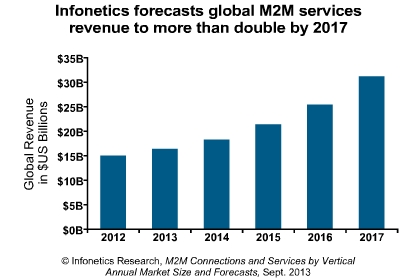
M2M Might Represent 6% of Global Mobile Connections by 2017


Virtually all observers concede that machine-to-machine mobile connections are growing.

The big question is how much growth will happen, and how much revenue M2M will contribute.

By 2017, machine-to-machine links will account for about 17 percent of global mobile data traffic, according to Deloitte analysts.

Berg Insights predicts M2M connections will grow at a compound annual growth rate of 24.4 percent to reach 489.9 million connections in 2018. 

If there are 8.5 billion total mobile connections by 2017, M2M would represent perhaps six percent of global mobile connections.

Chinese iPhone Buyers are Not "Average"

Can Apple succeed in the China market with its strategy of selling primarily in the "premium" segment of the handset market?

Though some doubt it, others think the strategy will work.

Doubters tend to point to low "average" income.

Mean (arithmetic average) and median (half of instances higher, half of instances lower) metrics do suggest something about the amount of income earned by residents in a country, but are not as helpful in illustrating the range of income earned either by individuals or households.

That is significant for sellers of luxury goods, of course, and are key to Apple’s hopes in China, where the Apple iPhone will be a pricey option. Some argue that most consumers will not be able to easily afford an iPhone, since Apple has not released a “low cost” iPhone.

That is not the point, others might say. Apple is pinning its hopes on a segment of the market that can afford the device, and will count on the income of potential buyers in the upper deciles of income distribution in China.

In China, income distribution, if not magnitude, is rather well correlated with income distribution in the United States, for example.

In one measure of income data, looking at the number of individuals whose incomes fall within a specified range of the average gross income of all individuals aged 15+ in that country or region, China and the United States are similar.

In China, 36 percent of people had incomes 200 percent above average, compared to 40 percent in the United States, for example.

Most significantly, the middle class in China, as elsewhere in the developing world, continues to expand in absolute terms.

Amit Daryanani of RBC Capital Markets estimates Apple will see an additional $9 billion to $10 billion in annual revenue added from a deal with China Mobile, for example.

By some measures, an iPhone could cost 10 percent of annual income in China. But that's the point: Chinese iPhone buyers will not have "average" income.

Wednesday, December 4, 2013

VoLTE Will Help Mobile Service Providers Shut Down 2G and 3G Networks

The launch of Voice-over-LTE (VoLTE) services by major carriers first in South Korea and soon in the United States is part of the effort to move voice calls from the circuit switched 2G and 3G networks to the packet switched LTE networks.

That will have important implications for suppliers of VoLTE platforms, ranging from infrastructure providers to handset suppliers.

“For CDMA operators such as Verizon, aggressive LTE deployment is necessary because a VoLTE call cannot fall back to the circuit switched domain,” said Ying Kang Tan, research associate at ABI Research. “Even for WCDMA operators like AT&T, it makes sense to do likewise because LTE is much more spectral efficient than WCDMA.”

But enabling VoLTE also makes possible spectrum refarming, making it easier for mobile service providers to turn off 2G networks and use that spectrum for more 4G capacity.

As such, by the end of 2014, when VoLTE has gained more momentum, ABI Research expects more than 93 percent of the North American population to have access to LTE, for example.

“In 2014, LTE handset shipments in Asia-Pacific and North America—the two largest handset markets—will grow by 28 percent and 25 percent  to reach 150 million and 81 million respectively,” said Jake Saunders, VP and practice director of the LTE Research Service.

New FCC Chairman Distinguishes Between "No Blocking" and "Quality of Service," It Seems

One clear difference of opinion about U.S. Internet policy is whether content delivery networks are an impermissible violation of the rule that users must be able to access and use all lawful applications on the Internet.

Content delivery networks are standard on the back end of the access market, allowing application owners to pay other firms to minimize latency. 


The issue has been whether it also is permissible to allow firms or end users to take similar measures to minimize latency and improve end user experience.


Blocking is not the issue. Methods of providing enhanced user experience, without any blocking, are the issues. 


Anti-competitive behavior is a potential problem, as if an ISP minimized latency for its own services, but would not allow it for competing services.


But the FCC seems keenly aware of such dangers, as does the Department of Justice. 


Also, business users already can buy services that support latency reduction. The issue is whether consumers can receive any similar quality of service support. 


New F.C.C. Chairman Tom Wheeler seems to affirm both the "Open Internet" rules, which forbid Internet service providers from favoring their own content or paid content when allowing data to flow through their system, as well as quality assurance mechanisms, though.


Wheeler said variable pricing and service plans represented the effects of competition. “We might see a two-sided market,” where a company like Netflix might pay an Internet service provider to guarantee that Netflix customers get the best available transmission speeds.


It's more than a nuance. At the moment, it is among the key dividing lines between supporters and opponents of such latency-reducing measures. 


Strand Consult has analyzed this debate and its stakeholders and presents the 30 arguments that net neutrality supporters will likely use to further their position. The 30 arguments are:

  1. Neutrality (or “openness”) is an original, deliberate, and essential feature of the internet.
  2. The end to end principle is responsible for internet innovation.
  3. Zero is a fair price for content delivery, and it was established early in the development of the commercial internet.
  4. The internet needs regulation to keep it neutral and to preserve its many fine features.
  5. Net neutrality is common carriage.
  6. Net neutrality is free speech.
  7. Without net neutrality there will be no innovation
  8. Without net neutrality there will be no democracy
  9. Operators' networks consist of smart edges and a dumb core. The operator's job is to deliver the bits.
  10. The internet is a human right.
  11. The internet is a public good and therefore should be regulated like a utility. Internet service should be free, meaning subsidized by the government.
  12. All content is equal or a bit is a bit is a bit.
  13. Consumers value all content the same, and more content is better.
  14. There should be the same internet available on every device.
  15. Applications don’t create traffic; users create traffic.
  16. The leaders of the net neutrality movement have good and right on their side.
  17. Consumers care about net neutrality, and the net neutrality activists are their voice.
  18. Net neutrality is needed because of vertical integration in the market for content and internet access.
  19. There is a lot of evidence proving that network management practices harm customers.
  20. Operators want to harm their customers, and only preventive measures will keep them in check.
  21. Operators want to block or throttle competing services.
  22. Operators want to use price discriminate to exploit their customers.
  23. Operators want to make agreements to preference certain content on the web.
  24. Operators will use pricing to create fast lanes and dirt roads for internet access.
  25. Operators will use deep packet inspection to exploit their customers.
  26. Operators only invest because of the growth in applications and content.
  27. Operators should just build infrastructure, and more infrastructure is better.
  28. Operators have always invested in infrastructure, and they always will
  29. All broadband providers, whether cable or telco, should be classified as common carriers and their obligations increased.
  30. Net neutrality is a human rights issue, not an economic issue.

Windstream Isn't the Company It Used to Be

Sometimes, a company has to enter new markets to survive the maturation of its older business. Windstream provides an example, as it is not the “rural telco” it was in 2006. Today, it is something closer to a “competitive local exchange carrier,” earning the bulk of its revenue from business customers.

Sure, Windstream now is more a “national” provider, where it used to be a “regional” service provider. But the big change is where it derives its revenue. In the past, it has made most of its money from rural consumers. Now, it makes most of its money from business segment customers, increasingly in instances where it does not own or operate full facilities-based access networks.

In fact, both Windstream and Frontier Communications, another firm whose legacy business could aptly be described as “rural consumers,” now make a majority of revenue from the business customer segment.


More Trouble for 4G LTE Investment Models

Will fourth generation Long Term Evolution profit margins be sacrificed to speed mobile operator growth? It already is, in some instances.

You know what that means: increased difficulty for the 4G LTE investment decision, in some instances.

French mobile service provider Free Mobile has added an LTE 4G high-speed broadband service to its Free Mobile package without raising the price, in a market where its chief rivals charge a premium for using the 4G network.

Iliad says its monthly Free Mobile subscription remains unchanged at 19.99 euros a month including 4G, without a long-term contract.

Pressure on LTE profit margins is evident elsewhere as well. EE in the United Kingdom is bundling unlimited calling and texting when roaming in some European countries on 4G. Without necessarily eliminating a cost premium for using the LTE network, the “no incremental cost roaming” is another way of merchandising the LTE network without directly eliminating a cost premium on recurring service.

Hutchison Whampoa’s “3” in the United Kingdom has added an additional four countries (United States, Indonesia, Sri Lanka, and Macau) to its U.K. “Feel at home” roaming plan which allows United Kingdom-based consumers access to their respective voice and data allowances abroad. These new territories make a total of 11 countries where free roaming is available.

The obvious implication is that 3 is deliberately sacrificing potential revenue to grow its global presence, since roaming fees are a high-margin service, as Free Mobile is using the “no incremental cost” approach to take market share from other mobile operators in France.

The use of free 4G LTE roaming is part of Hutchison Whampoa’s effort to create a bigger global network. Three operates in Indonesia and Sri Lanka, but the U.S. market is the first country offering free roaming where 3 does not have a facilities-based presence.

The “Feel At Home” program  now operates in 11 destinations around the world.

For mobile service providers investing in brand-new LTE networks, the fact that some competitors are willing to offer the new service at no premium over 3G will make the business case for 4G harder.

Half of all Smart Phones Bendable by 2019?

Some 40 percent of smart phones will be curved and bendable by the end of the decade, says Ramchan Woo,  head of the LTE Product Planning Division at the LG Electronics Mobile Communications Company.

Bendbles might not necessarily be thinner, though one suspects that is a requirement. At the very least, bendables should vastly reduce the number of cracked screens we seem to see these days. 

Why Word of Mouth is Essential for Really Big Companies

The converntional wisdom is that positive and enthusiastic word of mouth (people referring other people to a specific product) is helpful for any supplier of goods and services.

Some might argue world of mouth is the only a way a successful company becomes a huge company. The reason, as often is the case, is scale. 

When a company is small, marketing or advertising arguably can drive usage growth. But eventually, a firm gets so big that it simply can't spend enough money to have an impact.

At that point, only word of mouth recommendations make a difference in sales volume. 

True, the product has to be useful, priced right and of sufficient quality to make it "better" than other alternatives. Still, it is a useful insight: a very-large company is in the hands of its users, where it comes to marketing, even if a small company can affect sales by marketing.

It's Actually Too Early to See Widespread AI Productivity Gains

“Today, you don’t see AI in the employment data, productivity data or inflation data,” says Torsten Slok , Apollo chief economist. “Similar...