Sunday, December 8, 2013

Enterprise Customers Say More Cloud, More Consolidation of Service Providers was Trend in 2013

Moving applications to the cloud and providing more mobility support for an enterprise's customers are the two notable emphases for respondents to a Forrester Research survey. 

Among the bigger changes is attitudes toward cloud-based apps, up sharply. That suggests stronger markets for cloud-based hosting services and bandwidth, if the trend holds up in 2014.

Also notable was the significantly higher interest in consolidating communications suppliers. Look for more supplier churn, if that trend continues. 

Nearly as big a change is the desire to consolidate or change equipment suppliers, as well. 


Does the Telecom Industry have a Life Cycle?

Though the roster of contestants within any industry changes over time, few entire industries actually disappear.

Much depends on how one defines "industry." One might argue that the computing industry has gotten bigger over time, even though the "mainframe," minicomputer" and now "personal computer" segments have declined.

One might ask the same about the telecommunications industry.

In some ways, the question seems odd.

Over nearly every time period, global telecom revenue grows. The only possible exceptions were the years 1929 and 2001, but even there the dips were relatively slight.

For that reason, many consider telecommunications “recession proof,” a theory that was tested in 2000 and 2008. For the most part, aggregate revenue remained fairly stable, though there were some changes in composition of revenues.

And that generally remains the present revenue trend, where annual revenue, on a global basis, grows about 2.7 percent.

That, however, is a secular trend that was in place before the recessions, so the actual impact of specific recession-induced changes is hard to measure.

So while revenue growth might slow, the 2008 global recession did not halt revenue growth. The impact of the Great Recession beginning in 2008 is easy enough to describe. According to TeleGeography Research, revenue growth  slipped from about seven percent annually to one percent in 2009, returning to about three percent globally in 2011.

To be sure, growth prospects vary between regions. In fact, growth in Western Europe has gone negative, perhaps the first time in history that communications revenue actually has seen a declining trend.

The point is that any particular telecom product or service has a life cycle. The bigger question is whether telecommunications, as an industry, also has a life cycle. That does not necessarily require that people “stop communicating.”

The issue is whether the presently-constituted communications industry represents the way people do those things, in the future, or to the same magnitude.

Glimmers can be seen in the role cable TV companies now have assumed in the communications business.

Whether “communications revenue” earned by the cable TV industry has shifted to “another industry,” or whether cable TV providers simply have become part of the communications industry, is a judgment call.

From a telecom service provider’s perspective, it does not really matter how one classifies the revenue and market share. Telecom providers have lost revenue and market share to new providers, across the consumer and business segments, and across the voice and data services markets.

To be sure, telcos have compensated by earning new video entertainment revenues and by making the formerly distinct “mobile communications” business a core part of the telecommunications business.

So the question of industry life cycle is no mere speculation. Can a telco go bankrupt? A few already have, though so far no former incumbent telco has literally disappeared altogether.

But it remains an open question, albeit not a major issue, whether the way communications services and access will be provided exclusively by today’s telcos, cable TV companies and other access providers in the future.

Google Fiber poses the challenge in somewhat concrete terms. Again, one can argue that revenues earned by Google Fiber are simply “communications revenues” earned by a new provider in the traditional business.

But one might also argue that Google Fiber might eventually be something else, namely part of a shift of the traditional access business to a new industry.

It’s a bit of a stretch to label Google Fiber access or video entertainment revenues as “application” revenues. Google’s advertising revenues generally are measured as a distinct business from that of communications access.

But the boundaries are getting porous, as Google manufactures and sells mobile devices and Internet access as supports for its application and ad revenues business.

Indian Mobile Market Illustrates Key Principle About Retail Pricing

This chart of subscribers and price per unit in the Indian communications market illustrates a principle that economists always point out: when the price of a desired product goes down, demand goes up (the reverse also is a key principle).

Economic rules apply in telecom, no less than in other markets.


History of Indian Telecom

Why Sprint is Certain to Launch a Price War

SoftBank cut retailer fees 35 percent to defend its small merchant point of sale service, operated with PayPal, from an attack by rival Square.

In October of 2003, SoftBank had launched a price war with Rakuten, Japan’s biggest Internet mall, by cutting fees for merchants to use SoftBank's online shopping portal. 


Those moves are consistent with SoftBank's approach to pricing for mobile service. SoftBank, it is fair to say, surprised the two larger Japanese mobile firms when it launched a price war upon acquiring Vodafone's Japan business, which had struggled to get market share.

Since 2006, SoftBank has maintained it always would offer lower prices than the other carriers.

So many believe Sprint will do so as well, once SoftBank has put all the necessary pieces into place in the U.S. market.

T-Mobile US already is attacking the market with lower prices, and seems to be taking market share primarily from AT&T.

A Scary Bit of History

This is a scary chart, not that history repeats. And then there is the opposite view. We might hope for the latter, as much as we fear the former.

 Be careful out there.

Saturday, December 7, 2013

Video Traffic is Moving from "North-South" to "East-West"

A recent Bell Labs study forecasts total metro traffic will increase 560 percent by 2017, largely driven by IP video and the increasing adoption of cloud/data center services and applications.


IP video and data center (DC)/cloud traffic are the largest drivers for growth. According to the study, metro video traffic (including subscription TV and Internet video) will increase 720 percent.


Metro cloud and data center traffic will increase 440 percent by 2017, the study predicts.


As the demand for video content increases, video caching is now being implemented within metro networks, moving content caching deeper into the network.


As a direct consequence, traffic between data centers in metro areas will grow, keeping much traffic off the backbone networks. That’s a significant change.


Until recently, metro traffic had a “north-south” flow from a content source to the end user with content sources typically located at a national central location and delivered over the wide area
backbone network.


But there is a change coming, Alcatel-Lucent says. The north-south flows increasingly will be replaced by “east-west traffic  flows for traffic flows from data center to data center, increasingly located within metro centers.

There are revenue implications for providers of high-capacity metro networks.

Friday, December 6, 2013

Rare Earth Elements Underpin Modern Electronics, and Really are Rare

Rare earth elements really are rare, in the sense that replacements are difficult to non-existent, according to a study. Rare earth elements are used in smart phones and other modern electronics. 

In looking at substitution potential for 62 different metals, researchers found that, for a dozen different metals, the potential substitutes for their major uses are either inadequate or appear not to exist at all.

Those 12 elements are rhenium, rhodium, lanthanum, europium, dysprosium, thulium, ytterbium, yttrium, strontium, thallium, magnesium, and manganese.

Further, for not one of the 62 metals are exemplary substitutes available for all major uses.


U.S. Auction of Broadcast TV Spectrum by Mid-2015?

Sometime in 2015, the U.S. Federal Communications Commission hopes most TV broadcasters will be willing to sell their analog 600 MHz TV spectrum back to the government, allowing the FCC to hold a separate auction where U.S. mobile service providers can buy that spectrum.

"I believe we can conduct a successful auction in the middle of 2015," says Tom Wheeler, Federal Communications Commission chairman.

Since 2012, when the Federal Communications Commission voted to launch the
incentive auction process, the United States has been the first nation in the world to implement a new auction process to repurpose broadcast television spectrum for mobile broadband use.

The auction will actually have two linked auctions. In the initial “reverse auction” phase, TB broadcasters will submit bids to give up their 6 MHz channels, selling the spectrum back to the FCC.

There are some 8,402 total television stations operating in the UHF and VHF UHF and VHF bands which can be sold back to the FCC, each assigned a 6 MHz block of spectrum covering a particular local geographical area.

Then spectrum will be “repacked” by the FCC so that broadcasters not willing to sell their spectrum can continue to operatre.

Finally, the FCC will conduct a traditional "forward" auction in which mobile carriers will bid for the spectrum.
The FCC's proposed band plan calls for 5 MHz blocks of spectrum to be auctioned. The FCC anticipates that there will be 6 MHz guard bands to separate spectrum blocks used by carriers, and that the "white space" between the blocks will be open for unlicensed use. "I believe we can conduct a successful auction in the middle of 2015," says Tom Wheeler, Federal Communications Commission chairman.


Another Cycle of Faulty Predictions and Forecasts is Upon Us

This is the time of year where we start seeing lots of stories about “the year ahead.” At least some of the “what will happen in 2014” predictions will prove reliable, especially those which simply extrapolate from trends already in place.


Far harder are predictions about what might happen in five, ten or 20 years. And yet we are compelled to keep making predictions, sometimes for unworthy reasons, such as when trying to prove to others “how smart we are.”


But lots of firms make a business about predictions, because there is a market for such things, even when the forecasts are unreliable. Just how unreliable is the issue.


Philip Tetlock's Expert Political Judgment: How Good Is It? How Can We Know? found that “specialists are not significantly more reliable than non-specialists in guessing what is going to happen in the region they study.”


Sam L. Savage’s The Flaw of Averages points out that plans based on average assumptions are wrong on average, because uncertainty in life is much more pronounced than people generally assume to be the case.


Nassim Talib’s The Black Swan likewise deals with the powerful impact of unpredictable and unexpected developments.


In fact, some would go so far as to say that forecasts always are wrong. That isn’t necessarily a bad thing, as minor fluctuations along a predicted trend line nearly always happen. That is true of most economic forecasting, some argue.


What is important is the trend line, not the actual results that fluctuate around a trend line.


The bigger problem is when a forecast trend fails to materialize at all, has far-lower magnitude than expected or fails to conform to a forecast timeline.


In other words, there are bigger problems when a forecasted series of events fail to happen at all, represents a much-smaller change than expected, or takes significantly longer to occur than expected.


In such cases, whole companies or industries fail to develop, fail to have big consequences and impact or happen too far in the future to have immediate practical consequences.


Forecasts nearly always become less accurate the farther into the future one predicts. One might suggest a logical reason for that failure: we tend to extrapolate present trends into the future, when history suggests different assumptions of unclear dimensions will operate in the future.


Granted, there arguably is a difference between “forecasting,” the attempt to identify ranges of possibilities and “prediction,” the attempt to describe with certitude a future event or set of events.


In practice, the dividing line is likely arbitrary and porous. The future is nearly impossible to predict, and at risk of great, sometimes fundamental error, even when forecasting.

All that said, get ready for the “2014 predictions.” And that isn't a prediction! It's an observation!

Regulators in Mexico, Brazil Act to Spur Competition in Mobile Markets

Regulators in Mexico and Brazil are taking steps they hope will increase the amount of competition in mobile communications markets.

In Mexico, where a brand-new regulatory authority has been created, and where intent to intervene in the communications and television markets has been clear, the Federal Telecommunications Institute (IFT) has notified America Movil that it will be investigated as part of IFT’s examination of market dominance in telecom and TV broadcasting.

Since America Movil has 70 percent market share, the investigation undoubtedly will find that America Movil is a “dominant provider,” and then will face restrictions intended to benefit competitors, in both fixed line and mobile realms.

Actions could range from regulating America Movil more heavily than its rivals, forcing America Movil to unbundle its network or sell assets.

In fact, asset sales already are on the agenda in Brazil, where the Brazilian antitrust authority Cade has ruled that Spain's Telefonica, which owns stakes in two firms operating in the Brazil mobile market, must sell its stakes in TIM Participações SA or seek a new partner for Vivo, Brazil's largest mobile phone carrier and part of Telefonica Brasil.

Cade believes Telefonica, which generates most of its growth from South America, has
too much market share, and is acting to force Telefonica to reduce its presence, since Telefonica has equity stakes in two of the four leading mobile service providers in Brazil.

Telefonica owns all of Vivo and has indirect ownership of TIM Participacoes.
At the moment, Vivo and TIM Participacoes have more than 50 percent market share in the Brazil mobile market.

Vivo has 29 percent share of subscribers, TIM has 27 percent, America Movil has 25 percent and Oi has 19 percent.

Telefonica owns 66 percent of the firm that in turn owns 22.4 percent of Telecom Italia, which further owns TIM Participacoes.

Cade also does not want the number of competitors in the Brazil mobile market to be reduced.

That might prohibit America Movil, Oi and Vivo making a joint bid, then breaking up TIM Participacoes between them. That might suggest an opportunity for a new contestant to enter the Brazil mobile market.

Thursday, December 5, 2013

Two Views on Bitcoin

Bitcoin is a store of value, a method of payment and a virtual currency. It's also the subject of rather rampant speculation and some opposition, at the moment.

China's central bank has banned financial institutions from trading the emerging currency, while Bank of America Merrill Lynch, in its first research report on Bitcoin, said the currency has potential to become a "major means" of payment.

The People's Bank of China said in a statement on its website that Bitcoin isn't a currency with "real meaning" and that its legal status was different from other currencies.

Mobile Broadband will be 81% of Total Broadband in Emerging Markets by 2016

 By 2016, mobile broadband will represent 81 percent of broadband connections in emerging markets, according to Qualcomm.


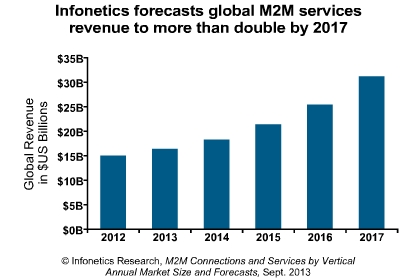
M2M Might Represent 6% of Global Mobile Connections by 2017


Virtually all observers concede that machine-to-machine mobile connections are growing.

The big question is how much growth will happen, and how much revenue M2M will contribute.

By 2017, machine-to-machine links will account for about 17 percent of global mobile data traffic, according to Deloitte analysts.

Berg Insights predicts M2M connections will grow at a compound annual growth rate of 24.4 percent to reach 489.9 million connections in 2018. 

If there are 8.5 billion total mobile connections by 2017, M2M would represent perhaps six percent of global mobile connections.

Chinese iPhone Buyers are Not "Average"

Can Apple succeed in the China market with its strategy of selling primarily in the "premium" segment of the handset market?

Though some doubt it, others think the strategy will work.

Doubters tend to point to low "average" income.

Mean (arithmetic average) and median (half of instances higher, half of instances lower) metrics do suggest something about the amount of income earned by residents in a country, but are not as helpful in illustrating the range of income earned either by individuals or households.

That is significant for sellers of luxury goods, of course, and are key to Apple’s hopes in China, where the Apple iPhone will be a pricey option. Some argue that most consumers will not be able to easily afford an iPhone, since Apple has not released a “low cost” iPhone.

That is not the point, others might say. Apple is pinning its hopes on a segment of the market that can afford the device, and will count on the income of potential buyers in the upper deciles of income distribution in China.

In China, income distribution, if not magnitude, is rather well correlated with income distribution in the United States, for example.

In one measure of income data, looking at the number of individuals whose incomes fall within a specified range of the average gross income of all individuals aged 15+ in that country or region, China and the United States are similar.

In China, 36 percent of people had incomes 200 percent above average, compared to 40 percent in the United States, for example.

Most significantly, the middle class in China, as elsewhere in the developing world, continues to expand in absolute terms.

Amit Daryanani of RBC Capital Markets estimates Apple will see an additional $9 billion to $10 billion in annual revenue added from a deal with China Mobile, for example.

By some measures, an iPhone could cost 10 percent of annual income in China. But that's the point: Chinese iPhone buyers will not have "average" income.

Wednesday, December 4, 2013

VoLTE Will Help Mobile Service Providers Shut Down 2G and 3G Networks

The launch of Voice-over-LTE (VoLTE) services by major carriers first in South Korea and soon in the United States is part of the effort to move voice calls from the circuit switched 2G and 3G networks to the packet switched LTE networks.

That will have important implications for suppliers of VoLTE platforms, ranging from infrastructure providers to handset suppliers.

“For CDMA operators such as Verizon, aggressive LTE deployment is necessary because a VoLTE call cannot fall back to the circuit switched domain,” said Ying Kang Tan, research associate at ABI Research. “Even for WCDMA operators like AT&T, it makes sense to do likewise because LTE is much more spectral efficient than WCDMA.”

But enabling VoLTE also makes possible spectrum refarming, making it easier for mobile service providers to turn off 2G networks and use that spectrum for more 4G capacity.

As such, by the end of 2014, when VoLTE has gained more momentum, ABI Research expects more than 93 percent of the North American population to have access to LTE, for example.

“In 2014, LTE handset shipments in Asia-Pacific and North America—the two largest handset markets—will grow by 28 percent and 25 percent  to reach 150 million and 81 million respectively,” said Jake Saunders, VP and practice director of the LTE Research Service.

AI is Solow Paradox at Work

An analysis of 4,500 work-related artificial intelligence use cases suggests we are only in the very-early stages of applying AI at work a...