Wednesday, January 1, 2014

One More Example of How Internet Apps Can Grow ISP Revenue

With the caveat that a mobile or fixed network Internet access provider has to be able to charge for greater consumption by end users, Internet apps possibly have harmed telecom revenue less than imagined.


In fact, even cannibalization of text messaging by over the top services might not be as big a hit to revenue (globally), as often is assumed.


A shift to greater amount of video streaming actually should help Internet service provider revenues, assuming some rather direct correlation between consumption and revenue is possible.


For the sake of argument, assume a household shifts consumption from a linear video TV subscription to some form of online delivery.


Ignore for the moment any revenue the Internet service provider can earn from providing TV content that once was consumed using a cable TV, satellite TV or telco TV connection, and focus only on the impact on purchased Internet access service.


Assume a one-hour TV show streamed to a TV requires 1GB at standard definition, and 2 GB, for an hour of HDTV. Assume you are a typical users and consume five hours of video a day. Assume half your consumption if HDTV and half is standard definition.


That implies 75 hours of standard definition TV consumed per person per month. At 1 GB per hour, that’s 75 GB of data. The 75 hours of HDTV represent 150 GB of data consumption, for a total of about 225 GB of data consumption a month, for linear entertainment television.


That might not be an issue for a single-person household with a monthly usage allowance of 300 GB. Assume the monthly cost is about $70 for such a plan.


The math gets tricker for multiple-person households, especially if many users are watching different programs. But the revenue logic is simple enough. If two residents watch five hours a day of TV, and that consumption is shifted (for the sake of argument) to online delivery, then that household has to buy an access plan with a bigger data allowance, to account for the 450 GB of video consumption by the household.


As this one example illustrates, demand for Internet apps drives enough incremental usage that one might argue the Internet sometimes directly drives ISP revenue.

It’s complicated, but not quite a zero-sum game, as some might fear.

How Much Text Messaging Cannibalization, Really?

Following up on the issue of how much the Internet has harmed telecom revenues, the amount of revenue destruction is rather complicated. While most wouild agree that some amount of telecom service provider revenue from voice and text messaging has been disrupted by over the top alternatives, the net revenue impact has to be balanced by creation of new revenue streams directly created by end user use of the Internet.

For example, Portio Research questions the actual amount of lost revenue. While in some markets over the top messaging presumably does cannibalize significant text messaging revenue, in other markets, where mobile Internet access is not widespread, dramatic growth of mobile adoption means more text messaging revenue is being created.

“During 2012 and 2013 we have seen many reports that operators are losing $20 billion to $30 billion in SMS revenue to OTT messaging apps,” said Karl Whitfield, a director at Portio Research. “We see reports that OTT traffic will be double that of SMS by the end of 2013,” he says. “This is wrong on both counts.”

It may be true that SMS revenues are levelling off and that OTT is on the rise, but SMS is still generating revenues of $15.3 million per hour, 24/7, that’s a massive $133.8 billion in 2013, Whitfield says.

Over the top apps generate about $3 million an hour, by way of comparison.

Worldwide SMS revenue has gone up year after year since the early 1990s and will continue to be above 2010 levels until 2017, Whitfield said.

In fact, in some markets, SMS and OTT apps are coexisting, serving end users in different ways.

There is a huge uptake of OTT messaging in Japan, particularly with local player LINE, yet the SMS market remains healthy and stable, he says.

The same goes for South Korea, where KakaoTalk is enjoying huge success; here again the SMS market remains stable and is not declining as many predicted.

Where SMS has seen a decline, in markets such as Spain and Greece, there has been an overall fall in subscribers and revenues at the same time.

“Our research into mobile messaging completely contradicts what some other industry observers are saying,” said Whitfield.


Global OTT and P2P Messaging Traffic (Billions)


2010
2011
2012
2013F
2014F
2015F
2016F
2017F
P2P SMS
5,812
6,546
6,623
6,687
6,654
6,522
6,304
5,931
OTT Messaging
1,494
3,840
6,774
10,452
14,970
20,437
26,359
32,141

The point is that product substitution, while a fact, might not be as destabilizing a revenue trend as sometimes  believed.

FAA Authorizes Commercial-Drone Testing

Most rather exotic technologies take a while to reach commercial maturation. Artificial intelligence and robotics might provide another example. Though robotics have been a mainstay of manufacturing for 40 years, the extension of more advanced forms of applied artificial intelligence only now seem to reaching a new stage of commercialization.

Google's self-driving cars are one example. A more important development is that the 

U.S, Federal Aviation Administration has selected a handful of universities and state agencies to operate sites for drone testing, in a step toward eventually integrating commercial unmanned aircraft into the U.S. aviation system.


That might begin to happen as early as 2015, some think. That's a huge step forward.

The six operators of test sites for unmanned aircraft include the University of Alaska, the State of Nevada, New York's Griffiss International Airport, the North Dakota Department of Commerce, Texas A&M University - Corpus Christi and Virginia Polytechnic Institute and State University.


None of those tests seem yet to involve commercial applications, instead focusing on how such systems might work, safely. The next big steps will involve apps using such drones.

Economics Does Not Explain Everything Because "Irrational" Behavior Matters

Economics is a discipline rather rare in the public policy arena, including the communications business, at times.

Though political rationality also is at work when policies are created, political rationality ("what can be done; what is possible") is not always quite so rational in terms of how people, firms and markets will change, once any set of policies are implemented.

In fact, it is impossible to know, with certainty, how behavior will change, in unexpected way, once a set of changes is made. That also applies for incentives people have when creating products and services. 

"People can be really smart or have skills that are directly applicable, but if they don’t really believe in it, then they are not going to really work hard," says Mark Zuckerberg, Facebook CEO.

That intangible--commitment--cannot be modeled mathematically. Sometimes forces that cannot be measured or modeled--love, affection, idealism--indeed can shape behavior. At least sometimes, that means impossible things can, at least for a time, become "possible."

So "irrational" behavior sometimes can confound forecasters and predictions. And by "irrational," one does not have to imply "not rational and therefore destructive." Love is irrational, too. Passion and idealism likewise can sometimes cause behaviors we cannot quite anticipate.

If some firms seem to continually outperform others, at least some of the time that is because those organizations have harnessed "irrational" commitments. No bureaucratic structure can fully compensate for that. 

Tuesday, December 31, 2013

New Sprint Nextel Business Offer Might Combine Fixed, Mobile Access

Anybody in the mobile business can attest how expensive and how difficult it is to create differentiation around a mobile brand and offer. Speed, price and coverage tend to be the concrete tactical sources of differentiation. 

Creating value through branding always is more tricky, but Sprint might try something that is interesting, for the small business customer segment. Apparently, Sprint is considering relaunching Nextel as a small business brand, with one interesting twist.

The proposed Nextel offer would combine both fixed broadband access and mobile service, a byproduct of Sprint's ownership of the former "Clear" fixed wireless network. In essence, Sprint would create a fixed network plus mobile service bundle. 

Some might say that only matches what AT&T or Verizon might be able to offer, but perhaps that is the point. In at least some markets, Sprint might be able to compete more effectively in the small business segment with a fixed broadband plus mobile offer, partly offsetting the speed, price and coverage comparisons every potential customer knows are among the potential differences between suppliers. 

How Much has the Internet Harmed the Telecom Business?

Has the Internet harmed the telecom business as much as it apparently has reshaped many other retail and consumer businesses?

You might think the answer is fairly simple. It would, after all, be possible to argue that the Internet has affected virtually every business in a way that reduces friction (and hence distribution cost), provides price transparency (driving prices towards the lowest cost producers) and creates new alternatives to existing services and apps that reduce demand for the legacy apps.

To use the most obvious example, over the top mobile messaging and over the top voice apps have displaced some amount of calling and text messaging, while arguably having the more important impact of reducing or capping prices for legacy services.

Of course, matters are more complicated. The Internet also creates the need for fixed and mobile network data services, which add revenue. So any assessment would have to include actual lost revenue from reduced legacy services, abandonment of services, the effect of stranded investments in legacy infrastructure, higher investment in IP infrastructure and then incremental new revenue based on Internet access.

Even the apparently clearest signs of cannibalization--abandonment of fixed voice lines--are not necessarily the result of Internet substitution, but rather preference for mobile calling. And though it also is possible that some amount of mobile carrier voice will be displaced by Internet calling, the magnitude of the eventual shift is not clear.

And some might argue that even when over the top calling services displace some carrier voice revenue, there are other forms of value that actually increase revenue for service providers.

Based on interviews with executives from 3 in the UK and customer analytics data from 3 and Skype, CCS Insight  concluded that use of Skype provided unexpected benefits for mobile service provider 3 in the United Kingdom.

“While 3 initially aimed to use Skype as a means of differentiation and as an acquisition tool, one of the most significant impacts was to drive up margins, especially through an increase in voice revenue, but also by reducing churn,” CCS Insight argues.

Mobile Skype users generated almost 60 percent more voice revenue than non-users and spent
almost a third more on text messaging than non-users of Skype.

Skype users provided margin uplift of more than 20 percent and regular Skype users churned 14 percent less churn than non-users, CCS Insight argued.

To be sure, it also is possible that heavy or regular users of Skype also use more communication services in general, so whether there is causation or only correlation is tough to say.

For example, in the U.S. market, though telco revenue from fixed voice lines is down, broadband and video entertainment revenues are up. For U.S. cable providers, the loss of video customers has been compensated with growth in Internet access and voice services.

For Verizon, whose third quarter 2013 mass markets revenue was up slightly over the third quarter of 2012, the obvious implication is that video and broadband are driving revenue growth at rates that compensate for losses of traditional voice accounts.

Likewise, AT&T reported third quarter 2013 fixed network consumer revenue growth of 2.4 percent versus the year-earlier period.

Those performances occur against a backdrop of declining demand for fixed voice lines.
Perhaps 39 percent of U.S. households no longer buy fixed voice service, according to the Centers for Disease Control.

The point is that the Internet has had a complex impact on telecommunications revenue. On one hand, it has put pressure on profit margins for legacy voice. At the same time, it has created a brand new market for Internet access in the fixed line business.

In the mobile services business, a similar trend is occurring. Revenue growth in saturated mobile markets now is lead by Internet access revenues.

In other words, the Internet arguably has had both positive and negative revenue implications for service providers.

Monday, December 30, 2013

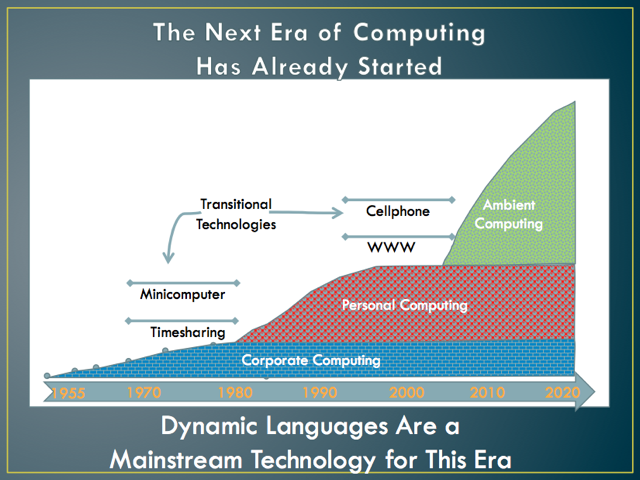
What Device Sales Indicate About Next Era of Computing

If in fact we are moving towards the next era of computing after the “PC era,” it should not come as a surprise that the types of computing devices also are changing. Tablets, which derive much of their value from cloud apps, content and storage, provide one example.

But the best example is a Chromebook, a device that relies nearly exclusively on cloud-based computing to provide value. To a growing extent, smartphones provide value by use of cloud-based content and apps as well.


Virtually everyone might agree that something important in computing architecture is happening, namely the transition from an older ear to a newer era.

Some of us prefer to call the earlier eras of computing “mainframe, minicomputer, PC,” followed by the current era, which seems not to have a universal appellation.

Others might say the eras are “mainframe, personal computer, web era, device era.” Some might specify the eras as corporate, personal, ambient.

Yet others might differentiate computing eras by computing architecture. IBM has spoken of “mainframe, departmental, PC, Internet and Social as earmarks of how enterprises use computing.

The point is that the signature devices in each era are different. Mainframes and minicomputers were used by only a few enterprises. PCs were adopted by consumers. Then came the Internet, and phones became computers. Recently tablets have gotten traction.

So we should not be surprised that devices optimized for the coming era of computing are grabbing more share of computer sales.

The issue is pinning down precisely the main characteristic of the next era of computing, which might be said to include attributes such as ambient usage, based on highly personal devices and relying on cloud resources to provide computing utility.

That would include tablets, smartphones and Chromebooks, to various degrees. Phones are most uniquely personal and ambient, while tablets and especially Chromebooks rely on cloud computing for core functionality.

So whether we emphasize “mobile or ambient,” types of devices or architectures, the elements of ambient and cloud-based would seem central to any description of the coming era.

So sales of cloud-based appliances should grow smartly. NPD Group reports that Chromebooks to commercial customers (not consumers) accounted for 21 percent of all notebook sales, for example, up from negligible share in the prior year, and eight percent of all computer and tablet sales through November 2013. Chromebooks represented just one tenth of a percent of notebook sales in 2012.

By definition, a Chromebook uses a cloud-based computing architecture to provide value.

Tablet sales likewise are an instance of reliance on cloud computing. Tablets represented more than 22 percent of all personal computing device sales sold through the commercial channel through November 2013.

For some of us, the important observation about business customer device sales is the uptick in devices that rely centrally on cloud computing for value. 

Sunday, December 29, 2013

10 things not to buy in 2014

Of the "10 things not to buy in 2014" cited by MarketWatch, cable TV is number one on the list. Ouch.

Landline phone service is number two on the list. Ouch, ouch.

Two-year mobile phone contracts are number six on the list. 

Saturday, December 28, 2013

Net Neutrality is Part of an Older Pattern of Technology and Media Warfare

We sometimes forget how much legal wrangling has occurred as the home video market was born. Sony released the Betamax digital video recorder in 1975. But not until 1984 was its use deemed fully lawful. Only because of that important decision was it possible to later see the rise of Blockbuster Video and Netflix.

It might seem odd, but it once was illegal to “own a copy of a movie.” So the notion of an “at home video market” was nonsensical. All media was consumed either outside the home or using devices that could receive but not store content.

Some level of conflict between proponents of technology and owners of content has been a rather common feature of the content business, though. Cable TV operators were at times denied the riight to import a distant TV signal and show those signals to local customers who could not otherwise get over the air TV service.

Later, the content industry tried to outlaw the rental of videos, music and software. The industry also tried to ban other new technologies, such as the digital audio-tape player, a successor to the analog audio tape player, and otherwise tax and slow the use of blank tapes, conpact discs and CD recorders, music players and digital video recorders.

Sometimes the opposition comes from other sources, though. For some, it might seem obvious that users ought to be able to obtain quality assured Internet apps from a caching site to their homes, as app providers now purchase the same quality assurance features from content delivery networks, or which business customers can buy.

For others the best effort Internet is better since it offers a level playing field, in terms of quality access (the biggest and the smallest app providers face the same challenges delivering quality experiences).

Beyond those differences of views, revenue models are at stake. Struggling to avoid commodity status for their product, ISPs hope to use quality of experience as content owners use image quality (standard definition, high definition, 3D) as ways of differentiating experience.

The helpful byproduct, from an ISP perspective, is the chance to create a new revenue stream or two, in the form of CDN services available to the end user, not simply to a data center. The other potential revenue stream is some optional ability for end users to set their own preferences for delivery of apps, when networks are congested.

In essence, some believe the Internet access service should be “dumb” (best effort only) while others think Internet access service should be “smart” (able to prioritize packets).

There is a bit of a nuance here: ISPs already have the right to manage traffic to maintain quality of service. That is called “network management.”

Telcos have done so routinely, actually blocking end user access when the voice network is overloaded (“I’m sorry, all circuits are busy right now. Please try your call again later.”) So “admission control,” a standard practice in the voice business, has an analogy in the Internet access business.

Some essentially could argue that prioritized packet access somehow defeats the “any to any” nature of the Internet. One hears that argument less these days as the old “any to any” Internet has been abandoned or transformed in many ways. Some country regulators do actually block apps.

And many private apps essentially “block” access to rivals by design. In other words, the Internet might permit anybody to communicate with anybody else. But that doesn’t mean any particular app has to do so.

It might be a bit of an existential argument, but some policies sometimes are necessary or desirable in part because they allow Internet access to exist and flourish. That is the argument made by ISPs who must keep investing in better and faster networks.

People can argue about the amount of market power held by app providers, device makers or ISPs. People can argue about the retail prices or profit margins enjoyed by any of the contestants.

Still, it is a legitimate matter to design and support a viable commercial ecosystem that allows the whole ecosystem to flourish, and differentiated services, features and prices might be a necessary part of that effort.

In other words, in order to provide first access, then quality access, to everyone, requires sustainable revenue models. A good part of the debate about quality of service mechanisms revolves around the effort to create such sustainable models.

It isn’t the only relevant issue, but it is a legitimate issue.

It's Actually Too Early to See Widespread AI Productivity Gains

“Today, you don’t see AI in the employment data, productivity data or inflation data,” says Torsten Slok , Apollo chief economist. “Similar...