Tuesday, September 9, 2014

Phablet Sales Surprise: Will Apple Embrace Phablets?

Things change. Sometimes they even change fast. Phablets provide an example.


In February 2013, Flurry said the phablet was “an insignificant player in the mobile ecosystem”
and was not having a meaningful impact.”


Things have changed. After Flurry surveyed owners of a sample of 59,214 devices worldwide, Flurry found phablet adoption (market share) almost almost quadrupled in a year’s time.


“Our data affirms what Samsung and other Android manufacturers have known for some time: consumers are hungry for bigger screens,” said Flurry. A shift in end user behavior drives the change: mobile devices are becoming major platforms for content consumption.


Over the course of a year, the installed base for phablets doubled.


Today, six percent  of all mobile users routinely use phablets, compared to three percent a year ago.


The other noteworthy trend is the shift in tablet form factors, from full-size to small screens.
Small tablets grew from five percent of active users to seven percent over a year, up five percent.


Full-size tablet users also grew from 13 percent  to 15 percent, growth of two percent.


As you would expect, a growing installed base of phablets translates into higher app usage and web browsing from those devices.


While they account for only six percent of active users, phablet users account for 11 percent of all app sessions, up from only three percent of sessions in 2013.


Though Apple’s iPhone 6 announcement might bring Apple into the phablet segment for the first time, Android devices own the phablet market.


Today, phablets account for 18 percent of all active Android devices compared to seven percent in 2013. Over the same time period, demand for medium-sized phones decreased nine percent, year over year.


Demand for small phones shrank four percent, year over year.


The point is that--despite some significant skepticism--phablets are showing stronger demand than many had forecast.


That might have implications for Apple, which traditionally has eschewed the phablet form factor, as well as for all suppliers of tablets.

Though Flurry finds there is not one “killer app” for phablet users.  As do users of tablets and smaller smartphones, users are big on gaming, social and entertainment app categories.


There is one exception, though. “Reading books” is the category in which phablet user behavior is most noticeably different from smaller-screen smartphones. Though accounting for about six percent of the installed base, about 10 percent of “reading” time on all devices happens on phablets.


In early 2013, it might have been easier to dismission phablet demand in most developed markets, though there has been growing evidence of stronger demand in some developing markets.


To be sure, skeptics doubt phablets will get big traction in the U.S. market, even if demand internationally is expected to be significant. In fact, phablet sales are cannibalizing tablets, International Data Corp. has said.


Something similar might be noted about Wi-Fi offload, which some might characterize as complementing, and in some cases cannibalizing, use of mobile Internet access networks.


Some have suggested that the introduction of Long Term Evolution access decreases consumer usage of Wi-Fi hotspots. But most of the studies suggest that reliance on Wi-Fi remains constant, even when consumers have access to mobile networks offering much better experience than 3G networks.


Wi-Fi access constitutes between 70 percent and 80 percent of total mobile device usage, some Informa studies have found. At least so far, some studies have found that LTE users rely on the mobile network a bit more than users of devices connected to 3G networks.


That is about what one would expect if consumers have been relying on Wi-Fi hotspots because of the better experience (speed). If 4G LTE offers a satisfactory mobile experience, people sometimes will use the mobile network where they might in the past have used Wi-Fi.


An Informa survey suggests users on both 3G and 4G networks in 2013 increased their use of Wi-Fi over the course of the year.


The point is that change can happen fast in the mobile business: phablet adoption provides one example. Suddenly decelerating tablet sales provides another example.

On the other hand, reliance on Wi-Fi for smartphone access really has not shown all that much change in end user behavior as 4G LTE networks have become operational in many more markets.

Apple could ratify the change today, in announcing the iPhone 6. Update: Yes, Apple is getting into the phablet segment.

"Mobile Payments A Failure"

Mobile wallet adoption in the retail payments space was always going to be a lengthy process in developed markets, for a couple of logical reasons. 


For mobile payments to succeed, there has to be "something broken" about the business model or experience, for customers, retailers or bankers and processing networks. 


It's hard to make the argument that paying using a debit card or credit card is flawed in some significant way, causing customer or retailer pain.


“It’s my opinion that the swipe isn’t especially broken,” said Josh Silverman American Express consumer products president. Silverman likely was being generous. 


“On wallets generally, we have had wallets in the market for quite some time, and there has been fairly limited adoption of those wallets," he said. 


"I think ‘fairly limited’ is generous" as a way to describe market success for many mobile wallet efforts, Silverman said.


And that is a problem Apple will confront if and when it launches its own mobile wallet effort. To be sure, up to this point, Apple seemingly has focused more on redesigning the retail experience by redesigning the payments process. 


The way people can buy products in Apple stores illustrates the "no-register" approach to the retail experience. 


To be sure, one can make many arguments about the other ways mobile payments and mobile wallets might affect retailing. Those angles range from personalization to promotions and marketing, loyalty, logistics and inventory implications. 


These days, less seems to be claimed about how mobile payments speeds up checkout processes or lowers retailer costs. 


And that is the issue Apple will confront, as have all others. The retail payments system fundamentally is not broken. And it is hard to sell a solution to a non-problem. 


Saturday, September 6, 2014

"Internet for Everyone?" Android One Helps

Skeptics often argue that service providers globally are too narrow minded and too greedy to provide high-quality communication services to customers. But that is why markets work. Where there is reasonable competition, there tends to be reasonable innovation.

And there is little question traditional service providers have lots more competition. Not only have virtually all former monopoly markets been liberalized, creating more competitive conditions, but mobile services now challenges fixed services.

With the rise of the Internet, the ability to manage and control prices, terms and conditions of services, device evolution or application creativity have lessened dramatically.

That is why service providers now engage in a relentless and deadly-serious effort to create big new revenue drivers. They must replace legacy revenue streams of huge scale.

On the other hand, the broader industry has achieved some formerly formidable successes many reasonably would have thought would take decades longer. In the 1980s, policymakers were worried about how to make voice services available to everyone. That is a task, but no longer a challenge.

The present challenge is how to provide the benefits of the Internet to everyone as well. And there the ecosystem--now much larger--is getting lots of help. Consider the question of devices. For decades, some had worked to create computing devices suitable for people in developing regions.  

We are on the verge of solving that problem.

Android One is Google’s reference design intended to make up-to-date versions of Android easily available to smartphone users in developing regions, at prices around $100.

The other angle is to help ensure that users in those markets have access to Google services and the most-recent versions of Android. That will help ensure consistency of experience under conditions where hardware platforms might be less robust.

Android One should also help Google maintain a more-consistent look and feel across the whole supply of Android devices sold in a market, since some suppliers will add custom software, and might not include native support for Google apps.

Google apparently is announcing Android One on September 15, 3014 in India.

Android One was unveiled in June 2014 as a way for Google to provide a consistent, high-quality Android experience on entry-level devices.

The premise is that OEMs will build inexpensive hardware that costs between Rs 7,000 ($115) and Rs 10,000 ($165), but the updates will be taken care of by Google.

The growing availability of low-cost smartphones in developing regions is an important trend.

Some of us can remember great "hand wringing" an concern in international policy circles about how to bring telephone service to two billion people who never had made a phone call.

You don't hear such concern anymore, since we rapidly are solving that problem with mobile communications, a solution not envisioned in the 1970s and 1980s.

Two decades ago the question largely had shifted to the problem of how to develop low-cost laptops for developing nations, at retail prices an order of magnitude less costly than devices generally sold in developed nations.

There was some work around the notion of special devices optimized for rural villagers that would be low cost, perhaps $150 or so.

For many at the time, likely most knowledgeable observers, the prevailing thinking was that it couldn't really be done. And that remained true even as recently as the middle of the 2000 decade.

But as we stumbled upon a solution to the problem of getting communications to people at prices they could afford, we are about to solve the problem of getting computers to people, also at prices they can afford.

People will use smartphones with larger screens or tablets as their “computer.” Problem solved.

The notion, for some time, has been that in many parts of the world, the smartphone would be "the computer" most people used. That might turn out to be largely correct, for at least a time.

But it also now is possible that we know how to create and sell computers to people that cost no more than $150. Consider that the prototype "One Laptop Per Child" device had a screen of 7.5 inches diagonal and flash memory, with no keyboard.and used Wi-Fi for Internet connectivity.

The point is that formerly-formidable challenges have been successfully met. There is at this point little reason to believe that the new challenge--Internet for everyone--will not also be met.

Friday, September 5, 2014

Global Mobile Service Revenue Will Begin Declining in 2019

If you want clear evidence of how tough revenue growth has gotten in the global communications business, consider this forecast by Strategy Analytics: though global mobile service revenue growth will accelerate in 2014, it is going to go flat in 2015.

By 2019, mobile service revenue actually will begin to decline.

The good news is that global mobile service revenue will surpass the $1 trillion level in 2015. The bad news is sharply-declining revenue growth rates thereafter, also affected by declining revenues for 2G and 3G services.

European markets remain a trouble spot.  In 2014, European mobile revenue growth will be 17 percent below its 2008 peak. In fact, an apparent jump in global growth rates in 2014 is largely down to the slowing rate of decline in Europe.

Will Apple Drive Inflection Point for Proximity Payments Business?

The rebranding of the AT&T, Verizon and T-Mobile US mobile payments app to SoftCard pretty much tells you what market SoftCard is chasing: retail payments made by mobile phones that displace payment by a credit card or debit card at a retail terminal.

That occurs just as the Apple iPhone 6 launch, among other things, means Apple also is getting into the mobile payment business for the first time.

Some of us have argued that Apple was the one company that could really make a breakthrough in mobile payments in developed markets.

The emerging issue now is whether, in fact, Apple’s presence can transform a market that has been slow to develop, even if there have been some successes, including the branded Starbucks app and credit card readers such as Square.

Among the long-standing issues is the matter of value--whether ability to swipe a phone is sufficiently more valuable than swiping a credit or debit card at a retail terminal.

There is an argument to be made that, in fact, the incremental value is relatively small. Some might point to the high use of the Starbucks card from mobiles as an example of how much value might be added.

Others might simply counter that the value is not the swipe, it is the free coffee one earns by swiping the Starbucks app from a phone, instead of paying by cash or card.

In that sense, the value for end users is not so much the “pay by phone” capability as the upside of free coffee. For Starbucks, the value is the data about its customers, as well as enhanced loyalty. And in 2012, Starbucks mobile wallet purchases accounted for perhaps half of all U.S. mobile wallet payments.  

There arguably also is some incremental lift in spending per customer, as often has been noted for credit card or debit card purchases, compared to cash payments.

Proximity payments, where a smartphone replaces a physical credit card, remains the big immediate opportunity in developed markets, many expect, even if money transfers have been the bigger development in developing markets.

That will likely be the case for Apple, SoftCard and others in the U.S. market as well.

Longer term, the bigger opportunity in developed markets might be banking or commerce in a broader sense. Still, the immediate measure will be the growth of merchandise sales in retail outlets where payment is made by a phone, linked to one or more credit or debit accounts.

U.S. mobile proximity payments are about to explode. Mobile proximity payments are payments for goods and services transacted via mobile device in bricks-and-mortar stores.

BI Intelligence, for example, estimates that mobile proximity payment volume will grow at a compound annual growth rate of 153 percent from $1.8 billion in 2013 to $190 billion in 2018, with an inflection point in 2016.

Mobile payments doubled in 2013 and will continue to grow at 43 percent annually through 2018, Forrester Research predicts.

All that noted, it remains unclear whether Apple will be able to make a breakthrough with its mobile wallet. At least so far, nothing about its approach is structurally different from what others have tried to achieve.

At its heart, Apple’s mobile wallet appears to be one more way to link credit and debit cards to phones, allowing them to act as the payment mechanism at a store.

Granted, Apple is Apple. Its market presence might be the tipping point, causing a critical mass of merchants to adopt new terminals and systems to support taking mobile payments.

But we likely are still a few years away from knowing. The iPhone ecosystem will need some time to replace older devices with devices capable of using the mobile wallet, and retailers still will have to make investments to support such payments.

The point is that Apple’s entry might help. But just how much, remains to be seen.

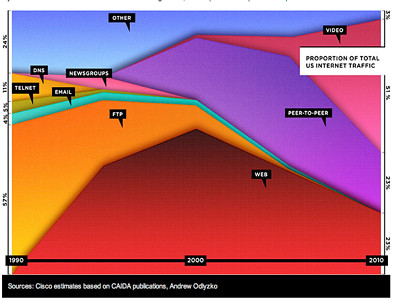
Internet was a Communications Network; Now it Mostly is a Distribution Network

Is the Internet a communications or content distribution network?


That's a rhetorical question, but an important question, nevertheless, since governments often regulate "communications" networks differently than they do "content delivery networks" (the generic function, not the business of CDNs). 


Even traditional language "any to any" speaks more to the original communications function than the ways most of the Internet actually is used as a content acquisition medium these days. 


The Named Data Networking project hopes to evolve the Internet's fundamental protocols in ways that acknowledge the key change by adding more security. But there is an equally-important change: the shift in Internet purposes from communication to content delivery.


"Recent growth in e-commerce, digital media, social networking, and smartphone applications has resulted in the Internet primarily being used as a distribution network for content," the NDN project says. 


Aside from the matter of security and protocols, that shift to content delivery could have important business and regulatory implications. 


One often hears it said that regulators should not allow the "Internet to become cable TV," That typically occurs in the context of discussions about network neutrality.


The notion is that the Internet should not become a media business.


The problem is that the Internet has become the enabler for precisely those developments. 


Many current and future battles will occur, around that change. The Internet originally was a narrowband communications network. Now it is a broadband media consumption network. 


By 2018, 1/2 of All Internet Users Will Live in Asia

By 2018, according to eMarketer, nearly half of the planet's Internet users will live in the Asia-Pacific region. At present, about 45 percent of Internet users live in Asia, according to Internet World Stats.

But China and India represent the majority of those users. For example, of perhaps about a billion Internet users in Asia, China represents 591 million, while India represents 213 million, about 80 percent of the total, according to Statista.

Japan represents about 10 percent, Indonesia about seven percent, South Korea about four percent, as does the Philippines. Bangladesh and Vietnam are closing on about four percent. 


Wednesday, September 3, 2014

Must ISPs "Upgrade or Die?"

"You upgrade or you die" is the catchy sub-title to a new report by GigU on the state of gigabit Internet access in the United States.

“We have made enormous progress,” the report suggests. “Scores of American communities” are building such networks. Moreover, “in a radical change ove rthe past 12 months, multiple service providers are initiating their own efforts.”

The “upgrade or you die” sub-title explains GigU’s view of competitive dynamics, where Google Fiber and municipal or other public-private testbeds have changed the competitive context.

The report also notes that progress towards gigabit access is not at a point where progress is “inevitable or irreversible.”

“We admit we’re not really sure that it is a case of upgrade or die for every telco or cable company,” the authors say. That likely is correct. In many markets, customers might not wish to buy gigabit services, at current or projected future price levels, compared to offers of 100 Mbps or 300 Mbps at lower price points.

Indeed, that is a current bet many cable companies are making, essentially gambling that, in the near term, the practical difference in end user experience between 100 Mbps or 300 Mbps and 1 Gbps is relatively slight.

But some extrapolation of Internet access speed trends since the days of dial-up access would suggest gigabit access will indeed be quite typical at some point. The issue is “when?”

By some reasonable extrapolation, it has been possible to suggest that 100 Mbps would be a typical access speed in the U.S. market by 2020, as crazy as that might have seemed 10 years ago, or even five years ago.

In 2002, it is hard to remember, only about 10 percent of U.S. households were buying broadband service. A decade later, virtually all Internet-using households were buying broadband access service.

Researchers at Technology Futures continue to suggest that 100 Mbps will be a common access speed for U.S. households by 2020, for example.

The new issue is how common gigabit access will be.

A reasonable forecast would have about half of U.S. broadband access users buying 100 Mbps connections--or faster--by about 2020.

About 10 percent will be buying 50 Mbps connections.

Nearly 24 percent will still be buying 24 Mbps service.

In 2009, Technology Futures predicted that, in 2015, about 20 percent of U.S. households would be buying access at 100 Mbps, about 20 percent at 50 Mbps, and something more than 20 percent will be buying service at about 24 Mbps.

That might have seemed a bold forecast back in 2009, but Technology Futures uses a rather common method of technology forecasting that has proven useful. In fact, Technology Futures has been relatively accurate about access speeds for a couple of decades, at least.

The 2009 forecast by Technology Futures furthermore seems to be a reasonable approximation of reality. Technology Futures had expected that roughly 20 percent of U.S. households would be buying 1.5 Mbps service by about 2010, another 20 percent would be buying 24 Mbps service, while 40 percent of U.S. households would be buying 6 Mbps service.

The Technology Futures estimates of 2009 seem to match other data reasonably well. An Akamai study suggested that typical U.S. access speeds. were about 4 Mbps, on average, in 2010,

Moore's Law, in fact, fairly well describes the growth of Internet access speeds in the U.S. market, since the time of dial-up access.

The point is simple enough: if Internet access bandwidth doubles every year, it is only a matter of time before 1 Gbps is a standard access offering. There will be a lag between the leading edge adopters and mainstream adopters.

But the more important point might be that mainstream users will, over time, have access to hundreds of megabits per second, where they now buy scores of megabits per second.  

Tuesday, September 2, 2014

Connected Car: Built in Versus Docking

According to the AutoTECHCAST findings, nearly two-thirds of car owners (65%) say they want built-in connectivity, compared to slightly more than one third (35%) who prefer brought-in connectivity using their smart phone.

That reminds me of the days of dedicated "car phones." Maybe it will be different this time around. But why isn't it simpler to dock a smartphone?

More than half of car owners say they are less likely to buy a vehicle that uses a data plan/carrier different from their own, and 31 percent say they are "much less likely" to purchase the vehicle.

That's crazy. Just make it easy to dock a smartphone or other. On nectar device.

Boost Mobile (Sprint) Counters T-Mobile US Prepaid Promotion

Sprint is offering new and existing Boost Mobile customers prepaid plans with unlimited calling, text messaging and one gigabyte of data for $35 a month, an offer evidently meant to be a response to T-Mobile US promotions for prepaid users offering a gigabyte of data for $40 a month, as well as a $40 a month, 500-MB plan offered by AT&T.

The Bloomberg report also notes that Sprint also is cutting the cost and doubling the data for its more expensive prepaid plans, which were priced at $50 a month and $60 a month.

As is typical for mobile marketing wars, each offer touted by a key competitor is quickly matched, and that seems to be the case here.

As part of an Amazon Fire promotion, AT&T Mobility reportedly is offering customers a “nothing down” plan for buyers of the Amazon Fire phone, at present offered exclusively through AT&T.

The limited time offer requires that customers  sign up for a two-year service plan or buy the device using the “Next”  installment plan, paying $32.50 a month.

Observers might disagree about whether the move reflects the mobile marketing war currently underway in the U.S. mobile market or just an oversupply of devices that AT&T wishes to reduce.

Separately, T-Mobile US doubled the number of music streaming services customers can use under the “Music Freedom ” plan that does not count music streaming against the user mobile data usage cap.

The original plan included  iHeartRadio, iTunesRadio, Pandora, Rhapsody, Samsung Milk, Slacker and Spotify. The latest move adds AccuRadio, Black Planet, Grooveshark, Radio Paradise, Rdio and Songza.

Promotions are not unusual even in “normal” times. But the present mobile marketing war means an unusually high number of promotions, some large, some small, will be launched.

Most recently, T-Mobile US quadrupled the amount of customers can get on its Simple Starter  plan, for an additional fee of $5 a month. The basic plan, costing $40 a month, provides 500 MB of Long Tern Evolution network data. For $45 a month, users get 2 GB.

T-Mobile US also now allows Simple Choice family plans including as many as 10 lines, and separately launched a promotion that matches smartphone data allowances when a tablet is added to a plan.

Sprint earlier had expanded its shared data plans to as many as 10 lines, doubled the amount of data included as part of such plans and set pricing that undercuts similar AT&T and Verizon plans.

Sprint also adjusted the single-line plan, setting $60 a month pricing for he tunlimited data plan.

Unlike family share plans offered by AT&T and Verizon Wireless, in which members draw from the same pool of data, each plan T-Mobile line has its own dedicated pool of data.

Under conditions where retail plans are changing so fast, a simple “no down payment” feature might not be viewed as that big a deal. Even under “normal” competitive conditions, that might not be so big a change.

Against the backdrop of a fierce mobile marketing war, every “little” promotion might have more significance.

Much of the recent activity has focused on the prepaid, or value segment of the market, in part because the major national service providers have been taking share from the independent prepaid brands.

Also, T-Mobile’s MetroPCS acquisition was an effort to bolster T-Mobile’s position in the faster-growing prepaid segment of the business.


In fact, the prepaid customer segments are a the center of marketing campaigns launched by T-Mobile US and Sprint.

T-Mobile US arguably has been picking up tablet accounts and single-line phone accounts, weighted towards the value end of the market.

In the second quarter, T -Mobile US booked virtually all net new prepaid account growth in the U.S. market, for example.

T-Mobile US now also has increased by 2 GB Long Term Evolution usage buckets for customers of its “Simple Starter” plans.

T-Mobile US now provides “Simple Starter” plan customers to quadruple their data to a full 2 GB of LTE data, for just $5 per month. That plan was launched in May 2014 as an entry-level solution with unlimited talk and text, and 500 MB of LTE data for just $40, starting in September 3, 2014.

The move allows T-Mobile US to improve the value of its entry-level offer.
Sprint, likewise, has launched new plans aimed at single-line customers, as well as a shared data plan that features double the usage bucket as comparable plans from AT&T and Verizon, for example.

Other carriers also are attacking at the value end of the market.

Cricket Wireless (owned by AT&T) is offering former T-Mobile and Metro PCS customers who switch to Cricket Wireless a $100 bill credit, available from Aug. 24 to Oct. 19, 2014, at Cricket stores nationwide and online.  

There is no limit on the number of lines a customer can switch to Cricket, receiving a $100 bill credit for each line transferred.

Cricket’s new offer is one more way AT&T can fight back against attacks on the value end of the market from T-Mobile US or Sprint.

Promotions will be launched for the higher value shared data plans that represent multi-line accounts as well.

Still, at the moment, it is tablet additions and phone accounts in the value segment that have been the focus of marketing attacks initiated by T-Mobile US.

Sprint arguably is the carrier with the broadest attack on shared data plan accounts that are, by definition, multi-line accounts.

Thailand Incumbent Telcos Face Revenue Shortfall

New Thailand Information and Telecommunications Minister Pornchai Rujiprapa said his priority will be finding new revenue for his two state telcos, CAT Telecom and TOT Corporation, which are facing a cash crunch.

Nearly everywhere,  it seems, Telco revenue models are threatened.

Goldens in Golden

There's just something fun about the historical 2,000 to 3,000 mostly Golden Retrievers in one place, at one time, as they were Feb. 7,...