Monday, September 21, 2015

Australia NBN Launches its Fiber to Node Services

The Australian NBN has launched its fiber to the node Internet access service, part of its goal of connecting eight million premises to the NBN network by 2020, of which more than 1.6 million homes and businesses are expected to be connected using FTTN by perhaps mid-2018.
NBN aims to have 500,000 FTTN premises ready for purchase and use by consumers by mid-2016, with 3.7 million active commercial lines active by mid-2018.

The initial FTTN rollout began in Belmont, New South Wales.

As the nation’s authorized wholesale network, NBN--despite some concern--should settle into a reasonable business model, if construction costs wind up contained, and not again wildly underestimated.  

After all, every fixed network connection essentially will be supplied by NBN on behalf of its Internet service provider customers, including Telstra, Optus, Optus Wholesale, Exetel, TPG, iiNet, AAPT, SkyMesh, Harbour ISP and M2 Group (Dodo, iPrimus, Commander).

Since business customer revenue generates about half of all industry service revenues in Australia, it is possible business segment revenues will represent much of the revenue for the NBN.

Connected Car Hardware, Software and Services Will Hit $150 Billion in 2020

It perhaps is a reasonable bet that revenue from connected car applications and services will change over the next decade.

Up to this point, connected-safety features have generated the most revenue of all of today's connected-car services, at $13 billion. In part, that is because few other services have been created and marketed.

But safety will lose its spot as the top revenue stream to driver assistance in 2017, eclipsing $60 billion in annual revenue. Driver assistance includes such functions as self parking.

Still, connected-safety features will bring in $44 billion in 2020, Business Insider predicts. Safety features  include alerting customers of road conditions, such as severe weather or an approaching hazard, as well as collision-avoidance.

Entertainment is one of the most popular features available for the connected car, but it is not a major revenue driver. The category will account for only $13 billion in revenue in 2020. Entertainment features include integrations with apps such as Pandora, Yelp, and Facebook.

Apps Now Represent 90% of Time Spent with Mobile Internet Functions

One can argue about whether apps are a front end to the web, but at one level, it is obvious that mobile users have become quite used to engaging with apps. In fact, about nine times out of 10, a user interacting with mobile content or an Internet function does so using a mobile app. 

Mobile users also spend more time with mobile appsthan they do with television. 

2015_09_21_Mobile_Users

Verizon Introduces 100-Mbps Symmetrical Internet Access in Tampa Markets

Verizon is introducing a new 100/100 Mbps tier in some Florida markets, including nearly 1.3 million premises in Hillsborough, Pinellas, Pasco, Polk, Manatee and Sarasota counties, at least for new customers taking triple-play packages.

Additionally, the price for its symmetrical 150 Mbps service has been greatly reduced.

Verizon earlier had introduced such 100-Mbps symmetrical tiers of service in its New York city market, in large part to gain a marketing advantage against area cable operators who had not upgraded to faster services. As in Florida, Verizon was able to say it was the only ISP offering such speeds.

Verizon likewise is the only communications provider to offer a symmetrical speed tier of 100/100 Mbps, or any Internet services offering the same fast download and upload speeds, in the Florida market.

New residential customers in the Tampa Bay area can order triple-play services featuring 50/50 Mbps Internet, Custom TV and Fios Digital Voice for $79.99 per year; 100/100 Mbps, Custom TV and Fios Voice for$89.99 per year; or 150/150 Mbps, Custom TV and Fios Voice for $99.99 per year. These are available with a two-year contract or month-to-month.

5G Commercialization Requires Core Network, 4G, App Awareness

It actually is getting hard to separate core network developments from access, present platforms from next generation networks and revenue drivers from all of that.

Consider a new agreement by Ericsson and LG Uplus, to collaborate on the development of fifth generation (5G) and Internet of Things (IoT) technologies.

The agreement covers collaboration around:
  1. IoT infrastructure, including narrow-band LTE
  2. software-defined networking (SDN) and Network Functions Virtualization (NFV)
  3. making the core network 5G ready; global content delivery networks (CDNs)
  4. and IoT-Advanced technologies.

So note the content of the four key areas: one major area concerns 4G networks, two elements concern applications and business models (IoT), two element relate directly to core networks, while a third concerns content delivery networks.

In other words, none of the key areas of collaboration related to “core” 5G standards and features. All relate to all the other key “wrap around” elements such as core networks, business models and apps and the transition from 4G to 5G.

So the agreement illustrates why developments in other portions of the network--as well as fourth generation Long Term Evolution--are crucial for 5G commercial deployment.

Under the terms of the agreement, which will initially run until 2020, the two companies say they aim to take the lead in the development of 5G and IoT platforms.

The collaboration suggests many issues not directly part of setting 5G standards will be foundational for 5G.

The focus on evolution of core networks and existing 4G, with application-specific support (content delivery networks and IoT), therefore are key.

Saturday, September 19, 2015

India OTT Voice Regulation Will Have Dramatic Potential Ramifications

Mobile operators in the highly-competitive mobile market, no less than operators in other markets, know that Internet access revenues now are the growth driver, not voice.

So it comes as no surprise that, facing pressure on voice revenues, and forced to invest in new spectrum and towers, data tariffs for prepaid customers were hiked 47 percent in June.

Bharti Airtel and Idea Cellular have now also increased charges for postpaid customers by 20 percent in various circles.

At the moment, data contributes perhaps 15 percent of total revenue.

But more price hikes could come, some warn. Mobile operators say they may have to increase data tariffs by up to six times to remain viable if proposed regulations on over the top voice services did not provide a level playing field.

“If you take data rate to five times or six times, a lot of people in India will never be able to access the Internet," said Gopal Vittal, Cellular Operators Association of India vice chairman and Bharti Airtel India managing director.

The assumption being made is that if OTT voice services are not regulated the same way as carrier voice (primarily in terms of fees and taxes), India’s mobile operators, who derive 85 percent of revenue from voice, will lost nearly all their revenue.

Frankly, that already is happening in most other developed country mobile markets, so the concern is not misplaced. On the other hand, mobile service providers in many other markets have essentially shifted to a “connection fee” for mobile service, not directly charging on a per-text message or per-call basis for domestic--and in a growing number of instances--international calls.

On the other hand, many will have a queasy reaction to the notion that services such as Skype or WhatsApp should be regulated in the same way as carrier voice.

In some other markets, services equivalent to carrier voice are regulated in the same way as carrier voice.

But OTT services such as Skype and WhatsApp, when used in an “app user to app user” way, are not so regulated.

It is a difficult issue.

New ISPs Have Potential to Seriously Disrupt Cable, Telco Business Models

There is a good reason why Comcast and AT&T have dramatically committed to widespread gigabit Internet access networks: they have to, just to stay competitive with growing threats from independent Internet service providers.

The dynamics of monopoly fixed network access markets are one thing. The dynamics and business model impact of a strong two-provider market are quite another. To note just one huge change, stranded assets become an immediate problem.

In a monopoly market, a service provider might expect to potentially get nearly every household or location as a customer, for an anchor service.

In a duopoly market, that potential drops to perhaps 50 percent, assuming two contestants, equally skilled and offering similar services.

Three-provider markets, though historically rare, are becoming more common. Again assuming three providers, equally skilled, potential might drop to perhaps 33 percent.

The business model impact is stark. A monopoly market provider can hope to generate revenue from up to 100 percent of locations. A duopoly provider, over time, should reasonably expect to generate revenue from half of location.

In a three-provider market, revenue could be generated from only about a third of locations.

Even in multi-product markets (triple play), the same sorts of dynamics apply.

In Hamilton County, Tenn., where EPB sells gigabit Internet access, entertainment video and voice services, and is the only provider of gigabit services, EPB has gotten 43 percent market share in the consumer Internet access business, leaving the incumbent telco and cable TV operator to split 57 percent between them.

In Kansas City, where Google Fiber first launched its gigabit service, at least one survey suggested Google Fiber  was getting 75 percent market share in some neighborhoods, and no worse than 30 percent in any neighborhood.

The long term issue is what percentage of all U.S. homes will eventually have three providers. If that happens, and if the new providers are competent, and have market-standard (or better) offers, incumbent telco and cable TV business models will be severely disrupted.


Gigabit Internet Access Network Boosts City Economy $865 million to $1.3 Billion, Creates 2,800 to 5,200 New Jobs, Study Argues

A study of the economic impact of gigabit Internet access suggests the EPB Fiber Optics network generated $865.3-million to $1.3-billion in economic and social benefits while creating between 2,800 and 5,200 new jobs.

The study by University of Tennessee at Chattanooga Finance professor Bento Lobo suggests benefits have exceeded the projected benefits by at least 27 percent and, possibly, by as much as 95 percent.

These estimates translate into benefits of between $2,832 and $3,762 per Hamilton County resident.

"Because of our fiber optic infrastructure, we are creating economic development opportunities and good, middle-class jobs today as well as positioning Chattanooga to compete in the innovation economy of tomorrow,” said Chattanooga Mayor Andy Berke.

The fiber optic network serves as the backbone for Chattanooga’s smart grid, which has delivered $237-million in benefits that include avoiding power outages by 124,734,486 customer minutes of interruption as of August 31, 2015, the study also suggests.

The study also estimated new investments between $198 million and $461 million between 2011 and 2015 and a net 3,716 jobs. Of these, 3,595 were new jobs and 121 were avoided (hourly) job losses due to outage reduction benefits of a smart grid.

Over the period 2011-2015, the fiber infrastructure generated incremental economic and social benefits ranging from $865.3 million to $1.3 billion while additionally creating between 2,800 and 5,200 new jobs.

Chattanooga’s City Council approved EPB’s FTTH plan and the build out was completed roughly six years ahead of schedule, with the first business customers connected in the fall of 2009.

In September 2010, EPB made available residential symmetrical internet connection speeds of up to one gigabit per second - the fastest Internet in the western hemisphere.

By 2010, the utility saw a 150 percent increase in customers. As of March 2015, the utility serves 43 percent of the Chattanooga residential market, a total of roughly 66,180 customers. Moreover, the fiber optic division of EPB became profitable in 2012 and has contributed to lowering EPB’s overall operating costs and electric rates ever since.

By 2016, the division is expected to be debt-free.

Fiber optic system access fees and rents paid to the electric system in 2014 amounted to $10 million and are estimated to be over $12 million in fiscal 2015.

In 2008, plans to modernize the electric system took off with EPB making a bond offering to fund the construction of a Smart Grid, one of the first and largest in the United States.

In November 2009, in the wake of the deep recession of 2007-2008, EPB received a federal stimulus matching grant in the amount of $111.6 million from the Department of Energy to expedite the build-out and implementation of the fiber infrastructure and Smart Grid.

The fiber optic division was set up as an asset of the electric division of the utility and leases the fiber optic infrastructure from the electric division.

In 2010, Business Facilities Magazine ranked Chattanooga number one among all American metros for “Economic Growth Potential”.

That might cause some to ask questions. If the network was activated for business customers in 2009, and for residential customers in 2010, how likely is it that the fiber to premise network was solely, primarily or even largely responsible for the 2010 ranking?

True, a company called HomeServe hired 140 employees to launch a call center in the city. And the company did attribute some of its decision to the Internet access. The gigabit services was said to be “one of the reasons” the company decided to open its data-intensive facility.

The problem with these sorts of claims is that it literally is impossible to untangle what is correlated from what is “causal.” Fast high speed access often is correlated with higher-income or faster-growing cities and regions.

But it literally cannot be proven whether the high speed access “caused” the growth, or whether growth was already happening.

Many would argue it is the robustness of local economies, with the increase in prosperity and wealth, that leads to higher demand for all sorts of products, including higher speed Internet access.

Keep in mind the “fiberhood” method now used by Google Fiber and other gigabit Internet service providers.

The neighborhoods that get built are those where demand is highest, and those neighborhoods universally turn out to be neighborhoods with higher incomes and wealth. In other words, economic prosperity lead to higher speed Internet access. Gigabit service did not cause the wealth to exist.

Likewise, a RelocateAmerica.com study indicated that the Chatanooga was attracting people at a rate about 30 percent faster than the national average, especially baby boomers and members of the millennial generation, arguably the driving force behind new, innovative businesses.

So again, in-migration and growth trends were already in place.

That isn’t to discount the study findings. Economic growth and value undoubtedly have occurred. Few would argue that gigabit access “hurt.” Most sense it “helped.” What never can be determined without doubt is the causal relationship between economic benefits and the supply of Internet access.

Grim Future for Much Content, Apps, if Ads are Blocked, Bundles Disaggregated

In a world where the linear TV bundle is diminished, many expect there will simply be “fewer channels” in existence. In a world where app or Web advertising is largely blocked, will there likewise be less ad-supported free content? One is forced to consider that it will be so.

In such a world, without as much ad-supported content, more content will be supported by other revenue models, commerce or subscription, for example.

End users might find there are significantly less “free” content or applications available, with more value obtainable only by paying a transaction or subscription fee.

As with a future “over the top” video entertainment market, popular content and applications will still find an audience. Less-popular fare will not be produced at all, or will have somehow shifted to alternate revenue models for smaller audiences.

Advertising long has been part of the fundamental fabric of media business models, subsidizing lower cost or free consumer access to content products, ranging from over the air radio and TV to newspapers and magazines.

It isn’t the only possible model. Concession and ticket sales support movie theaters, while subscriptions support linear video services or SiriusXM (both of which use a hybrid model including subscription fees and advertising).

But most web content has been provided at no incremental charge for consumers, as advertising supplies the revenue. That could change if “ad blocking” largely becomes the rule.

Less content produced, and much less available “for free” is an inevitable result, in that case, as it will be for unbundled linear video channels.

Most predict there simply will be fewer channels, were unbundling to happen, since current business models are predicated on aggregating packages of popular and niche channels in ways that allow smaller channels to exist. And diminished advertising potential plays a role there as well.

In an unbundled world, smaller channels simply would not be able to generate enough revenue from advertising to survive totally on subscription fees. A simple look at potential alternative revenue models based solely on subscription fees illustrates the problem.

What is the expected retail price for content from any single channel, assuming one believes that will continue to be a relevant form of bundling? Part of the answer hinges on volume, a function of popularity, when people must buy individual channels directly.

Most agree that ESPN and sports would have relatively large audiences willing to pay. But many smaller channels simply could not charge prices consumers would pay.

An analysis by analyst Jason Bazinet at Citi Research suggests that “in a pure OTT world most firms would see their equity value fall,” Business Insider reports.

Where ESPN might be able to earn a return selling subscriptions at close to $20 a month, most of the larger channels (top 40 by audience) could not expect to charge more than $5 a month, and the vast majority would be limited to $1 to $2.

Many niche channels could not hope to reach even the $1 level, most would therefore conclude.

So one might conclude that ad blocking in the app and web domains is going to have impact similar to what is expected if linear video bundles are disaggregated. There will be fewer suppliers of content and apps able to survive.

Screen Shot 2015 09 18 at 12.00.51 PM

Friday, September 18, 2015

One Way or the Other, Distributors are Going to Make Less Money from Entertainment Video

Even when there are segment winners and losers as industries are transformed, so too are there possible winners and losers within each segment that is changing. If video entertainment moves largely to an over-the-top distribution model, many have reason to ask what prices today’s legacy providers could command.


The expected retail price for content from any single channel--assuming one believes that will continue to be a relevant form of bundling--is the usual way the question is asked.


In that regard, an analysis by analyst Jason Bazinet at Citi Research suggests that “in a pure OTT world most firms would see their equity value fall,” Business Insider reports.


The exception: Disney, on the strength of its sports franchise (ESPN). He estimates other firms would lose.


Bazinet estimates that sports content is worth 3.7 times more than typical TV content.


In fact, the report estimates the optimal price for ESPN in an over-the-top format is $20 per month, by far the highest of the 41 channels Bazinet analyzed.


To the extent there is good news, it is that profit margins for distributors from selling linear service are dropping. In other words, the linear business is becoming less attractive, over time.

It is one thing if the business produces 25 percent free cash flow . It might be quite another thing if the linear video business produces just nine percent free cash flow margin, as analysts at Deutsche Bank predict will be the case for the larger video distributors by perhaps 2020.


And triple-play service providers already know where this all is going.They will earn more money providing high speed access, less money selling video entertainment, more money from business customers, less money from consumers.

To be sure, some distributors might create new revenue by offering mobile video, their own streaming services or partnering with third party streaming services to provide retail marketing and fulfillment.

But if history provides any guidance, the new markets will be smaller than the former markets, in terms of gross revenue.

FCC Wants Subsea Cable Outage Reporting

The Federal Communications Commission has proposed new rules requiring submarine cable networks to report significant outages to the FCC.

The rules would affect  60 undersea cable networks that provide connectivity between the mainland U.S. and Alaska, Hawaii, Guam, American Samoa, the Northern Mariana Islands, Puerto Rico, and the U.S. Virgin Islands, as well as virtually all connectivity between the United States and the rest of the world.

The Commission’s proposed rules requires that submarine cable licensees report major outages (lost connectivity or degradation of 50 percent or more of an undersea cable’s
capacity for periods of at least 30 minutes), irrespective of whether the cable’s traffic is re-routed.  

The Commission also seeks comment on how the agency can improve submarine cable deployment processes generally.

Internet Interests Win Most Political Battles

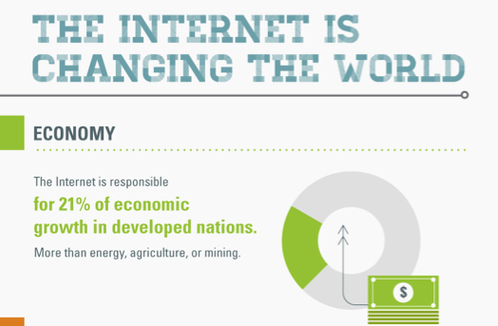
Economic impact of the internet "The Internet hasn't lost many political battles," says Reed Hastings, Netflix CEO. How true. 

One is hard pressed to think of a major political battle pitting Internet interests against others, where the Internet interests have not won.

The only times when that general rule is in question is when two or more Internet interests or partiipants themselves disagree about a policy outcome. 


No Sustainable Business Advantage, For Anybody

There arguably are no permanent sources of sustainable business advantage in any business, these days. Sooner or later, some attacker will nullify the advantage held by any single provider or firm. In a similar way, no specific business model is permanently safe from disruption.

That might be the growing case for all forms of ad-supported content, applications and services. In part, that is because use of ad blocking software is growing.

Internet access charges and user experience are the apparent drivers of such behavior. Few people claim to enjoy advertising. But an equally-big problem is the fact that advertising bumps up data plan usage. So blocking ads also reduces data consumption.

The advertising community eventually will react in a more-structured way. But stresses are growing, most especially, one might argue, in the key mobile advertising realm. Though gross revenues still are small, they are growing very fast making mobile bigger than desktop as an opportunity.


Know Mobile, Know Internet

If you know the state of mobile network services in most developing countries, you also mostly know the status of communications. The reason is the sheer dominance of mobile-delivered services.

More than 97 percent of Indian voice subscriptions are provided by mobile networks, less than three percent by fixed networks, the latest data from the Telecom Regulatory Authority of India shows.

More than 85 percent of Internet access subscribers likewise are provided by mobile networks.

The number of broadband subscribers increased from 104.96 million at the end of May 15, 2015 to 108.85 million at the end of June 15, 2015 with monthly growth rate of 3.71 percent.

The point is that a quick snapshot of mobile subscriptions and usage in most developing countries is a relatively accurate picture of the status of communications overall.


Facebook Reaffirms Support for Internet.org in India

Undeterred by criticism, Facebook seems committed to expanding its Internet.org program in India and elsewhere.

Internet.org works with mobile operators to create free access to key applications without charge, at least for limited periods of time, in an effort to allow new users to experience the value of the Internet and Internet access.

Some have sharply criticized the program as a violation of network neutrality rules, using the logic that the program “does not treat all apps the same.”

Supporters counter that the program is not different than any other retail policy that offers limited-time promotions, coupons, discounts or incentives to buy or try any consumer product.

The program already has proven to be a useful way of providing exposure to the value of the value of the whole Internet and has stimulated sustainable demand for Internet access.

As practiced by Internet.org, the whole program is voluntary: consumers pay nothing to use the apps. Internet service providers pay nothing to make the offer and Internet.org apps and Facebook pay nothing to operators to enable the access.

Internet.org "does not violate the principles of net neutrality", said Kevin Martin, Facebook VP for Mobile and Global Access Policy."We have no program to withdraw internet.org from India where we provide the platform with Reliance Communications."

Goldens in Golden

There's just something fun about the historical 2,000 to 3,000 mostly Golden Retrievers in one place, at one time, as they were Feb. 7,...