Thursday, May 11, 2017

Spectrum Prices Have to Fall in 5G Era

Spectrum prices are going to quite important in the 5G era, for fundamental reasons related to changing mobile business models. Higher network investment and limited revenue upside are among the key issues.

The next generation of 5G networks will cost more than 3G and 4G networks did, in part because they will use small cells. That will have dramatic cost implications for the simple reason that shrinking cell site radius by 50 percent quadruples the number of cells required.

That reduction of cell radius has been going on for some time, as higher-frequency signals have been put into use.

“One study found that the cost (capex) of coverage at 3500 MHz using presently available technologies (not 5G) was roughly 6.7 times as great as the cost of coverage at 700 MHz,” says Bruegel contributor Scott Marcus.  That cost differential comes primarily from the greater number of cell sites required at higher frequencies.

At the same time, revenue upside is more questionable than has been the case in the past. One reason is that services humans will pay for (to use their smartphones and other personal devices) are more limited, as every major revenue source (voice, texting, internet access) is saturated, reaching saturation or going to reach saturation.

That means the higher capital investment is not clearly matched by proven incremental revenue upside that will pay for the new networks.

In many advanced countries, subscriber penetration is well above 100 percent and average revenue per account is not increasing.

Against this background, the ability of operators to monetize the growth in demand for mobile data, for example through fixed-mobile convergence or new value-added services linked to the Internet of Things, is uncertain.

Also, big changes in spectrum supply are coming, for a combination of reasons including a shift to small cell architectures, huge amounts of new spectrum in the millimeter regions, spectrum sharing and additional unlicensed spectrum, better radios and even the ability to create larger channels, which itself increases effective utilization of any available spectrum.

Normal economic realities suggest that vastly increased supply of a desired good should lead to lower prices. That suggests spectrum prices must decrease.

High spectrum costs always have been a barrier to market entry in the mobile industry. Indeed, some would argue that mobile business models are built on spectrum scarcity.

The corollary is that releasing more spectrum, at lower prices, spurs competition and innovation.

A study by NERA Economic Consulting, sponsored by the GSMA, argues that high spectrum prices have lead to lower-quality networks, reduced take-up of mobile data services, reduced incentives for investment, higher consumer prices and lost consumer welfare with a purchasing power of US$250 billion across a group of countries where spectrum was priced above the global median.

“Where governments adopt policies that extract excessive financial value from the mobile sector in the form of high fees for spectrum, a significant share of this burden is passed onto customers through higher prices for mobile and lower quality data services,” NERA says.

“In summary, the current outlook is for reduced spectrum scarcity but uncertain scope for operators to generate revenues from mobile networks,” NERA notes. “This implies that prices paid for spectrum should fall, especially as future releases are increasingly focused on higher frequency bands.”

“Countries that try to resist this trend, either by restricting spectrum availability or overpricing newly released spectrum, are likely to see large amounts of spectrum go unallocated,” NERA warns.


source: GSMA

Will CBRS Be the New Wi-Fi, a New Real Estate Play or Wholesale Capacity Play?

It is hard to know, in advance, how important a new block of 150 MHz of mid-band mobile spectrum can be, and in which deployment models, especially since the rules on indoor and outdoor use are so different. 

The Citizens Broadband Radio Service (CBRS) is a prime example. CBRS creates a three-tier access system where primary licensees are protected, but licensed secondary users have access when the primary user has fallow spectrum. Also, tertiary users can have "best effort" access, on the Wi-Fi model, when neither primary nor secondary users need all the available spectrum. 

In principle, CBRS also includes different licensing rules for outdoor and indoor use. Indoors, a property owner can create a private Long Term Evolution (LTE) 4G network. In principle, a big enterprise could essentially create a private LTE network to support better indoor signal reception. 

Of course, the issue is that the value of doing so is highest if if multiple commercial LTE networks (AT&T, Verizon, T-Mobile US and Sprint are supported, since that ensures that any customer, on any network (retail or wholesale), can use the network. How much capital any enterprise wants to sink into that sort of infrastructure is the issue.

One obvious monetization method is to create a wholesale infrastructure that is open to use by any of those network services providers. In other words, in principle, a real estate opportunity essentially is created. As always, that also means there is room for specialized real estate developers to enter the market. 

In other words, eventually, as commercial aggregators of commercial Wi-Fi hotspot have developed, so in principle a new type of indoor mobile infrastructure could develop (think Boingo), with the business model being selling access rights to mobile operators. 

The other logical platform is to use outdoor rights to build a "traditional" mobile service, using the secondary licensing method. 

Possible, though more complicated, are other business models based on tenant communications, though that always has been a fragmented and difficult undertaking. 

It's new terrain. Never before has so much spectrum been made available on a "shared" basis, where new licensed users can be added to a band where primary licensees retain their rights to primary use. 

Spectrum traditionally has been a very scarce resource. Indeed, whole business models and industries have been built on exclusive use to spectrum. In the analog world, sharing was difficult to impossible. In today's world, it is comparatively easy. Not always easy, but doable. 

Spectrum clearing and reallocation used to be the only way to shift capacity from one set of licensed users to others. It always is expensive and time-consuming. 

Spectrum sharing now allows more-effective use of existing licensed spectrum that is underused, not by moving licensees, but allowing new users access on a shared basis. 

Neville Meijers, VP Business Development, and Patrik Lundqvist, Director Technical Marketing, Qualcomm Technologies, talk about use models for CBRS. 

Wednesday, May 10, 2017

AI Revenue to Reach $60 Billion by 2025

Revenue generated from the direct and indirect application of artificial intelligence (AI) software will grow from $1.4 billion in 2016 to $59.8 billion by 2025, according to researchers at Tractica.


Out of the top 10 use cases, 40 percent are related to big data and 60 percent are related to computer vision and natural language processing. The former has use cases such as customizing content feeds for consumers. The latter has application for user interaction with devices (language processing) and process automation (automated vehicles).


Deep learning remains the largest technology category overall, although machine learning has been changed to represent a larger portion of the overall mix, Tractica says.


Deep learning applies some of the same machine learning principles like clustering and classification onto neural networks (computing networks that process like humans do).


Machine learning (the ability of machines to learn from their experiences without explicit programming) is described by Tractica as “classical machine learning techniques like support vector machines, regression, classification, and clustering that do not use neural networks.”


Mergers "Everyone Expects" Might Not Happen

Since “everyone” expects a wave of consolidation across the U.S. communications and media space over the next year or so, wouldn’t it be surprising if the “expected” deals being pushed by dealmakers wind up not happening, either because acquirers do not move, or deals are blocked.

Among the “expected moves” that will likely be blocked is a merger between Sprint and T-Mobile US, despite happy talk about a “different” regulatory environment. It is going to be hard for Department of Justice attorneys to okay a deal that will reduce competition in the U.S. market, no matter how much we will hear about the pro-competitive aspects of such a merger.

The best possible argument, despite the greater market concentration, will be that a merged Spring plus T-Mobile US will have the scale to compete better with AT&T and Verizon. The obstacles are that equity analysts and service provider executives want such a merger precisely because it reduces competition in the market.

DoJ is almost certain to continue to apply a market concentration rule that suggests the market already is highly concentrated.

That is not to argue that Sprint and T-Mobile US are not “in play.” It is to argue that other mergers with less exposure to market concentration tests are conceivable, even likely, if not in the next 12 months, then at some point over the next several years.

For about the next year, it appears two of the would-be buyers are signaling they have no intention of doing so.

Comcast Corp. and Charter Communications, the two largest U.S. cable operators, and the largest and second-largest U.S. internet service providers, have agreed to explore ways to work together in the mobile business nationwide.

The two cable companies also agreed that if they want to strike a deal with a mobile provider other than Verizon or buy a mobile company within the next year, they have to do it together.

The deal essentially means neither company can make a move (acquisition, merger, joint venture) in the mobile space involving more than about $200 million, without the other firm’s consent.

That sort of takes Comcast and Charter out of the “logical buyer” category for the immediate future. The deal does not mean either one of those firms will be out of the market for acquisitions later on. But it does not appear either will be considering any such move for a year.

Perhaps another cable company might consider a move, but not Comcast or Charter.

That also means more uncertainty for some other players such as Dish Network. Neither Charter nor Comcast are normally among the names of firms that are “logical buyers” of Dish assets. Verizon normally is mentioned as a spectrum acquirer, though. But recent bidding on 28-GHz spectrum by Verizon suggests Verizon sees other ways to get more spectrum.

Perhaps ironically, for the moment, we are left with one proposed merger that will be controversial and many would-be buyers on the sidelines.

T-Mobile US has tried to merge twice, and been rejected twice (first AT&T, and then Sprint). Comcast, Charter, AT&T and Verizon will not try.

That leaves a number of well-heeled, cash rich app or content providers that theoretically could weigh a bid for Sprint, T-Mobile US or Dish, but who have many other priorities.

The point is that the expected spate of horizontal mergers might well not happen, leaving the field for vertical mergers of the sort Comcast has done, and AT&T now is pursuing.

Wi-Fi Monetization Remains Largely Indirect

Nomadic or untethered access has become a bigger part of the mobile device access pattern for some time, and likely will assume more importance as home-based internet of things apps proliferate and related trends such as voice control of devices increases.

What always has been harder are ways to monetize large hotspot networks. To a large extent, some U.S. cable operators have been able to use widespread hotspot access to boost new account and retention for fixed network internet access customers. It is not so clear that AT&T and other mobile operators have had quite the same success.

It remains the case the most of the monetization opportunities are indirect, though. Wi-Fi offload is valuable for mobile operators, even when they do not directly own the Wi-Fi assets being used, to reduce congestion and load on their networks.

Consumers value offload because it means they do not use so much mobile data. Eventually, Comcast and Charter Communications expect to use offload to their own Wi-Fi hotspots and in-home customer Wi-Fi networks to reduce the amount of wholesale capacity they must buy from Verizon.

Also, over time, in-home internet of things apps and devices should benefit from in-home Wi-Fi. Comcast might well have a direct revenue stream from providing home security that leverages the Wi-Fi and internet connection.

In such cases, the revenue model is likely to continue to be indirect; the customer paying for the security service that happens to use Wi-Fi and the internet access connection.

source: Cisco

"Fake 5G?" Consumers Will Not Care; They Will Buy

If you remember the nomenclature wars when 4G first was launched in the U.S. market, you will not be surprised at the amount of hype or controversy “pre-5G” or “early 5G” is going to generate.  As U.S. mobile operators begin to deploy “pre-5G” platforms, some are going to quibble, arguing those deployments “are not really 5G.” Fixed deployments likewise, will not be considered “true 5G.”

All that has a logic. And none of it will matter. Sprint says it will deploy 5G in late 2019, using the 3GPP New Radio standard and Sprint’s 2.5GHz spectrum.

AT&T likewise earlier pointed out that 5G-NR radio interfaces would allow faster deployment of 5G using a virtualized network core, compatible with 4G, as early as 2019, to provide faster speeds and lower latency (both of which are features of 5G).

T-Mobile US, for its part, touts its coming 5G availability starting in 2019, promising “real 5G.” Purists are going to say none of those claims is entirely and fully correct, as they rely on 5G-NR radio interfaces, which are formally pre-5G, as the full standard is not yet finalized.

Verizon, meanwhile, is launching its own pre-5G services in 11 metro areas in 2017, albeit in fixed, rather than mobile mode. It is fair to characterize all those efforts as falling short of the full 5G standard.

As was the case with 4G, it will not matter to customers. Faster speeds and lower latency, with or without many new services, when marketed as 5G, will still be bought, because there is a value proposition that makes sense.

No matter how much observers or participants argue about “fake 5G,” there will be enough marketing differentiation to matter, from a customer standpoint. In the end, the early period of the transition will not matter, as it did not matter, in the end, for 4G.

Customers will hear about, and will want, the additional value “5G” is said to provide. They will buy. The standards will be fleshed out and the full implementation will happen over a few years.

The point is that it will matter--commercially--when the mobile operators start to market 5G. Our “inside baseball” arguments will not be a factor.

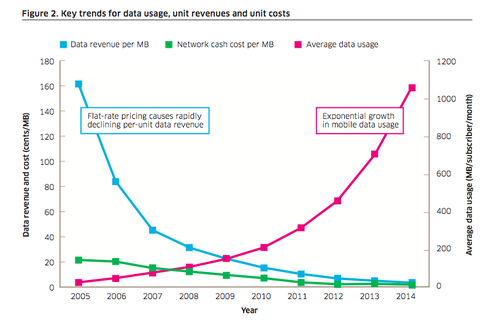
Mobile Data Poses a Different Sort of Business Problem

Mobile data presents a business model problem we did not see in the voice era. In the past, increased usage was incrementally matched by additional usage revenue. Even when the correspondence was not 1:1, increased usage inevitably lead to higher revenue.

Mobile data often presents a different business issue. Unlimited usage, for example, means potentially much-higher usage, with no revenue upside. And even where usage is not formally unlimited, increased usage typically leads to incremental revenue that likely does not keep pace with the costs of providing the additional capacity.

That has been a problem for some years.


source: Nokia (Alcatel-Lucent)

The present issue is not that revenue per gigabyte is a negative number. The problem is that, eventually, that could happen.

John de Ridder at IT Wire asks a couple of important questions about a possible end to scarcity of mobile bandwidth; price points for mobile bandwidth that could make mobile data usage a substitute product for fixed internet access, and at least conceptually, the idea that mobile might, in the 5G era, become a functional substitute for fixed access.


Right now, such substitution makes sense for some customers; not all. The frequent use case is a single user, mobile centric, using a mobile device for virtually all personal internet access, and doing so to save money. Such a user might and rely on Wi-Fi for long form video consumption or not watch much long form video.


That use case can make “mobile only” internet access a reasonable option. Up to this point, multi-user households and households where significant video is consumed have not generally been ideal candidates for mobile substitution, largely because fixed consumption typically is an order of magnitude higher than mobile consumption, and because mobile cost per gigabyte also is higher by perhaps an order of magnitude (10 times higher) or two orders of magnitude (100 times higher).


That could change.


Several developments would have to happen: faster mobile speeds; a shift to functionally unlimited mobile data usage (practically speaking, there always are some limits, but usually those limits are set high enough that the typical user does not have to worry about excessive usage and attendant costs); and a cost-per-gigabyte that approaches what is offered by fixed services.


In other words, mobile data bandwidth has to change from being a “scarce” commodity to becoming an “abundant” resource, which is among the differences between fixed and mobile internet access services for consumers.


Such abundance is potential good news (mobile substitution opens a big new market for some mobile operators) but also potential bad news (network bandwidth will have to expand by an order of magnitude or two orders of magnitude, but revenue will not increase, per account).


That latter possibility (a shift to unlimited usage including lots of video) now is a “negative” that mobile executives will insist is a “positive,” though. In the U.S. market, where the all the biggest four mobile operators now heavily are marketing “unlimited usage” plans, just about all the company executives say their spectrum holdings now mean they are well prepared for competition based on unlimited usage as a continuing and defining offer.


Michael Henshaw, Petra Capital director, forwarded this look at the impact of unlimited mobile data plans and the possible implications for mobile substitution. The clear business problem is the combination of potentially much-higher usage and capped revenue.


Other analysts think that dynamic is so important it eventually will lead to massive restructuring
of the mobile business, precisely because data consumption will not be matched by revenue increases of equivalent magnitude.


Tuesday, May 9, 2017

Rural Fixed Network Internet Access Remains Disturbingly Expensive

Rural internet access, like rural telecommunications generally, always has been an economic challenge. Infrastructure costs, relative to higher-density urban areas, are higher to much higher.

The number of potential customers is far lower and propensity to spend tends to be lower as well. That is why telecom policy makers always have subsidized rural communications from profits earned elsewhere in the ecosystem (taxes and fees levied on business and urban customers).

In the U.S. market, for example, the last five percent of residences is where the problem lies, with most of the cost issues related to connecting the last couple of percent of locations, as shown by the U.S. Federal Communications Commission National Broadband Plan and Broadband Availability Gap analysis.

In that regard, several major changes have happened since the end of the monopoly era. For starters, the high profits once earned from business customers have diminished sharply. That matters because it was those profits that funded the money-losing networks in rural areas.

A rough rule of thumb always has been that mass market telecom providers make money in urban areas, break even in suburban areas and lose money in rural areas.

That is not likely to change, though the magnitude of losses in rural areas, and the breakeven situation in suburban areas, are the subject of much activity (switching from fixed to wireless or mobile access, for example).

To be sustainable on a stand-alone basis, rural networks have to rely both on better technology that is much more affordable, and always must keep operating costs in control. The former tends to be the issue. Rural companies always have had to operate efficiently.

Government subsidies likely always will be needed, as an actual sustainable business model does not really exist.

Consider many U.S. states where rural population density ranges between 50 and 60 locations per square mile, and ignore the vast western regions east of the Pacific coast range and west of the Mississippi River, where population density can easily range in the low single digits per square mile.

Assume 55 locations per square mile, and two fixed network suppliers in each area. That means a theoretical maximum of 27 customers per square mile, if buying is at 100 percent. Assume for the moment that buying rates really are at 100 percent. Two equally skilled competitors might expect to split the market, so each provider, theoretically, gets 27 accounts per square mile.

At average revenue of perhaps $75 a month, that means total revenue of about $2025 a month, per square mile, or $24,300 per year, for all the customers in a square mile.

The network reaching all homes in that square mile might cost an average of $23,500 per home, or about $1.3 million.

At 50 percent adoption, that works out to roughly $47,000 per account in a square mile, against revenue of $900 per account, per year. Over 10 years, revenue per account amounts to $9,000.

The business case does not exist, without subsidies.

Other Federal Communications Commission studies also suggest the business case challenges. Assuming a standard fixed network investment cost, that might not produce a positive business case over a 20-year period, the FCC has suggested.


source: Ohio State University

Monday, May 8, 2017

Biggest U.S. ISPs Strike Deal on Mobile

Comcast Corp. and Charter Communications, the two largest U.S. cable operators, and the largest and second-largest U.S. internet service providers, have agreed to explore ways to work together in the mobile business nationwide.

As a practical matter, the agreement seems immediately focused on scale economies that will help both firms acquire phones at better prices, even if the agreement also “intends to explore potential areas for operational cooperation” such as common billing and operating platforms, technical standards development and harmonization, handset and tablet device life cycle management including forward and reverse logistics, and emerging wireless technology platforms.

The two cable companies also agreed that if they want to strike a deal with a mobile  provider other than Verizon or buy a mobile company within the next year, they have to do it together.

That will strike some as a clue to a more-substantial deal, particularly an effort to acquire one of the four U.S. mobile service providers outright. Others will argue the chances of a federated approach--where Comcast and Charter create a joint venture to acquire a mobile asset--working are low, for reasons related to the rareness of successful deals of that type overall, and the specific corporate culture within the cable industry, where managements are used to full control within their geographic territories.

The deal essentially means neither company can make a move (acquisition, merger, joint venture) in the mobile space involving more than about $200 million, without the other firm’s consent.

Sunday, May 7, 2017

51% of U.K. Locations Can Buy Internet Access of at Least 100 Mbps

Platform competition is not always economically feasible, in all countries or markets, making a mandatory wholesale access regime (one infrastructure provider, with retail competitors sourcing access from the infrastructure company )the best alternative.

Yet even where a wholesale approach is taken (United Kingdom, for example), the potential upside for competition dynamics seems clear enough. In the United Kingdom, present deployment of fiber to the home is about 1.6 percent. But the percentage of locations able to buy service at speeds of at least 100 Mbps is 51 percent.

That is because Virgin Media, using the hybrid fiber coax platform, has been able to upgrade to hundreds of megabits per second without installing fiber to the home, and gigabit speeds already possible, using commercial customer premises equipment.

In the U.S. market, where regulators decided to pursue a facilities-based competitive regime, Comcast and other cable operators are deploying gigabit services to every location, using HFC, not FTTH. With the exception of Verizon, which already had upgraded much of its footprint to FTTH, most of the other telcos have moved more slowly, as the business case has not been clearly favorable.

That is a major problem for many internet service providers, not just the tier-one and other telcos. Google Fiber, even using a neighborhood build approach, has found that the key problem is demand. It just costs too much to build lots of FTTH plant, with the prevailing take rates. Verizon has reached 40 percent adoption over a decade. Most other overbuilders struggle to get 20 percent buy rates and Google Fiber apparently did not do that well, possibly getting 11 percent take rates for its internet access service.

Indeed, that might be the big takeaway, so far, after a couple decades of internet access demand. It often is said that internet access prices are “too high” and that people “need lower prices.”

That might not be true. It might be more correct to say that, given a choice between a gigabit service costing $70 to $120 a month, and having the ability to buy other services costing less, people mostly buy the services costing less.

To say they “cannot afford it” is not likely correct. Most U.S. households spend more than $100 a month on a variety of streaming and linear TV services. So the issue is demand, not just supply. One of the key market implications of a headline rate of a gigabit service, sold for $70 to $100 a month, is that it necessarily means existing lower-speed services also have to adjust to the value-price umbrella set by gigabit.

In other words, customers will expect that if a gigabit costs $70 a month, lower speed services will cost less than that. And the truth is that lower speeds work for nearly 100 percent of the potential buyer base.

That has other important implications. If demand tends to center on internet access costing $50 or less, per month, then the network platforms have to match that expected price expectation. That means lower-cost infrastructure, now being addressed by open source, to some extent, and by wireless platforms, which are the big potential game-changers.

source: Think Broadband Can

Saturday, May 6, 2017

5G Will Cost More than 4G, But How Much More?

It is fair to note that the cost of building a 5G network hinges on several key inputs: which spectrum bands are available; what bandwidth can be refarmed and whether millimeter wave bandwidth is used.

The costs of using millimeter  spectrum bands to build 5G networks across Europe could be astronomical, according to Bruno Jacobfeuerborn, Deutsche Telekom CTO, costing between
€300 billion ($318 billion) and €500 billion ($529 billion).

Other estimates suggest far lower radio costs. But it might be reasonable to assume 5G will cost more than 4G, based simply on historical trends, where each new generation of networks is more capable than the earlier networks, in part because greater numbers of cell sites have been necessary, over time, to account for signal propagation of higher-frequency signals and greater need for frequency reuse.

Much of the cost comes from radio infrastructure, since the assumption is that small cells will be required, perhaps requiring an order of magnitude or more cell sites.

Barclays reckons the return on capital employed, or ROCE (a common investment measure), needs to be at least 8% for operators to be able to finance 5G rollout. Incumbents like Deutsche Telekom are likely to have a higher ROCE, according to its research, but Tier 3 mobile network operators fall well short of the mark, and the overall industry barely hits the 8% target.

Will SD-WAN Eventually Displace MPLS and Other Legacy Services?

You can often get a good debate going, with no chance of settling the argument, yet, about whether SD-WAN complements or displaces other services such as MPLS. As you would expect, existing suppliers nearly always say there will not be much product substitution, which might disrupt existing revenues.


“It's not going 100 percent from MPLS to SD-WAN,” said CenturyLink CEO Glen Post.” It's usually a hybrid network solution.” But will there be some cannibalization. There almost has to be, as Post acknowledges. “Our concern is it's more of a competitors' advantage.”


AT&T’s position also is about what you might expect from a firm that stands to lose if substitution is what eventually happens at its enterprise accounts, and gains if it can hang on to what it already has, and then adds new accounts in the smaller business area.


According to AT&T CEO Randall Stephenson, SD-WAN “tends to be real down-market” (smaller accounts, not enterprise).  But there already is a small impact on the more-traditional products. “We're seeing some effect from it.”


“Up-market, the traditional VPN capability is always, we think, is going to be the enduring capability,” Stephenson says. “But down-market, we're going to have to be prepared to compete with this kind of offering.”


The strategic problem is that, quite often, the selling point for SD-WAN is that it is a less-costly, easier-to-manage VPN.


In the near term, it will be hard to discern how much SD-WAN is a replacement for MPLS (it is) and how much it also represents a new product category that represents incremental growth (the “down market” segment AT&T believes exists).

Long term, it is hard to see how software-defined networking does not, in fact, displace one or more legacy product categories. Can you think of any enterprise, mid-market, small business or even consumer data products that have not been replaced by newer offerings?


source: Siemon

U.S. Consumers Still Buy "Good Enough" Internet Access, Not "Best"

Optical fiber always is pitched as the “best” or “permanent” solution for fixed network internet access, and if the economics of a specific...