Monday, September 24, 2012

More Smart Phone Users in Latin America than Developed Regions by 2017?

Telefónica has 208 million customers in Latin America, of which 173 million are mobile. Some would argue that in the next five years the region will surpass established markets by number of smart phones and their IP traffic will be multiplied by seven, with an annual growth rate of 49 percent.

In fact, Brazil has more smart phone users than Germany or France do.  In fact, with about 27 million and 23 million smart phone users respectively, Brazil and Mexico both have more smart phone users than Australia has people (Australia’s population is around 22 million).

Google's Mobile Planet also revealed that Argentina has 24 percent smart phone penetration.

These numbers defy the common perception that these large Latin American markets are far behind the rest of the world in smart phone adoption, Google argues. They in fact already possess larger absolute numbers of smartphone users than many other countries, and above-average usage patterns in many areas, Google says.

Some 65 percent of Mexican smart phone users search on their phones every day, compared to 57 percent in the U.S. market.

Some 90 percent of Argentine smart phone users use their phones to access social networks, compared to 63 percent in Japan, and 29 percent of Brazilian smartphone users have changed their minds about a purchase while in a store due to research conducted on their phone, compared to 15 percent in Canada.

Latin America’s smart phone sales picked up in 2010 when smart phone sales in the region grew 117 percent and total handset sales grew 17 percent.

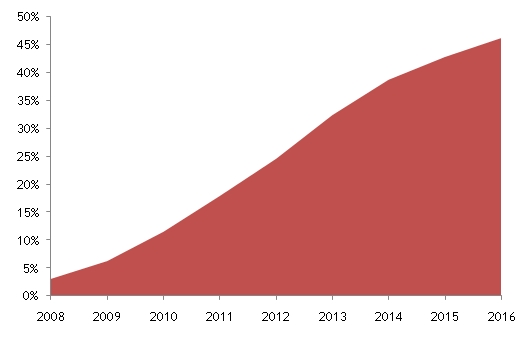
In 2011 smartphone sales were predicted to represent 17.9 percent of total handset sales and will continue to be the fastest growing category, increasing at a compound annual growth rate of 30 percent in the next five years, compared with a seven percent CAGR for overall handset sales during the same period.

By 2016,  Pyramid Research expects smart phone sales to account for roughly 46 percent of total handset sales in the region.

Others might point to China as the driver of growth in emerging markets. Research firm Ovum says emerging markets in 2011 accounted for 160 million of 450 million smartphones sold worldwide. China accounted for about 66 percent of smartphones sold in developing markets, Ovum says.

Latin America smartphone sales as percentage of total handset sales, 2008–2016
Bango, Facebook Use Carrier Billing for Virtual Goods

Carrier billing is not new. It has been available since about 1983, as was made necessary by the breakup of the former monopoly AT&T into separately-owned and independent long distance and local businesses. Basically, local service providers needed a way to allow long distance carriers to bill local telephone service customers for their long distance calling. 

As a byproduct, carrier billing has been available to other third parties, and primarily has been used to support third party sales of content or virtual goods such as ringtones, songs and more recently, mobile apps or in-app products.  

Bango says it now is providing Facebook carrier billing services  in Germany, the United Kingdom and United States, and will be expanded to other countries during the remainder of 2012.

Bango now provides Facebook users the ability to easily purchase digital content without the use of premium text messaging services or credit cards. Instead, purchases appear on the mobile customer phone bills. 

Has BlackBerry Subscriber Base Gone into Decline?

A decade after Research In Motion Ltd. introduced its first smartphone, the tribe of BlackBerry users has stopped growing stopped growing. The bigger question is whether something worse than that has happened over the last quarter, namely an actual decline in the user base. 

Some would point that although it has faced huge challenges, Research in Motion has until recently been able to show sales growth, albeit at rates that do not match those of Apple iOS, Samsung or other Android devices.

In August, 2011 RIM had 70 million BlackBerry subscribers worldwide, and in June 2012 reported 78 million users globally. 

Some analysts now believe the total number of BlackBerry users is now declining, or about to start declining. This contrasts with first weekend sales of the new Apple iPhone 5 of perhaps five million units. And some analysts appear to be disappointed at that sales level, which is more than for the similar first weekend of any other version of the iPhone, but less than some had anticipated based on pre-order activity. 

iPhone 5 Sales and growth opening weekend

U.S. "Falling Behind" Rest of World in Spectrum Auctions?

One has to be skeptical at times about claims that a specific country is "falling behind" on some measure of communications intensity.

That might apply, in some ways, to claims the United States "has quickly fallen behind the world" in  auctioning off spectrum that can be used to support wireless communications.

It is argued that Germany and Spain have auctioned about 50 percent more spectrum for broadband than the United States has. It is said that France has auctioned about 40 percent percent more spctrum, while Italy and Japan have auctioned 30 percent more spectrum.

"Specifically, the U.S. has auctioned about 410 MHz, Germany about 615 MHz, Spain about 600 MHz, France about 560 MHz, Italy roughly 510 MHz, Japan an estimated 500 MHz, and the United Kingdom preparing to auction about 600 MHz, Precursor principal Scott Cleland says. 

Some skeptics will argue that one would expect Cleland to take that view, as one virtually always will find Cleland taking positions that are "against" Google and "for" telcos. And there is little doubt that mobile service providers virtually always seem to be looking for more spectrum as they add more customers. 

The new reality is that each of those new customers are starting to consume network bandwidth at unprecedented rates, compared to past usage of narrowband voice and messaging apps. 

That isn't to deny that more spectrum will be needed, in most countries, as mobile broadband adoption increases. Nor are U.S. regulators unmindful of the need to clear unused former TV broadcast spectrum for mobile use. So the "auction gap," like many other past "gaps," will close over time. 

Also, what isn't immediately so obvious is what other spectrum assets already exist that can be "re-purposed," as U.S. mobile service providers are decommissioning older 2G or iDEN spectrum for new use by fourth generation networks. 

And then there is spectrum Clearwire already has deemed surplus, the potential Dish Network, LightSquared and Nextwave spectrum, for example. 

Long term, most service providers will need more physical spectrum. What isn't so clear is that there really is a spectrum auction gap that means anything terribly important at the moment. 


Conventional Retail Wisdom Might be Wrong for Online Retailing

Conventional wisdom in the retail business is that the longer a retailer can keep a customer in the store, the more the typical customer will buy. Paradoxically, small retailers operating online e-commerce sites might find the converse is true: the longer a user stays on a site, the less the chance that user will buy something.

Dane Atkinson, CEO of Sumall, an analytics company CEO, said that many online businesses tend to think of traffic in monolithic terms, namely that more traffic equals more money. That's wrong

“There’s a sweet spot where you’re getting someone to do a transaction,” Atkinson said. Using the company’s data, which includes more than 10,000 e-commerce stores and $1 billion transactions, Sumall noted that, for most businesses, that sweet spot is around 3 minutes and 20 seconds, adding that if a customer is on the site for 14 minutes, they’re more likely to browse that visit than buy.

Some might suggest there is a logical explanation for such behavior. Many users go online when they already have decided to buy a particular item, and simply are looking for which particular supplier will handle the transaction.

In such cases, a short session indicates a user has concluded that one specific online provider has the best combination of value and price, or at least, "good enough" to trigger an immediate purchase. 

A longer session might indicate a prospect has not yet decided to buy a specific item, but is doing product research. 

Sunday, September 23, 2012

Transaction Fee Part of Mobile Payments Looks Like Replay of VoIP Business

Groupon has launched a new mobile payments service, after trialing the service with 150 businesses in San Francisco. The service allows merchants to accept credit and debit cards by swiping them through a card reader attached to an iPhone or iPod touch.

For some observers, the activity in the mobile payments business will bring to mind the changes in the voice business wrought by over the top VoIP.

In a general sense, an attacker in an established market will always find the logic of the “same product, lower price” value proposition quite compelling. It answers the question of why a customer should buy the product (the transaction processing service). It answers the question of “what is the customer value proposition?”

Groupon Payments clearly is seeking to grow by offering cost savings. That’s the same approach taken by most VoIP providers, including both facilities-based cable operators and over the top suppliers as well.

Of course, you know where that story leads. Over time, we should expect to see pricing pressures in the payments processing business become more pronounced.

In other words, the amount of revenue transaction processors can make should fall, over time, as has been seen in the voice calling business, for example.

Groupon’s move is the latest bit of evidence that mobile payments are going to transform the retail payment process overall, in the same way that over the top VoIP has transformed voice communications globally.

To be specific, the profit margin is going to be wrung out of the business.

Mobile Drives Revenue Growth; Broadband Drives Mobile

It has been obvious for some time that mobility and broadband are driving virtually all growth in the global telecom business. By International Telecommunications Union estimates, about $4.5 is earned, globally, for every $1 of fixed network revenue. And even if those ratios are higher in "developing" regions than in "developed" regions, the trend is clear even in those parts of the world with the most well developed communications infrastructure.

Both Verizon and AT&T, for example, earn a majority of their total revenue from wireless sources.


Insight Research Corp. has noted that wireless revenue will grow by 64 percent from current levels, while wireline revenues show only modest growth.

Nearly all of the growth in both sectors is expected to occur in broadband services, with wireless 3G and 4G broadband services projected to grow at a compounded rate of 24 percent over the forecast period and wireline broadband services projected to grow at a 13 percent compounded rate over the same forecast horizon.

Those trends are as evident in the Asia-Pacific region as elsewhere globally. Telecom service provider retail revenue in the Asia–Pacific region is predicted to grow at a compound annual growth rate of seven percent between 2011 and 2016, according to Analysys Mason. For the most part, that growth will be driven almost exclusively by mobile services.

Total telecom service revenue will grow by 29 percent from $229.7 billion in 2011 to $323.7 billion by 2016. But note the composition of revenue contributors. About 90 percent of the voice connections in the entire region will be mobile by 2016, up from 84 percent in 2011 and from 73 percent in 2008.

Overall, the number of voice connections in the region will increase by 45 percent, to 3.9 billion connections, with most of this growth coming from China and India.

Perhaps the most significant implication of the Analysys Mason forecast is that, over the next five years, the key drivers will be 3G and 4G services, which will account for 46 percent of mobile connections in the region by 2016 and the growing demand for Internet access, driving mobile broadband.

Mobile and fixed wireless will account for more than a third of broadband connections in the emerging APAC region in 2016, and for the vast majority of connections in rural areas where fixed-line infrastructure is unavailable.


Analysys Mason also predicts that active mobile penetration rates in the region will rise to 95 percent by 2016, a 32 percent increase over 2011 levels. 

The number of active SIMs will increase from 2.33 billion in 2011 to 3.7 billion by 2016 as well. 

In the last twelve months, 118 million mobile phones were sold across the seven key markets in the Southeast Asia region (Singapore, Malaysia, Thailand, Indonesia, Vietnam, Cambodia and the Philippines), representing $13.7 billion in device revenue, according to GfK Asia.

Some 10 million feature phones were purchased, about 12 percent more than a year ago. 

The rate of smart phone purchases increased by 78 percent across the seven countries. 

Though feature phones still are prevalent, smart phone sales are growing at rates between 42 percent and 326 percent, ” said Gerard Tan, GfK Asia account director. Indonesia is the region’s largest smart phone market, with smart phone sales growing 56 percent. 

In the Philippines, smart phone sales grew 326 percent. "Unlike the more developed countries like Singapore and Malaysia, smart phone sales in Thailand and Vietnam are still relatively low at 19 and 11 percent respectively.

Access Network Limitations are Not the Performance Gate, Anymore

In the communications connectivity business, mobile or fixed, “more bandwidth” is an unchallenged good. And, to be sure, higher speeds have ...