The Play Store now has 675,000 applications and games available, which is within distance of the 700,000 applications Apple claimed earlier this month. Apple does have the edge on media, however, stocking over 26 million songs, 190,000 TV episodes, and over 45,000 films.
Wednesday, September 26, 2012
Google Play to Hit 50 Billion Downloads Early in 2013?
Google Play, the app store formerly known as the Android Market, expects to hit the 50 billion downloads milestone early in 2013. In March the company said it had had 13 billion downloads.
The Play Store now has 675,000 applications and games available, which is within distance of the 700,000 applications Apple claimed earlier this month. Apple does have the edge on media, however, stocking over 26 million songs, 190,000 TV episodes, and over 45,000 films.

Gary Kim was cited as a global "Power Mobile Influencer" by Forbes, ranked second in the world for coverage of the mobile business, and as a "top 10" telecom analyst. He is a member of Mensa, the international organization for people with IQs in the top two percent.
Others Will Drive Mobile Payments, Not Telcos
Mobile (including communications, commerce, platforms, and software and applications) comes a close second to cloud computing in its potential to shake up consumer and enterprise markets, a survey of 668 global technology executives, conducted by KPMG, has found.
As you might suspect, in a specific market, namely mobile payments, respondents believe Internet companies, technology companies, credit card companies, payment specialists and commercial banks are likely to lead the market, ahead of telecom companies.
That is one illustration of the concern telecom and other access providers have about innovation within the ecosystem, namely that most of the value is being provided by third parties who use access to the Internet as an input, but are not especially dependent in any fundamental way on access providers to get to the potential customers.
Three key findings highlight the "mobile anytime, everywhere" nature of the coming potential market disruptions. Smart phones and tablets lead as top tech breakthroughs, followed by cloud and storage.
What is truly transformational is the combination of the mobile Internet connected to the cloud as an enabler of new business models, KPMG says.
When it comes to their home country, respondents feel that mobile device manufacturers (such as Apple) outrank other types of businesses for tech innovation leadership.
Roughly a third of respondents say that Internet companies are the emerging champions in the fast-developing mobile commerce ecosystem.
These trends are led by the advanced mobile communications markets of Japan and Korea, big and growing mobile bases in China and India, and the fast uptake of next-generation mobile standards around the globe.
More than half of respondents point to the cloud (SaaS, IaaS and PaaS) as the next indispensable consumer technology and the greatest driver of business transformation. Smartphones and tablets lead as top technology breakthroughs that will result in the biggest business transformation for the time being.
Nearly half (44 percent) forecast mobile as the next indispensable consumer technology while more than one-third (36 percent) predict mobile will be the leading game-changer in the enterprise market. Of the four mobile sub-categories, mobile communications leads the pack.
Select geographic markets favor mobile over the cloud as the top change agent. In Israel, for instance, 64 percent believe mobile will lead the next generation of consumer technologies while 58 percent feel the same way about the enterprise market.
Additionally, in the Europe, Middle East and Africa region (EMEA), 54 percent foresee mobile as the most likely technology to shake up consumer markets in the next three years.
In one more measure of mobile’s impact, smart phones and tablets lead as the next technology breakthrough that will provoke the greatest business transformation four years from now (according to 22 percent of respondents), followed by cloud and storage, at 18 percent.
As you might suspect, in a specific market, namely mobile payments, respondents believe Internet companies, technology companies, credit card companies, payment specialists and commercial banks are likely to lead the market, ahead of telecom companies.
That is one illustration of the concern telecom and other access providers have about innovation within the ecosystem, namely that most of the value is being provided by third parties who use access to the Internet as an input, but are not especially dependent in any fundamental way on access providers to get to the potential customers.
Three key findings highlight the "mobile anytime, everywhere" nature of the coming potential market disruptions. Smart phones and tablets lead as top tech breakthroughs, followed by cloud and storage.
What is truly transformational is the combination of the mobile Internet connected to the cloud as an enabler of new business models, KPMG says.
When it comes to their home country, respondents feel that mobile device manufacturers (such as Apple) outrank other types of businesses for tech innovation leadership.
Roughly a third of respondents say that Internet companies are the emerging champions in the fast-developing mobile commerce ecosystem.
These trends are led by the advanced mobile communications markets of Japan and Korea, big and growing mobile bases in China and India, and the fast uptake of next-generation mobile standards around the globe.
More than half of respondents point to the cloud (SaaS, IaaS and PaaS) as the next indispensable consumer technology and the greatest driver of business transformation. Smartphones and tablets lead as top technology breakthroughs that will result in the biggest business transformation for the time being.
Nearly half (44 percent) forecast mobile as the next indispensable consumer technology while more than one-third (36 percent) predict mobile will be the leading game-changer in the enterprise market. Of the four mobile sub-categories, mobile communications leads the pack.
Select geographic markets favor mobile over the cloud as the top change agent. In Israel, for instance, 64 percent believe mobile will lead the next generation of consumer technologies while 58 percent feel the same way about the enterprise market.
Additionally, in the Europe, Middle East and Africa region (EMEA), 54 percent foresee mobile as the most likely technology to shake up consumer markets in the next three years.
In one more measure of mobile’s impact, smart phones and tablets lead as the next technology breakthrough that will provoke the greatest business transformation four years from now (according to 22 percent of respondents), followed by cloud and storage, at 18 percent.
Gary Kim was cited as a global "Power Mobile Influencer" by Forbes, ranked second in the world for coverage of the mobile business, and as a "top 10" telecom analyst. He is a member of Mensa, the international organization for people with IQs in the top two percent.
U.K. Domino's Pizza Gets 18.5% of All E-Sales from Mobile Devices
Total online sales for the period rose by 39.3 percent to £62.8 million (2011: £44.8m) and have
reached £184.9m for the year to date (2011: £129.9m).
But it is mobile sales that are the most significant number, some would say. In fact, mobile sales were up by 46.9 percent, and now account for 18.5 percent of total online sales. That's a significantly higher percentage than would be expected in the U.S. market, for example.
Gary Kim was cited as a global "Power Mobile Influencer" by Forbes, ranked second in the world for coverage of the mobile business, and as a "top 10" telecom analyst. He is a member of Mensa, the international organization for people with IQs in the top two percent.
Does Twitter Have a Role in E-Commerce?
Twitter is looking at ways it might play in the e-commerce business, which might suggest to some how heated the e-commerce space has gotten. Others might say there is a direct relationship between distribution of perishable inventory and real-time offers that Twitter might provide.
Twitter CEO Dick Costolo says Twitter is looking at ways to “participate” in transactions that take place on the social network.
“It’s particularly interesting in areas where you’ve got things like perishable inventory, like tickets,” Costolo says.
In the past, for example, Google tweeted a promotion code that people could use for tickets to its IO conference, and about 100 tickets sold in a little over 10 minutes.
“That’s $55,000 with one tweet in 13 minutes,” said Costolo . Separately, the San Diego Chargers tweeted about tickets that were left for a game, and in a little over half an hour they were gone. Those are concrete examples of how Twitter might build a new business based on liquidating high perishable excess inventory.
Twitter CEO Dick Costolo says Twitter is looking at ways to “participate” in transactions that take place on the social network.
“It’s particularly interesting in areas where you’ve got things like perishable inventory, like tickets,” Costolo says.
In the past, for example, Google tweeted a promotion code that people could use for tickets to its IO conference, and about 100 tickets sold in a little over 10 minutes.
“That’s $55,000 with one tweet in 13 minutes,” said Costolo . Separately, the San Diego Chargers tweeted about tickets that were left for a game, and in a little over half an hour they were gone. Those are concrete examples of how Twitter might build a new business based on liquidating high perishable excess inventory.
Gary Kim was cited as a global "Power Mobile Influencer" by Forbes, ranked second in the world for coverage of the mobile business, and as a "top 10" telecom analyst. He is a member of Mensa, the international organization for people with IQs in the top two percent.
People Don't Remember Mobile Ads: Duh!
Azullo conducted a survey of 1,014 U.K. smart phone owners and found about 21 percent could recall an ad on their smart phone in the past six months. But look at matters another way, how many people could recall many details of any event with low emotional impact or involvement, at some point in the last half year?
When asked if they could recall brands, products or services promoted by these ads, 53 percent said no, Azullo says.
Gary Kim was cited as a global "Power Mobile Influencer" by Forbes, ranked second in the world for coverage of the mobile business, and as a "top 10" telecom analyst. He is a member of Mensa, the international organization for people with IQs in the top two percent.
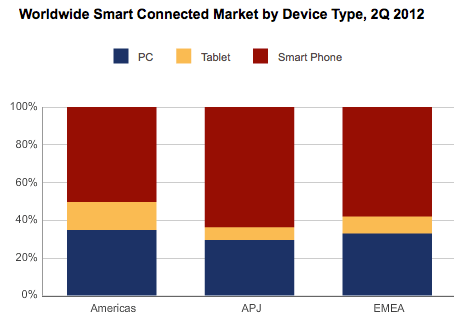
Smart Phones Will Grow Share of Smart Devices Through 2016
Tablets will grow the fastest, though, rising from a 10 percent share in 2012 to 13 percent by 2016.
PC share will drop from 31 percent to 24 percent during the same time period.
Gary Kim was cited as a global "Power Mobile Influencer" by Forbes, ranked second in the world for coverage of the mobile business, and as a "top 10" telecom analyst. He is a member of Mensa, the international organization for people with IQs in the top two percent.
App Users Younger, Wealthier
Among U.S. mobile device users, those who use apps tend to be younger and more affluent than those who stick just to the web, Forrester Research says.
Nearly a third of those who use mobile apps fall between the ages of 23 and 31, and another third are in the 32 to 45 category. So roughly 66 percent of app users are younger than 46.
Usage varies by OS, however, and Apple’s iPhone app audience are generally younger and better off financially, while those on Android tend to be older and less moneyed.
Gary Kim was cited as a global "Power Mobile Influencer" by Forbes, ranked second in the world for coverage of the mobile business, and as a "top 10" telecom analyst. He is a member of Mensa, the international organization for people with IQs in the top two percent.
Subscribe to:
Comments (Atom)
On the Use and Misuse of Principles, Theorems and Concepts
When financial commentators compile lists of "potential black swans," they misunderstand the concept. As explained by Taleb Nasim ...
-
We have all repeatedly seen comparisons of equity value of hyperscale app providers compared to the value of connectivity providers, which s...
-
It really is surprising how often a Pareto distribution--the “80/20 rule--appears in business life, or in life, generally. Basically, the...
-
One recurring issue with forecasts of multi-access edge computing is that it is easier to make predictions about cost than revenue and infra...