Tuesday, May 21, 2013

European Mobile Revenue: Structural or Cyclical Problems?


Vodafone is the world’s second-largest mobile service provider or perhaps the seventh largest, as measured by revenue. In its past year ending in March 2013, Vodafone revenue fell 4.2 percent  to £44.4 billion.

The shortfall was caused principally by economic conditions in Europe and new EC rules on wholesale termination revenue, both of which are hitting revenues in European markets.

But there is a broader trend at work. In developed markets, revenue drivers continue to evolve.

Before 2000, global telecom revenue growth was driven by voice revenues. After 2000, as voice declined, total revenue was sustained by growth of mobile service revenues, driven by voice, and then supplemented by text messaging revenue.

So mobile service revenues became the growth driver for the global business, which also expanded to include the formerly separate video entertainment business.

In many markets, though, mobile voice revenue now is flagging, as are text messaging revenues. In the business as a whole, growth rates of mobile revenue have been dropping since 2007, while average mobile revenue per subscriber has been under pressure as well, as first voice usage and now text messaging usage has begun a decline.

The obvious next growth driver is mobile data, which grew about 14 percent. But Vodafone’s revenue issues show that is not an easy or foolproof process. Mobile data revenue is growing, to be sure.  

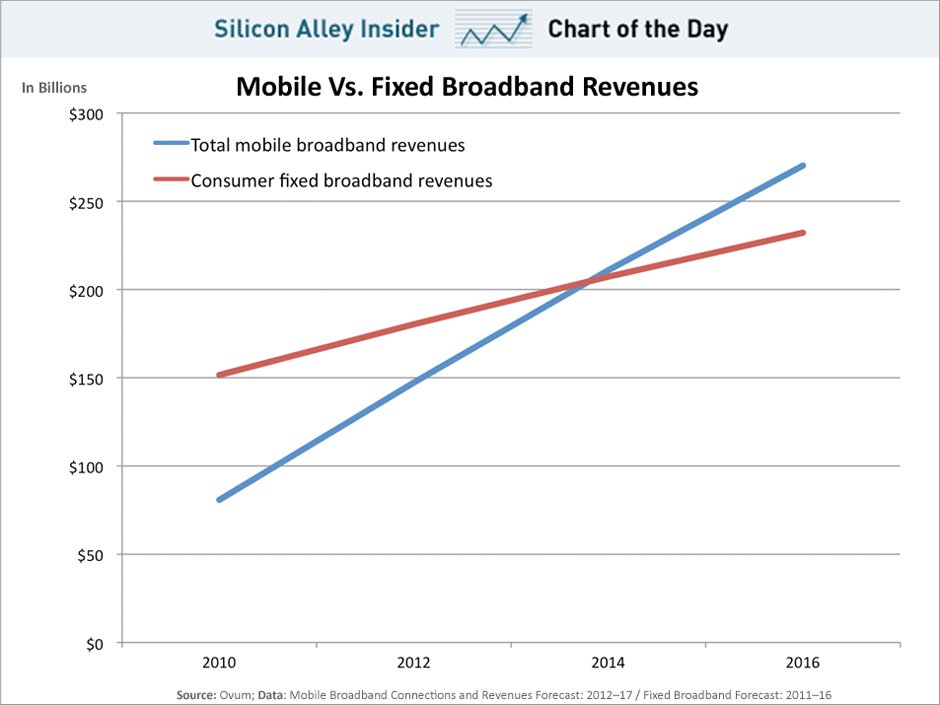
In 2014, telecommunications companies will make more money from mobile broadband than from fixed broadband for the first time.

But nothing remains the same in the communications business, these days. At some point, as smart phones displace most use of feature or basic phones, and as most consumers therefore start buying mobile data plans, mobile data will itself become a legacy revenue source.
So the big question is “what comes next?” For most service providers, machine-to-machine services are part of the answer. Bigger mobile data plans, generating more revenue, are part of the answer as well. For some, mobile applications will be part of the creation of new revenue sources. Mobile payments, mobile banking and mobile commerce likewise are among the potential new sources of revenue.

The point is that the next big transition for the mobile industry will come rather soon. And that transition will entail the maturation of the mobile data revenue “growth” story and its eventual replacement by a next wave of revenue drivers.

Much will hinge on how fast those new sources can be developed and scale.


1-Gbps LTE? Yes, But You Need 40 MHz of Bandwidth

There is a simple answer to the question of why mobile service providers and would-be providers want more spectrum. As usage continues to climb, and as access speeds continue to climb, there is little chance of boosting access speeds, in the mobile or fixed wireless realms, without adding more spectrum.

For example, it is possible to deliver 1-Gbps mobile Internet access using Long Term Evolution, but that requires a 40-MHz block of spectrum, not the 10 MHz or 20 MHz channels now used by LTE providers.

LTE Advanced vs LTE
Numerical superiority: LTE Advanced vs LTE
Source: 3GPP


Monday, May 20, 2013

Dish Network Offers $2 Billion for LightSquared’s Spectrum

imageDish Network reportedly has offered to buy LightSquared spectrum, offering $2 billion for LightSquared's 60 MHz of spectrum.

LightSquared apparently has until May 31, 2013 to accept the offer, which was made May 15, 2013, Bloomberg reports.

Dish already has received Federal Communications Commission permission to use former mobile satellite service spectrum to create a terrestrial Long Term Evolution network.

Dish had acquired that spectrum for $3 billion from bankrupt satellite companies DBSD North America Inc. and TerreStar Networks.


As with most initiatives undertaken by Charlie Ergen, Dish Network CEO, there typically are a number of ways to monetize an asset. Ergen always has believed spectrum has value, whether to support an on-going business venture or simply as an asset to be sold. 

But most observers might agree that Dish Network is acting as though it has clear intentions of entering the mobile business, and is not simply "bluffing."


Google Hangouts Video on AT&T Getting Broader Support


Mobile service providers have had a complicated relationship with over the top applications viewed either as displacing existing revenue-generating services (carrier voice services) or imposing high loads on mobile networks (video apps and video conferencing apps).

That is one reason why, at least initially, use of Apple iPhone “FaceTime” was restricted to Wi-Fi access on the AT&T mobile network, for example.

To be sure, there are both public policy issues (can a person use a lawful application) and .  management issues (how do resource intensive apps get access to the network?) In the past, there also have been business model issues (can a mobile service provider support unlimited use of video for a flat rate price?)

Google Hangouts provided the most recent issue. Hangouts unifies Google messaging services, including video chats and conferencing. But AT&T indicated initially that video chats could be used only on Wi-Fi networks.

AT&T seems to have quickly clarified that policy, at least for some users. AT&T originally had allowed mobile use of Hangout video chats on Apple, Samsung and BlackBerry devices used on “Mobile Share” or tiered data plans (3G). Long Term Evolution support will be enabled by mid-June, AT&T says.

In the second half of 2013, AT&T will enable pre-loaded video chat apps that work on the mobile network for all customers, regardless of data plan or device; that work is expected to be complete by year end.

Today, all of its customers can use any mobile video chat app that they download from the Internet, such as Skype, AT&T also says.

Smart Phone Shipments Will Pass Feature Phones in 2013


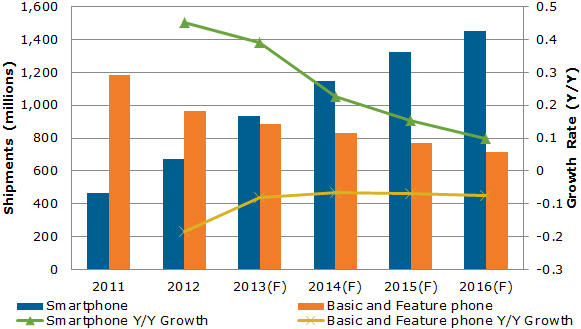
Global smart phone shipments will surpass shipments of basic and feature phones for the first time in 2013, according to NPD.

Global smart phone shipments are expected to reach 937 million units in 2013, compared to just 889 million units for basic phones and feature phones.

Between 2011 and 2016, smart phone shipments will grow at a compounded annual growth rate of 26 percent, to 1.45 billion units, which will account for 66 percent of the mobile phone market.

Emerging markets are driving most of the smart phone growth, NPD researchers say.  In these markets, entry-level smart phones priced below $200 are important.

China leads in the entry-level smart phone category, comprising 55 percent of shipments. China is also the largest market for smart phones as a whole, and the Asia-Pacific region will account for over 50 percent of smart phone shipments in 2013.

At the high end of the market, LTE-enabled smart phones will reach 23 percent market share in 2013, NPD DisplaySearch says.

Screen sizes are also changing. In 2013, more than half (57 percent) of smart phone displays will range between four and five inches, while screens larger than five inches will grow to 16 percent of the market.


How Big a Revenue Boost from LTE?


Whenever a next-generation mobile network replaces an older network, there typically is room for both product substitution that does not dramatically affect total revenues, and incremental revenue lift, initially from higher prices, and later from new services.


Juniper Research forecasts Long Term Evolution network subscribers will double from an estimated 105 million subscribers in 2013 to nearly 220 million in 2014.

What that means in terms of incremental revenue is less clear, though many service providers are using the LTE rollout as an opportunity to raise data plan prices. In many markets, 4G data plans will simply cannibalize 3G plans, with some incremental revenue lift if operators are able to charge a 4G pricing premium.

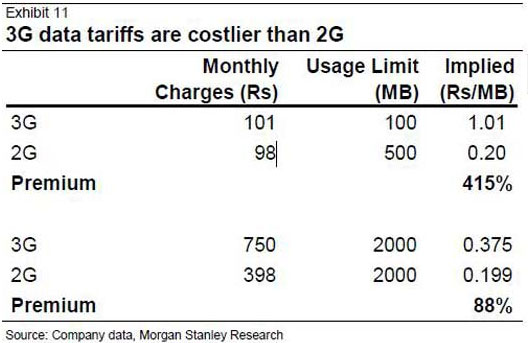
That might be more the case in developing markets, where 3G cost premiums over 2G rates were quite significant.

But market conditions might lessen the amount of price premium possible in particular markets. In many markets, 4G tariffs had to be lowered, or usage buckets increased, while price remained constant,  because of market conditions.

And some competitors have simply chosen not to charge a premium for LTE access.

In some cases, consumers think the 4G prices are too high.


That is not to say new applications are unimportant. It might turn out that revenue lift occurs for indirect reasons, such as users consuming more mobile data as appetites for mobile video entertainment consumption continue to grow.

It also is possible more consumers will start using tethering features for their tablets and PCs, which likewise will increase consumption. The point is that, even in the absence of new apps, mobile service providers should see incremental revenue from 4G.

But the “gross revenue” figures we will be seeing will have to be weighed against the cannibalization of 3G data revenues.

“To some extent, 4G may not impact mobile innovation the way 3G did,” observes Dan Hays, PwC US Wireless Advisory Leader. “We may be more likely to see second order effects from 4G rather than new things enabled by the technology itself.”

In other words, there might not be as much application innovation as some believe, nor might the revenue lift revenue lift be as significant as some believe.

“I believe 4G will enable operators to deliver a more consistent experience, more ubiquitously,
at a lower cost and allow them to make money and stay in business,” said Hays. That sounds a bit like the upside from fiber to home networks.

There is some revenue upside, particularly from video entertainment services. But much of the benefit comes from “future proofing” or lower operating and repair costs. Lower costs per bit is one advantage, for example.

Saturday, May 18, 2013

Two Orders of Magnitude More Access Speed Within 10 Years? History Says "Yes"

If history is any guide,  gigabit Internet access will not be at all rare in a decade, though how much demand for 1-Gbps might well hinge on retail pricing levels.

In August 2000, only 4.4 percent of U.S. households had a home broadband connection, while  41.5 percent of households had dial-up access. A decade later, dial-up subscribers declined to 2.8 percent of households in 2010, 68.2 percent of households subscribed to broadband service.

If you believe gigabit access is to today’s broadband as broadband was to dial-up access, and you believe the challenge of building gigabit networks roughly corresponds to the creation of broadband capability, a decade might be a reasonable estimate of how long it will take before 70 percent of U.S. homes can buy gigabit access service, and possibly 50 percent do so.

Consider that by June 2012 about 75 percent of U.S. households could buy a service of at least 50 Mbps, while half could buy service at 100 Mbps. So it took about a decade to put into place access at two orders of magnitude higher than the baseline (dial-up speeds).

The key distinction is between “availability” and “take rate.” Even though consumers are starting to buy faster access services, most seem to indicate, by their buying behavior, that 20 Mbps or 25 Mbps is “good enough,” when it is possible to buy 50 Mbps or 100 Mbps service.

In the U.K. market, for example, though service at 30 Mbps is available to at least 60 percent of homes,  buy rates were, in mid-2012, at about seven percent (to say nothing of demand for 100 Mbps).  

The European Union country with the highest penetration of such services was Sweden, at about 15 percent, in mid-2012.

To be sure, retail prices are an issue. With relatively few exceptions, U.S. consumers tend to buy services up to 25 Mbps, and price for a gigabit service is probably the main reason.

That is the reason behind Google Fiber's disruptive pricing for gigabit access at $70 a month. That pricing umbrella implies far lower prices for 100 Mbps service than consumers can buy at the moment.

And that is every bit as important as the headline gigabit speed. If a gigabit connection costs $70 a month, will a 100-Mbps connection cost $35 a month?

On the Use and Misuse of Principles, Theorems and Concepts

When financial commentators compile lists of "potential black swans," they misunderstand the concept. As explained by Taleb Nasim ...