Sunday, July 21, 2013

Google Fiber Enables Sightdeck

One reason Google Fiber was launched was to show what innovations are possible when gigabit Internet access is available. 

Sightdeck, developed by iMatte, is one such example.

Sightdeck is a fully integrated display system, camera system, compositing system, presentation system, full HD production system and broadcast studio; all in one system for one price, and made possible by symmetrical gigabit Internet connections.

Sightdeck suggests the system can be used for collaboration, distance learning, real-time editing and business conferencing, for example.

So far, those are some concrete examples of new apps or services enabled by gigabit speeds. By extension, the same should be true of any other cloud-based service.

Saturday, July 20, 2013

It's Wrong to Borrow Today, Stick the Repayment on Your Kids and Grandkids

The reason many U.S. voters are outraged by $17 trillion in federal government deficits is that it represents inter-generational borrowing: simply, older people borrow to support their benefits today, while leaving the repayment for their children, grandchildren and great grandchildren.

It’s wrong. It’s just that simple.

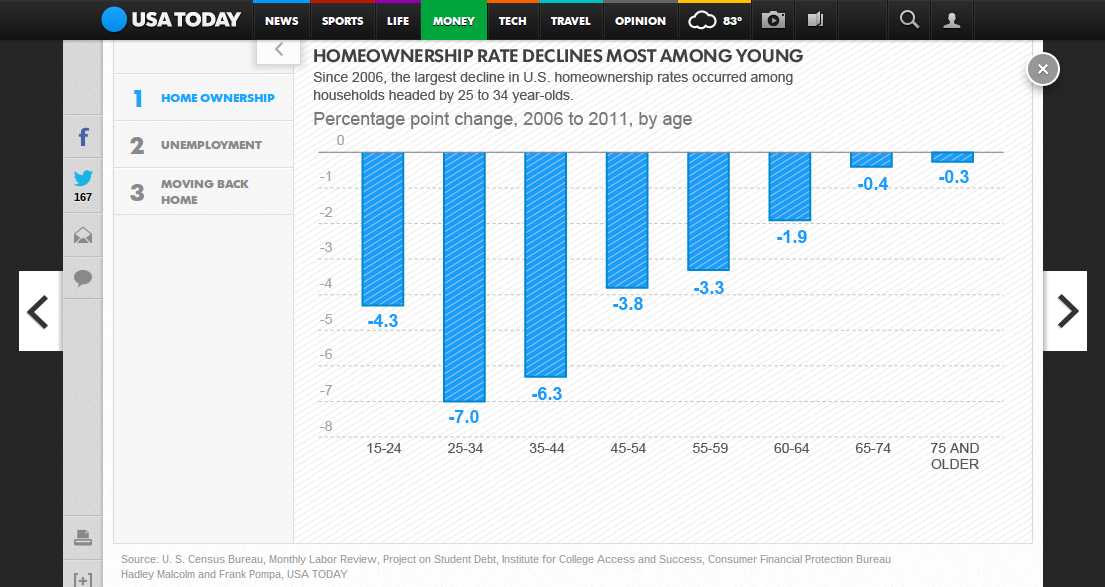
High unemployment and debt loads arguably have led to a decreased ability to save for a down payment or qualify for a mortgage.

Between 2006 and 2011, those 25 to 34 experienced the largest decline in home ownership rates in the country, according to a USA Today analysis of Census Bureau data.


Source: U. S. Census Bureau, Monthly Labor Review, Project on Student Debt, Institute for College Access and Success, Consumer Financial Protection Bureau

Hadley Malcolm and Frank Pompa, USA TODAY

5G Might Not be About Layer One

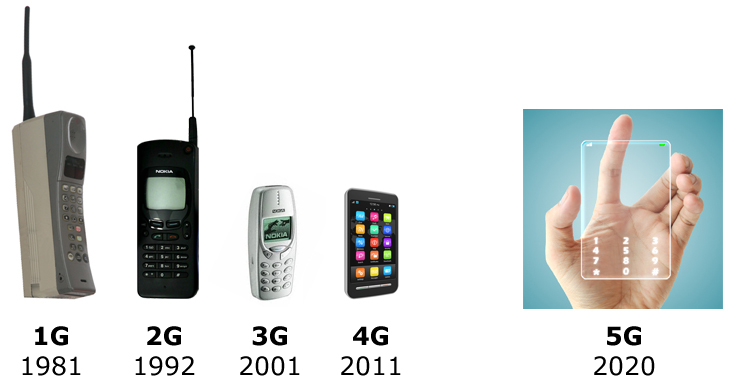
Up to this point, mobile network generational advances have largely been about layer one access, especially the air interface, on the subscriber-facing side of the network. 

Whether that will be the case in the future now is seen by some as the defining issue for future potential 5G networks, which in principle might for the first time not directly be defined by a different air interface.

At least, that is how Intel Labs views the matter. Instead, Intel seems to believe, 5G will be about pervasive connectivity, and therefore network features at layers other than layer one.

5G technologies will, in intel's view, focus more on uniform experience throughout the network by offering a consistent level of connectivity and connection quality, across networks and air interfaces. 

Intel also believes 5G will be more about user personalization, the sort of thing standards bodies will not be able to define with much precision, if at all. For that reason, some question the claims by some, such as Samsung, about what 5G will be, sometime in the future. 

As Intel sees matters, 5G will be about a network of networks that enables personalized and ubiquitous connectivity, across networks, more than network speed or air interface protocols. 

Friday, July 19, 2013

"Less Change Than You Think, Near Term; More Than You Think Later"

Important innovations in the communications business often seem to have far less market impact than expected. 

That is one reason why the Gartner notion of the “hype cycle” resonates. 

In most cases, innovations are expected to have large impact “soon,” and often fail to deliver on those expectations, leading to a period of disillusionment and then finally to useful deployment. 

Even really important and fundamental innovations (steam engine, electricity, automobile, personal computer, World Wide Web) can take much longer to produce measurable changes. 

Quite often, there is a long period of small, incremental changes, then an inflection point, and then the whole market is transformed relatively quickly.

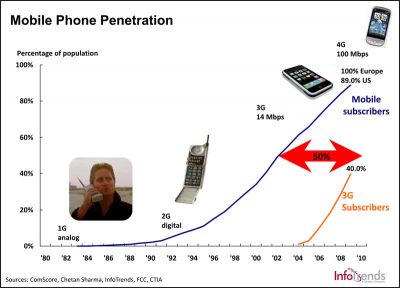
Mobile phones and broadband are among the two best examples. Until the early 1990s, few people actually used mobile phones, as odd as that seems now. 

Not until about 2006 did 10 percent of people actually use 3G. But mobiles relatively suddenly became the primary way people globally make phone calls and arguably also have become the primary way most people use the Internet, in term of instances of use, if not volume of use. 

 Prior to the mobile phone revolution, policy makers really could not figure out how to provide affordable phone service to billions of people who had “never made a phone call.” 

That is no longer a serious problem, and the inflection point everywhere in the developing world seems to have happened between 2002 and 2003. 

Before 2003, one could assume that most people in the developing world could not make a phone call easily. 

A decade later, most people use mobile phones. That would have been impossible to envision, in advance of the reaching of the inflection point.

What is Impact of Early Device Upgrade Plans?

The competitive impact of new device upgrade plans launched by T-Mobile USA, AT&T and Verizon Wireless is hard to determine at the moment. T-Mobile USA might have hoped its plan would not soon be copied by the other leading national service providers, but with the exception of Sprint, the competitive response came quickly.


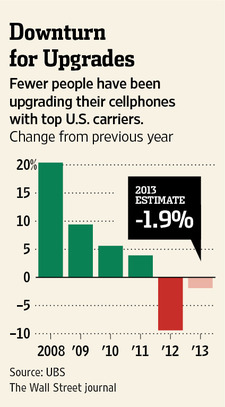
Also, there are signs that consumers are upgrading their devices more slowly than they had been doing in the past several years.


According to analysts at UBS, replacement rates actually turned negative in 2012, when device upgrades dropped about nine percent, year over year.

UBS predicts upgrades will fall again in 2013. So it is unclear how much demand exists for more-rapid upgrade cycles on smart phones. In principle, the new plans allow for upgrades as often as every six months to a year, depending on the service provider and the payment plans subscribers choose.


Nor is it entirely clear whether handset subsidies are “good” or “bad” for consumers who choose to buy service plans featuring bundled devices. 

A study by the Organization for Economic Cooperation and Development suggests the advantages of unbundled device plans are somewhat nuanced and subtle.


For those countries where both bundled and “bring your own device” options exist, such as in France or the United States, the report concludes that the bundled option (with discounted smartphone) was, on average, between $10 and $20 a month more expensive than the BYOD option.


“This is not unexpected,”  a new OECD report shows. When service providers bundle or subsidize a device over time, they essentially are loaning the customer money. The difference in cost over three years essentially represents the cost of credit.


There are other consumer advantages, but they are a bit subtle. Unbundled phone sales can have a positive impact on both consumers and the ecosystem that exists around smartphones, the report suggests, in the area of price transparency, for example.


But the report also concludes that, in broad terms, service pricing is only slightly affected by the presence of bundled discounts for popular smart phones.


On the other hand, in many cases, consumers possibly pay higher costs over three years, when purchasing a device that is bundled with a service plan.


But bundled devices are beneficial for consumers by removing high upfront payments that are a deterrent to use of high-end smart phones.


In some cases, there also are service provider effects. The report notes that there is some evidence that when one mobile service provider provides subsidized devices, and others do not, the non-bundling carriers suffer marketplace damage.


In Spain, Telefonica and Vodafone, the two operators with the largest market share, decided to remove handset subsidies in February 2012 (Cinco Dias, 2012).This action was not followed by Orange (Spain) which gained market share from Telefonica and Vodafone during the first half of that year.


Possibly as a result of this experience Vodafone reintroduced what it described as a short term special offer, which included the price of a handset, at the end of July 2012.

The point is that benefits and costs for early device upgrade plans, or bundled or unbundled device sales, are quite subtle.

European Service Providers Continue to Face More Market Troubles than North American Providers

New financial results from service providers in North America and Europe continue to show the disparate fortunes of tier-one service providers in those regions.

Verizon Communications reported second-quarter 2013 results that stand in high contrast to results many Europe-based service providers are likely to post in 2013, across both Verizon’s fixed network and mobile lines of business.

Service revenues in the quarter totaled $17.1 billion, up 8.3 percent year over year. Retail service revenues grew 7.8 percent year over year, to $16.4 billion.

Verizon Wireless generated $20 billion in second-quarter revenues, up 7.5 percent year over year. Postpaid average revenue per account rose 6.4 percent to $152.50. Wireless operating margin came in at 32.4 percent, up from 30.8 percent for the same quarter of 2012.
In the wireline business, revenues increased 4.7 percent to $3.6 billion in the second quarter, with most of the growth coming from Verizon’s FiOS service. Verizon added 161,000 net new customers to its FiOS Internet service and 140,000 to its FiOS video service. FiOS Internet service is up 12.2 percent compared with the second quarter of 2012, and FiOS video service is up 12.6 percent.

Vodafonel Group service revenue including joint ventures declined 3.5 percent; or 1.3 percent excluding joint ventures. Though revenue grew strongly in Turkey at 15.5 percent and India at 13.8 percent, revenues in Germany declined 5.1 percent and 4.5 percent in the United Kingdom.

Revenue in Italy dropped 17.6 percent, while in Spain revenue dropped 10.6 percent.

Telefonica, Europe's biggest telecom operator (ranked by revenue), in May 2013 reported a 11.7 percent revenue drop to 6.7 billion euros ($8.8 billion) for its European operations in the first quarter, with total revenue down 9 percent at 14.1 billion.

Deutsche Telekom said revenue in Europe shrank 6.9 percent to 3.33 billion euros, while overall revenue fell 4.5 percent to 13.8 billion.

But there are perhaps signs that Verizon is being forced to spend a bit more to propel those earnings. Verizon operating expenses were up 1.4 percent year over year.

Sales, general and administrative expenses were up 2.2 percent in the quarter to more than $8 billion.

Verizon also is slightly increasing its capital spending guidance from $16.2 billion in 2013 to a new range of $16.4 billion to $16.6 billion, with the capital slated for deploying new wireless data and services spectrum in the second half of 2013.

Retail postpaid average revenue per account increased 6.4 percent over the second quarter 2012, to $152.50 per month.

The number of retail postpaid customers grew by 941,000 in the quarter, bringing Verizon’s total number of retail connections to 100.1 million, up 6.3% compared with the second quarter of 2012.

Mobile  operating income margin was 32.4 percent, compared with 30.8 percent in second quarter of 2012. EBITDA margin on service revenues was 49.8 percent.

Fixed network consumer revenues were $3.6 billion, an increase of 4.7 percent compared with second-quarter 2012. Consumer ARPU for wireline services increased to $109.67 in second-quarter 2013, up 9.4 percent compared with second-quarter 2012.

FiOS revenues grew 14.7 percent, to $2.7 billion in second-quarter 2013, compared with $2.4 billion in second-quarter 2012. ARPU for FiOS customers continued to be more than $150 in second-quarter 2013.

Sales of strategic services to global enterprise customers increased 4.8 percent compared with second-quarter 2012 and represented 57 percent of total enterprise revenues, compared with 52 percent in second-quarter 2012. Strategic services include cloud and data center services, security and IT solutions, advanced communications, strategic networking and telematics services.


Gigabit Speed Prompts Kansas City Library to Lend Productivity Apps

One of the claimed advantages for enabling faster Internet access is that doing so encourages developers to create new applications that take advantage of those higher bandwidths. One might point to the precedent of the World Wide Web, real-time applications of all sorts and video-heavy apps as examples of what happens when faster Internet access is available.


It appears one example is a new plan by the Kansas City Public Library to provide access to high-end productivity software such as Microsoft Office, Adobe Photoshop and Adobe Premier, to library patrons.


With the help of the Mozilla Ignite Challenge, intended to foster applications that take advantage of gigabit-per-second Internet speeds, the Kansas City Public Library is developing a high-speed Software Lending Library that will allow users to “check out” applications hosted by the library.


According to the proposal, the library can do so because of gigabit speeds provided by Google Fiber, which will enable library patrons to access brand-name business software from gigabit-wired locations even using low-performing or older computers and devices.

So far, that is one concrete example of a new app enabled by gigabit speeds. By extension, the same should be true of any other cloud-based service.

On the Use and Misuse of Principles, Theorems and Concepts

When financial commentators compile lists of "potential black swans," they misunderstand the concept. As explained by Taleb Nasim ...