Tuesday, August 13, 2013

Mobile Business Now Faces "End of Growth" Driven by Subscriber Adds

In the second quarter of 2013, U.S. mobile service providers added an aggregate net new 139,000 connections, down about 95 percent from the second quarter of 2012.

It might not yet be possible to say we are at "peak mobile," in terms of the market top in terms of subscribers, but we are getting close. 

Of course, mobile execs have seen this coming for a long time, so it is not a shock nor a surprise. As execs in the video entertainment and fixed network telecom business learned years ago, markets saturate.

When that happens, revenue growth becomes largely unhinged from growth of "lines" or "subscribers." You start hearing terms such as "revenue units." The reason is drop dead simple: when markets saturate, service providers cannot grow by adding subscriber units. 

Instead, they have to start selling more things to a fixed or declining number of subscriber or customer accounts. 

If you want to know why mobile service providers globally are investing in mobile payments, machine to machine services, connected car, mobile commerce, mobile app, home security or mobile advertising initiatives, as well as gearing up for a wave of consolidation, the end of subscriber-driven growth is the reason. 


The almost non-existent subscriber growth is not a shock or a surprise. It has been coming for some time, and service providers had begun a serious movement to new revenue sources some time ago. 

7% of Surveyed Mobile Execs Think Joyn Will Succeed; Only 7% See Skype as Top Messaging Threat

Only seven percent of 40 surveyed mobile executives believe Joyn--the GSMA-backed messaging service, is the solution to combat over the top voice and messaging services such as Facebook, Skype and WhatsApp.


Another 29 percent of surveyed mobile service provider executives say Joyn had the potential to be the solution, but it has taken too long to launch and is too complex. Joyn would need virtually ubiquitous global operator support, and many respondents doubt that will happen.


The study was conducted by mobilesquared and sponsored by messaging service provider tyntec.
The international survey also found that 36 percent of respondents are uncertain of the impact the GSMA-based standard will have on their ability to compete with OTT messaging suppliers, the
Not so surprising, for a firm such as tyntec that competes with Joyn, the study suggests the threat to revenues continues to build, and more mobile service providers decide they should cooperate with, not compete with, the leading over the top messaging services.
Some 36 percent of mobile operators now partner with OTT providers, up from 32 percent in 2012, according to tyntec. About 36 percent of operators believe WhatsApp presents the greatest threat, followed by Google and Facebook, each of which is viewed as the greatest threat by 21 percent of respondents.


Apple was viewed by 14 percent of respondents as being the top threat.


And times have changed. Remember when Skype was seen as the top challenger? The survey found only seven percent of respondents viewed Skype as the ost significant threat to revenues.


Perhaps that is because mobile operators already are resigned to losing international voice revenue, while messaging revenue is viewed as the latest battlefield.


More Consolidation in U.S. Mobile Market is an Easy Call


The U.S. mobile data market predictably continued to grow in the second quarter of 2013, up more than four percent quarter over quarter and more than 14 percent year over year. 

On a broader level, one might easily make a prediction that market prospects for smaller regional service providers now are disappearing, though, as growth has shifted to the four largest national service providers.


How Much Will Global Telecom Revenue Grow in 2013?

Despite obvious stresses, global telecom revenue has tended to grow, in nearly every year. There tend to be dips when global recesssions occur, as in 2008, or in the wake of major market crashes, such as in the wake of the Internet bubble burst of 2000.

Global trends also are a mix of declining, flat to slow growth in developed regions, with growth in emerging markets.

Looking just at enterprise and government segment spending, 2013 looks like a one percent to two percent growth business in 2013. 

Global information technology spending is projected to total $3.7 trillion in 2013, a two percent increase from 2012 spending of $3.6 trillion, according to the latest forecast by Gartner.

But enterprise and government telecom spending actually declined in 2012, and might grow less than one percent in 2013, according to Gartner.

                      Worldwide IT Spending Forecast (Billions of U.S. Dollars)
2012
Spending
2012
Growth (%)
2013
Spending
2013
Growth (%)
2014
Spending
2014
Growth (%)
Devices
676
10.9
695
2.8
740
6.5
Data Center Systems
140
1.8
143
2.1
149
4.1
Enterprise Software
285
4.7
304
6.4
324
6.6
IT Services
906
2.0
926
2.2
968
4.6
Telecom Services
1,641
-0.7
1,655
0.9
1,694
2.3
Overall IT
3,648
2.5
3,723
2.0
3,875
4.1
Source: Gartner (July 2013)

Fixed broadband is showing slightly higher than the overall telecom services rate. The impact of voice substitution is mixed as it is moving faster in the consumer sector, but slightly slower in the enterprise market, though, according to Gartner.

Gartner’s latest annual survey of 1,959 CIOs worldwide from all industries was conducted in the fourth quarter of 2012 and represents CIO budget plans reported at that time. It included 398 public-sector CIOs from all tiers of government around the globe.

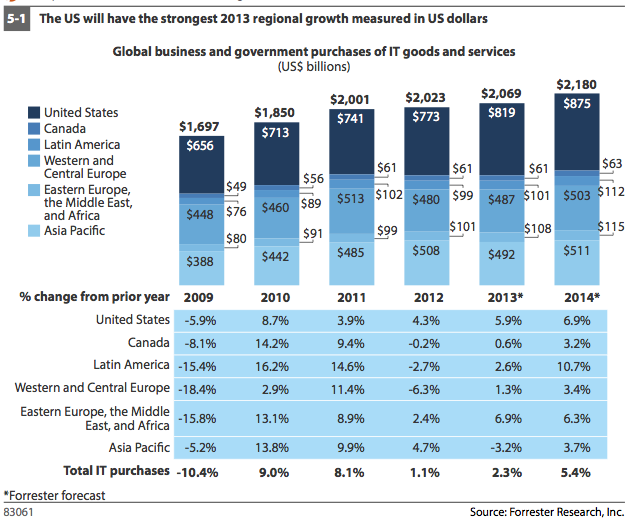
But there will be significant regional differences. The United States, Eastern Europe, Middle East and Africa will grow much faster than Asia-Pacific or Western Europe as a whole, for example.


To be sure, other forecasts are more optimistic. As recently as two years ago some forecasters actually were suggesting global telecom revenues could double in just about five years. That now seems hopelessly wrong.

The global telecommunications industry was not immune to economic forces in 2012 that slowed growth from earlier predictions, according to Insight Research.

Spending for wireline services contracted in 2012, while spending on wireless services grew modestly.  

According to the new industry market study, telecommunications services revenue worldwide will grow from $2.2 trillion in 2012 to $2.7 trillion in 2018 at a combined average growth rate of 3.8 percent.

So Insight Research continies to be more optimistic than do Gartner or Forrester Research analysts.

Mobile subscriber growth compounded with rising usage  will raise wireless revenues by 31 percent from current levels, yet wireline revenues will remain flat until substantial economic recovery kicks in, Insight Research predicts.

Ethernet, cloud, and mobile solutions revenue will show double-digit annual percentage growth, though.

In North America, mobile revenues will grow by 35 percent and wireline broadband revenues will grow by 19 percent over current levels.

Telekom Austria and KPN Wholesale Fiber Network a Sign of "Peak Telecom?"

Telekom Austria and Dutch group KPN have formed a new optical fiber wide area network linking 35 countries, and allowing Telekom Austria to use KPN's network for its customers in western Europe while KPN can use Telekom Austria's network in central and eastern Europe.

Under some circumstances, that would simply represent another bilateral deal between two carriers with complementary network assets. But one might argue we are not seeing normal circumstances in the European telecom market. 

Since about 2008, fixed network revenues have dipped about three percent annually, while mobile revenues have declined about eight percent annually. 

In other industries, such as the oil business, similar trends (declines)  have lead forecasters to talk about "peak oil" and the corollary, the decline of oil production. In Europe, one might wonder whether we already have seen "peak telecom."

If so, and if service providers cannot quickly figure out ways to reverse the revenue declines, mergers and acquisitions are inevitable, as that is one proven way to temporarily bolster declining revenues in a declining business.

It perhaps is noteworthy that the new deal links two firms in which Mexican telecom magnate Carols Slim has investments. The new fiber network is not necessarily an indication of what might happen in the future. But given Slim's obvious interest in becoming a player in European telecommunications, an eventual merger between KPN and Telekom Austria would not be out of the question. 

Both assets could play a role in Slim gaining a foothold in the lucrative German market. 


Orange Money Expands into Retail Payments, Branded Prepaid Cards in Africa

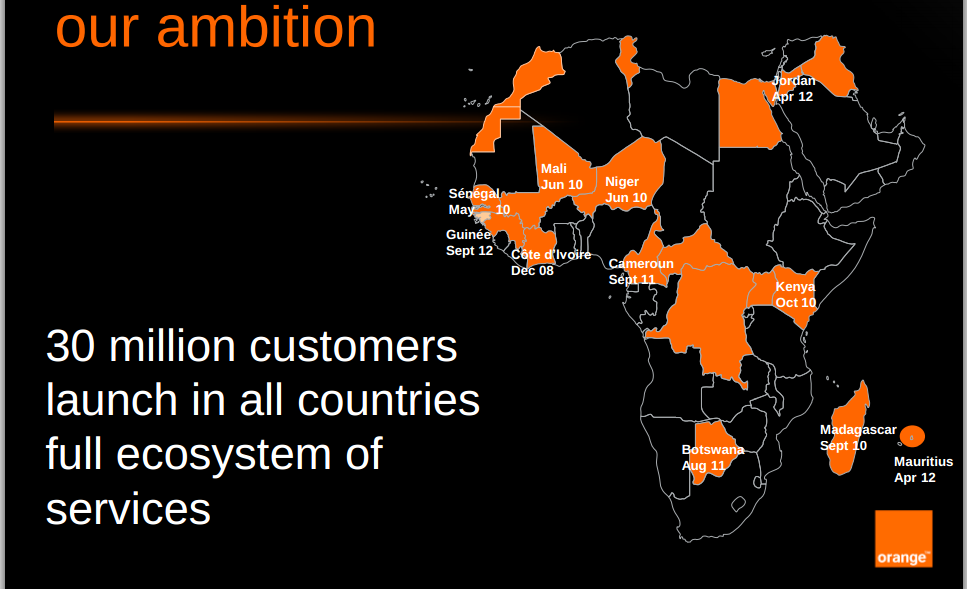
Orange is launching mobile payment services in partnership with Visa that will extend the range of operations for Orange Money beyond “mobile payments.” Though it is premature to speculate on just how far Orange will move into the banking business, Orange Money now will be issuing its own branded prepaid cards.


Whether most mobile service providers eventually will become “banks,” at least to some degree, is one question the initiatives raise.


Rogers in Canada already is certified as a bank by Canadian regulators, though it still appears Rogers is most interested in offering branded credit card services, not undertaking broader banking operations.


That is a traditional banking function, as is the processing of money exchanges between people and institutions.


Botswana is slated to be the first country to get the new point-of-sale, online and ATM transaction options, in addition to the existing ability to use mobile phones to send and receive money and pay bills.


Starting in August 2013, though, Orange Money subscribers in Botswana will be able to use their Orange Money account to make Visa enabled payments and pay invoices at stores, international online merchants and at over 300 Visa ATMs across the country.


That moves Orange Money into the retail payments business in a new way.


Is "mobile banking" a key revenue opportunity for mobile service providers, or not? The answer is that "it depends" on what you mean by "mobile banking,” where those operations are conducted and how the business evolves.


According to a  survey by ACI Worldwide, 76 percent of Indian mobile respondents used their mobiles for mobile banking in last six months (in 2012).


Comparatively, only 38 percent of  respondents from the United States, and 31 percent from the United Kingdom said they had used mobile banking in last six months.


Obviously, money transfers are a bigger opportunity in regions where retail banking services are relatively rare, and less an opportunity where banking infrastructure is highly developed.


China, came in after India with 70 percent of users using mobile banking followed by South Africa (61 percent). The global average for Mobile Banking adoption rate stands at 35 percent of mobile users.


Where both online banking using PCs, and branch bank infrastructure are highly developed, people tend to use mobile banking to check balances or move money between accounts.


In regions where the banking infrastructure is undeveloped, and availability of PCs and Internet access is limited, people more often use mobile banking as a way to move money from one person to another, or from person to organization (to pay a utility or school bill, for example).


As you would guess, the revenue opportunity for a "mobile banking" services supplier is greater, and more direct, in scenarios where peer to peer payments are involved. As people pay fees to Western Union to move money, so mobile banking in a P2P context represents per-transaction fees that are easy to measure.


That is not the case for "softer" mobile banking transactions conducted in regions where the banking infrastructure is highly developed. In Western Europe or North America, for example, mobile banking more often is used in place of an online session to check balances, rather than as a way to move money from person to person, or person to organization.


Subscribers will need to have an Orange Money prepaid Visa card that is linked to their existing Orange Money account. The card will enable use of those funds to make point-of-sale payments at retailers and withdraw cash at ATMs, as well as make web purchases.


Other countries in Africa and the Middle East, where Orange Money is already available, will eventually offer the Orange Money prepaid Visa card as well.


Safaricom’s M-Pesa already offers the same service through Safari Pre-Pay card offered in conjunction with I&M Bank.


The moves illustrate one of the potential ways mobile service providers or telcos might diversify their core operations to replace declining voice and messaging revenues.


Mobile payments, something AT&T, Verizon Wireless and T-Mobile US now are preparing to introduce as a nationwide commercial service, is another example.


Isis, the mobile wallet service owned by the three carriers, plans its national U.S. launch before the end of 2013.


It is some measure of the new services revenue challenge now facing communications service providers in the developed regions that mobile payment and mobile banking are serious initiatives.


But it is hard to see right now just how far matters could eventually progress. What is clear is that Orange considers mobile money and possibly other mobile banking opportunities serious indeed.


Monday, August 12, 2013

CenturyLink Touts 1 Gbps

To be sure, only some users in some parts of Omaha, where Qwest Communicatons had installed fiber to the home, originally to test IPTV services, will be able to buy this 1-Gbps service. But the offer itself shows the impact Google Fiber has had in the U.S. ISP market. 

Over the long term, it won't matter so much that such "hero" services are not widely available from most ISPs. The point is that Google Fiber now is resetting consumer expectations about what a reasonable high speed Internet access offer includes. 

Access Network Limitations are Not the Performance Gate, Anymore

In the communications connectivity business, mobile or fixed, “more bandwidth” is an unchallenged good. And, to be sure, higher speeds have ...