Friday, October 23, 2015

EU Internet Access Coverage Reaches 99 Percent

A study prepared for the European Commission Directorate-General of Communications Networks, Content and Technology by IHS Global Limited, Valdani Vicari Associati shows Internet access coverage no longer is  problem within the European Union.

While availability is not the same as purchase, a variety of access platforms are widely available across the European Union, with digital subscriber line, 3G mobile and satellite having the widest availability. Broadly speaking, there is no lack of high speed access infrastructure in the European Union, though rural areas are tougher to serve, as always.

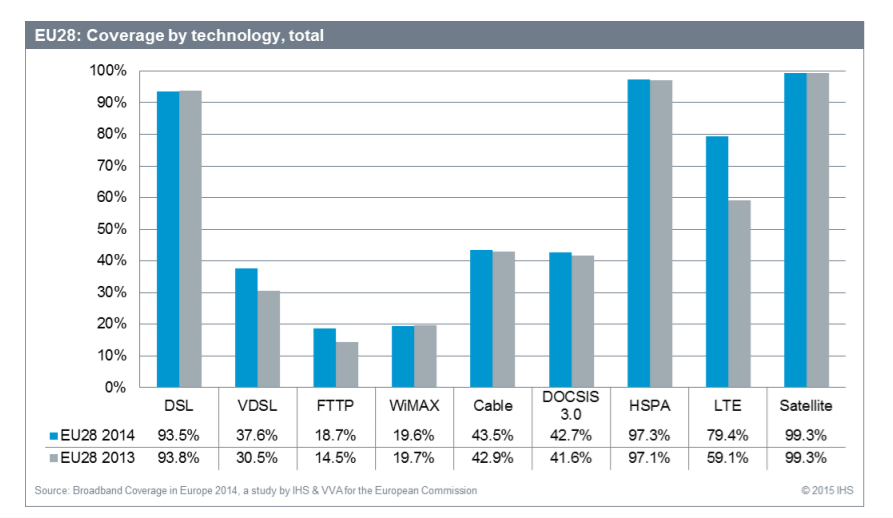
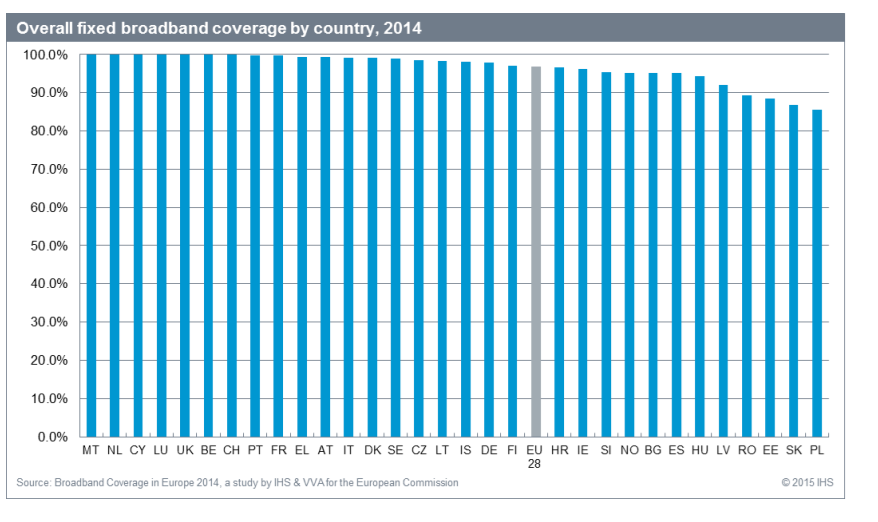
The study results show that over 216 million EU households (99.4 percent) had access to at least one of the main fixed or mobile broadband access technologies at the end of 2014 (excluding satellite).

VDSL coverage  increased by over seven percentage points throughout 2014, reaching 37.6 percent of households by the end of the year.

The proportion of homes passed by fiber to the premises networks increased by 4.3 percentage points to reach 18.7 percent, while DOCSIS 3.0 coverage grew slowly, reaching 42.7 percent of households covered in 2014 compared to 41.6 percent the previous year. Some 98.2 percent of cable connections are now DOCSIS 3.0 capable across the EU.

LTE coverage has increased from 59.1 percent to 79.4 percent.


Thursday, October 22, 2015

Spectrum Sharing that Does Not Displace Licensed Users is Coming

Spectrum sharing can take any number of forms, some methods being nearly indistinguishable from spectrum leasing, other forms using the model set by Wi-Fi (essentially uncoordinated sharing), and newer forms relying on various forms of spatial sharing (sharing allowed in some areas, not in others), time-based sharing (as some radio or TV broadcasters might do) and coordinated sharing (either using databases or cognitive radios).


One of the newer thinking about sharing involves sharing of existing licensed spectrum with new users, without relocating the existing users.


Licensed shared access ( LSA), for example, allows licensed services to share spectrum in a band with new users without disrupting existing users, while still increasing the amount of spectrum available for other users.

That is important for a number of reasons, the most important reason being that it is less disruptive than moving users from their current bands to give access to new users. Not only does this approach save the significant costs for relocating users and their access gear from one frequeny to another, it also creates new capacity much faster than any relocation approach requires.


Under the licensed shared access approach, additional users can use the spectrum (or part of the spectrum) in accordance with sharing rules that protect incumbents.


Such approaches almost always will require incentives for the incumbent users to permit sharing.


That might include direct payments from the new user or the regulator, payments to upgrade equipment or take other costly actions than would facilitate sharing or savings on fees paid to the regulator for underused spectrum.


In Europe, such sharing likely will emerge first in the 2.3 GHz band, to support mobile services.


LSA is being worked on in France, Finland, Italy and the Netherlands.


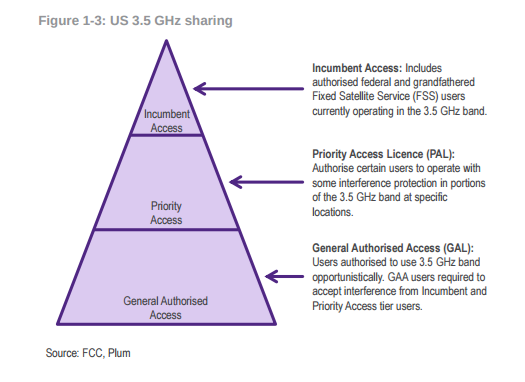
The United States is developing an approach to sharing in the 3.5 GHz band, as well.


A three-layer model is envisioned, with protected incumbent access, priority access (some interference protection) and general authorized access (opportunistic access without interference protection).


AT&T Dramatically Changes Revenue Source Profile

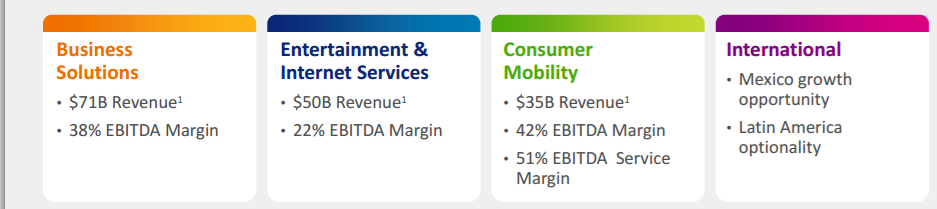
On an annualized basis, AT&T will earn about 46 percent of its revenue from business sources and about 54 percent from consumer services. That is a big change from the prior year, when AT&T earned about 54 percent of revenue from its business solutions category.


The perhaps-shocking change is that AT&T, on an annualized basis, will earn just 22 percent of revenue from consumer mobile services, making AT&T almost a mirror image of Verizon, which earns about 85 percent of total revenue from mobile services.

Altogether, about 41 percent of AT&T’s total revenue is earned from mobility services.

In the quarter, AT&T earned about 45 percent of total revenue from business solutions, 28 percent from entertainment and Internet services and 24 percent from consumer mobility. About 38 percent of business solutions revenue was generated by business customer mobile services.


Beyond that, AT&T reported double-digit revenue, adjusted operating margin, adjusted earnings per share and free cash flow growth in the third quarter of 2015.


Third-quarter consolidated revenues of $39.1 billion were up nearly 19 percent year over year,  primarily due to the acquisition of DirecTV.


Business Solutions revenues up 1.2 percent, year over year, with strategic business services revenues of $2.8 billion, up 12.6 percent and up 15.2 percent, when adjusted for foreign exchange


Operationally, AT&T gained 26,000 domestic DirecTV net adds, 192,000 IP broadband net adds
and 2.5 million AT&T Mobility domestic mobile account net adds.


Of those mobile net adds, 755,000 were branded phone accounts, including 289,000 postpaid and 466,000 prepaid net accounts.


AT&T also added 1.6 million connected device accounts, including one million connected cars.


Total churn was 1.33 percent, down year over year, while postpaid churn was 1.16 percent.

The company also is increasing its adjusted EPS and free cash flow outlook for the year. For the full year, AT&T now expects adjusted EPS in the $2.68 to $2.74 range and free cash flow in the $15 billion range or better.

Enhancing Competition Sometimes Decreases Investment

Perhaps there are instances where government policies can both stimulate competition and investment. That arguably was the case when the Telecommunications Act of 1996 was first passed, for example, legalizing competition in U.S. local access markets that had been sanctioned local monopolies until that point.

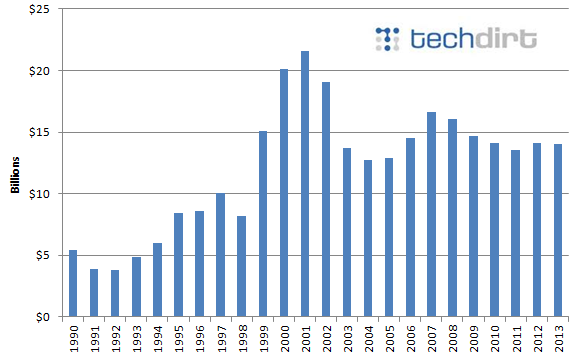
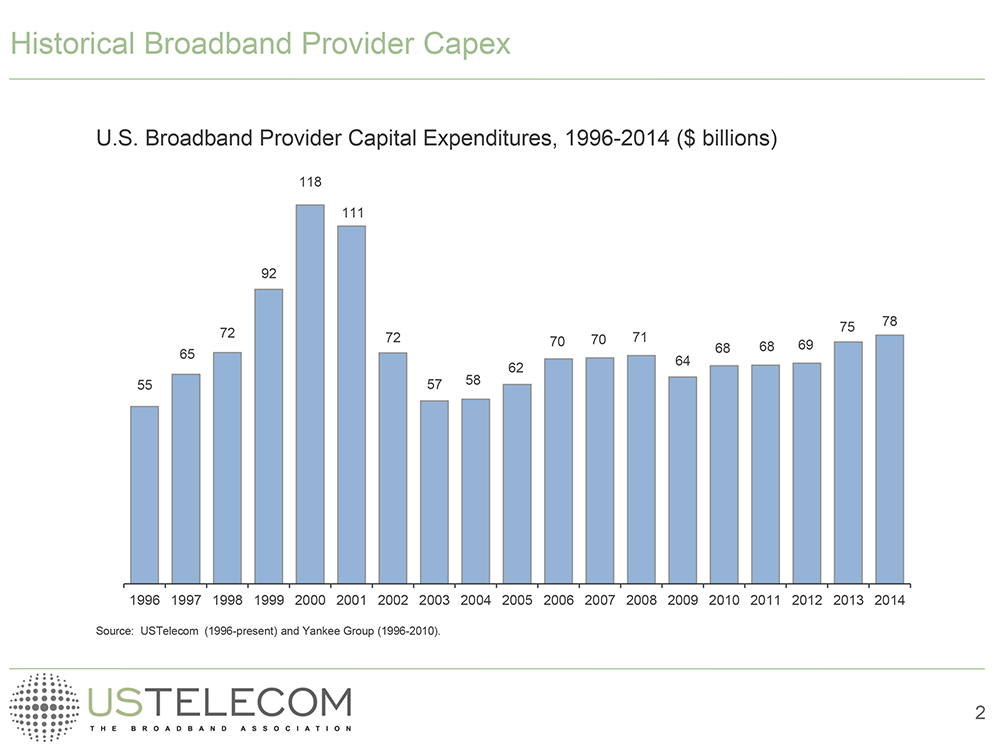
As a historical matter, investment climbed at the same time as competition bloomed. Looking at cable TV capital investment, there was a huge run-up in investment after the Act was passed allowing cable TV companies to create new roles as the most-significant new providers of consumer voice and Internet access services.

After reaching a peak, investment later declined to levels that are generally higher than previously had been made. In that sense, an argument can be made that both competition and investment were enhanced, over the medium to long term.

On the other hand, one might also argue that the higher levels of investment have little to nothing to do with legacy services, and everything to do with new services that might, or might not, have been dependent on the Telecom Act.

It is plausible, perhaps even certain, that investment levels were hiked to support new revenue streams based on the Internet, and had nothing to do with the deregulation of voice services.


In other instances, policymakers often face tougher choices. Policies that promote competition might increase investment in the short term, but also might depress investment in the long term, if investments in a specific industry consistently lag investments elsewhere.

In other words, whatever the near term impact of any policy decision, long term investment will flow to where firms believe returns are higher, and decrease in any areas where companies believe returns will fall, or are slim and in danger of reaching zero.

Something along those lines seems to be happening in India, where the Department of Telecom (DoT), to preserve competition, has decided to maintain existing rules about the maximum amount of spectrum any single provider can use.

Those rules will prevent several of the larger mobile service providers from rationalizing their spectrum holdings in ways that lead to lower costs.

The DoT decision means larger telcos will not be able to share spectrum, or trade spectrum.

Under the existing rules, a telecom operator cannot hold more than 25 per cent of total spectrum assigned to all companies in a circle and over 50 per cent of total spectrum assigned in a particular frequency band.

To be sure, the ultimate impact on investment is not entirely clear. Service providers always have multiple tools for increasing capacity, and one way to do so is to build more cells, with smaller coverage radius.

Prevented from adding more spectrum by trading or sharing, service providers might well be forced to invest in additional cell sites. On the other hand, service providers might conclude the faster route is to buy out competitors, thus adding their networks and spectrum. That might mean less investment in new facilities, but also less competition.
Is U.S. Mobile Operator Capex Growing, or Not?

Service provider capital spending trends are important for any number of reasons. Aside from the immediate relevance for firms who supply infrastructure, such trends offer clues about service provider strategy.

Quite often, spending ramps up when a next-generation network platform is being deployed, when competition heats up or a major new revenue source requires such investment.

Spending often ramps down when a network build is finished, when a major recession or other financial disturbance pinches revenues or when service providers decide to momentarily shift resources elsewhere (acquisitions; major spectrum purchases or required investment elsewhere in the business).

Sprint and AT&T offer examples.

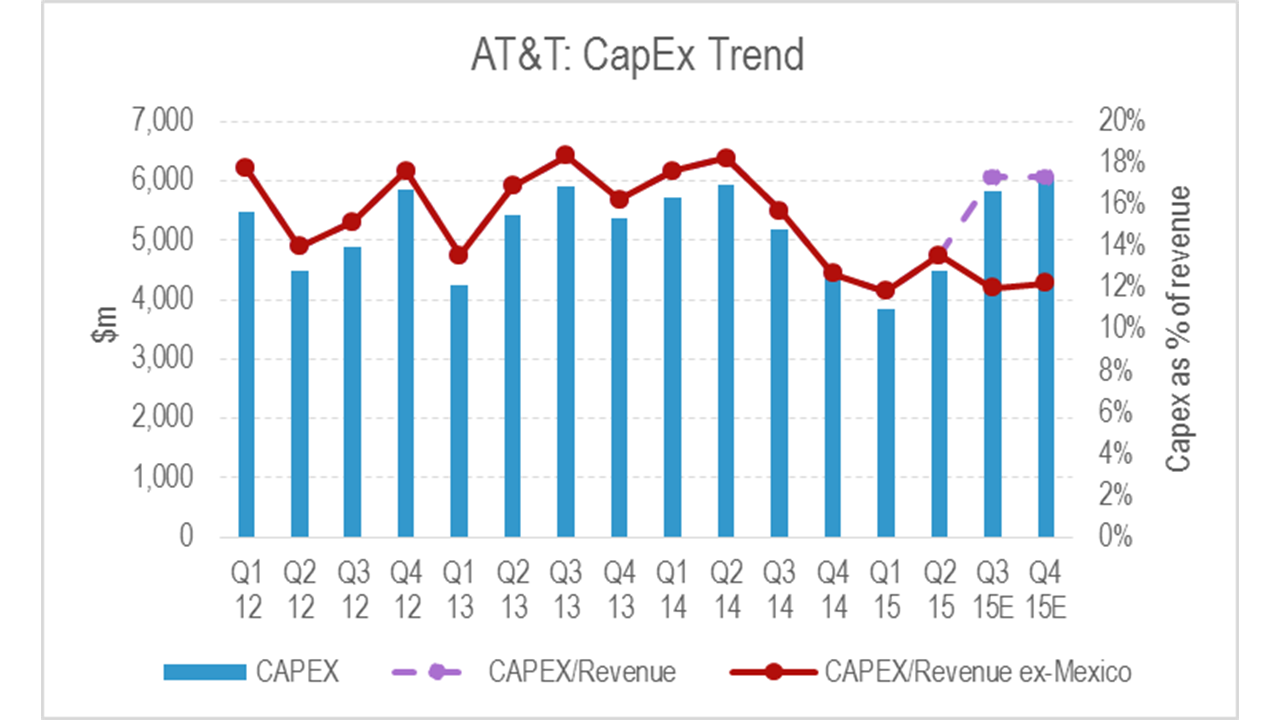
AT&T plans on significantly lower capital investment over the next few years. In some part, that is because AT&T has finished its fourth generation network build, is deploying capital to make acquisitions, and likely is conserving on capital for expected spectrum auction investments as well.

From the second quarter of 2013 to the end of the second quarter of 2014, AT&T spent on average $5.7 billion a quarter on network-related infrastructure. 

Since then, the average is $4.4 billion (excluding capital related to AT&T Mexico networks investment), representing a dip in U.S. capex of perhaps 21 percent. But some might argue that capex dipped for a year between 2014 and 2015 before resuming a typical profile.

Some might argue AT&T capex has not shrunk, but it has shifted to new locations outside the United States.

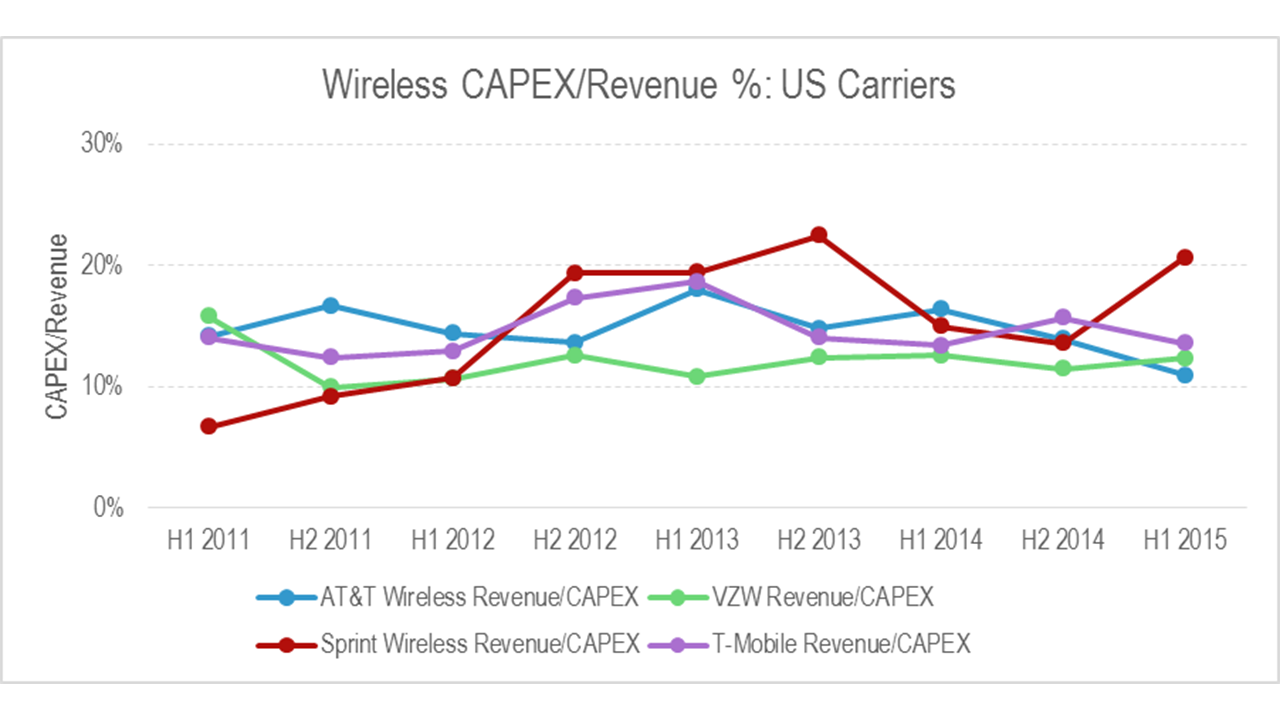
Sprint, on the other hand, after a similar slowdown in 2014, has hiked capex--as a percentage of revenue--to remedy network deficiencies, compared to other leading competitors. The key there is “revenue.” Sprint simply has less revenue available to offset any incremental move in capital spending.

On an aggregate industry-wide basis, U.S. mobile carriers have grown capex since about 2012. Given expected spending on additional spectrum--and new expected competitive threats--overall capex might remain at higher levels for some period of time.

As much as a rational mobile service provider executive might prefer to spend a lower percentage of revenue on capex, or even lower gross amounts, the market might continue to require relatively higher levels of investment.

The entry of Google Fi and the coming entry of Comcast into the mobile business are examples of how competition could change in the future, irrespective of any continuing market share battles between the four big national service providers.


Satellite Market Shows Classic Signs of Competitor Behavior in Deregulating Industries

Some trends are “evergreen” in the communications business, or have been so since the advent of deregulation, new technology and competition starting in the 1980s globally.

Among the recurring themes is pricing instability--or pricing wars--in virtually every segment of the business, driven by new competitors with disruptive price offers based on use of new technology.

So it is not surprising that U.K.-based satellite services provider Talia warns of pricing wars in many regional satellite markets.

“It is becoming a price war among satellite operators,” Alan Afrasiab, Talia CEO told Via Satellite. “We cannot make decisions to buy additional capacity or even renew capacity because we don’t know when the bottom price will be reached.”

“At the moment it is unstable, and it’s bad for everybody,” he said. “I think big satellite operators now realize the market needs lower prices, especially on Ku-band, simply because of the Ka-band prices and also some of the smaller operators that have been quite aggressive.”

High throughput satellites and Ka-band are two big influencers of price today, he said. Afrasiab said HTS is pushing prices down, and putting pressure on traditional Ku-band pricing. Anybody familiar with .

Shifts in demand towards the terrestrial networks also are happening, leading to a situation where “the satellite industry overall has less demand.”

None of those laments are unusual. One of the hallmarks of any market that formerly was a monopoly and then gradually is deregulated is the emergence of new competition, notably from outside the traditional industry boundaries.

One example might be the shift of capacity demand away from satellite to to terrestrial networks. New technology also often underpins new competition. So we see the growing level of competition from HTS and Ka-band competitors.

Virtually always, some new competitors attack using the “same product, lower price” marketing platform, and that also is a trend Talia notes. In response, Talia is moving to create a hybrid fixed and satellite business, an example of another common trend in deregulating markets, namely the emergence of new product niches and roles in a relatively undifferentiated market for services.

Wednesday, October 21, 2015

Comcast Begins Move into Mobile Services

The waiting is almost over: Comcast Corp. is planning to launch its own mobile service. As some of us recall, the deal called for an initial right to resell Verizon service, but later the ability to act as a mobile virtual network operator.

That suggests the first steps will involve Comcast bundling mobile service (still branded as “Verizon” service) with triple-play bundles. After a period of time, Comcast would then create an MVNO business, allowing Comcast to brand the service.

A market trial of a Comcast wireless service could begin six months after a notification to Verizon, which apparently has been made.

Comcast has the right to use Verizon as the underlying network provider as part of a sale of spectrum to Verizon in 2012. As part of that agreement, a consortium of cable companies led by Comcast sold nationwide spectrum licenses to Verizon for $3.6 billion and secured the rights to resell its wireless services.

Commercial service could start late 2016, some believe.

Verizon Chief Financial Officer Fran Shammo has said unnamed cable companies have informed the carrier they now want to execute the reseller part of the agreement.

“Obviously, the industry is moving,” Shammo said. “Cable is going to do what they’re going to do, and we’re going to do what we’re going to do.”

Comcast eventually would leverage its network of homespots and public Wi-Fi hotspots, connecting customers to such Wi-Fi hotspots whenever possible to reduce payments to Verizon for use of the mobile data network. Comcast alone has deployed perhaps 10 million such homespots.

It isn’t yet clear whether Comcast would want to start out that way, however, given the learning curve of becoming first a mobile reseller and then later a branded service provider.

Access Network Limitations are Not the Performance Gate, Anymore

In the communications connectivity business, mobile or fixed, “more bandwidth” is an unchallenged good. And, to be sure, higher speeds have ...