Tuesday, November 3, 2015

Orange Business Services Intros Faster Business Cloud Access

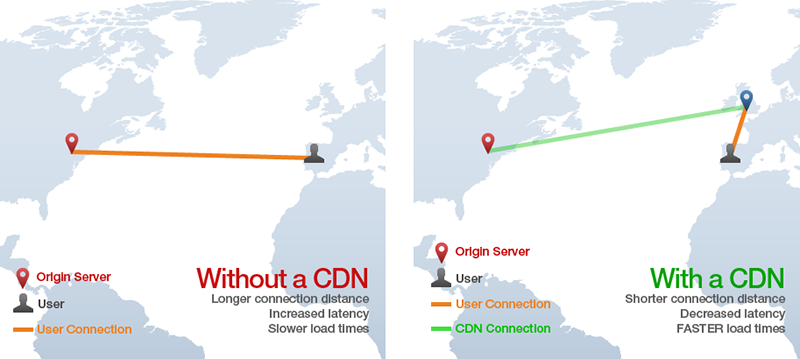
A new global business-grade Internet service from Orange Business Services--Business VPN Internet Accelerate--provides access to cloud applications up to ten times faster (based on a test of the Paris-to-Singapore route).

Based on Akamai Cloud Networking, the business-grade Internet service is built on the Akamai Intelligent Platform, which includes nearly 200,000 servers across more than 110 countries and advanced optimization technologies.

Sometimes, such content delivery networks improve response time because they cache content closer to a user’s location.


Project Loon for India?

The Indian government is considering a test of Google’s Project Loon. The pilot project might also involve use of BSNL 2.6 Ghz spectrum for downlink.

Three leading mobile service providers in Indonesia, plus authorities in Sri Lanka, also are testing Project Loon as a backhaul platform.

Can mobile service providers across South Asia, Southeast Asia and Oceania get Long Term Evolution coverage at an order of magnitude lower costs by partnering with Google’s Project Loon?

Project Loon supporters believe that is possible.

In tests, Project Loon has partnered with mobile service providers with in-place LTE towers to provide backhaul to Project Loon balloons, along the 40th parallel.

At the 30th parallel, winds are easterly. Near the equator the winds are westerly. Presumably the same techniques would work at other latitudes.

By definition, some LTE tower infrastructure is required, as those towers provide uplink to the balloons.

But the balloons then provide LTE coverage directly to LTE-capable handsets. At this point, it likely makes sense for mobile service providers to source wholesale retail capacity on the balloons, which essentially substitute for fixed mobile cell sites.

The mobile service provider networks and towers, on the other hand, will provide Project Loon with backhaul.

Google says it can now deliver data at 5 Mbps to mobile phones, or 22 Mbps to fixed antennas.

Unlicensed Spectrum Sustainability Model Still Will Be an Issue in a "Shared" Environment

Use of license-exempt spectrum always has posed--and continues to represent--business model challenges. Initially, Wi-Fi mostly had an indirect business model in the consumer segment of the business.

Access to public Wi-Fi hotspots was an amenity gained from using a specific high speed access provider.

These days, public Wi-Fi plays a role on the capital investment side of the infrastructure business. Mobile service providers offload half or more of their customers usage from the core networks, slowing the rate at which core network upgrades are required.

In a coming iteration, public Wi-Fi will play a role supporting upstart mobile service providers.

Some firms have created direct revenue models by using public and amenity Wi-Fi to support enterprise and business customers.

But most services using unlicensed spectrum tend to face key business model challenges. Shared access to 3.5-GHz spectrum in the U.S market will not be exempt.

As envisioned, a formal tripartite model would be applied. Licensees would continue to be protected for the purposes the spectrum originally was intended to support.

But where surplus exists, commercial users would be allowed to have subsidiary rights to use spectrum, and likely would pay for the privilege. Where even the primary and secondary users are accommodated, opportunistic access would be allowed (on the model of Wi-Fi spectrum use, with license-exempt access, but without guarantees of quality or availability).

One might argue there is no fundamental business model issue with either primary licensed access or secondary usage. Primary licensees already have a sustainable model of some sort.

Commercial users would have to create a sustainable model. But some potential users, including cable TV companies, mobile service providers or possibly some app providers, have existing models that benefit--indirectly or indirectly--to an existing revenue model.

The traditional issue has been the sustainability of business models based strictly on opportunistic access, though. As anybody familiar with the fixed wireless business understands, lenders have been cautious about any business models founded on use of license-exempt spectrum, because there is a not a defensible “moat.”

In other words, there is no enforceable scarcity that keeps competitors out. That does not mean there are no “moats.” Geography sometimes creates potential barriers to entry. Large sports stadiums and airliners provide examples, says Armand Musey, Summit Ridge Group founder.

The other obvious potential model is a wholesale infrastructure model, which U.S. cable TV companies have suggested is a possibility for them, at least as a business model for their access facilities, which might become an attractive backhaul platform for small cell deployments, for example.

The point is that shared spectrum, as such, does not pose major unknown issues, as far as business model, for some commercial entities, especially when spectrum is used as on sub-licensed basis.

On the other hand, some traditional issues faced by small wireless Internet service providers and amenity Wi-Fi providers will remain, when opportunistic access is the platform.

Some things do seem to change. 
India Enterprise Communications Spending $28.3 Billion in 2016

Communication services will continue to account for the largest share of information technology spending in India and will account for 39.2 percent of revenue in 2016, or about $28.3 billion, according to analysts at Gartner.

Communications arguably represents a smaller percentage of total enterprise IT spending in India, compared to many other countries. Globally, communications represents about 43 percent of enterprise IT spending.

That factoid illustrates the intimate relationship between information technology and communications services.


Communications revenue will grow about 2.1 percent in 2016, Gartner also predicts.


Total India IT spending is forecast to reach $72.3 billion in 2016, a 7.2 percent increase from 2015 levels.


“India will continue to be the fastest growing IT market for the second year in succession and will continue growing to total $87.67 billion by the end of 2019,” said Aman Munglani, research director at Gartner. “India is currently the third largest IT market in Asia/Pacific, and by 2019 India will become the second-largest IT market within the Asia/Pacific region, following China.”


Devices, which include mobile phones, PC’s and tablets, will account for almost 33 percent of the overall IT spend in India, and the devices  segment will grow 9.4 percent in 2016.


Mobile phones will continue to be the single largest technology sub segment in India and the third fastest-growing through 2019.


“Data center systems will grow 3.9 percent in 2016, with most of this growth coming from enterprise network equipment and servers that will grow at 5.9 percent and 5.3 percent, respectively.


IT services, which accounts for 18.1 percent of overall IT spend in India, will be the fastest growing segment in India in 2016 with 13.8 percent growth year on year. Within these segments, business IT services will grow 15.2 percent over 2015 figures,” said Munglani.

Software, which accounts for nearly seven percent of IT revenue in India, will grow 12.7 percent as a segment, but within this segment, enterprise application software will be the fastest growing sub segment in 2016, with revenue forecast to grow 16.2 percent over 2015.

Saturday, October 31, 2015

Internet Basics to Test Demand for Village Wi-Fi

Facebook’s Internet Basics initiative now plans to test demand for Wi-Fi in 100 Indian villages. As always, sustainability is an issue.

Initially, Internet Basics will help create service in 25 villages, buying bandwidth from BSNL for a minimum period of three years, allowing time to test the extent of demand for a “for-fee” service.

Internet Basics has partnered with an Indian rural Internet access provider, AirJaldi, to manage the operation of the “Express Wi-Fi” service.

As currently configured, Express Wi-Fi costs 10 rupees, or about 15 cents, for one day’s access to 100 megabytes of data. For $3, users can buy use of 20 gigabytes of data, which can be used over the course of a month.

There are, according to Professor Rekha Jain, of the Indian Institute of Management, 640,000 villages in India, containing 180 million houiseholds.

Those households hve monthly household income of US$230, with US$24 a month in per person spending.

So part of the challenge is convincing those consumers they should spend money buying Internet access. By way of comparison, the typical Indian mobile account repersents a bit less than US$2 a month in spending.

The government of India has said it will create facilities offering public Wi-Fi in 2,500 cities and towns across the country over three years, with the network built and operated by state-owned Bharat Sanchar Nigam Ltd (BSNL).

Use of Wi-Fi as an Internet access platform in India is growing, even if that might seem a difficult proposition in country with fixed network facilities. BSNL is among those who now are deploying public hotspot networks.

The city of Delhi also separately is working on a municipal Wi-Fi plan of its own, that might use a freemium business model.

For its part, Bharti Airtel Limited (Airtel) announced that Uber riders across India will be able to pay for their trips using Airtel Money, the firm’s mobile wallet service. As part of that plan, Uber vehicles will be outfitted with Airtel 4G connections, offering free Wi-Fi inside Uber vehicles.

The government of Bihar, meanwhile, plans to offer free Wi-Fi at all colleges within the state.

Friday, October 30, 2015

MIMO and Small Cells Can Only Do So Much: More Spectrum is Needed

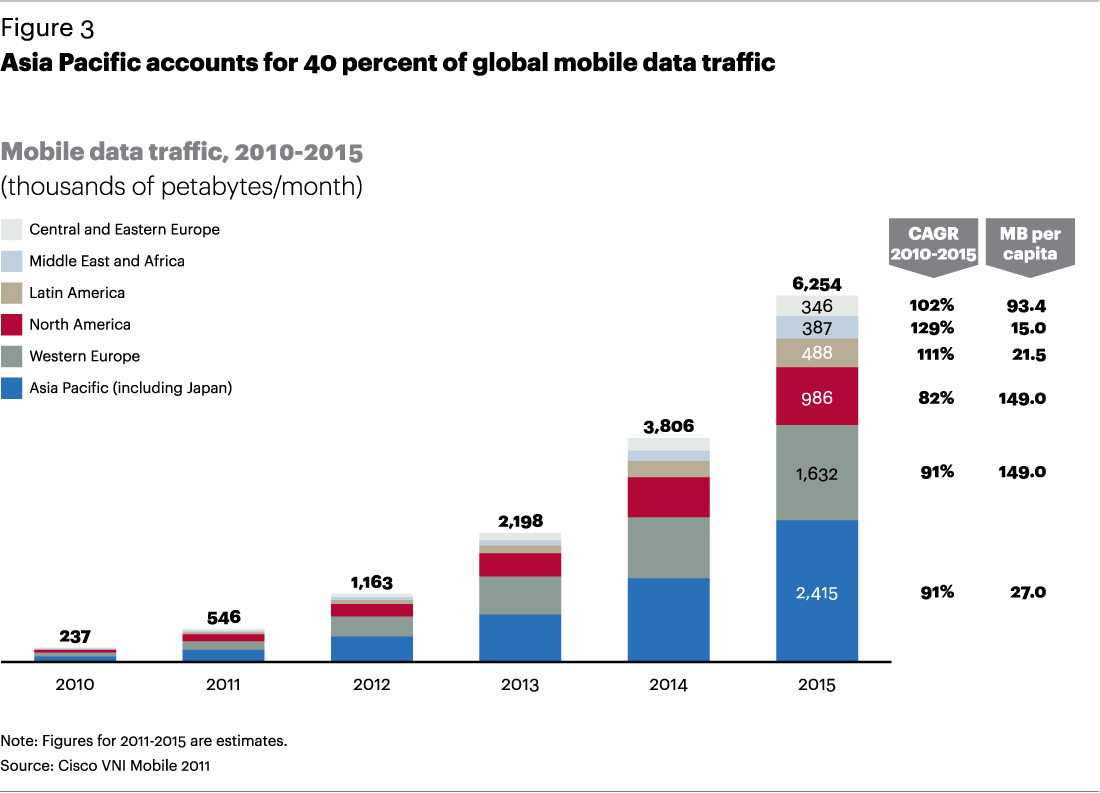
If you assume demand for mobile Internet access bandwidth is going to keep growing in excess of 50 percent a year, as it presently is doing (Cisco predicts bandwidth consumption in Asia will grow at 58 percent annual rates through 2019), then supply also has to be increased.

If you also assume the percentage of higher-performance smartphones will keep growing, then you also must account for much-heavier bandwidth demand. A feature phone tends to use about 22 MB a month. A smartphone tends to use 819 MB each month, while a smartphone used on a 4G network will tend to consume 2,000 MB a month, according to Cisco.

As smartphone adoption grows, so will the percentage of phone customers regularly using mobile data. That also applies to use of smartphones on 4G networks or 3G networks, compared to 2G networks. People consume more data on faster networks

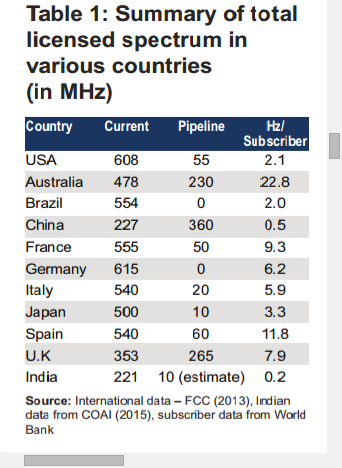
It also follows that significant additional capacity will have to be supplied.


Traditionally, there are three ways to do so. Regulators can allocate more spectrum. Operators can move to smaller cells or use more-efficient antenna technologies, to reach the so-called “Shannon limit (the theoretical maximum efficiency of any communications channel.”

Use of Multiple Input Multiple Output (MIMO) antennas might jokingly be said to prove “Shannon was wrong.” He was not wrong, but the point is that after MIMO--and massive MIMO--are applied, service providers will have wrung as much as possible out of antenna technology.

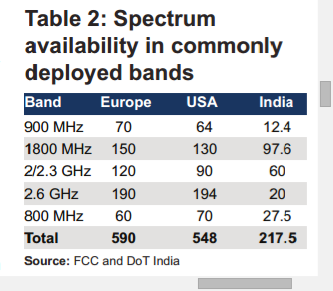
That will leave new spectrum and smaller cells are the remaining technology tools to boost usable bandwidth (one can think of many ways to provide consumer incentives that reduce demand, but those are not technology tools).

Operators can control network architectures. They cannot control spectrum allocation.


Brookings

Is Google Fiber an Existential Threat? How Much Can it Do with 30% Coverage of the U.S. Market?

Is Google Fiber an existential threat to either telcos or cable TV? That might seem an overblown threat. “Existential” implies a threat to existence.

To the extent there is legitimate danger, it comes not from massive losses of telco or cable TV market share and gross revenue (though that might well happen), but “only” from a sustained dip in profit margins caused by the new competition.

In other words, assuming Google Fiber currently is sustainable itself (earning a positive rate of return), the issue is whether the competition tips either telco or cable TV profit margins below the 20-percent level, towards zero.

Nor does Google Fiber have to do all the work.

Other trends work in that direction, namely declining demand for fixed network voice and declining demand for linear video, in addition to the obvious new pressure on high speed access pricing and profit margins.

The challenge Google Fiber represents is that cable TV and telco competitors have to increase capital investment while simultaneously risking zero net increase in revenue, or even actual declines in revenue. More spending to earn less revenue, in other words.

Simply, a market rate of a gigabit for $70 a month resets consumer expectations enough to destroy existing pricing-value relationships upon which current cable TV and telco business models are built.

In other words, it is not necessary that Google Fiber, or any other competitor in the high speed access market, reduce telco or cable TV market share far below current levels.

All Google Fiber and others must do is attack profit margins. Cable TV gross margin is typically somewhere in the low 20s and net margins are maybe in the 10 percent to 11 percent range.

AT&T has net margin in the five percent range.  Other telcos might have net margins in the six-percent range, with Verizon somewhat higher, at perhaps seven to eight percent.

The competition “merely” needs to reinforce existing revenue and cost trends in ways that undermine the sustainability of cable and telco business models, especially the net margin performance.

You might well argue that is why the leaders of the cable TV industry “must” get into the mobility business, or telcos “must” get into the Internet of Things business. There is simply going to be increased pressure on gross revenue and profit margins in the fixed network business.

Given existing trends--shrinking voice and slow diminution of linear video revenue--all that has to happen is enough market share pressure and share gains by the new competitors to tip the cable TV and telco business model towards zero.

To be sure, we are likely five to 10 years away from any such scenario, as Google Fiber coverage remains relatively limited, compared to the larger telcos and cable TV companies (though far beyond what most independent ISPs could sustain).

The issue is how much coverage Google Fiber would have to attain, on a national basis, to become a significant and material force on pricing in most of the market, and whether Google Fiber decides to continue pushing in that direction.

So far, Google Fiber has avoided the “NFL cities,” targeting second-tier cities instead. Whether Google Fiber can exert national market power without significant footprint in the biggest markets is an important issue.

Some have estimated the cost of a truly-nationwide network at perhaps $140 billion. But keep in mind that no other service provider serves more than about 30 percent of all U.S. homes. Whether Google Fiber would be permitted to exceed roughly that coverage, and whether it wants to, are key issues.

At least in an environment where Internet access is considered a “common carrier” service, one has to believe that the government would not let even a Google Fiber exceed about 30 percent coverage of all U.S. homes. No other service provider is allowed to do so.

So if I am thinking about how to maximize the Google Fiber market impact, I would focus on how to wring the greatest effect from operations that never will exceed coverage of more than 30 percent of U.S. households.

How Much Do Tariffs Affect Inflation?

Today’s political discussions can be frustrating and unhelpful, in large part because people disagree about what the “facts” of any subject ...