Wednesday, February 3, 2016

Back to the Future for AT&T Technology Development?

The “telecom” business has gotten tougher over the last couple of decades, in ways large and small.

The big things have to do with maturation and now decline of the legacy revenue sources; new competitors with different business models and lower cost structure; and a fundamental shift in the way applications and services get created.

In voice services, even firms that had been growing now are shrinking. Comcast’s voice revenues, for example, shrank in the most recent year, even as it added more accounts, suggesting that Comcast is merchandising its voice services to protect revenue and margins for other products.  

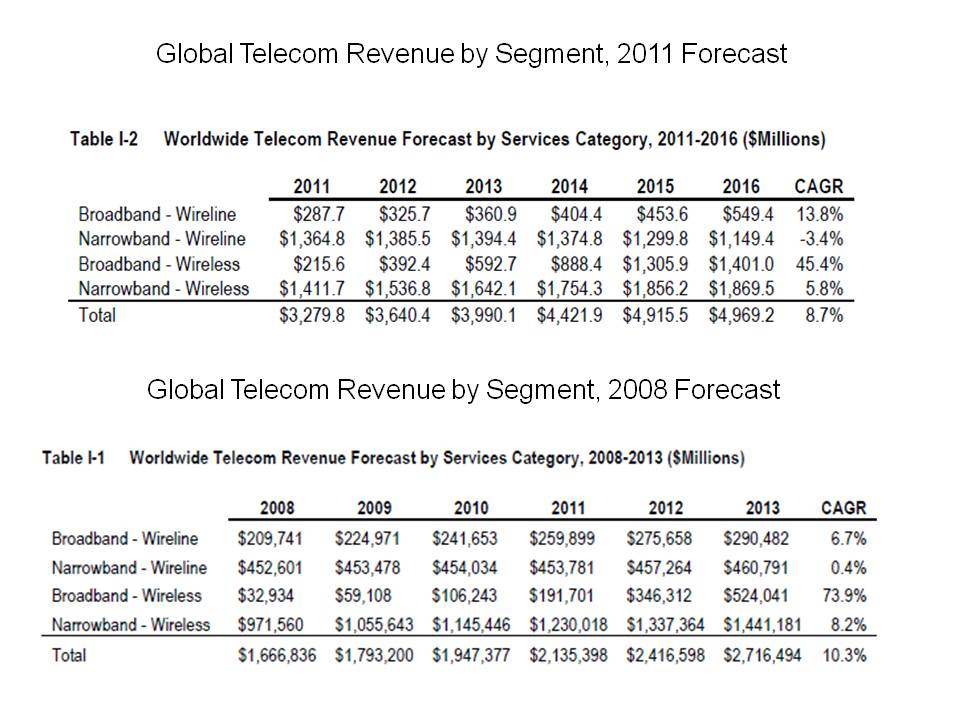
A decline in voice revenue, in fact, is a global trend.

The same trend actually can be seen for fixed networks supplying high speed access, which will decline, over time, in favor of mobile Internet access.

One small change is AT&T’s way of adapting to supplier risk, especially the risk that a key supplier might go out of business.

When working with key small suppliers, AT&T now “expects to increase the depth of understanding of our core technologies held by our staff to the point that they can integrate, and even design the systems from scratch,” AT&T says. “AT&T expects to develop key software resources in a way that they can be openly used, and cannot be lost through the acquisition or insolvency of a vendor partner.”

The AT&T system used to develop its own technology (Bell Laboratories and Western Union). That began to change with the AT&T breakup in 1984, and today the tier one providers source their core technology from third-party suppliers.

That might change in the future, as virtualized networks are developed, running on common and commodity hardware, using more open approaches, and with a core commitment to develop strategic systems in a way that allows AT&T to survive even the bankruptcy of any key suppliers.

So we might see something of a shift back towards service provider knowledge of, creation of, and maintenance of, core technology services and systems.

We haven’t seen that since before 1984. To make that work, service providers must have the ability to develop core technology themselves. For some of us, that harkens back to an older time.

Broadband : fixed and mobile
Percent market shares ¹
Date
Fixed (wired) broadband
Active mobile broadband
Actual %
Forecast %
Actual %
Forecast %
2005
100
100
2006
100
100
2007
56.4
54.2
43.6
45.8
2008
49.3
49.6
50.7
50.4
2009
43.2
44.6
56.8
55.4
2010
40.4
39.4
59.6
60.6
2011
33.7
34.2
66.3
65.8
2012
29.1
29.2
70.9
70.8
2013
24.9
24.8
75.1
75.2
2014
20.9
79.1
2015
17.8
82.2
2016
15.4
84.6
2017
13.5
86.5
2018
12.1
87.9
2019
11.1
88.9
2020
10.4
89.6
Annual average growth rate
-12.7%
-11.9%
9.5%
5.3%

Tuesday, February 2, 2016

Comcast Rolling Out Gigabit Service Commercially in 5 Metros in 2016

Comcast plans to introduce the world’s first DOCSIS 3.1-powered gigabit Internet service to residential and business customers in Atlanta and Nashville in early 2016, with Chicago, Detroit, and Miami to follow in the second half of the year.

Keep in mind that the Concast deployments are "whole city" deployments, not "neighborhoods." Every location will get gigabit capability, not just locations in selected neighborhoods.

The new technology will, for the first time, make it possible for Xfinity and Comcast Business Internet customers to receive gigabit speeds over existing hybrid fiber coax networks already installed to support current service, and will not require a fiber upgrade.

Last year, Comcast launched its residential fiber-based multi-gigabit service--Gigabit Pro--in metropolitan Atlanta, making it the first market to receive the company’s 2-gigabit symmetrical service.

Chicago, Detroit, Miami, Nashville, and several other markets were added over the following months, and Gigabit Pro is now available to 18 million homes across Comcast’s national footprint.

Gigabit Pro does require installation of a direct to location fiber connection, unlike DOCSIS 3.1.

Comcast also has increased Internet speeds for residential customers 16 times in the last 14 years, at rates equivalent to Moore’s Law, Comcast has said.

Internet Access Growing Faster than in Asia or Africa

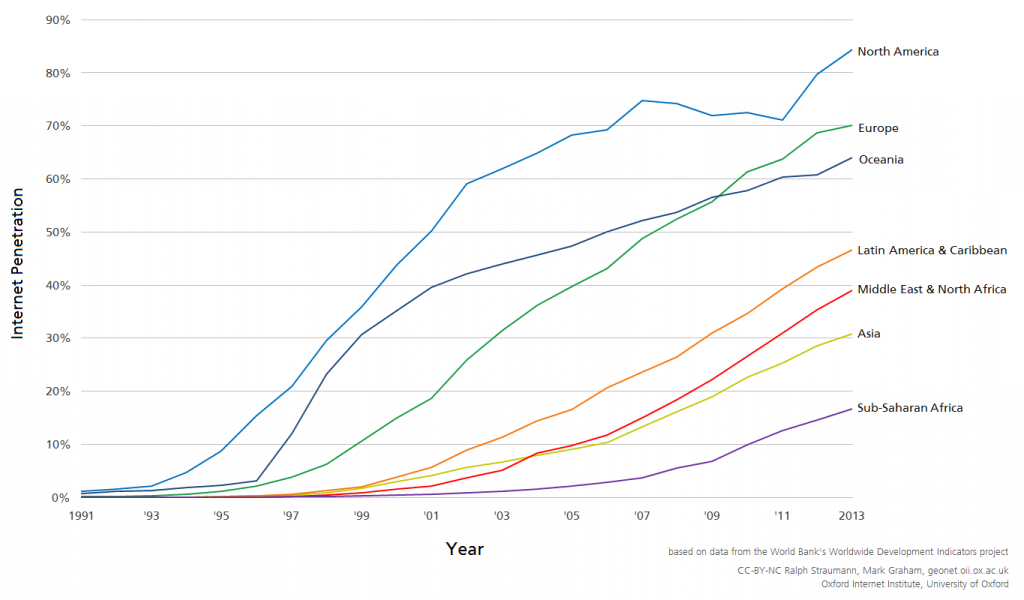
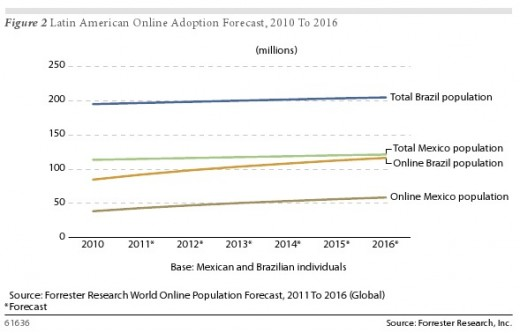
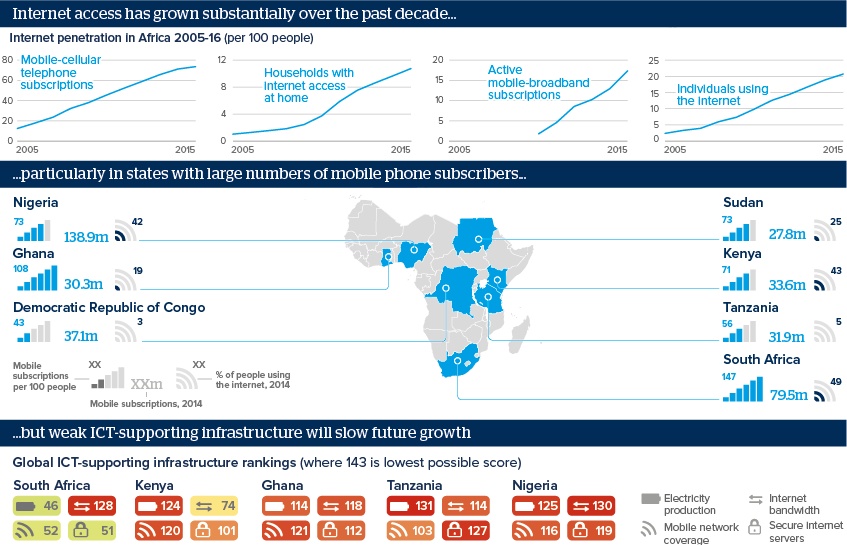
Internet adoption in Latin America is growing faster than Asia or Africa, on some measures, slower than Asia or Africa, on other measures. On the other hand, Internet access adoption already is higher in Latin America than in Africa or Asia.

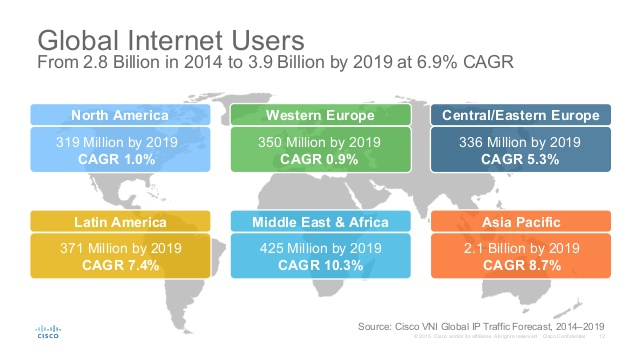
Between now and 2019, Latin America Internet usage growth rates should be at 7.4 percent every year. That is lower than for Africa or Asia, where compound rates of rate will be 8.7 percent for Asia and 10.3 percent for Africa.

Of course, as always is the case, statistics must be viewed in context. Brazil and Mexico have much larger populations than most other countries in Latin America, so Internet users, traffic and other metrics have to be filtered.

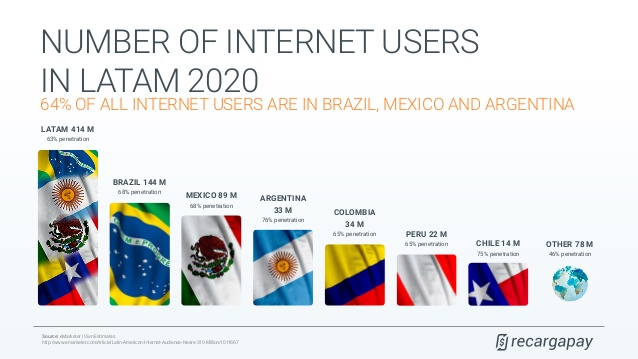
Some six countries will represent 81 percent of all Latin American Internet users by 2020: Brazil, Mexico, Argentina, Columbia, Peru and Chile. The four countries bordering the Pacific will represent 38 percent of all Internet users.

Across Central America, Mexico dominates existing, and potential customer connections. Across the globe, a few large countries have disproportionate impact on such metrics.

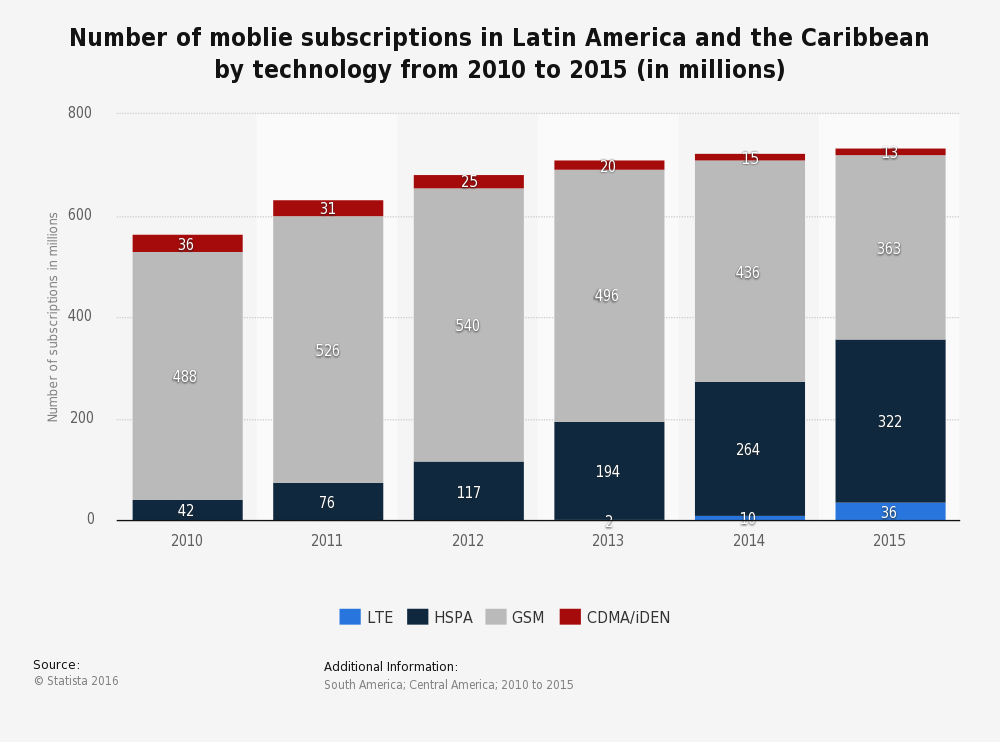
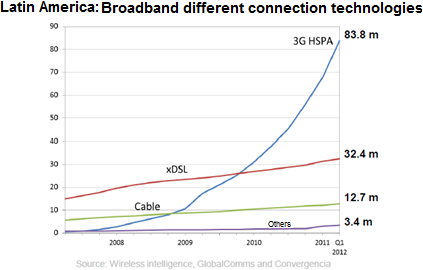
At the moment, about 70 percent of all Internet users in Latin America do so using their mobile phones and networks. By 2020, perhaps 95 percent will do so, according to RecargaPay.  

As is the case elsewhere, though, fixed networks play a muted role. By 2014, fixed-network broadband penetration reached almost 10 percent globally, while mobile Internet adoption was about 32 percent, according to the International Telecommunications Union.

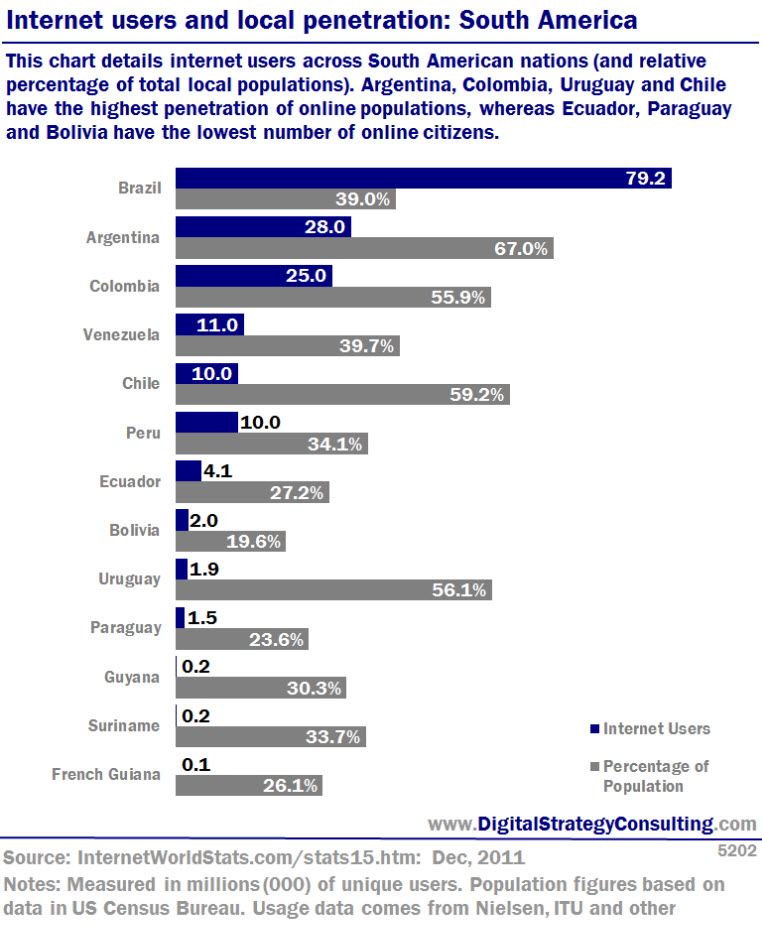
Perhaps 57 percent of the Latin American population will be connected by about 2019, Cisco estimates. In some countries, that is already has become the case. In Argentina, as early as 2011, 67 percent of people were connected. In Columbia, 56 percent were connected; in Chile, 59 percent; in Uruguay 56 percent.


Central America Internet Usage and Population Statistics
Population
( 2014 Est. )
Internet Usage,
30-Jun-2014
% Population
(Penetration)
340,844
108,048
31.7 %
4,755,234
4,028,302
84.7 %
6,125,512
1,742,832
28.5 %
14,647,083
2,885,475
19.7 %
8,598,561
1,602,558
18.6 %
120,286,655
59,200,000
49.2 %
5,848,641
906,539
15.5 %
3,608,431
1,899,892
52.7 %
Total
164,210,961
72,373,646
44.1 %

Latin America also is different some ways. Compared to Asia and Africa, the population to connect is largely urban, not rural. In principle, that means different access technology choices and platforms might be important, compared to markets where the challenge substantially involves connecting rural users.

Broadly speaking, that means platforms offering low cost coverage are relatively less important than platforms offering low cost capacity. Where mobility or fixed wireless platforms are concerned, that tends to mean higher-frequency platforms arguably are more important than lower-frequency platforms that are better for coverage, less valuable for capacity.

Retail local access can cost an order of magnitude more, on a price per megabit per second (price per Mbps) basis, than similar costs for countries of the Organization for Economic Cooperation and Development, which clearly is an issue.

Backhaul and long haul prices also are issues.


On the Use and Misuse of Principles, Theorems and Concepts

When financial commentators compile lists of "potential black swans," they misunderstand the concept. As explained by Taleb Nasim ...