Tuesday, October 29, 2019

Why Nobody Can Predict What Happens in 5G Era

Few industry executives are too certain about what big new 5G innovations will develop, and we should not be at all surprised by that lack of clarity. 

The reason futurists and industry executives have been generally unable to accurately predict the development of new use cases, applications and business models in the era of 3G and 4G, and will similarly find the same task difficult in the 5G era is that each of those network generations might be considered complex systems. 

And one attribute of a complex system is that they are virtually impossible to model reliably, as chaos theory suggests. 


A complex system is composed of many components which may interact with each other, and where small initial changes can have very-large, unexpected outcomes (the butterfly effect). 

Examples of complex systems often are said to include Earth's global climate, organisms, the human brain, power grids, transportation or communication systems, social and economic organizations (cities). 

An often-used example is an ecosystem. And it is reasonable to describe the entire connectivity business (fixed, mobile, satellite, other networks) as now existing as part of a larger internet ecosystem. And if a single complex system is intrinsically difficult to model, an ecosystem of complex systems arguably is impossible to model accurately over time. 

In large part, uncertainty about 5G exists because all complex systems are inherently highly dynamic, where no single actor in the ecosystem can direct progress. Also, the connectivity business as a whole now is part of the internet ecosystem. 

It is easy enough to point out the differences between the connectivity function and the applications and services that take advantage of internet connectivity. But even those important distinctions do not fully capture the differences.

Ever since the global telecom industry decided that internet protocol was the next-generation network, the industry has had to adapt to a business ecosystem where the creation of services and apps can easily be conducted by third parties with no business relationship with any connectivity provider. 
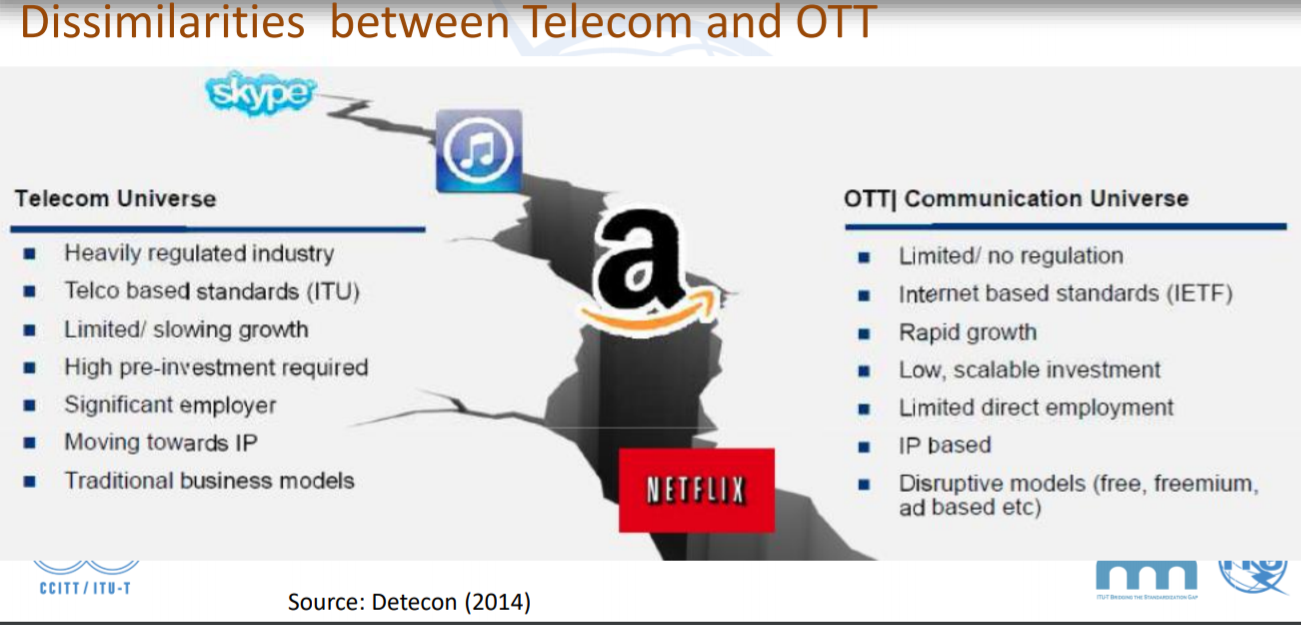

And that changes everything. Yesterday, telecom was a complex system of its own. Today, the whole connectivity function is part of the broader internet ecosystem. The fundamental change is that connectivity providers no longer control the scale or pace of business development of the whole ecosystem. 

Where today the assumption is that system conflicts must be resolved and resolved centrally and uniformly, a complex system actually requires decentralized control. 

Where a complex system inherently features conflicting, unknowable, and diverse requirements, today’s assumption is that requirements can be known in advance,  and will change slowly. That leads to the assumption that tradeoff decisions will be stable. 

But complex systems have inherently unknowable behaviors. 

Where today’s notion is that system improvements can be, and are, introduced at discrete intervals, complex systems evolve continuously. Where it once was believed that the telecom industry could make changes where the effects could be predicted sufficiently well, complex systems do not support such certainty. 

Where it was believed that the configuration information for any specific change was accurate and could be tightly controlled, a complex system actually means changes happen in an inconsistent environment. 

All of that explains why nobody really can predict what will develop in the 5G and subsequent eras of mobility.


Monday, October 28, 2019

DOCSIS 4.0 or FTTH?

Though other options, such as fiber-to-the-premise, are likely going to be a bigger part of the story, U.S. cable TV operators also believe they can upgrade their hybrid fiber coax networks for symmetrical 10 Gbps operation in a couple different ways, using either DOCSIS 4.0 or FTTH. Much will hinge on the incremental cost. 

Many executives are going to prefer DOCSIS 4.0, assuming it continues to offer a lower capital investment profile than switching to full FTTH. 

“We did the DOCSIS 3.1 rollout over two-year period which took our capability from a couple of 100 megabits per customer up to one gig per customer everywhere. capital cost of about $9 for home passed,” said Tom Rutledge, Charter Communications CEO.

Small Cells are Small, and Getting Smaller, Lighter

Both mobile operator and cable TV firms looking to reduce costs of supplying internet access bandwidth will rely on small cells that supply additional bandwidth in areas of high demand, using a variety of spectrum assets, both licensed and unlicensed.

For some mobile virtual network operators--especially cable TV affiliated operations--small cells running on owned fixed networks also will lower operating costs by supplying access directly, on owned facilities, not using leased mobile spectrum.

Some, including Charter Communications, expect to use unlicensed spectrum available under the Citizens Broadband Radio Service, and might consider licensed CBRS as well. The advantage of unlicensed CBRS is, of course, no need to buy spectrum licenses.

Another obvious issue is the cost of creating small cells, in terms of radio infrastructure, real estate and power. Mobile operators often use light poles. Cable operators will likely prefer strand-mounted units, especially because they already have rights to attach network elements to their cables, and will not incur additional real estate costs.

Those cells are small, and getting smaller. Cable operators, for example, are looking to use strand-mounted small cells that literally hang on aerial coaxial cable, and do not need poles for mounting surfaces. 

Thursday, October 24, 2019

Comcast 3Q Results Driven by Internet Access, Which Explains Potential Danger of 5G Fixed Wireless

Comcast’s third quarter results were driven by consumer and business internet access connections. And that is the potential threat posed by 5G fixed wireless alternatives: they strike at the heart of the revenue growth model based on the Comcast fixed network. 


Revenue from Digital Transformation Will Take Twice as Long as Enterprises Expect

Through 2021, incremental revenue from digital transformation initiatives is largely unlikely, Gartner researchers predict. That will not come as good news for executives hoping for revenue growth from repositioning existing business practices for digital delivery and operation. 

On average, it will “take large traditional enterprises twice as long and cost twice as much as anticipated,” Gartner researchers predict. 

"In most traditional organizations, the gap between digital ambition and reality is large," said Daryl Plummer, distinguished vice president and Gartner Fellow.. "We expect CIOs' budget allocation for IT modernization to grow seven percent year over year through 2021 to try to close that gap."

We probably should not be surprised, as major new technologies quite frequently take decades to show visible financial results. That might be another manifestation of the productivity paradox

Quite often, big new information technology projects or technologies fail to produce the expected gains. That “productivity paradox,” where high spending does not lead in any measurable way to productivity gains,  is likely to happen with artificial intelligence and machine learning, at least in the early going. And that “early going” period can last far longer than many believe.

To note just one example, much of the current economic impact of “better computing and communications” is what many would have expected at the turn of the century, before the “dot com” meltdown. Amazon, cloud computing in general, Uber, Airbnb and the shift of internet activity to mobile use cases in general provide examples.

But that lag was more than 15 years in coming. Nor is that unusual. Many would note that similar lags in impact happened with enterprises invested in information technology in the 1980s and 1990s.

investments do not always immediately translate into effective productivity results. This productivity paradox was apparent for much of the 1980s and 1990s, when one might have struggled to identify clear evidence of productivity gains from a rather massive investment in information technology.

Some would say the uncertainty covers a wider span of time, dating back to the 1970s and including even the “Internet” years from 2000 to the present.

Computing power in the U.S. economy increased by more than two orders of magnitude between 1970 and 1990, for example, yet productivity, especially in the service sector, stagnated).

And though it seems counter-intuitive, some argue the Internet has not clearly affected economy-wide productivity.

Wednesday, October 23, 2019

Mobile Industry is Highly Concentrated, and Unlikely to Change

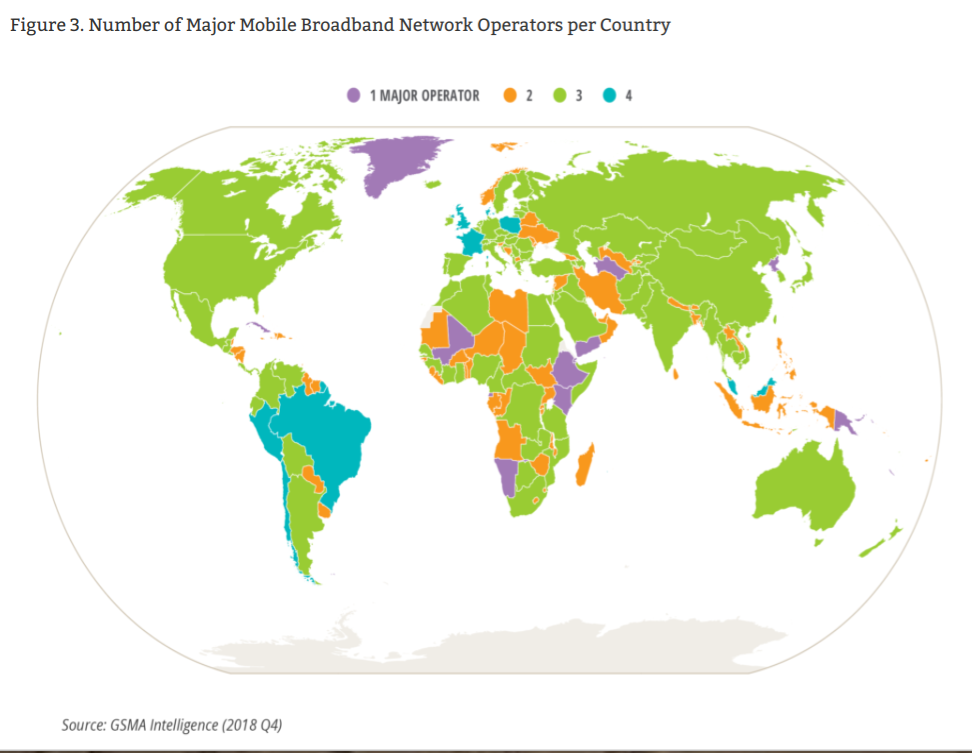
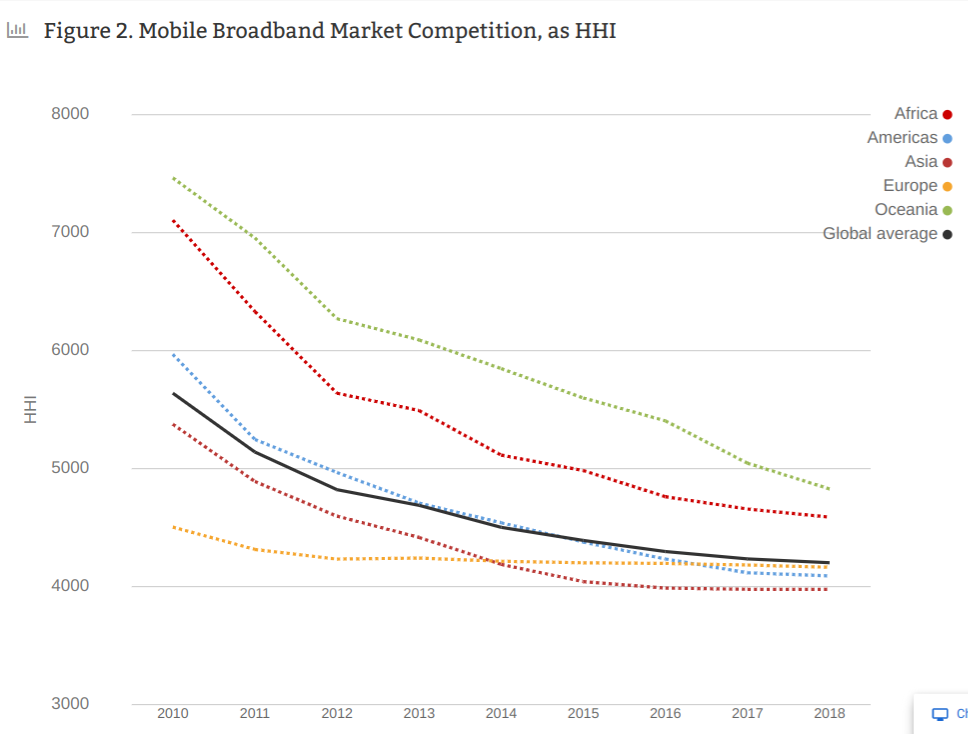
With a few exceptions, the mobile service provider business tends to feature three providers in any single country. With the caveat that nationwide telecom systems always tend to be few in number, virtually every mobile market is highly concentrated, using the Herfindahl-Hirschman Index (HHI), a widely-used measure of market concentration. 

A market with an HHI of less than 1,500 is considered to be a competitive marketplace, an HHI of 1,500 to 2,500 to be a moderately concentrated marketplace, and an HHI of 2,500 or greater to be a highly concentrated marketplace.

No mobile market actually can be deemed “competitive” using the HHI test. On the contrary, every mobile market is highly concentrated. 

Some might argue that relative lack of competition explains the price of mobile data, which because of less than robust competition costs users an estimated $3.42 per gigabyte, according to the Alliance for Affordable Internet. 

In cases where only a single facilities-based supplier operates, breaking up a broadband monopoly can create a savings of up to $7.33 per GB for users, the Alliance for Affordable Internet argues. 

Across Africa, for example, a continent with generally less robust competition, the average cost for 1GB data is 7.12 percent of the average monthly salary. In some countries, 1GB costs as much as 20 percent of the average salary, says the Alliance. 

If the average U.S. earner paid 7.12 percent of their income for access, 1GB data would cost $373 per month.

Though many would note that the existence of mobile virtual network operators will increase competition, it also is an industry fact of life that capital-intensive connectivity networks will always be relatively few in number. It is an oligopolistic industry. 


Monday, October 21, 2019

How Much Market Share Does 5G Fixed Wireless Have to Take to be Meaningful?

How much market share does 5G fixed wireless have to gain to be meaningful? For some new potential suppliers, even a few percentage points of market share could be significant. A million accounts represents about one percent of the total U.S. fixed network internet access market. 

For a new provider, that could represent incremental recurring revenue of perhaps $720 to $960 in annual account revenue, assuming monthly recurring revenue of either $60 a month to $80 a month. 

At just one percent market share, that represents $720 million to $960 million in recurring annual revenue. If the functional definition of the minimum revenue opportunity large enough to be considered by a tier-one service provider is $1 billion, then 5G fixed wireless fits the bill. 

If any single internet service provider is able to get five percent market share, that represents about $5 billion in incremental recurring annual gross revenue. For a firm such as AT&T, with debt service payments about $6.8 billion (though set to decline), that is an important revenue contribution. 

Another answer might be that,  in the U.S. market, 5G fixed wireless will be meaningful for fixed network ISPs if it brings the rate of cable TV net additions close to zero. For cable, that would choke off the most-important driver of subscription revenue. For telcos, that also could mean a halt to share losses in the internet access category that have been on-going for at least a decade. 

Consider that in any particular quarter, cable tends to gain about half a percent market share, or about 532,000 net accounts. With internet access now driving subscription revenue growth, that matters. 

If all suppliers of 5G fixed wireless collectively manage to gain 532,000 accounts per quarter, or about 2.1 million net accounts a year, cable’s subscriber business grinds to a halt, all other things being equal. 

Some predict 5G fixed wireless accounts could, over the next four years, garner about 4.5 million accounts. That would not cause cable gains to go to zero, but would cut internet access gains--all other things being equal--in about half. 

Though many doubt fixed wireless can reach 15 percent to 20 percent share of the U.S. fixed network internet access market, that implies gains of between 15 million and 20 million accounts. 

Some of us might argue that 5G fixed wireless would be significant for the market at even 10 percent share gains, as that could represent a key reversal of market share trends of some years standing, between cable and telcos. Gains might also be important for some other providers not presently in the fixed network internet access business.

Access Network Limitations are Not the Performance Gate, Anymore

In the communications connectivity business, mobile or fixed, “more bandwidth” is an unchallenged good. And, to be sure, higher speeds have ...