Friday, October 16, 2015

A Quick, Real-World Discussion of LTE Speed

This discussion of LTE performance nicely, and in non-technical fashion, explains why an LTE network's theoretical speed is not often the typical speed experienced by a customer.

Given that most mobile device data consumption these days happens when users are on Wi-Fi, blazing speed might not even add as much value as people expect. And, of course, user experience is powerfully affected by the far-end servers--and the subsequent round-trip latency of those servers,  at any moment in time. 

That might especially be important for mobile access, since mobile apps often are assembled from several to many different physical locations, so multiple latency sources are introduced.  

As a rough measure, latency greater than 450 milliseconds will provide unsatisfactory experience. 

Thursday, October 15, 2015

"More of Everything" for Backhaul

It certainly is possible to predict that fixed wireless (including TV white spaces) will be a bigger part of the backhaul and Internet access market over the next decade, in Asia and elsewhere. But it also is possible to predict that existing platforms will grow, even as new platforms reach commercial deployment.


But new platforms are going to represent a bigger share of backhaul globally, as well.


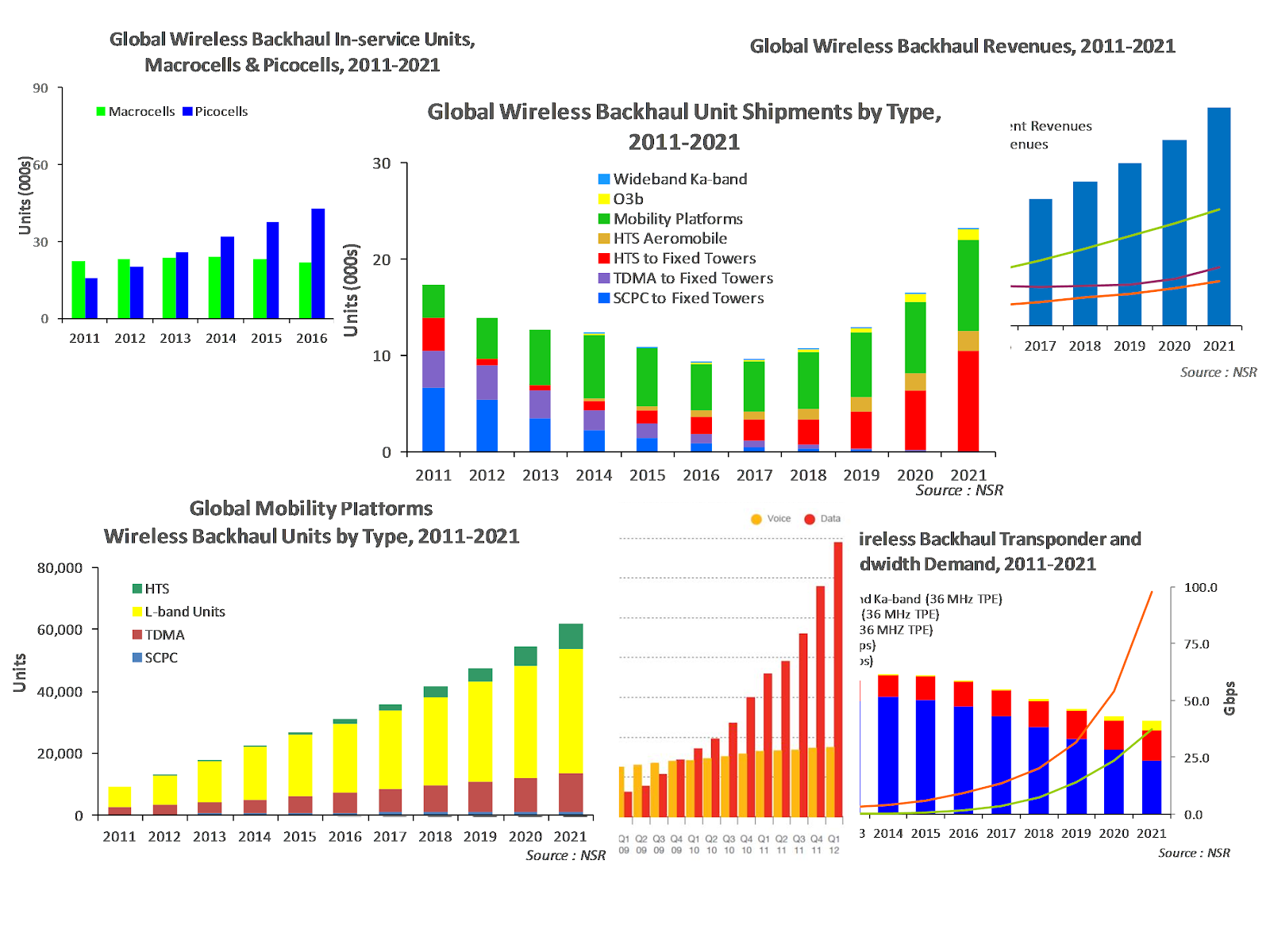
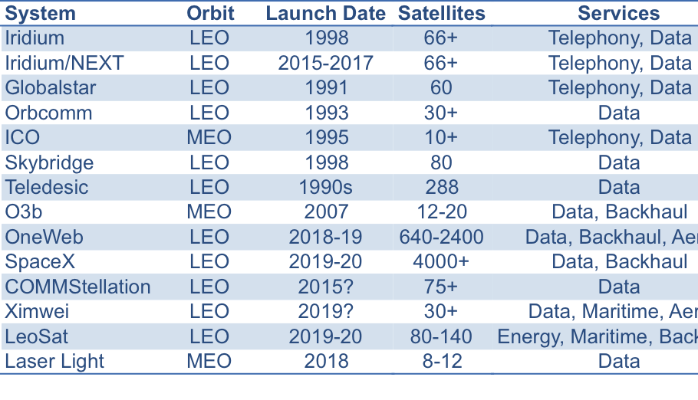
New high-throughput satellites are part of the reason. So are new constellations of satellites in medium-earth or low-earth orbits, plus other platforms based on use of unmanned aerial vehicles or balloons.


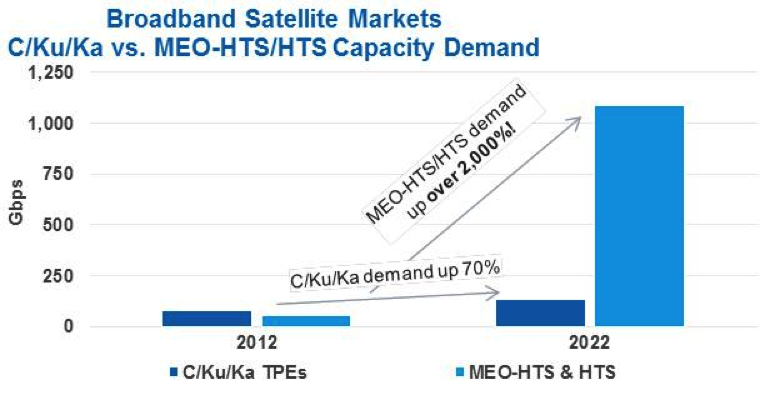
Over about a decade, traditional bandwidth supplied by fixed satellite services will increase about 70 percent, according to Northern Sky Research.


On the other hand, bandwidth supplied by high-throughput satellites and medium earth orbit constellations will grow 2,000 percent, NSR has argued.

One might well argue, though, that much of the new capacity will consist of backhaul to mobile cell towers.


AT&T Earns 54% of Revenue, 66% of Operating income from "Business Solutions"

If you believe the “80/20 rule” generally holds, then 80 percent of results result from about 20 percent of activities. Something like that appears to characterize AT&T’s operating income.

What might be most striking is the degree to which services sold to business customers are vital for AT&T.

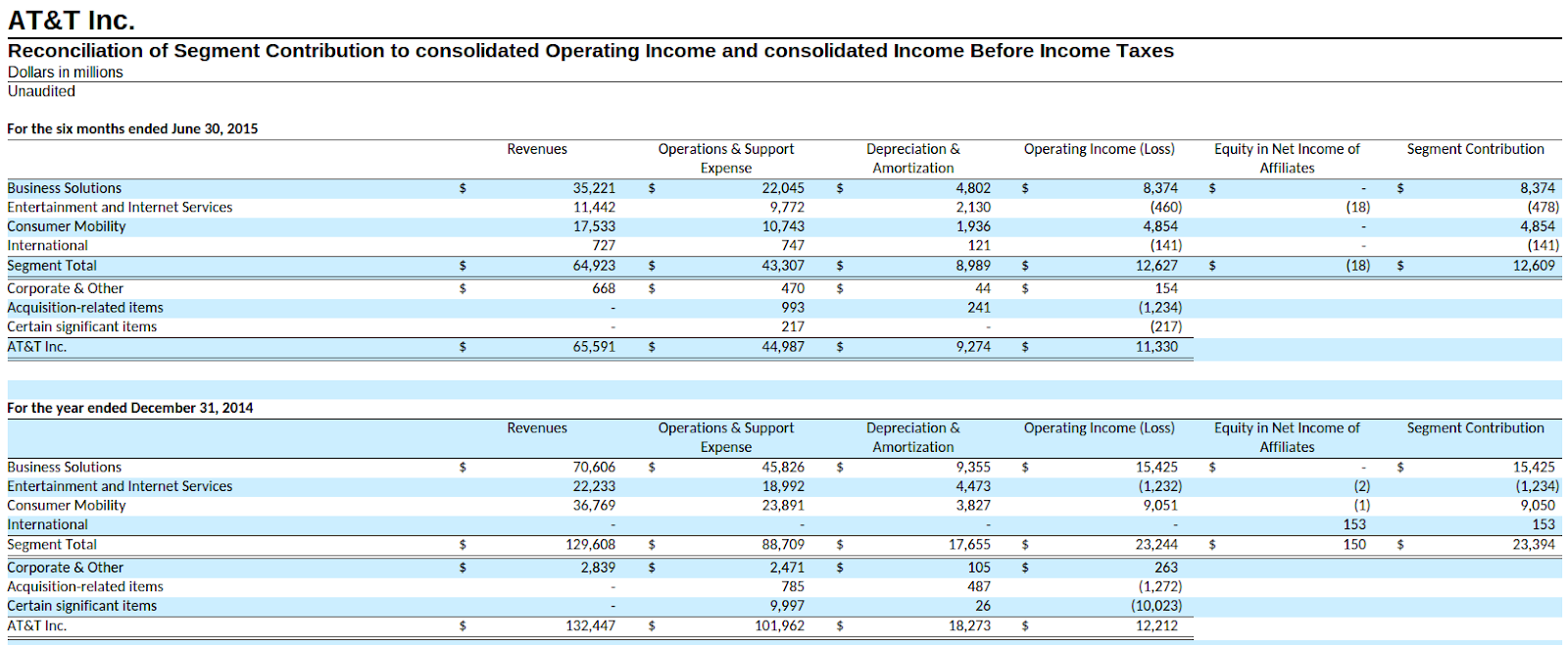
If one looks at revenue, business solutions, consumer mobility, entertainment and Internet services and international are the four buckets AT&T reports results.

Business solutions represents 54 percent of total revenue. Consumer mobility represents 27 percent. Entertainment and Internet Services generates about 18 percent of revenue, while International produces only about one percent of revenue.

In other words, 81 percent of revenue is generated by business solutions and consumer mobility.

The operating income story is more skewed. Business solutions represents 66 percent of total operating income. Consumer mobility represents 38 percent of operating income. Entertainment and Internet Services has negative operating income, as does the International segment.

In terms of operating income, it all comes from business solutions and consumer mobility.

One suspects that will change when AT&T starts reporting results that reflect DirecTV operations, with the entertainment and Internet operations segment assuming both a higher role in revenue, but also contributing operating income.

DirecTV might contribute at least $32 billion in incremental revenue and perhaps $5.6 billion in operating income, more than doubling AT&T’s segment revenues and lifting segment operating income solidly into positive territory.

Whatever else might happen, AT&T's revenue and operating income profile is going to shift. Entertainment and Internet services will be the biggest single change.

Not Only "3 or 4," but "Which" 3 or 4

In many mobile markets, all fundamental policy choices about the right mix of competition and investment center on the numbers "three" and "four." Those numbers correspond to the number of leading providers in the market.

It might be fair to qualify the notion by adding that "which three" and "which four" also are important. Some firms arguably are better able to compete, either because their cost structures are lower or because they have other key revenue streams to rely upon.

The sheer number of firms in a stable and sustainable market still matters. But so do the business models of those firms matter. How can Google, Facebook and others offer valuable services "for free?"

They have different business models than firms relying on subscriptions or transactions. How can cable TV firms sustainably offer lower prices than telcos? Their cost structures are lower.

Economics, alas, is not a science, any more than any of the “social” sciences. Beyond general principles, it is very difficult (impossible, many would say) to “scientifically” tune whole economies, or even reliably predict the actual impact of most proposed policies.

That always applies to the matter of telecommunications service provider regulation, particularly as it applies to the matter of how to fashion policies that stimulate investment in facilities and promote enough competition to improve consumer welfare.

Obviously, policies can do too little, or too much, in either case leading to sub-optimal levels of competition, investment and consumer welfare.

Generally speaking, the bigger problems are structural: rules that arguably “artificially” restrict the amount of competition, prevent rationalized markets or reduce incentives to invest. But finding the right balance is tricky.

That is precisely at the heart of regulatory thinking in the European Union, for example.

Broadly speaking, the matter of promoting investment and competition takes practical expression in policies related to the “right” number of providers in markets. In the European Union mobile market, the key numbers are “four” and “three,” referring to the minimum number of leading contestants believed to be necessary to support robust competition.

The obverse also holds: four versus three also is believed to shape the profitability of investments. Three, in that sense, is more inviting than four.

Industry and regulators do not agree on the numbers. Telcos argue more scale--and therefore more mergers--are necessary to reduce the number of suppliers. Regulators now argue that no more big mergers are desirable, as that would reduce the level of competition.

The parties are not talking past each other, just focusing on different problems. Policies that promote “more competition” often can create less-inviting prospects for “more investment.”

“Less competition” can create better prospects for “more investment.” That is why the balance matters so much. More of one outcome means less of the other outcome. But there are worse outcomes.

Getting the balance wrong ultimately implies--at least for a time--less competition and less investment, however.

That happens because too much competition inevitably leads to supplier death. That can happen in several ways. Struggling firms typically reduce capital  investment to try and survive. In other cases, firms overinvest in facilities that ultimately do not produce a return. Either way, firms eventually exit the market.

What form the exits take is another matter. Firms can disappear, to be sure. But the more typical exit is absorption of failing firms by stronger firms. In those cases, there is at least a possibility that the level of competition actually is enhanced, not reduced.

That arguably will be the case in the U.S. market, for example, if two of the leading four U.S. mobile firms are acquired by cable TV, app provider or device supplier owners. In principle, that could happen in some EU markets as well.

So the issue is perhaps not only “three or four,” but “which three, and which four.”

Tuesday, October 13, 2015

U.S. Cable TV Operator Capex to Grow in 2015, Decline Afterwards

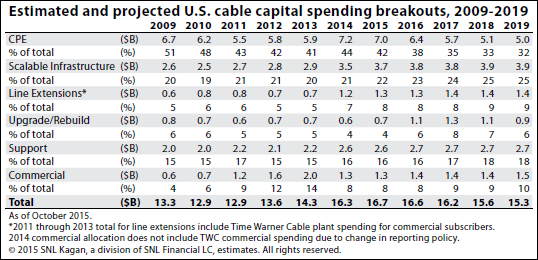
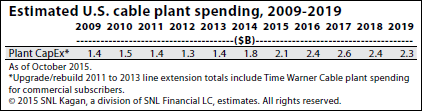
SNL ImageU.S. cable operators will in 2015 will have made more capital investment than ever before in a single year (not adjusted for inflation).

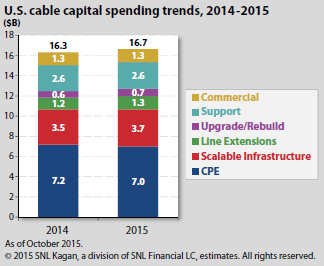
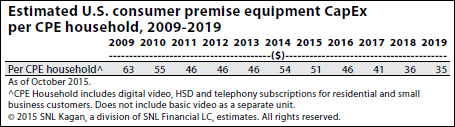
According to SNL Kagan estimates, U.S. cable operators will invest $16.66 billion. Some of that capital will go to plant extensions and upgrades, but about $7 billion, or 42 percent, is for customer premises equipment. Much of that is for video set-tops, while some is for high speed access routers and modems.
SNL Image


Comcast plans to allocate 14.5 percent of cable segment revenue to capital investment. 

Other firms also will boost spending, while some will decrease capex. 

Time Warner Cable will boost capex to $4.45 billion, up 8.6 percent, year over year. 

Suddenlink will boost spending about 16 percent.

Charter will drop capex 27 percent from 2014 levels, as will Cablevision Systems.

SNL Kagan expects modest declines in 2016 capex, industry-wide.

SNL Image

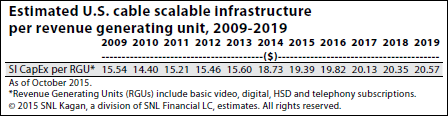
Spending on scalable infrastructure on network virtualization, DOCSIS 3.1, the Converged Cable Access Platform, increased on-demand and multiscreen content delivery, enhanced cloud-based guides and increased reliance on unmanaged devices also will grow modestly.

SNL Image

The upgrades to 1 Gbps broadband services are boosting spending on capacity upgrades, as well.

SNL Image

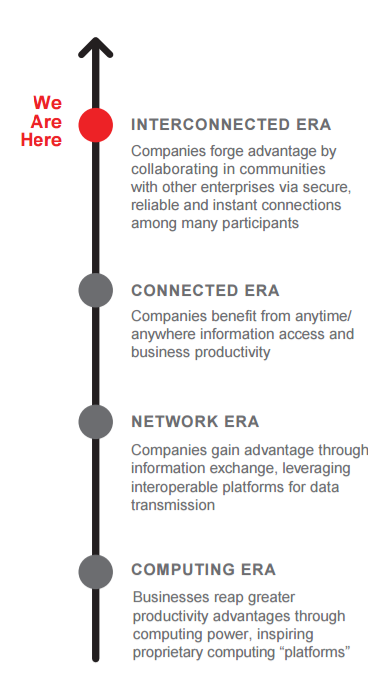
"Interconnected Era" Arrives, says Equinix

Direct connections between private Internet Protocol domains lead to six nines levels of availability, with 15 percent fewer network incidents and outages, according to studies produced for Equinix.

Increased direct interconnection of domains contributed to a 42 percent average reduction in latency and 40 percent reduction in bandwidth costs, Equinix says.

“We are now in the interconnected era,” Equinix says. “This period is dominated by the need for a level of interconnection that delivers instant collaboration between and within dense industry ecosystems consisting of partners, employees, customers and data sources.”

The number of interconnected enterprises is set to more than double from 38 percent to 84 percent globally by 2017, Equinix argues.

There are a couple of reasons for that growth Some 75 percent of enterprise employees reside in locations other than the corporate headquarters, while 82 percent of enterprises report a multi-cloud strategy. Hence the need to create connections with very low latency, enabled by domain-to-domain direct connections.

Dell Merger with EMC Points to Cloud Future

The merger of Dell and EMC, at $67 billion, is the biggest-ever merger in the information technology industry.

Whatever else the deal might mean, it shows the evolution of computing from the personal computer era to the era of cloud and mobile computing.

In the past, most computing happened locally, whether on mainframes, minicomputers or PCs. These days, most computing happens remotely, in data centers. So one might logically argue that the Dell merger with EMC is an effort to transition to the next computing era.

It is virtually impossible to compare the volume of local computing compared to remote--or cloud--computing. It is easier to quantify the amount of computing-related traffic.

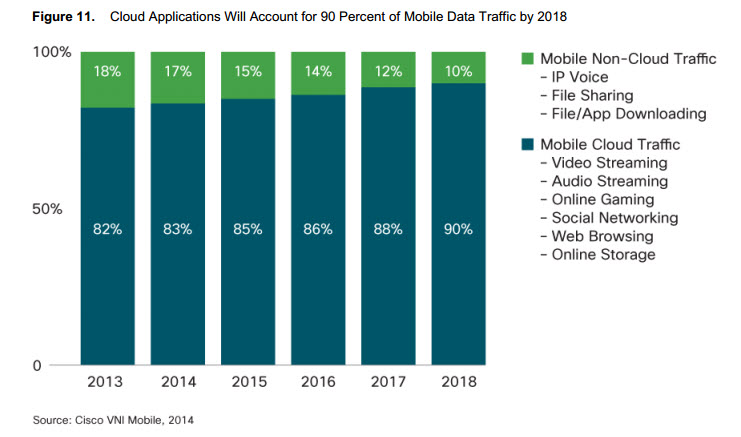
According to Cisco, perhaps 85 percent of applications traffic volume now is directly produced by cloud computing.


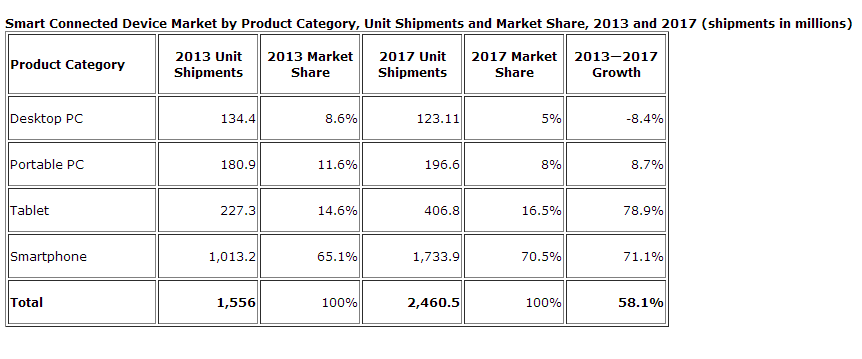
Likewise, the installed base of computing devices has shifted dramatically to smartphones, devices that rely on cloud or remote computing for most of their value.

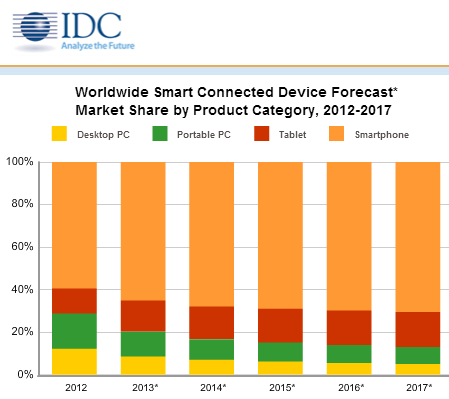
By 2017, 87 percent of the global smart connected device market will be tablets and smartphones, with PCs (both desktop and laptop) being 13 percent of the market.


Cloud-based apps now matter because nearly all apps--enterprise or consumer--now are consumed that way.

In 2015, 83 percent of all mobile apps used by U.S. consumers are cloud apps, according to Cisco. By 2019 cloud apps will represent 90 percent of all mobile apps.

The trend often will appear less advanced in the enterprise computing segment, as cloud computing, by volume of operations or enterprise spending, rarely is more than small percentage of total spending.

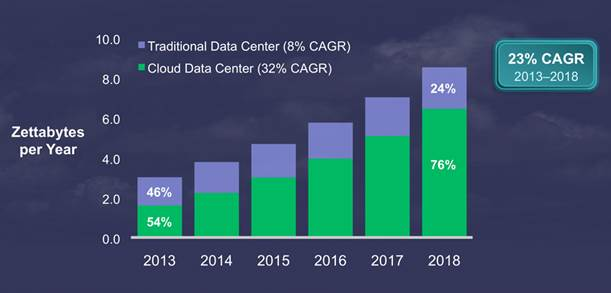
By 2018, cloud data centers should represent as much as 76 percent of all data center workloads, according to Cisco.


Overall, most U.S. businesses use cloud computing to some extent, with most enterprises using a hybrid approach (both internal and external cloud operations).

Of the 37 percent of U.S. small businesses that already buy cloud-based services, most buy software as a service, with marketing, e-commerce, sales, collaboration and productivity functions used among the top six functions being cloud sourced, although back office often is the function most likely to be moved to the cloud.

The core market might be about three million firms, largely in the services segment, followed by retail and healthcare. There are perhaps nine million additional small or home office based businesses (owner operated or with a maximum of four employees).

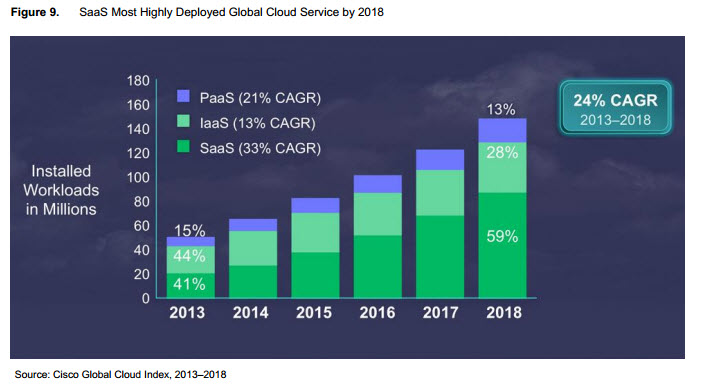
By definition, software as a service is consumed without any need to buy cloud infrastructure, and the largest segment of the cloud services market is SaaS, representing 81 percent of all cloud spending.

In other words, a direct purchase of cloud capability represents about 19 percent of cloud purchases by business users.


On the Use and Misuse of Principles, Theorems and Concepts

When financial commentators compile lists of "potential black swans," they misunderstand the concept. As explained by Taleb Nasim ...