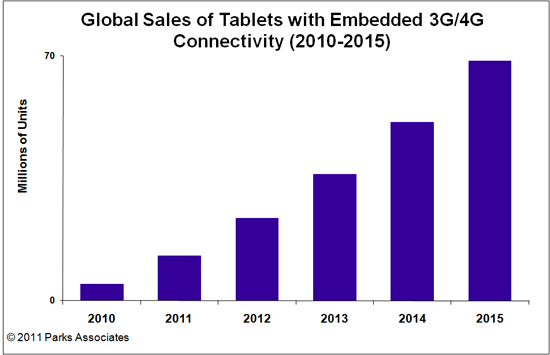
Some 29 percent of the 16.5 million tablets sold in 2010 featured embedded 3G technology, while tablets with 3G or 4G technology will account for over half of all tablets sold in 2015.
Wednesday, March 30, 2011
Tablet Sales Could Drive Significant Mobile Broadband Sales
Some 29 percent of the 16.5 million tablets sold in 2010 featured embedded 3G technology, while tablets with 3G or 4G technology will account for over half of all tablets sold in 2015.
Gary Kim was cited as a global "Power Mobile Influencer" by Forbes, ranked second in the world for coverage of the mobile business, and as a "top 10" telecom analyst. He is a member of Mensa, the international organization for people with IQs in the top two percent.
U.S. SMBs Highly Likely to Buy Tech Support Services for Tablets, Other IT
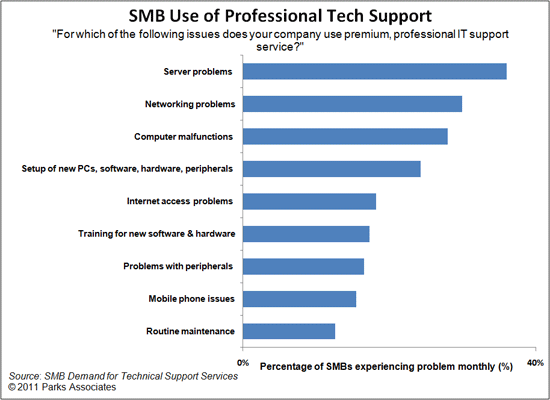
"SMBs waste dozens of hours per month troubleshooting technology issues," said Kurt Scherf, VP, principal analyst, Parks Associates. "Over 70 percent are involved with ongoing computer maintenance on a monthly basis."
About half deal with Internet access issues, 44 percent troubleshoot computer problems, 31 percent troubleshoot networking issues, and 27 percent deal with server problems.'"
There might be new opportunities for a variety of companies and channels. Apple, for example. recently announced JointVenture, a new support network for small businesses that combines remote and retail support for its iPads and Macs.
Gary Kim was cited as a global "Power Mobile Influencer" by Forbes, ranked second in the world for coverage of the mobile business, and as a "top 10" telecom analyst. He is a member of Mensa, the international organization for people with IQs in the top two percent.
Tech Company Valuation: 1999 and 2011
It's hard to say for certain whether we are in a dangerous valuation bubble for Internet companies or not, as we were around 2000.
It is clear there is an enormous wave of Internet innovation going on at the moment. But there will be excesses and failures, as well as some big new market leaders.
But one difference seems to be that all the emerging companies are applications and software firms. You'd be hard pressed to name a hardware company that is among the emerging firms.
It is clear there is an enormous wave of Internet innovation going on at the moment. But there will be excesses and failures, as well as some big new market leaders.
But one difference seems to be that all the emerging companies are applications and software firms. You'd be hard pressed to name a hardware company that is among the emerging firms.
Gary Kim was cited as a global "Power Mobile Influencer" by Forbes, ranked second in the world for coverage of the mobile business, and as a "top 10" telecom analyst. He is a member of Mensa, the international organization for people with IQs in the top two percent.
Microsoft Strategy Chief: Tablets May Just Be A Fad
Microsoft's chief technical officer and strategic leader Craig Mundie told an audience in Australia that he's not sure if tablets are here to stay. Steve Jobs agrees with Mundie on one point: the iPad is not a PC. Beyond that, Apple and Microsoft do not seem to agree on much else.
Gary Kim was cited as a global "Power Mobile Influencer" by Forbes, ranked second in the world for coverage of the mobile business, and as a "top 10" telecom analyst. He is a member of Mensa, the international organization for people with IQs in the top two percent.
Google "Plus One" is Another Way Users Can Annotate the Web
Gary Kim was cited as a global "Power Mobile Influencer" by Forbes, ranked second in the world for coverage of the mobile business, and as a "top 10" telecom analyst. He is a member of Mensa, the international organization for people with IQs in the top two percent.
NFC is Overhyped, says Sybase
Sybase is a leader in text messaging based mobile payments, so Sybase might be forgiven its public view that mobile payments using near field communications are over-hyped at the moment. The general observation is correct, as always is the case. Enthusiasm always outruns actual adoption when brand-new technologies are introduced.
Sybase says text-based payments more than doubled in 2010, so “mobile commerce is exploding." But the skeptical view about NFC is both a realistic assessment of what can happen in 2011, and a rational response for a leader using a rival method.
Gary Kim was cited as a global "Power Mobile Influencer" by Forbes, ranked second in the world for coverage of the mobile business, and as a "top 10" telecom analyst. He is a member of Mensa, the international organization for people with IQs in the top two percent.
Microsoft Planning Mobile Payments Support
Microsoft Corp. is working on a version of its Windows Phone software with near field communications support, allowing creation and use of NFC-based mobile payments applications and services. What isn't immediately clear is whether Microsoft wants to provide NFC support without creating its own mobile payments solution, or will try to compete as a supplier of mobile payments or related services.
Gary Kim was cited as a global "Power Mobile Influencer" by Forbes, ranked second in the world for coverage of the mobile business, and as a "top 10" telecom analyst. He is a member of Mensa, the international organization for people with IQs in the top two percent.
Is a Wireless Duopoly a Good Idea?
Though the notion will strike some as obviously ill-fitting, until 30 years ago, telecom companies were regarded as natural monopolies. There are few places left where that remains the case.
That doesn't necessarily mean there is universal agreement about the best way to foster competition, or which patterns are stable and yet workably competitive. In some cases, network access still is seen as a sort of utility function, with competition between retail providers using a shared wholesale network now seen as the way to harness competition while minimizing investment in expensive access networks. That isn't the pattern in the U.S. market, however.
AT&T's proposed acquisition of T-Mobile USA, with no change in the Verizon Wireless footprint, which would result in nearly 75 percent of U.S. subscribers being served by just two national carriers. In some cases, duopolies arguably have provided workable, though not perfect competition.
In the wireless sphere, some will argue that the analog services duopoly was characterized by low rates of innovation, high prices and modest mass market adoption. Not until new competitors and digital services were unleashed did the mobile industry really reach ubiquity. So some will worry about a return to a national duopoly.
But some also will note that much innovation and competition in the wireless space now is conducted by application and handset providers, and that access is just one element. It will not be a terribly easy analysis to figure out what the "market" is, or how the dynamics of competition now work.
Gary Kim was cited as a global "Power Mobile Influencer" by Forbes, ranked second in the world for coverage of the mobile business, and as a "top 10" telecom analyst. He is a member of Mensa, the international organization for people with IQs in the top two percent.
Kansas City, Kan. to Get Google 1-Gbps Fiber to Home Network
Kansas City, Kansas will get a Google-built 1-Gbps fiber-to-home access network as part of a Google test of what can be done when such networks are available.
Gary Kim was cited as a global "Power Mobile Influencer" by Forbes, ranked second in the world for coverage of the mobile business, and as a "top 10" telecom analyst. He is a member of Mensa, the international organization for people with IQs in the top two percent.
Buyer Processes for Software and Hardware are Changing
As more business software moves to a cloud-based model, something else is going to change: The way business customers buy software and applications. To an extent probably not yet appreciated, a shift to Internet-delivered software makes it easier for business buyers to focus on business outcomes, not "speeds and feeds."
Buyers will start to focus less on "features" and start to concentrate on the quality of business outcomes enabled by technology, and not the technology itself, said Peter O’Neill, Forrester Research analyst.
That should have implications for sales teams, as it suggests the typical buyer is going to be inclined to look for a discussion of how a particular solution helps an organization boost its chances to grow revenue, or conversely how a given solution helps an organization reduce its costs in some measurable way.
As always, it is a good bet that the more interesting stories will revolve around "growing revenue" rather than "reducing cost." For some suppliers, this will represent a challenging shift. All too often, a hosted IP telephony discussion, or a potential new premises phone system sale, will center on all the features a new solution offers. That doesn't fit with the growing emphasis on "business impact," especially as the actual "buying" becomes easier, since applications can be sourced simply by using the Internet access connection and browser.
By simplifying all the implementation and provisioning tasks, hosted or cloud-based applications mean the buyer can spend more attention on the direct business benefits attached to any solution. That will prove a different, and perhaps more difficult sales challenge, since the pitch will have to be on the business benefits, not the attributes of a given solution. Instead of "our box or software does X, Y and Z," sales forces will have to speak to the ways the deployed solution helps boost revenue, customer acquisition, retention, sales volume or number of prospects that can be contacted in a day.
Gary Kim was cited as a global "Power Mobile Influencer" by Forbes, ranked second in the world for coverage of the mobile business, and as a "top 10" telecom analyst. He is a member of Mensa, the international organization for people with IQs in the top two percent.
Gartner Identifies 10 Consumer Mobile Applications to Watch in 2012
The most important mobile apps in 2012 will be those that are purpose-built to take advantage of mobile device capabilities and situational use cases, say analysts at Garner. Perhaps the most interesting apps will combine multiple mobile-specific features that use sensor information, combine it with other user-supplied preferences, and then create some sort of commerce activity.
In other words, the mobile experience is becoming a distinct medium from the location-based experience, representing something more than simply a smaller-screen, out of home or "on the go" version of the tethered Internet experience. If you had to pick one element that is most distinctive, it would be "location," the smartphone's ability to use the actual user location, as it changes, to modify the application experience.
Most of the distinctive mobile apps will use location, mapping and directions, in conjunction with other user-supplied data and preferences, to create new experiences and new business models for application and service providers. Context awareness is the new wrinkle.
Gary Kim was cited as a global "Power Mobile Influencer" by Forbes, ranked second in the world for coverage of the mobile business, and as a "top 10" telecom analyst. He is a member of Mensa, the international organization for people with IQs in the top two percent.
How Traditional Telecom Suppliers are Preparing for Mobile Payments
Mitch Cornell, Xius VP, talks about the mobile payments business, particularly illustrating how a traditional provider of prepaid mobile solutions believes its traditional solutions can be "re-purposed" for the mobile payments ecosystem.
Gary Kim was cited as a global "Power Mobile Influencer" by Forbes, ranked second in the world for coverage of the mobile business, and as a "top 10" telecom analyst. He is a member of Mensa, the international organization for people with IQs in the top two percent.
Apps Moving to PCs
Gary Kim was cited as a global "Power Mobile Influencer" by Forbes, ranked second in the world for coverage of the mobile business, and as a "top 10" telecom analyst. He is a member of Mensa, the international organization for people with IQs in the top two percent.
Enteprise Hierarchies Endangered?
As 24/7 connectivity, social networking, and increased demands for personal freedom further penetrate the walls of the corporation, corporate life will continue to move away from traditional hierarchical structures, a Booz & Co. analysis apparently suggests. Instead, workers, mixing business and personal matters over the course of the day, will self-organize into agile communities of interest.
By 2020, more than half of all employees at large corporations will work in virtual project groups. These virtual communities will make it easier for non-Western knowledge workers to join global teams, and to migrate to the developed world.
The proliferation and increasing sophistication of communication, interaction, and collaboration technologies and tools, and the economics of travel itself, will result in knowledge workers’ traveling much less frequently. Many of you undoubtedly would agree that although work processes are becoming more collaborative and fluid, the hierarchy of authority has not much changed.
Gary Kim was cited as a global "Power Mobile Influencer" by Forbes, ranked second in the world for coverage of the mobile business, and as a "top 10" telecom analyst. He is a member of Mensa, the international organization for people with IQs in the top two percent.
Is Mobile Voice Nearing a Tipping Point?
Sprint has announced very-significant integration of Google Voice, allowing Sprint subscribers to use their Sprint phone numbers to access a full range of Google Voice features, including routing calls to fixed phone numbers, as well as replace Sprint voice mail with the Google Voice voice mail service. That move can be interpreted in numerous ways. At a tactical level, you might say that more-substantial innovations in a market tend to come from contestants that do not have market power, and which need to shake things up.
At another level, you might ask whether a strategic shift has been made at Sprint, in terms of where the single most important revenue stream is coming from. It is no secret that mobile service provider revenue, which has been based on voice, but augmented significantly by text message and now mobile broadband revenue, continues to evolve in the direction of primary reliance on broadband-based services and access. Perhaps Sprint has made a decision to essentially hasten that process by attempting to change the value equation for voice, even if that hastens the demise of voice as a revenue stream in many ways.
Whether merely tactical, or indicative of a broader strategic shift, the Sprint deal with Google Voice is possible evidence that a turning point is about to be reached, historic for either the fixed-line or mobile businesses, where at least some contestants reach a point in their business development where the growth of broadband revenues and the tempo of innovation has to be spurred, even at the expense of putting further pressure on the core voice services revenue.
"For an operator to work with a company such as Google, which is widely perceived as a significant threat in the most lucrative areas in mobile, and to endorse a service that has previously been seen by many as a threat to core voice revenue, is intriguing," says Steve Costello, GSMA content editor. "At the very least it reflects changing telco attitudes, as the previous business model is swept away by new-entrants from the internet world."
Whether merely tactical, or indicative of a broader strategic shift, the Sprint deal with Google Voice is possible evidence that a turning point is about to be reached, historic for either the fixed-line or mobile businesses, where at least some contestants reach a point in their business development where the growth of broadband revenues and the tempo of innovation has to be spurred, even at the expense of putting further pressure on the core voice services revenue.
Gary Kim was cited as a global "Power Mobile Influencer" by Forbes, ranked second in the world for coverage of the mobile business, and as a "top 10" telecom analyst. He is a member of Mensa, the international organization for people with IQs in the top two percent.
Subscribe to:
Comments (Atom)
Is Private Equity "Good" for the Housing Market?
Even many who support allowing market forces to work might question whether private equity involvement in the U.S. housing market “has bee...
-
We have all repeatedly seen comparisons of equity value of hyperscale app providers compared to the value of connectivity providers, which s...
-
It really is surprising how often a Pareto distribution--the “80/20 rule--appears in business life, or in life, generally. Basically, the...
-
Financial analysts typically express concern when any firm’s customer base is too concentrated. Consider that, In 2024, CoreWeave’s top two ...