Friday, April 1, 2011

85% of Smartphone Users Access Mobile Web

There aren't yet any apps, aside from specific "mobile apps" or "social apps," that people access more on a smartphone than on a PC, a survey by Yankee Group has found. But researchers also find that use of smartphones to access web apps of all sorts is growing, and that most popular apps people like to use on their PCs also get used from their smartphones, though at a lower frequency, so far.

GPS and navigation apps likely are one clear exception, likely used virtually exclusively in a mobile context.

Most likely, we will relatively soon find there are some apps that are used primarily from a smartphone or other mobile device, compared to a PC. Mobile payment apps come to mind.
 LR-55441-EX01.jpg

39% of Small Businesses Will Be Buying Cloud Services Within 3 Years

About 39 percent of small and medium-sized businesses recently surveyed by Edge Strategies on behalf of Microsoft say they expect to be using, and paying for, cloud-based services within three years.

Accounting and payroll apps, project management, data storage and customer relationship management are among the top categories of apps respondents expect they will be sourcing from a cloud services provider.

http://www.microsoft.com/Presspass/presskits/commsector/docs/SMBStudy_032011.pdf

Where Will 4G Compete with DSL?

You can get an argument about whether fourth-generation mobile broadband services work well enough to be a viable substitute for a fixed-line connection, and what user requirements are best suited for such potential substitution.

Wireless might or might not work so well for multi-person households, for example, but might be quite adequate for a single-person household, especially when a user does not watch much online video.

Some service providers also will have incentives to try and sell wireless substitutes for fixed-line service anywhere those service providers do not have fixed-network assets.

Long Term Evolution "provides a real opportunity for the first time to give a fixed customer in a home, broadband service — wireless — but broadband service,” says Dick Lynch, Verizon CTO.

Eighty Percent of Consumer Purchases will be Influenced by Social and Mobile Marketing

By 2015, digital strategies, such as social and mobile marketing, will influence at least 80 percent of consumers' discretionary spending,' said Adam Sarner, research director at Gartner. "Marketers still need to shift their traditional campaign management strategy around executing campaigns to a customer and move toward a digital marketing, two-way engagement approach."

Digital agency Morris argues that the shift away from mass marketing thinking into "laser-focused relationship creation" is enabled by all manner of technology that allows products to be customized and personalized, by the end user directly if not at the manufacturing stage.

What AT&T's Potential Purchase of T-Mobile USA Doesn't Change

People love to speculate about what the AT&T purchase of T-Mobile USA means, or could mean. Right now, all such talk is speculation, as the deal cannot clear Federal Communiations Commission and Department of Justice reviews for roughly a year. People eagerly describe the deal as "transformative" or "industry-altering."

So here's a bit of a contrarian view: it will change much less than most people now think. AT&T and Verizon have been the two industry-leading providers since 1995 or so, and each firm has only become more dominant since then. The AT&T acquisition will make AT&T bigger, but nobody can say yet how much bigger, as divestitures will undoubtedly be required to gain regulatory blessing.

Verizon might bulk up a bit more as well, though Verizon's interest in doing so remains unclear. Many will assume the deal, if approved, will reduce the number of leading national wireless providers from four to three. Whether that is stable over the long term is open to question.
Nor is it entirely clear whether consumer benefits, ranging from innovation to prices, would necessarily diminish, in a three-provider or even two-provider environment. The reason is that most innovation now occurs on the handset and application fronts. Nor can we accurately predict what will happen as cable operators and other existing and potential providers ramp up their own services. And though hoped-for spectrum auctions will likely find AT&T and Verizon in leading roles, spectrum auctions in the past have proven capable of shaking up the existing industry in serious ways.

There could well be far less impact, one way or the other, in the immediate wake of a successful AT&T acquisition of T-Mobile USA. In part, that is because the merger approval conditions undoubtedly will prevent AT&T moving in ways that are clearly threatening to continued innovation and competition.

Thursday, March 31, 2011

SIP Trunking Service Revenue Grows 143% in 2010

The VoIP services market reached $49.8 billion in 2010, compared to $34.8 billion in 2008. While the residential services segment remains the largest of the market at 69 percent of total revenue, business VoIP services are growing at faster rates.

SIP trunking had a breakout year with 143 percent revenue growth in 2010,” notes Diane Myers, directing analyst for VoIP and IMS at Infonetics Research.

Infonetics Research forecasts the combined business and residential and small office/home office VoIP services market to grow to $74.5 billion in 2015.

Managed IP PBX business VoIP service revenue is expected to more than double from 2010 to 2015.

The fastest growing segments of the VoIP services market are SIP trunking and hosted UC telephony. Based on healthy demand for cloud-based services, the number of seats for IP Centrex and hosted UC services grew 20 percent in 2010, says Infonetics.

Kansas City Might Not be Last to Get 1-Gbps Fiber to Home from Google

Google has suggested it might fund more than one test site. From the Google blog:


We’ve heard from some communities that they’re disappointed not to have been selected for our initial build. So just to reiterate what I've said many times in interviews: we're so thrilled by the interest we've generated—today is the start, not the end the project. And over the coming months, we'll be talking to other interested cities about the possibility of us bringing ultra high-speed broadband to their communities.

Blogger is Changing

0.05% of Entities Produce Tweets Read by 50% of Twiiter Users

On Twitter, roughly 50 percent of tweets consumed are generated by just 20,000 elite users including celebrities, large media and other organizations and some bloggers, a study by Yahoo Research has found. In other words, 20,000 users, comprising less than 0.05 percent of the user population, attracts almost 50 percent of all attention within Twitter. read more here

39% of SMBs Will be Buying Cloud Services by 2014, Study Suggests

Some 39 percent of small and medium-sized businesses expect to be paying for one or more cloud services within three years, an increase of 34 percent from the current 29 percent, a study conducted by Edge Strategies has found. The study also found that respondents expect to almost double their use of cloud services over the next three years.

The global survey of 3,258 firms that employ up to 250 employees included respondents from Australia, Canada, China, France, Germany, India, Japan, the Netherlands, Norway, Russia, Singapore, South Africa, South Korea, Spain, the U.K. and the U.S.

Collaboration, data storage and backup and business-class email are some cloud-based services that hold promise for channel partners and other sales entities. SMBs paying for cloud services will be using 3.3 services, up from fewer than two services today, over the next few years, the study suggests.

The larger the business, the more likely it is to pay for cloud services. The study suggests 56 percent of companies with 51 to 250 employees will pay for an average of 3.7 services within three years.

Within three years, 43 percent of workloads will become paid cloud services, but 28 percent will remain on-premises, and 29 percent will be free or bundled with other services.

http://www.microsoft.com/presspass/emea/presscentre/pressreleases/MSSMBCloudAdoption.mspx

Wednesday, March 30, 2011

Consumerization of Enterprise IT Continues

Workers now report using an average of four consumer devices and multiple third-party applications, such as social networking sites, in the course of their day, according to a study sponsored by Unisys. Also, workers in the survey reported that they are using their own smartphones, laptops and mobile phones in the workplace at nearly twice the rate reported by employers.

In fact, 95 percent of respondents reported that they use at least one self-purchased device for work. Another big change is that where enterprise IT staffs used to assume they were responsible for training and supporting users on enterprise technology, these days many users simply will go ahead and train themselves to use tools they prefer. That also is a big change.

That 'consumerization' of technology is quite a big shift. Decades ago, the pattern of technology diffusion was fairly straightforward. The latest new technology was purchased by large enterprises and large government entities. Over time medium-sized businesses and organizations started to buy the same technology. Later, small businesses and organizations adopted the tools. Finally, some consumers 'brought the technology home' and used it as well.

All of that has changed over the last two decades. These days, many enterprise tools actually were brought into the enterprise by consumers who already had adopted the technology for home use.

Net Neutrality Positions Hinge on Assumptions

Sir Tim Berners-Lee, inventor of the World Wide Web, has told Internet service providers that their plans for a two-tier Internet go against the principle of net neutrality. Berners-Lee said that Internet users should have free and open access to all content, and that content providers should also have unrestrained access to customers.

That sort of points up the confusion around the whole notion of network neutrality, understood as the idea that every user and entity should be able to communicate with every other user, for "free."

Even the original thinking that every entity should be able to communicate with every other entity no longer is possible. China will not allow some communications, on some subjects, by any Chinese user, no matter what a content or application provider might think. Many governments will not allow the use of Skype or other VoIP services and applications.

Watch for Significant Cord Cutting in 2012

Nearly 25 million U.S. households have watched online video on their standard TVs, Forrester Research reports. The U.S. online adults Forrester Research surveyed reported that 14 percent of their total video viewing was coming from the Internet, on average. Assuming a typical user watches five hours a day worth of video, which implies about 42 minutes a day of online video consumption using TVs, PCs or other devices.

When the results are sorted to include only respondents who say they watch online video on a TV, 28 percent of total viewing time—about an hour and 24 minutes a day—is online video.

In about 56 percent of cases, consumers are using their videogame consoles as the gateway to online viewing that is displayed on a TV. That makes sense, as the game players are, by definition, already connected to the TV and to a broadband connection.

The personal computer is the second most common gateway device used to view online video on a standard TV, Forrester Research reports that 10.9 million homes currently connect a PC to a TV at least occasionally, representing about 44 percent of the gateway devices used to watch online video on a TV display.

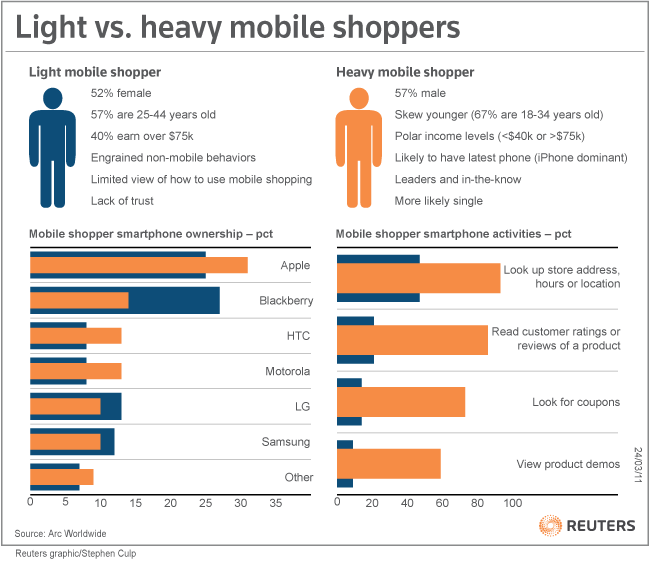
Half of Mobile Subscribers Use Their Phones to Shop

About half of mobile phone owners use their devices when shopping, to one extent or another.

While 89.7 percent of the U.S. population aged 18 to 64 have mobile phones, only 49.1 percent are using their phones to shop, according to Arc Worldwide, the marketing services arm of advertising agency Leo Burnett.

Mobile shoppers are using phone-friendly versions of websites and apps to compare prices, read reviews, check out product features, download coupons and make purchases.

read more here

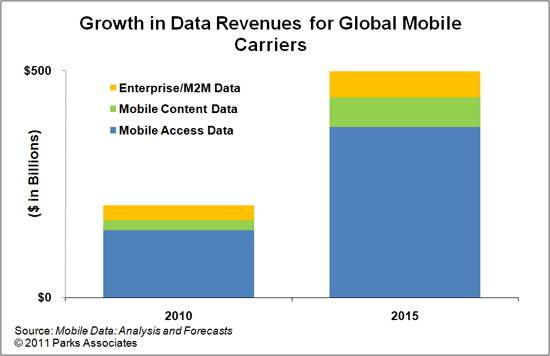
Half of U.S. Mobile Users Buy Mobile Broadband, Parks Associates Says

Growth in Mobile Data Revenues"Almost 50 percent of U.S. mobile phone users pay for mobile Internet access, according to Parks Associates. Some 95 percent pay for SMS, 92 percent pay for Internet access, 83 percent pay for mobile email, 63 percent pay for mobile navigation, and 43 percent pay for mobile video.

Is Private Equity "Good" for the Housing Market?

Even many who support allowing market forces to work might question whether private equity involvement in the U.S. housing market “has bee...