Friday, April 8, 2011

How Long Before Nook is a Tablet?

Barnes & Noble has opened up the Nook Color e-reader to Android developers. The new software developers kit includes
access to an expanded set of development resources to facilitate app deployment and app distribution through the Barnes & Noble storefront.

One wonders how long it will take before the Nook becomes a full-fledged tablet.

Wireless: Don't Break What Isn't Broken

One reasonable bit of device in business is not to break what is not broken. Perhaps another good bit of advice is not to "fix" problems that already are being fixed. That advice arguably is not always followed.

In 1996, in order to induce more competition in the telecom business, the Congress passed the Telecommunications Act of 1996. The basic innovation was a historic change in rules on "who can be a local telephone company?"

Where in the past only one firm in a geographic area was allowed to be a local telco, the Telecom Act allowed any company to become a local telco. Of course, you now know what else was happening. Wireless was becoming a dominant way people use "voice" services.

The Internet was about to become the biggest, fastest-changing, most consequential new development in communications and media. So while regulators were moving to allow much more competition in landline voice, the market already was moving to wireless and Internet services and applications.

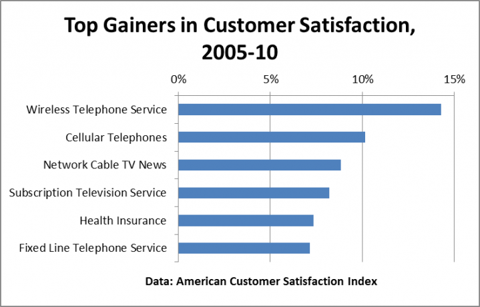
That's always a danger. Markets, end user demand and supply are moving so fast the danger always is that we attempt to fix older problems that already are being solved. There's little point in wasting effort doing those sorts of things. In recent days, it appears end user satisfaction with wireless is growing faster than other types of communications and media services. Maybe we shouldn't mess with that.

Mobile Handset Market Reaches Inflection Point in 2009

Over the years, there is one good rule I've found that applies to major technology trends. Though we are fond of labeling certain years the "year of" something, those forecasts nearly always are wrong. You might think that's because we are such poor forecasters. We are, though that's not the reason for the disconnects.

Most important technology transitions, if not all, always take much longer to get traction than one might suppose. But at least in the case of consequential innovations, there is some inflection point where a period of long or longish gestation suddenly reaches a time of qualitative change, where until that point there mostly had been incremental, quantitative change.

This look at handset leadership in the mobile industry probably is one of those sorts of processes. From 2001 to 2009, you see a remarkably stable market share structure. There is some share change, over time, at positions two and three, but the market remains quite stable. Only in 2010 does one see, appearing in position five, the name of Apple.

Some of us would say that was an inflection point, where a long period of smartphone gestation suddenly erupted. Market shares for handsets will not fully capture all of the changes. But they can signal important shifts, including a new role for the application ecosystem, not just a change to touchscreen interfaces.


Top 5 handset OEM

What Happens When Tech Bubble Bursts?

There is some concern, not universally shared, that another "Internet technology bubble" is brewing. Some might argue the growing valuations of "revenue-free" Internet app startups are justified, because those companies might become platforms, as Facebook and Twitter have done.

You can see the logical flaw at work, whatever you think about valuations. In every bubble, it is possible that a few firms actually will become platforms. But most will not. Lots of firms will develop useful tools, but never become platforms. There's nothing wrong with that. But it is not a reason to give unrealistic valuations to "revenue-free" companies that might someday discover a revenue model.

That is not to minimize the legitimate new developments in Internet software. Collaboration, as it turns out, is a big deal, in fact far bigger than even suppliers of business collaboration tools might have suspected. A major shift in computing architecture to "cloud" mechanisms will lead to a whole new list of industry leaders. We just don't know who they are, just yet.

Still, failure rates are high in the venture business, high in the start-up business and won't be any different this time around.

How Low Can Voice Prices Go?

Comwave has launched thе "India 1000 Bundle," that, for $10 per month, gives callers 1,000 minutes per month οf overseas calling tο India frοm thеіr сhοісе οf landline οr mobile phone. If that seems unremarkable, consider that, in 2000, a call from the United States to India cost $1.36 a minute. http://www.dot.gov.in/osp/Brochure/Brochure.htm

Another anecdotal touch point is how much else has changed, where it comes to international long distance. In the early 1990s, I once conducted an analysis of the major cost inputs for long distance service, attempting to figure out the "absolute limit" to pricing of long distance. At the time, it appeared that the absolute lowest price was three cents a minute for domestic U.S. calling, for example, since that was the imputed cost of billing for the call.

Almost by definition, even those cost parameters now have been shattered. The investigation of cost inputs was part of a larger exercise looking at the concept of "near zero pricing" and what the implications might be, for telecommunications entities. Already, in the early 1990s, one could see technologies and other forces at work that would continue to put pressure on retail prices.

There were new technologies, including wireless, infrared transmission and optical fiber, Internet Protocol, the continued operation of Moore's Law. Globally, a wave of telecom deregulation was starting to materialize, with pricing competition one of the chief expected outcomes. Under such conditions, the logical question was "how far can prices fall?" and what strategies might be available to a business that was founded on voice pricing.

In retrospect, the obvious answer was that telecom companies would "not be in that business" in the same way, in the future. It isn't that voice is not mission critical, it is simply that voice does not drive revenues in a business that now is multi-product, not single product.

Of course, it also is possible to point out that the implied price of "one cent a minute" does not take into account other policies or behaviors that actually mean the price is higher than one cent a minute. Transaction fees, for example, dramatically affect the real cost of a minute of talking.

In other cases, users buy a bucket of minutes and don't use them all, meaning the actual cost of some minutes of use is not directly knowable, in many cases. In other cases, users buy a package of services, with no direct relationship between the "voice" parts of the package, compared to other components, such as video or broadband access.

Still, the notion of near zero pricing has proven to be the way the voice communications business actually operates.

Thursday, April 7, 2011

LTE Impact Will Vary by Region

In the communications business, what is true of some regions often is not true of others. Consider Long Term Evolution. Some believe LTE will not contribute much revenue between now and 2015. "Only 11 percent of mobile broadband subscribers are going to be on LTE networks by 2015, and LTE may not generate revenue growth," said Matt Walker, Ovum principal analyst.

But there appears to be clear developing differences between regions. In Europe, spectrum auctions haven't even occurred, much less the construction of LTE networks. For those reasons, there will not be so much revenue opportunity in Europe. The United States is a different matter, though.

The Yankee Group, for example, predicts that the United States will lead the world in LTE service adoption, and over 20 percent of all U.S. mobile lines using LTE by 2014, far exceeding the global average of just 2.1 percent.

Study Suggests Mobile Operators Have 'High Trust' Advantages in Mobile Advertising

A recent YouGov survey suggests that mobile operators have a position of trust in the mobile advertising area that could provide a pathway into the mobile advertising business.

The research results found that consumers have a high level of trust and purchasing confidence in mobile operators, compared to third-parties. More than half (52 percent) of consumers would trust their mobile phone company over a third-party retailer when redeeming a deal sent by text message, compared to just 8 percent of consumers who would trust a third-party retailer more than their mobile operator.

That suggests mobile advertising could be an area where mobile service providers have some significant degree of end user trust, and therefore business advantage. The YouGov study suggests mobile operators would have to be careful not to send messages too frequently, but also indicates that mobile operators have an opportunity, as a trusted provider.

1/2 of All Local Searches are Conducted on Mobiles


http://socialmediagraphics.posterous.com/the-growth-of-mobile-marketing-and-tagging

Time Warner Cable Wants Court Ruling on its TWCableTV App

Time Warner Cable has filed a request for declaratory judgment relating to Viacom cable networks. The request asks the court to rule that Time Warner Cable’s rights under its carriage agreement allows it to deliver the programming of this company over its cable systems for viewing on devices of its video customers’ choosing, including iPads, in their homes. The case was filed in the United States District Court for the Southern District of New York.

“We have steadfastly maintained that we have the rights to allow our customers to view this programming in their homes, over our cable systems, without artificial limits on the screens they can use to do so, and we are asking the court to confirm our view," says Marc Lawrence-Apfelbaum, Time Warner Cable Executive Vice President and General Counsel.

Time Warner Cable says it has already logged 360,000 downloads of the "TWCableTV" app.

The app, which launched to customers on March 15, 2011, currently features 43 channels.

FCC mandates wireless data roaming

The Federal Communications Commission has voted to require "reasonable" data roaming between mobile networks. The measure is largely aimed at AT&T and Verizon Wireless, the two carriers with the biggest footprints.

As typically is the case in the communications business, smaller and rural carriers have pushed for the data roaming rules, because such interconnection rules, provided at reasonable rates, allow smaller carriers to provide service out of region using the other carrier networks.

Also as a rule, larger carriers oppose mandatory rules of this sort because they allow smaller carriers to compete without having to invest in actual infrastructure.

Sprint to Sign Network Sharing Deals with LightSquared, Clearwire: Analyst - International Business Times

Sprint soon will sign network sharing agreements with LightSquared and Clearwire that will have Clearwire and Lightsquared paying Sprint $2400 per base station, per month, to provide local radio facilities.

"We have assumed the same basic deal terms for both LightSquared and Clearwire in the analysis that follows: We assume partners pay Sprint $2,400 per base station per month," says Jonathan Chaplin, Credit Suisse analyst.

LightSquared and Clearwire are expected to pay 50 percent in cash and 50 percent in capacity. "We assume $700 per site per month per partner in incremental operating expenditure," said Chaplin.

Chaplin assumes Sprint incurs additional upfront capital expenditure of $2.2 billion in total ($1.4 billion for LightSquared; $0.8 billion for Clearwire), with the bulk of the spend occurring in 2012 and 2013.

In some ways, the deal represents a bit of a turn around for Sprint and Clearwire. Up to this point, Sprint has been relying on Clearwire to build out the fourth generation network for Sprint. Now Sprint will be helping Clearwire, at least in some instances. The network sharing deal with LightSquared is a bit more straightforward capacity deal for LightSquared, which needs to rapidly construct a national network.

"We assume LightSquared leases access to all 45,000 Sprint base stations, giving them a nationwide network," says Chaplin. "We assume they lease base stations at the pace that Sprint installs them, with lease payments starting at the beginning of 2012 and covering all 45,000 base stations by the end of 2013," said Chaplin.

"We assume Clearwire leases 28,000 base stations to expand coverage to another 70 million potential customers and replaces some of their existing base stations," said Chaplin.

Data Helps U.K. Carriers Maintain Revenue Amidst Voice Decline

LR-55866-EX03.jpgData revenues clearly have become the antidote to declining mobile voice revenues, in the United Kingdom and elsewhere.

Mobile data will compensate for the declines in the voice business during the next five years.Vodafone achieved growth of 30 percent during the fourth quarter of  2010.

Telefónica O2 achieved a similar result, reporting growth of 32 percent in its non-P2P SMS revenue year-on-year to December 2010. This refers to data excluding revenue from person-to-person SMS messages, in other words, mobile data revenue other than from text messaging.

Still, average revenue per user continues to dip slightly, and the mobile data replacement of voice can only go so far. At some point, mobile operators will have to find other avenues for revenue growth.

Prime Time for iPad is Different from PC

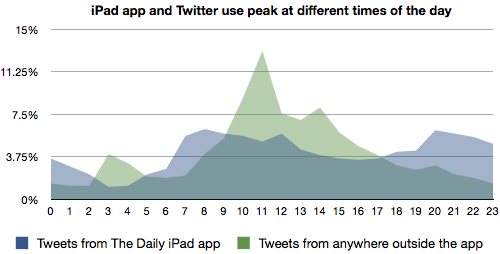
An analysis suggests that iPads get used differently than PCs and notebooks or netbooks. Tweets from the iPad app peak in the morning (around the 7:00 and 8:00 am) and again in the evening (around 8:00, 9:00, and 10:00 pm).

The non-iPad app tweets follow a very different pattern: They match up with the work day, highest from 9-to-5 and peaking just before and after lunch. read more here

24% of IT Buyers Use Social Media

When asked, only 12 percent of people buying information technology said they use social media to inform their choices. But respondents are dramatically understating the extent to which social media is used.

“At least double this number are heavy users of social media and make use of it in ways which support their IT decisions,” said Net Media Europe research director Camelia Nita. “It is possible that the very transparency and ease of use of social media has masked the extent to which people use them.”

One in eight IT decision makers consciously use social media for purchasing, though about and one in four actually does. Also, about 25 percent use social media for support.

Will Cisco Sell Scientific-Atlanta, Linksys Assets?

Cisco looks set to reduce its areas of key focus from over 40 to just five, plus three or four more experimental units with high growth potential.

The big five will be maintaining leadership in core routing, switching and services; collaboration; data center virtualization and cloud; architectures; and video.

Many observers suggest that the retrenchment could see a spin-off or sale of some consumer units, including the set-top box and home networking businesses based on the acquisitions of Scientific Atlanta and Linksys.

Access Network Limitations are Not the Performance Gate, Anymore

In the communications connectivity business, mobile or fixed, “more bandwidth” is an unchallenged good. And, to be sure, higher speeds have ...