Saturday, April 9, 2011

Social Shopping Raises New Tax, License, Fee Issues

It often isn't easy being a market disruptor. Incumbents--both in the marketplace and in the government and regulatory apparatus-- often can raise any number of obstacles to new ways of doing things. One of the perennial problems is simply how to apply existing law, developed in one context, to different practices in a new context.

That sort of problem is common in telecommunications, where regulators have to figure out what a "telephone call" is when it can be completed in other ways, using Internet apps such as instant messaging or other clients, for example.

Competitors have obvious incentives to argue for a "level playing field." But regulators and taxation authorities also care. If cable TV revenues fall, so do the fees that cable operators pay municipalities, for example.

Amazon and other online retailers have been fighting state efforts to tax their operations, and it is no secret that large brick-and-mortar retailers find this in their own interest, even as taxation authorities try to maximize revenue under new circumstances that do not fit the old models well.

Groupon, for example, offers limited-time, limited-volume deals. A particular offer might offer $20 worth of merchandise for $10, for example.  Groupon keeps half the revenue, the retailer gets the other half, without having spent any money up front, and the consumer gets a deal.

But regulators in Massachusetts argue that Groupon discount vouchers for alcohol violate liquor laws, and it is possible as many as 25 states will follow suit.
The legal issue is that regulators may decide that Groupon, which takes a cut of sales, has been selling alcohol without a license, fine it and perhaps force the company to get its own liquor license.

More likely--and as unappetizing for Groupon--its local business customers could face hefty fines or loss of their licenses. Groupon doesn't appear to be greatly concerned, insisting the laws don't apply to its business.

Another problem: who pays the sales tax, and in what amount? Is tax owed on the $10 a consumer paid, or on the $20 value?

read more about Groupon issues here

Verizon Wireless to eliminate one-year contract option on April 17th | BGR

Verizon Wireless is eliminating its one-year contract option. After April 17th, a customer purchasing a new device must either sign a two-year agreement and pay the standard advertised price, or pay the full cost of a handset. Some might see the move as "anti-consumer" in some way, but apparently few customers actually opt for a one-year contract when they can choose to pay full price for a handset, with no contract, or get a substantially-subsidized device with a two-year contract.

In the European Community, regulators recently have decided to require one-year contracts, and some mobile providers already have begun to do so, perhaps because of the competitive situation in the United Kingdom. Vodafone trails behind both the T-Mobile/Orange joint venture, Everything Everywhere, and O2, and has been seeing competition from MVNOs at the low end. Retailer Tesco has been offering 12-month deals, for example.

Vodafone's one-year contracts start at £35 a month and so far come with four high end handsets - the HTC Desire HD, RIM BlackBerry Torch, Samsung/Google Nexus S, and the Nokia N8. Other models will also be included in the scheme as it evolves. Vodafone has had12-month terms for SIM-only contracts for some time.

There's no magic here. Consumers can pay full price for their devices and buy service with no contract. But most consumers want subsidized phones, and the two-year contract terms are set at levels that arguably simply recoup the cost of the subsidies. The one-year plans obviously represent less generous subsidies.

Market dynamics also are different in the EC nations and in the U.S. market. In the EC, virtually all providers use a single air interface, so a phone purchased for service with one carrier can be shifted easily to another carrier. In the U.S. market, the air interfaces remain split. A CDMA phone that works on Verizon or Sprint networks will not work on AT&T or T-Mobile networks. For that reason alone there is less opportunity to switch providers.

Still, the point is that no-contract service, one-year or two-year contract plans simply represent different combinations of value and price.

Jumio Seeks "End of Cash"


Jumio The End of Cash from Jumio Inc. on Vimeo.
Facebook co-founder and Jajah co-founder are backers.

Friday, April 8, 2011

Why Coupons Are Interesting to Mobile and Social Advertisers

nch-cpg-fsi-apr-2010.JPGConsumer product goods marketers allocated the largest share of their coupon distribution to free standing inserts during 2010, according to a new study from NCH Marketing. FSIs accounted for roughly 88 percent of CPG coupons in 2010, with all other forms of media comprising the remaining 12 percent.

The amount of that activity probably explains the new interest in distributing some coupons by mobile devices, where the shopper's context and preferences can, in principle, be used to target the messages. 
In-store handouts represented five percent of coupons, followed by direct mail (2.4 percent), magazine (2.2 percent), other (including all digital formats – two percent), and in/on-pack and cross-ruff (one percent).
nch-cpg-face-value-apr-2011.JPGWhile distribution demographics for grocery CPG coupons were similar to overall results, a slightly higher percentage (13.2%, or 7% more) were distributed by non-FSI means. The largest difference in the breakdown of non-FSI coupon media was an 11.5% higher percentage distributed via in-store handouts (5.8%).

The average face value of a CPG coupon in 2010 was $1.46, up 6.6% from $1.37 in 2009. Average CPG coupon face value has risen year-over-year each year since 2006, when it stood at $1.18. Between 2006 and 2010, average value rose almost 24%.

Read more here


YouTube is going "Live"

"YouTube Live" now has begun to roll out in beta (of course), integrating live streaming capabilities and discovery tools directly into the YouTube platform for the first time. The YouTube Live browse page (www.youtube.com/live) will attempt to feature "the most compelling live events happening on YouTube" and add events to user calendars.

The beta allows certain YouTube partners with accounts in good standing to stream live content on YouTube.

Facebook Won't Become E-Commerce Force, Analyst Says - Digits - WSJ

Facebook is not going to be a major e-commerce player, says Forrester Research analyst Sucharita Mulpuru.

A social-network presence, she found, was less effective at customer acquisition and retention than e-mail and paid search.

The study found that the average Facebook metrics are a one percent click-through rate and a two percent conversion rate. E-mail marketing, by comparison, has an 11 percent click-through rate and a four percent average conversion rate.

Study Shows Games are Top Tablet Pursuit

A new study by AdMob has found that games are the application getting the most use on tablet devices. The study found that 68 percent of tablet users spend at least 1 hour a day on their tablet, and that 77 percent of respondents have decreased the amount of time they spend on their desktop or laptop after they started using a tablet.
AdMob survey: tablet owners primarily use their devices for gaming

Tablets are used widely for playing games, searching for information and emailing. Of those pursuits, you might have guessed that email and search would be leading activities. But you might not have thought that playing games would be the single most popular use for a tablet.

About 84 percent of respondents said they played games on their tablets, while 78 percent searched for information and 74 percent used email. About 42 percent used a tablet for shopping and 46 percent used a tablet for reading e-books. About half said their tablet use was for consuming entertainment content.

Some 82 percent of respondents said they primarily use their tablet at home, and more than a third say they use their tablets more than they watch TV.

Read more here

Google Rolls Out Check-in Deals

Google Latitude, Google's location-sharing mobile app, is launching checkin offers nationwide, giving users the ability to unlock discounts with a handful of launch partners.

Google’s initial list of partners includes Arby’s, Macy’s, RadioShack, Finish Line, Famous Footwear, Great Clips, Naturalizer, Tasti D-Lite, Quiznos, Wireless Zone, Cellairis, PostNet and American Eagle Outfitters.

Google Acquisition of ITA Software Gets OK

The Department of Justice will approve the Google acquisition of ITA Software, with some conditions.

DOJ will require Google to develop and license travel software, to establish internal firewall procedures and to continue software research and development. Those measures are intended to protect competition for airfare comparison and booking websites and ensure those websites using ITA’s software will be able to power their websites to compete against any airfare website Google may introduce.
The department said that Google will also be required to provide mandatory arbitration under certain circumstances and provide for a formal reporting mechanism for complainants if Google acts in an unfair manner.

Google thinks one direct result is that users will be able to type "flights to somewhere sunny for under $500 in May" into Google and get not just a set of links but also flight times, fares and a link to sites where the user can actually buy tickets quickly and easily

Windows Alternative to Macbook Air?

A pricey "hero" device, for sure.

Tired of the FAA pre-flight instructions?

Here's a more entertaining take.

Acer's new Honeycomb tablet to compete with iPad on price

Acer's new Honeycomb tablet to compete with iPad on price
As big a player in netbooks as Acer has become, you'd expect the firm to compete aggressively in tablets, if tablets are seen as a product that cannibalizes netbooks. The Iconia Tab A500 is Acer's first foray into tablets, and it has built a device that has to compete, price-wise, with the iPad.

Available for pre-reorder on Best Buy’s web site for $450, the device apparently will be available in Best Buy retail stores beginning April 24.


The tablet will run Android version 3.0 (Honeycomb) on its NVIDIA Tegra 250 1GHz dual-core processor, supported by a gig of RAM.

The price ranks in at just below the cheapest iPad 2, which costs $500 and is Wi-Fi only with 16GB of internal storage (just like the Iconia A500).

How Long Before Nook is a Tablet?

Barnes & Noble has opened up the Nook Color e-reader to Android developers. The new software developers kit includes
access to an expanded set of development resources to facilitate app deployment and app distribution through the Barnes & Noble storefront.

One wonders how long it will take before the Nook becomes a full-fledged tablet.

Wireless: Don't Break What Isn't Broken

One reasonable bit of device in business is not to break what is not broken. Perhaps another good bit of advice is not to "fix" problems that already are being fixed. That advice arguably is not always followed.

In 1996, in order to induce more competition in the telecom business, the Congress passed the Telecommunications Act of 1996. The basic innovation was a historic change in rules on "who can be a local telephone company?"

Where in the past only one firm in a geographic area was allowed to be a local telco, the Telecom Act allowed any company to become a local telco. Of course, you now know what else was happening. Wireless was becoming a dominant way people use "voice" services.

The Internet was about to become the biggest, fastest-changing, most consequential new development in communications and media. So while regulators were moving to allow much more competition in landline voice, the market already was moving to wireless and Internet services and applications.

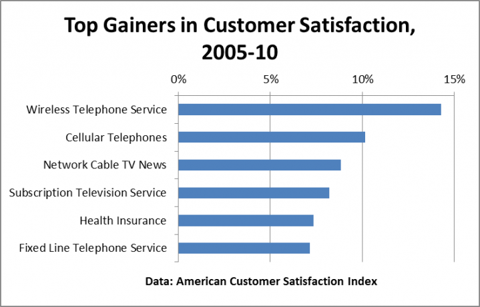
That's always a danger. Markets, end user demand and supply are moving so fast the danger always is that we attempt to fix older problems that already are being solved. There's little point in wasting effort doing those sorts of things. In recent days, it appears end user satisfaction with wireless is growing faster than other types of communications and media services. Maybe we shouldn't mess with that.

Mobile Handset Market Reaches Inflection Point in 2009

Over the years, there is one good rule I've found that applies to major technology trends. Though we are fond of labeling certain years the "year of" something, those forecasts nearly always are wrong. You might think that's because we are such poor forecasters. We are, though that's not the reason for the disconnects.

Most important technology transitions, if not all, always take much longer to get traction than one might suppose. But at least in the case of consequential innovations, there is some inflection point where a period of long or longish gestation suddenly reaches a time of qualitative change, where until that point there mostly had been incremental, quantitative change.

This look at handset leadership in the mobile industry probably is one of those sorts of processes. From 2001 to 2009, you see a remarkably stable market share structure. There is some share change, over time, at positions two and three, but the market remains quite stable. Only in 2010 does one see, appearing in position five, the name of Apple.

Some of us would say that was an inflection point, where a long period of smartphone gestation suddenly erupted. Market shares for handsets will not fully capture all of the changes. But they can signal important shifts, including a new role for the application ecosystem, not just a change to touchscreen interfaces.


Top 5 handset OEM

Is Private Equity "Good" for the Housing Market?

Even many who support allowing market forces to work might question whether private equity involvement in the U.S. housing market “has bee...