Thursday, June 2, 2011

Enterprises Match Support to End User Technology Choices

At least some enterprises in North America and Europe are trying to work with the growing trend of end users wanting to use their own applications and devices at work. Some information technology executives have created managed digital allowance (MDA) programs that match corporate support to the types of technology users prefer.

These are more closely managed variants of "Bring Your Own Technology" programs, where employees select and often fund the productivity tools they want.

MDA programs provide their workers with a portion of the funds they need to invest in applications and devices of their choice. Rather than dictate a limited range of company-provided mobile devices, this policy adjustment helps employees choose the tools that best suit their work styles, roles, and geographical location.

On the support side, the MDA model requires creation of a flexible service catalog, in which the IT organization matches the support services it provides to specific applications and devices. This increase in choice actually helps reduce service-delivery costs, because it eliminates the old, always-on-call help desk and relies instead on significant user self-service in support and IT service request management.

33% of Brands are Running Mobile Campaigns

A third of companies surveyed by Kingfish Media currently have a mobile strategy in place, and among those who don’t, two thirds plan to have one within the next 12 months.  

Not a lot of investment is currently taking place, though. Only about 12 percent of brands’ marketing spend is on mobile. However, the vast majority of respondents (82 percent) plan to increase their spending on mobile over the next year, with 30 percent taking the budget from mainstream marketing and advertising.

Currently two thirds of companies use a mobile website, while 28 percent are using a native app. Some 27 percent are using both.

In 2012, respondents foresee an increase in native app development as 43 percent plan to have an app and 49 percent report they will be using an app and mobile site.

Most commonly, brands are using mobile initiatives to build or grow relationships, which explain why the most popular content types are currently social media, branded, email capabilities, geo-location or maps and general reference.
Original branded content, ads, expert content and videos are the types of content used most often in mobile format.
Commerce over mobile channels is slow to take hold among respondents. Less than 20 percent are currently conducting mobile commerce, mostly over a mobile web site. Interest does rise for 2012.

Nearly 60 percent are tracking visitors to their website from mobile devices, usually with Google Analytics. Among those tracking, companies are finding that a relatively small percentage of traffic is coming from a mobile device—on average 8%. And only about 10% of customer/prospects are using a mobile app developed by the company.

http://www.contentmarketinginstitute.com/2011/06/mobile-study-and-content-marketing/

Will Groupon Really Boost Your Local Business?

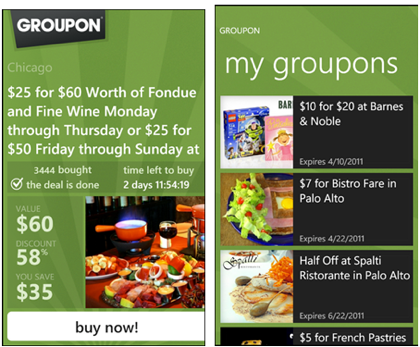
my grouponGroupon, the group shopping or social coupon business, might or might not increase near term profits for a business that uses it. Offers are designed to get people "in the door" who might not have shopped at a particular establishment before.

Groupon gets people into your shop, but it doesn’t keep them there, necessarily. Also, a retailer has to weigh the higher traffic with the reduced gross margins a discount implies. All of that means a Groupon campaign will boost revenue, but not profit, in the near term.

The best feature of a Groupon experience is the exposure. It will boost your website, blog and social media traffic, which will lead to more signups, likes and follows. This is what you’re paying for when you’re running a Groupon.

People Would Give Up Their TVs Before Their Mobile Phones

Twitter is a Mobile App

Though only 13 percent of online adults use Twitter, more than half of Twitter users access the service on a mobile phone, researchers at the Pew Internet & American Life Project report.

As of May 2011, 13 percent of online adults use the status update service Twitter. That represents a significant increase from the eight percent of online adults who identified themselves as Twitter users in November 2010.1

The study also found that 54 percent of Twitter users access the service from their mobiles.

Tech Bubble?

Some continue to insist there is no tech bubble. But some who used to think there was no bubble are starting to worry. Though most companies on public markets remain fairly valued, there is pent up demand for growth stories. Oddly enough, the sluggishness of the rest of the economy, and the lack of growth, is going to heighten interest in the coming wave of application-driven initial public offerings. See Let’s Not Get Too Cocky About The Blubble.

Still, it is worth noting that even bubbles are spurred by genuine change in the computing business. Bill Gates famuosly acknowledged that he "didn't get the Internet." Now former Google CEO Eric Schmidt candidly says he missed the social revolution, aside from writing memos that were not followed by vigorous action. See http://techcrunch.com/2011/06/01/eric-schmidt-is-a-surprisingly-worried-man/.

That's the sort of big miss by an industry leader that fuels a new wave of computing innovation, and typically is lead by new firms. But we tend to overshoot. Always. So expectations for most of the coming application IPOs will be excessive.


Wednesday, June 1, 2011

Google +1 Makes Web Pages More Social

Twitter CEO says 80 percent of advertisers renew | Reuters

More than 80 percent of the companies that advertise on Twitter renew their marketing efforts on the microblogging service, CEO Dick Costolo says.

The Twitter chief also says the company does not face immediate pressure to boost revenue as it seeks to grow its business.

"Move Up the Value Chain," Twitter Developers Told

LightSquared Considers AT&T Capacity Deal

LightSquared is considering a deal with AT&T to buy network capacity from the carrier, Bloomberg reports.
LightSquared would pay to use AT&T’s fourth generation network when it needs additional capacity. The move would be a little puzzling to the extent that LightSquared, which owns its own spectrum and is leasing tower and radio capacity from Sprint Nextel, would buy additional capacity wholesale, to sell wholesale, when it presumably has plenty of actual spectrum available.

Hard to Measure Mobile Marketing ROI, Users Say

ROI of Advertising on Mobile Platforms According to Companies in North America, April 2011 (% of respondents)Mobile still doesn’t measure up as “important” to most marketers, according to an April 2011 survey by King Fish Media sponsored by HubSpot, Junta42 and Maxymiser.

But that could change as more marketers get on board with a mobile strategy. More than six in 10 North American marketers plan to have one within the next year, compared with just a third who already do.

When asked specifically about the ROI of their mobile advertising programs, a plurality of North American companies said they were doing about as well as expected.

A quarter of respondents said mobile advertising wasn’t meeting expectations, however, compared to just 13 percent who said results were better than they had hoped.

Cellphone Radiation May Cause Cancer, Advisory Panel Says

A World Health Organization panel has concluded that cellphones are “possibly carcinogenic,’’ putting the popular devices in the same category as certain dry cleaning chemicals and pesticides, as a potential threat to human health.

The finding, from the agency’s International Agency for Research on Cancer, adds to concerns among a small but growing group of experts about the health effects of low levels of radiation emitted by cellphones. The panel, which consisted of 31 scientists from 14 countries, was led by Dr. Jonathan M. Samet, a physician and epidemiologist at the University of Southern California and a member of President Obama’s National Cancer Advisory Board.

Studies of non-ionizing radiation impact on human tissue have been inconclusive to date, which is why the WHO can only say there is a "possible" danger. To be on the safe side, some of us minimize our mobile usage and use the speaker phone as much as possible.

E-Reader Comparison


http://paidcontent.org/article/419-comparing-the-latest-e-readers-heres-our-chart/

Cisco Projects 26-Fold Growth in Global Mobile Data Traffic From 2010 to 2015

Worldwide mobile data traffic will increase 26-foldbetween 2010 and 2015, says Cisco, reaching 6.3 exabytes per month or an annual run rate of 75 exabytes by 2015.

This traffic increase represents a compound annual growth rate of 92 percent over the same period. Two major global trends are driving these significant mobile data traffic increases: a continued surge in mobile-ready devices such as tablets and smart phones, and widespread mobile video content consumption, Cisco notes.

The Cisco study predicts that by 2015, more than 5.6 billion personal devices will be connected to mobile networks, and there will also be 1.5 billion machine-to-machine nodes -- nearly the equivalent of one mobile connection for every person in the world.

Mobile video is forecast to represent 66 percent of all mobile data traffic by 2015, increasing 35-fold from 2010 to 2015, the highest growth rate of any mobile data application tracked in the Cisco VNI Global Mobile Data Traffic Forecast. Mobile traffic originating from tablet devices is expected to grow 205-fold from 2010 to 2015, the highest growth rate of any device category tracked.

How Many Mobile Payments Users in India by 2015?

With the mobile phone penetration expected to reach 100 percent by 2015, mobile devices are likely to emerge as a popular medium of payment in India, a recent survey has predicted.

According to the report conducted by The Associated Chambers of Commerce and Industry of India, India counts nearly 720 million mobile subscribers, which are expected to start using more their devices to carry out mobile payments in the future. In addition, the report indicates that this prediction is based on the fact that although the majority of Indian residents are unbanked they do have a mobile phone.

Moreover, the study has pointed out that the retail market in India has annual transactions worth USD 410 billion (approximately Rs 1,850,000 crore).

OpenAI, Azure, Alphabet: Comparing Apples and Oranges

The adage about comparing apples and oranges is well illustrated by the many news reports suggesting the “AI trade” is alive and well after...