Tuesday, July 19, 2011

With Cable Seemingly Winning the Consumer Market, How Much More Investment Should Telcos Make in Fixed Infrastructure?

The current discussion within the European Community about the investment impact of “net neutrality” rules is not a new debate. In the wake of the passage of the Telecommunications Act of 1996, dominant U.S. fixed-line providers argued, successfully, that mandatory wholesale rules, providing deeply-discounted rates for wholesale customers, would severely discourage investment in optical facilities. And, in fact, Verizon's FiOS effort did not get into high gear until after the Federal Communications Commission approved such rules.

These days, the EC argument revolves to a great extent around the impact “network neutrality” rules could have on incentives for broadband investment. Specifically, operators argue that restriction of services to “best effort only,” without the ability to create differentiated service plans involving quality of service measures, will be a significant disincentive to the high rates of investment EC officials would prefer to see.

Some will say the carriers are bluffing about requiring some path to revenue when investing in 100-Mbps or 1-Gbps access facilities. Some of us would disagree. The alternative is to invest in mobile facilities and applications instead. In fact, some recent global estimates of market share suggest telcos globally are losing the consumer market share battle to cable companies. In fact, looking just at triple-play accounts, it appears cable operators have roughly 66 percent market share. In other words, telcos arguably are losing the market share battle in the consumer market. http://www.digitaltvresearch.com/ugc/press/14.pdf

Are You Embracing the 5C's? | ClickZ

Google's "Zero Moment of Truth" campaign illustrates its thinking about real-time marketing, which includes the ability to engage with consumers wherever, whenever, and on whatever device they are using.

Cable Will Lead Triple-Play Market Globally

More than a quarter of the world’s TV households will subscribe to triple-play services (TV, broadband and telephony) by 2016, according to Digital TV Research. The firm estimates triple-play penetration was only about seven percent of households at the end of 2010.

What will stand out is the dominance cable operators hold in triple-play subscriptions.


Nothing Beats Experience

Nothing replaces experience, when considering how much money, time and effort to spend on search engine optimization techniques. And nothing is easier than following expert advice, unless the advice is wrong. Watch the video.

Google's Eric Schmidt Slams Apple Patent Infringement Lawsuits

"The big news in the past year has been the explosion of Google Android handsets and this means our competitors are responding," says Google executive chairman Eric Schmidt. 'Because they (Apple) are not responding with innovation, they're responding with lawsuits."

"We have not done anything wrong and these lawsuits are just inspired by our success," says Schmidt.

The comments follow the initial finding by the U.S. International Trade Commission that HTC infringed two of Apple's phone patents. The full ITC has not made a ruling on the matter, though, and HTC certainly will appeal.

If upheld, the decision could force other Android phone makers to pay significant royalties to their main competitor, or, worst case, prevent sales of Android devices in the U.S. market.

Whatever else one might think, Google's culture, which emphasizes providing the "best" solution in any category, would naturally lead to such thinking. Google's leaders tend to think they shouldn't win a market unless they do indeed have the best solution. So such lawsuits would tend to be seen as an attempt by a "not as good solution" to use other methods to slow down the superior solution's acceptance.

One doesn't have to agree that Android is, in fact, the best solution to understand the sentiment.

Google's Eric Schmidt slams Apple


U.S. Mobile Backhaul Networks at Capacity, More Investment Needed


Wireless networks in the United States are operating at 80 percent of total capacity, the highest of any region in the world, according to a report prepared by investment bank Credit Suisse.

The firm argued that wireless carriers likely will need to increase their spending on infrastructure, as a result. Globally, average peak network utilization rates are at 65 percent, and that peak network utilization levels will reach 70 percent within the next year, the report says.

Investors may be underestimating the level of equipment spending that is required on an ongoing basis to support rapid growth in wireless data, Chaplin adds.

Some 23 percent of base stations globally have capacity constraints, or utilization rates of more than 80 to 85 percent in busy hours, up from 20 percent last year. In the United States, the percentage of base stations with capacity constraints is 38 percent, up from 26 percent in 2010.

Credit Suisse analyst Jonathan Chaplin says "wireless capex expectations may need to increase longer-term." Chaplin thinks investors seem to expect capital intensity to start to decline in 2012, once LTE spending is largely complete, but that might not be correct.

Read more here.

More 2.3 GHz, 2.5 GHz Spectrum to be Auctioned?

NextWave, which owns spectrum in the 2.3 GHz and 2.5 GHz bands, might be headed for bankruptcy again, which also means its spectrum might be up for sale. NextWave bought $4.7bn worth of spectrum in 1996, sold most of its spectrum assets to Verizon, but retained frequencies in 2.5GHz and 2.3GHz bands.

Clearwire has tried recently to sell spectrum in the 2.5 GHz block and failed to do so, so some will question current demand for assets in those frequencies. But we might get another chance to see whether there is interest in those bands.

Orange, T-Mobile Rethinking Everything Everywhere?

Everything Everywhere, the joint venture between Orange and T-Mobile, might have the biggest share in the U.K. market, but reported a two percent decline in earnings, as well as a slowing of new customer additions in the first quarter of 2011. And the parents might now be unwilling to subsidize the joint venture much longer. http://www.eweekeurope.co.uk/news/everything-everywhere-execs-go-elsewhere-34475

So the departures of former CEO Tom Alexander and Duncan Hay, director of indirect sales, likely are telling. Everything Everywhere loses CEO

Monitise Nigerian Mobile Money Pilot Gets 6,700 Users

Mobile money services provider Monitise has signed up 6,700 users for a test of mobile money services in Nigeria. Some 160 agents working in four cities

Monitise has built a network of 160 agents in four cities across Nigeria since March 2011. The initial launch uses authorized agents in in corner shops, news-stands and market place kiosks, allowing Nigerians deposit cash and checks, send money to each other and withdraw funds without the need for a bank account by using a mobile phone.

Monday, July 18, 2011

Wireless Industry Sheds Jobs

In May 2011, on the heels of a record year for industry revenue, employment at U.S. wireless carriers hit a 12-year low of 166,600, according to U.S. Labor Department figures released earlier this month. That's about 20,000 fewer jobs than when the recession ended in June 2009 and 2,000 fewer than a year ago. Some will wonder what that means.

While the industry's revenue has grown 28 percent since 2006, when wireless employment peaked at 207,000 workers, the work force has shrunk about 20 percent. Some will point to productivity gains as the possible reason for job loss, and it is hard to deny some impact in that regard.

"The disconnect between employment and industry growth reflects the broader head winds lashing the U.S. job market, as consolidation, outsourcing and productivity gains from new technology and business methods combine to undermine job growth," the Wall Street Journal says.

The number of customer-service workers at wireless carriers, for example, dropped to 33,580 last year from 55,930 in 2007, according to the Labor Department. "It used to be you had to scale your customer-care resources linearly with the number of customers you had," said Dan Hays, a telecom consultant. "We don't do that anymore."

Beyond all that, one might argue that the hugely capital intensive infrastructure business must dramatically reduce its operating costs if revenue is expected to be difficult on the top line. In other words, in a business with huge sunk costs, facing headwinds in the revenue area, with value and revenue shifting to third party parts of the ecosystem, lower operating costs are almost essential.

That isn't to argue that access providers are "only or primarily" providers of low-margin, moderate-revenue" access services. It is to note that much of the new value and revenue will flow largely to application providers in the ecosystem. Prudent executives will work to create as much of a role in the new revenue areas as possible, but also will plan for tougher going in all the existing lines of business.

Generally speaking, that means simplifying operations and taking out cost, allowing more generated cash to be invested in growth initiatives, and providing some protection from slowing growth in core revenue segments.

Social Media Increasingly is All Media

Why People Discuss products in socialThere's a reason social media has become so important for marketers. People are using social media to research products and compare prices, sharing information about products with their friends and apparently using social media to make decisions about what to buy, and where to buy.

Dell Could Use Google+ "Hangouts" for Customer Service

Consumer tools have become a growing part of enterprise thinking about software and services, and that seems to be the case for Google+ "Hangouts," a group video conferencing app. Dell says it could soon use Google’s new group video chat platform Google Hangouts as an alternative to the traditional customer service call, according to the company’s chairman and CEO, Michael Dell.

Dell posted aquestion on Google+: "I am thinking about hangouts for business. Would you like to be able to connect with your Dell service and sale teams via video directly from Dell.com?"

Apparently hundreds of people agreed. Hangouts obviously could be a substitute for "enterprise" video collaboration systems and tools.

Mobile Ads Still "Annoying"

About 79 percent of smart phone users find mobile ads intrusive and annoying, according to new research from YouGov. Some 88 percent also say they ignore ads on applications. To no surprise, 86 percent said that they’ve ignored mobile ads. So despite all talk of personalization and targeting, it appears that brands still are not able to deliver consistently valuable messages.

As often is the case, consumers indicate they "don't like ads." Just five percent of consumers think that mobile ads are a good idea. It long has been true that advertising is considered an annoyance, tolerable only because consumers "get something" from the experience, typically lower=priced content.

For smart phone users in particular, basic banners remain the most recognized formats. About 87 percent report see them while browsing, and 80 percent notice3 them while using apps. When browsing, recommended links to search (63 percent), rollover banners (51 percent), and special offers (47 percent), attract the most attention.

Sunday, July 17, 2011

User Generated Content Has Not (Yet) Disrupted the Video Business

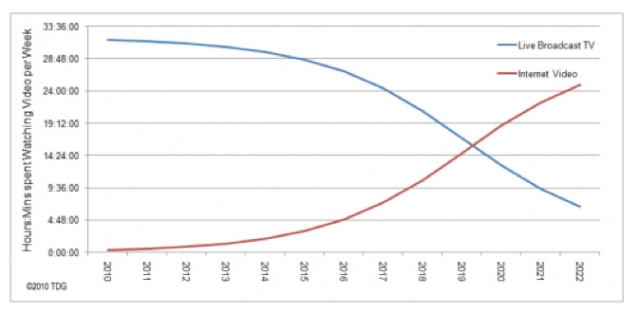
This looks like a disruption. to be sure. But what kind of disruption? Ten years ago, some would have argued that user-generated video would disrupt a substantial part of the "professional media" market.

One doesn't hear that argument so much anymore.

On the other hand, one might argue that user-generated text and image content has disrupted the business of "publishing" in rather direct fashion. One might argue that it is a lot harder to create rival video entertainment than it is to create useful "text" content.

The business dynamics of entertainment video and publishing also have been on different trajectories for decades. Video has continued to add revenue almost without exception, year in and year out. Newspapers and magazines have not been that successful, and arguably have been shrinking. "Online" and user-generated substitutes seem to have accelerated the print decline, but so far have largely been incrementally a factor in online video.

What Causes Telco or Cable Customer Service Issues?


Most telcos and  cable companies have gotten much better at customer service over the last decade. That isn't to say most surveys show people think the service is "outstanding," or "best," but that more effort is being put into customer service.

That said, most customers will, at least on occasion, find themselves angry, frustrated or exasperated with telco and cable execution.

As this graphic suggests, complexity can be an issue. As most consumers will recognize, using more than one channel, or more than one agent in any channel, will require providing information at the beginning of each session. Different actors a consumer might interact with to solve one problem might require different data base operations, some of which will not seem to be coordinated, or which can take months to reconcile.

In my own experience as a consumer, most of the larger service providers do a decent job providing what it was they sold me. That is partly a reflection of the objective and subjective parts of the experience. Nearly always, what I bought "works." But they tend to cause friction in other areas, ranging from their business policies to data base integration, though I tend to think even the data base integration issues could be related to business policies.

That does not mean I do not anticipate dropped mobile calls from time to time, or slower mobile broadband in some locations, at some times of day. While none of those characteristics of the service tends to make me categorize communications service providers as "excellent," there are known performance issues, and I can deal with it. One might say I am a "tolerant" consumer in some ways: what I buy from ISPs, mobile companies and video companies works well enough, and for the most part provides sufficient value, that the actual delivery isn't a big sore point.

On a more subjective level, value and price are generally in line for some features and services, generally relating to broadband access, always in line for voice, and almost perennially out of line for multi-channel video entertainment, which is the product which has the biggest gaps between value and price alignment.

Keep in mind that I am a heavy "mobile everything" user, so the "slower" speed and "greater latency" or higher cost per bit issues are simply a trade-off I am willing to make. My usage is either "mobile mostly" to "mobile exclusively," with the exception of entertainment video, which remains "tethered" for the most part.

I understand what "best effort" means, what "contention ratios" are, and, in a general sense, what the sources of "latency" are.

My point is that delivery of service generally is not where service providers fall down. In my experience, that tends to happen with billing-related or data base issues. In fact, as a rule I'd say the delivery is generally (within the context of my expectation that calls will sometimes drop, speeds will slow or latency be a bit of an issue) not an irritation. But the apparently "not integrated" data bases, and access to those data bases, almost always is an issue, which means I typically anticipate some level of friction.

I realize service providers struggle to maintain consistency, compliance with regulations, while protecting security and privacy. I realize a service provider cannot actually afford to spend too much on "customer service."  But I also will note that interactions with two of the four major service providers in the United States, though satisfactory to good during the four to five years I used them, were decidedly unpleasant during the termination period, and not because I was breaking a contract. I am always "out of contract" when any service is terminated.

For whatever reason, the issue is trailing disagreements about the "final bill" which seem to be unnecessary, or can't be fixed immediately and fully, without escalating the process. So a relationship that had been trouble free became a memorable issue when stopping one particular service (though generally I continue to buy other services from the same provider).

This is important for a simple reason. I have over the last decade simultaneously used services from four to five major service providers at a time, at multiple locations, for different reasons. I might change one account (mobile and broadband, typically) from time to time, but the relationships tend to remain.

Most of the major providers tend to claim they are the "best" at one or another aspects of network quality. Sadly, few can claim to be consistently as good at the customer service ends of their businesses, at least for consumer-facing services. That probably is one reason why cable companies and telcos tend to run in the middle of the pack, or worse, in most consumer opinion surveys.

I understand that consumer service providers cannot afford to spend much money on consumer customer service. I would also say that when buying business services, the experience tends to be different. When service providers make enough money from an account, they are better at most forms of service.

Of course, the services worked well enough that my preferred interaction with my providers is "no interaction." Terminating service, even when a contract is not involved, has not been universally pleasant, and it seems to be related to data base or business rule issues and call center interactions. I would add that the front line retail store personnel, across the board in the mobile space, are doing fine. It's the call center processes you worry about.

read more here.

Which Language Model Do You Prefer?

Our choices of “favored” language models will probably remain somewhat idiosyncratic for a while, until some winnowing of market leaders occ...